November Core Update, Day 12: Software and How-To Results Took 21 New Top-10 URLs vs 9
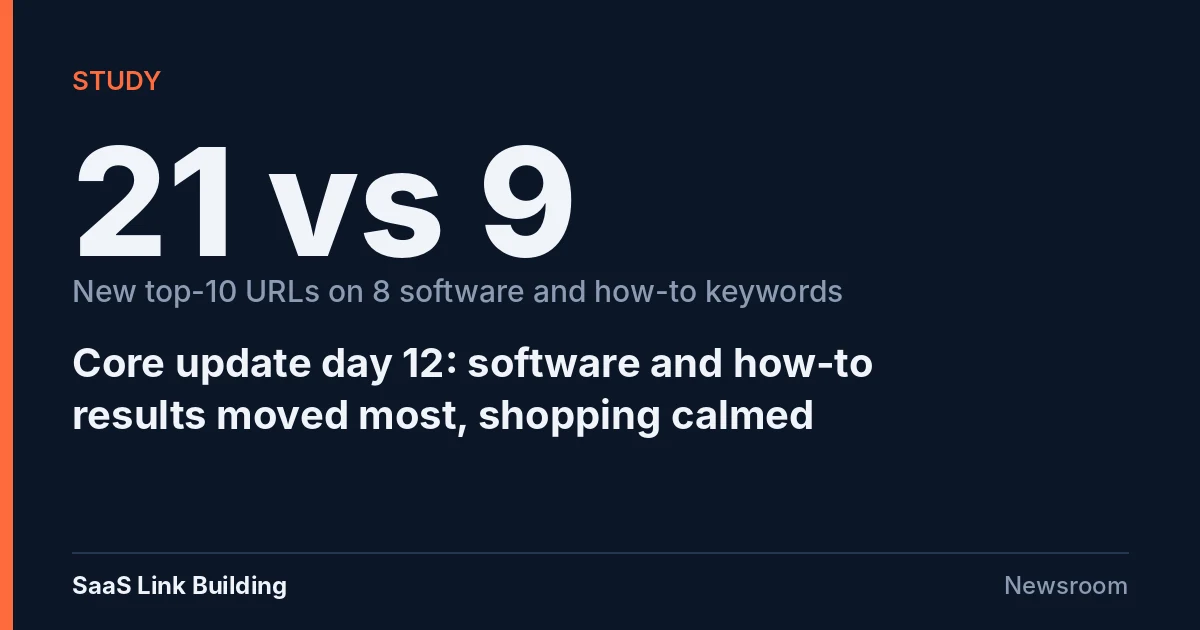
Twelve days into Google's November 2026 core update, overall top-10 turnover in our 22-keyword US panel matches a normal fortnight, but the change is concentrated: eight software and how-to keywords took in 21 new top-10 URLs, against 9 before the update, while shopping results grew calmer.
 Vibhu Dhariwal
Cofounder & CTO, Digital Gratified
- Published
- Section
- Studies
- Reading time
- 8 minutes
Ras Al Khaimah, United Arab Emirates, .
Twelve days into Google's November 2026 core update, page one has not churned more overall than in an ordinary fortnight, but the change has concentrated in two kinds of search. We compared stored US Google snapshots for 22 high-volume keywords before and after the update began on 10 November. On eight software and how-to keywords, 21 new URLs entered the top 10 during the update, against 9 in the roughly two weeks before it. On the other 14 keywords, covering shopping, finance, health and travel, new entrants fell from 32 to 26.
Google's Search Status Dashboard entry still shows the update as in progress, with no end time and no update since the launch notice posted at 18:07 UTC on 10 November. That notice says the rollout may take up to two weeks, which would put the outer edge at 24 November, two days before Thanksgiving and three before Black Friday. In our first-four-days check of the November core update we found less churn than in the week before, and said we would rerun the comparison once the rollout ended. It has not ended yet, but with Google's two-week estimate nearly used up, this is an interim second look with a wider keyword set and a longer window.
Key findings
- Overall churn looks normal: 108 of 152 pre-update top-10 URLs (71.1%) were still in the top 10 in the latest snapshots, taken 17 to 22 November. Over the comparable window before the update, 111 of 159 held (69.8%).
- Software and how-to moved most: those eight keywords took in 21 new URLs during the update, up from 9. Every one of the four software keywords added at least two.
- Shopping calmed down: the four shopping keywords took in 5 new URLs, down from 12. Amazon best-seller pages dropped out of the top 10 for "best running shoes" and "best air fryer".
- Forums and video gained a little: Reddit appeared in the top 10 for 11 of the 22 keywords, up from 9 in the pre-update snapshot, and YouTube for 9, up from 7.
- Mixed at keyword level: 8 keywords churned more during the update than before it, 7 churned less and 7 were unchanged, so the rise is not spread evenly.
Where the new URLs landed
Each keyword has three stored snapshots in our pull: the last one taken before about 28 October (the control), the last one taken before the update's logged start, and the newest available. The control comparison spans a median of 13.6 days and the update comparison a median of 12.2 days, so the two windows are close in length.
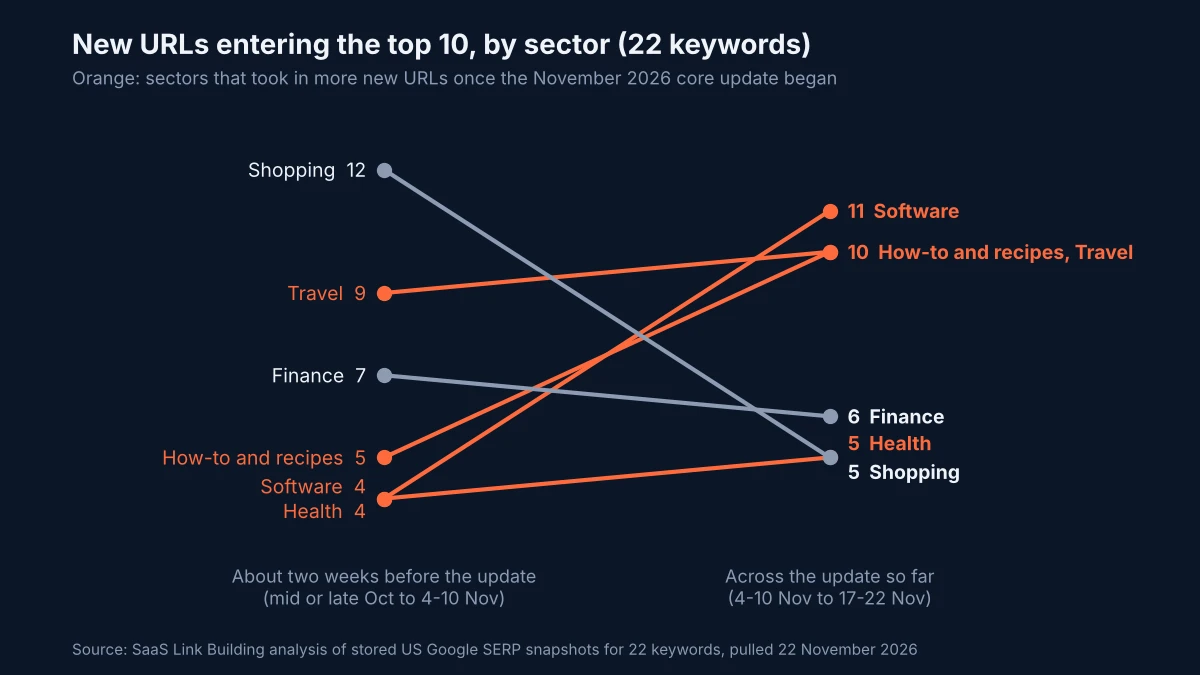
Software. On "project management software", two vendor blog posts and the Wikipedia entry left the top 10, replaced by three independent comparison pages and a Reddit thread. "best vpn" swapped a security review site and a YouTube video for a Reddit comparison thread, a travel blogger's VPN roundup and a VPN provider's own comparison page. On "crm software", a CRM vendor's glossary page and a US Chamber of Commerce article gave way to two CRM vendors' product pages. "website builder" lost nothing but gained two builder product pages.
How-to and recipes. "chicken breast recipes" again showed the largest change in the set. Its pre-update snapshot held only four organic URLs in the first ten positions; the newest holds seven, five of them new, including a YouTube video and three food blogs. New York Times Cooking stayed, but with a different URL. "how to tie a tie" added a YouTube channel page, and the banana bread and rust removal queries each added a YouTube video and swapped one other page.
Shopping. Here the update window was quieter than the fortnight before it. Besides the two Amazon exits, Dell's buying guide left "best laptop", and RTINGS and Food52 left "best air fryer", which took in a Food Network review, a YouTube video and a different Reddit thread. "best laptop" added no new URL at all.
The before and after numbers
| Measure (22 keywords) | About two weeks before the update | Update window so far |
|---|---|---|
| Top-10 URLs carried over | 111 of 159 (69.8%) | 108 of 152 (71.1%) |
| New URLs entering the top 10 | 41 | 47 |
| New URLs, 8 software and how-to keywords | 9 | 21 |
| New URLs, 14 other keywords | 32 | 26 |
| Median days between snapshots | 13.6 | 12.2 |
| Keywords with Reddit in the top 10 (end of window) | 9 | 11 |
| Keywords with YouTube in the top 10 (end of window) | 7 | 9 |
Source: SaaS Link Building analysis of stored US Google SERP snapshots, pulled 22 November 2026. Organic results in SERP positions 1 to 10 only.
Two snapshots we set aside
We pulled 24 keywords and dropped two from the comparison. The control snapshots for "mortgage rates" and "vitamin d deficiency symptoms" shared no URLs at all with their next snapshot, and the mortgage one included state-level rate pages from US Bank and Bankrate and a New York state housing agency page, which looks like a localised or otherwise unusual result rather than the national page. Left in, those two snapshots inflate the pre-update churn and make the update look calmer than it is (71.9% held against 63.8%). We have reported before on altered results served to rank trackers, and an unexplained full turnover of a stable result is the kind of reading worth excluding rather than headlining.
What this means for SEO teams
- Do not judge the update yet. Google's core updates guidance recommends waiting at least a full week after the rollout completes, then comparing that week with the week before it started. With the dashboard still open, that point is at least a week away.
- Software and SaaS sites should check comparison queries first. In our set the movement on software terms ran toward independent comparison pages, Reddit threads and vendor product pages, and away from vendor blog posts and glossary pages. If you rank with a blog listicle on a "best X software" term, watch it now.
- Retailers should not read calm as safety. Shopping churn fell during the update, but the update is not finished, and Black Friday traffic will land on whatever the final rankings are.
- Count how many organic slots exist, not just your position. On the recipe query the number of organic results in the first ten positions went from four to seven. A change in layout can shift clicks without any change in rank.
- Check a few snapshots before reacting to one. Two of our 24 control snapshots were outliers. A single odd reading in a rank tracker can look like a ranking crash.
Whether Google holds updates back during the shopping season is a separate question, one we examined in our analysis of whether Google pauses updates for the holidays.
Methodology
On 22 November 2026 we pulled stored Google US SERP snapshots from a commercial SEO tool's SERP database for 24 high-volume keywords, four in each of six sectors: shopping, finance, health, software, how-to and recipes, and travel. For each keyword we took three snapshots: the newest available (taken between 17 and 22 November), the last one before 18:00 UTC on 10 November (taken between 4 and 10 November, all before the update's logged start at 18:06 UTC), and the last one before 00:00 UTC on 28 October (taken between 14 and 26 October). We counted organic results recorded in SERP positions 1 to 10, so search features such as AI Overviews and video packs can occupy some of those positions. URLs were normalised for letter case, trailing slashes and tracking parameters. "Carried over" means the same URL appeared in both snapshots of a pair; "new" means it appeared in the later snapshot but not the earlier one. We excluded "mortgage rates" and "vitamin d deficiency symptoms" because their control snapshots shared no URLs with the next snapshot, leaving 22 keywords. Three control windows ran longer than the rest (19 to 21 days, for "things to do in paris", "how to tie a tie" and "banana bread recipe"), which, if anything, raises the pre-update churn figure. This is a small panel of head terms in one country. It shows where change is concentrated, not the size of the update across Google, and the keyword set differs from our first check, so the two hold rates are not directly comparable.
Conclusion
At day 12, the November 2026 core update has left overall page-one turnover in our 22-keyword panel close to a normal fortnight, with 71.1% of top-10 URLs holding against 69.8% before it. The movement it has caused sits mostly in software and how-to searches, where new top-10 entrants more than doubled, while shopping results grew calmer.
The rollout has not been marked complete, and Google's two-week estimate runs out on 24 November. We will run the full before and after comparison once the dashboard closes the entry and a week of post-update data is available. Our launch report on the November 2026 core update covers the start of the rollout and the 173-day gap that preceded it.
Questions and answers
Has Google's November 2026 core update finished rolling out?
No. When we checked Google's Search Status Dashboard on 22 November 2026, the entry for the update had no end time and no update since the launch notice of 10 November, which said the rollout may take up to two weeks.
How much has the November 2026 core update changed Google's top 10 so far?
In our 22-keyword US panel, 108 of 152 pre-update top-10 URLs (71.1%) were still in the top 10 in snapshots taken 17 to 22 November. Over a similar window before the update, 111 of 159 (69.8%) held, so overall turnover is close to normal.
Which kinds of search moved most during the update?
Software and how-to keywords. Our eight software and how-to keywords took in 21 new top-10 URLs during the update window, against 9 in the roughly two weeks before it. Shopping keywords took in 5, down from 12.
When should I measure the core update's effect on my site?
Google's core updates guidance recommends waiting at least a full week after the update completes, then comparing that week with the week before the rollout started.
More releases
-
Studies
104 of 170 Page-One Black Friday Deal Results Predate 2026; One Dates to 2009
Five days before Black Friday, 61% of Google's page-one organic results for 20 "black friday deals" searches carried a pre-2026 date, and only 7 of the 20 No. 1 results were from this year. Retailer and brand deal hubs, the pages Google's recurring-URL advice targets, were the main exception.
-
Studies
Does Google Rank Subdomains Lower? They Held 15 of 50 No. 1 Spots in Our Test
Google's documentation says it sometimes treats a subdomain as a separate site, and John Mueller says the choice affects how new content ranks. But in 50 US Google searches pulled on 22 November 2026, subdomain results ranked as well as subfolders and took 15 of 50 top spots. Our verdict: unproven.
-
Explainers
Mueller Says Site Moves Don't Fix Quality; 22 of 70 Old Domains Send Every URL to One Page
Google's John Mueller says a site move does not improve a site's quality. Our redirect test of 70 old domains found the mechanics often fail too: 22 send every URL to one page, 8 chain more than three redirects, and one blog URL loops forever.
Tell us the site and the goals.
Rankings in Google and visibility in AI answers, from one monthly plan. One call is enough to say which one fits. Email works just as well.