104 of 170 Page-One Black Friday Deal Results Predate 2026; One Dates to 2009
Five days before Black Friday, 61% of Google's page-one organic results for 20 "black friday deals" searches carried a pre-2026 date, and only 7 of the 20 No. 1 results were from this year. Retailer and brand deal hubs, the pages Google's recurring-URL advice targets, were the main exception.
 Vibhu Dhariwal
Cofounder & CTO, Digital Gratified
- Published
- Section
- Studies
- Reading time
- 7 minutes
Ras Al Khaimah, United Arab Emirates, .
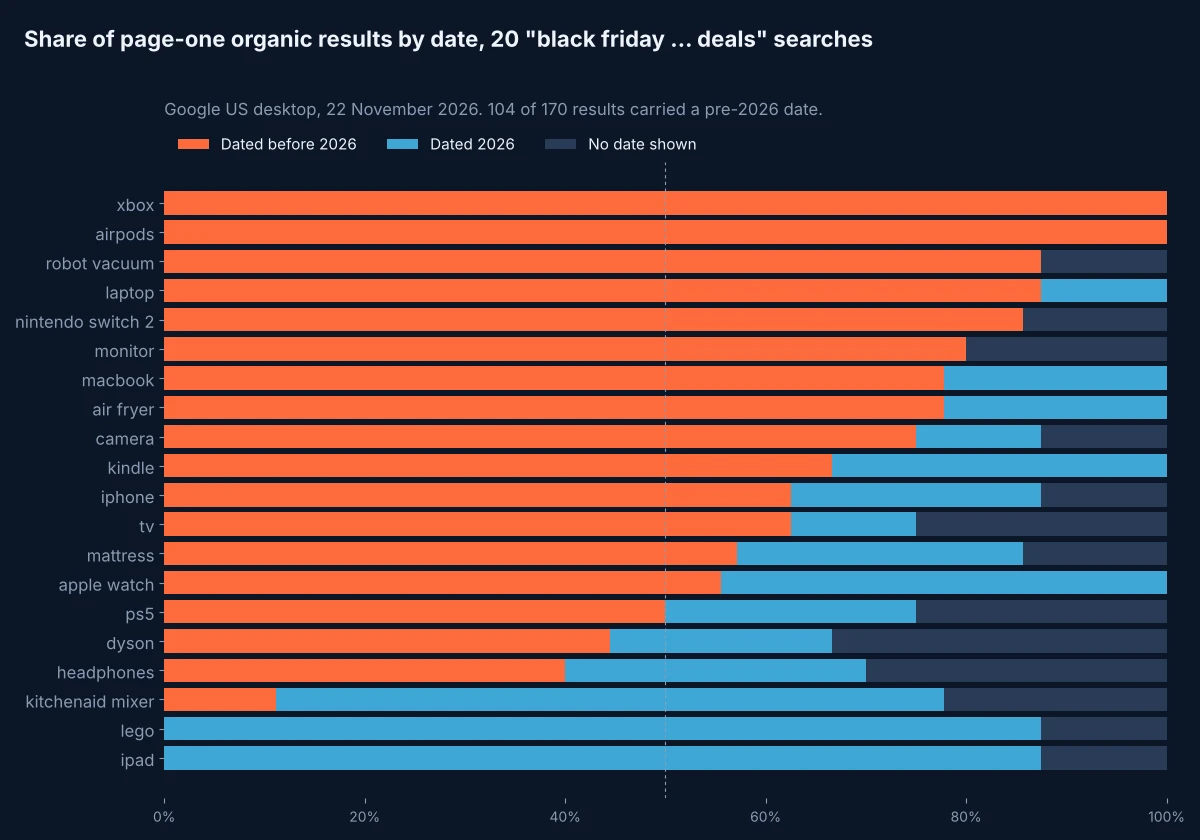
Five days before Black Friday, Google's first page for common "black friday [product] deals" searches is still dominated by coverage of earlier sales. In 20 US desktop searches we ran on 22 November 2026, 104 of the 170 organic results on page one (61%) carried a date before 2026. The oldest was a 2009 Gizmodo post on rumoured Apple discounts, ranking for "black friday macbook deals". Half of the No. 1 results (10 of 20) were dated 2025 or earlier.
The pattern matters for anyone publishing seasonal pages, because Google has told merchants since 2020 to keep one Black Friday URL and refresh it each year rather than launch a new page. In our pull, retailer and brand deal hubs, the kind of page that advice is written for, were the ones showing 2026 dates, while publisher roundups from past years kept their rankings.
Key findings
- 61% of page-one results predated 2026. Of 170 organic results across 20 searches, 104 showed a pre-2026 date, 45 showed a 2026 date and 21 showed no date.
- The top three skewed old too. 37 of the 60 results in positions 1 to 3 carried a pre-2026 date. Only 7 of the 20 No. 1 results were dated 2026.
- Two searches had no current result at all. Every dated page-one result for "black friday airpods deals" (10) and "black friday xbox deals" (8) came from 2025 or earlier.
- 34 results were from before 2024, including pages from 2016, 2017 and 2018 as well as the 2009 post.
- Retailers were the exception. Only 2 of 24 retailer and brand results were dated before 2026, against 77 of 100 results from publishers and other sites.
Which pages were current
The freshest results pages were the ones where retailers and brands own the query. For "black friday ipad deals", 7 of 8 results were dated 2026, including pages from Apple, Target, Best Buy, Back Market and AT&T. "black friday lego deals" also had 7 of 8 dated 2026, including two Lego.com pages, and "black friday kitchenaid mixer deals" had 6 of 9, three of them on KitchenAid's own site.
At the other end, the AirPods and Xbox results were made up of news articles, deal posts and forum threads from previous sales, dated 2020 through 2025. The laptop results included a Consumer Reports page from November 2017, and the TV results were topped by a CBS News deals list from November 2018.
| Site type | Results | Dated 2026 | Dated before 2026 | No date shown |
|---|---|---|---|---|
| Retailers and brands | 24 | 14 | 2 | 8 |
| Social, forum and video | 46 | 16 | 25 | 5 |
| Publishers and other sites | 100 | 15 | 77 | 8 |
| All results | 170 | 45 | 104 | 21 |
Source: SaaS Link Building analysis of 20 Google US desktop SERPs, 22 November 2026. Site types assigned by domain; see Methodology.
Among the pre-2026 results, 2025 was the most common year (42 results), followed by 2024 (22), 2022 (10), 2023 (8), 2021 (6) and 2020 (4). Six more carried relative labels such as "1 year ago" or "3 years ago".
What Google has said about seasonal URLs
Google's guidance points in the same direction as the data. In an October 2020 post, Alan Kent of Google's Search Relations team set out best practices for Black Friday and Cyber Monday pages, advising merchants to "use a recurring URL, not a new URL for each occurrence of the event" and giving /sale/black-friday rather than /sale/2020/black-friday as the example. The same post says to create the page well before the sale so Googlebot can discover and index it, and to link to it from the home page.
A July 2021 follow-up on deal pages in Google Search repeated the advice to reuse the same URL each year and added that the page title should name the event, giving "Black Friday 2021 Deals" as its example. Read together, the two posts describe a stable address with a title and content that change each year.
Google has not said how it weighs a page's date for seasonal deal queries, and nothing in our data shows why older pages hold their positions. One possible explanation, which is speculation, is that annual deal articles collect links and engagement over several seasons that a page published this month cannot match yet. We tested a related question in our study on whether Google rewards fresh dates, which found the effect depended on the query.
The shopping units above the links
The organic links are only part of these results pages. In 11 of the searches we also pulled the full results layout: a "Popular products" unit appeared in all 11, and an AI Overview appeared in 5 (TV, laptop, iPhone, iPad and Apple Watch). On the AirPods search, the product unit sat above the first organic link.
Google is pushing its own shopping tools into the same week. Its Black Friday shopping post of 16 November highlights Universal Cart price-drop alerts, Price Insights labels that rate a price as low, typical or high, and gift searches in AI Mode. Earlier this month we found AI Overviews named promo codes on 12 of 20 brand coupon searches, another place where shoppers can get an answer without opening an older article.
Rankings are also still moving. Google's Search Status Dashboard lists the November 2026 core update as starting on 10 November with no end time logged, so positions in this sample may shift before Friday. Our look at past holiday-season updates found a ranking update running on 51% of peak-season days.
What this means for SEO teams
- Keep one evergreen URL per event. If your Black Friday page moves to a new year-stamped address each November, you start from zero while last year's article keeps its links. Redirect old year-specific URLs to the recurring one.
- Change the content, not the address. Update the title, intro, product list and visible date each season, as Google's 2021 post suggests, so the page that ranks shows this year's offers.
- Audit your own stale rankings. Search Console's Performance report, filtered to queries containing "black friday", will show which old pages still earn impressions. Those are the pages to refresh or redirect this week.
- Publish early. Google's 2020 advice is to create the page well before the event and link it from the home page so it can be crawled and indexed in time.
- Do not fake freshness. Changing the visible date without changing the offers leaves a page that says 2026 but lists last year's prices, which does nothing for shoppers who click through.
Methodology
On 22 November 2026 we pulled Google US, English, desktop organic results (first page, depth 10) through a SERP data API for 20 queries in the form "black friday [product] deals", covering TVs, laptops, iPhone, AirPods, PS5, Nintendo Switch 2, Apple Watch, iPad, headphones, robot vacuums, air fryers, MacBook, Xbox, KitchenAid mixers, Dyson, Lego, cameras, monitors, Kindle and mattresses. This gave 170 organic results.
Each result was dated from the first signal available, in this order: the date Google displayed at the start of the snippet; a date or relative label ("3 weeks ago", "1 year ago") in the displayed URL line; a year in the title; a year stated in the snippet text. Results with none of these were marked as undated. Relative labels of one year or more were counted as pre-2026. Where a snippet date and a title year disagreed, we used the snippet date. Site types were assigned by domain: retailers and brands sell the product directly; social, forum and video covers Facebook, Instagram, YouTube, Reddit, Lemon8 and forum sites including MacRumors, RedFlagDeals and Lens Rumors; everything else is publishers and other sites.
For 11 of the 20 queries we also pulled the full results layout to record SERP features. Results vary by location, device and time. When we repeated the Nintendo Switch 2 search a few minutes apart, several organic results changed, so individual positions should be read as a snapshot. The displayed date reflects what Google shows searchers, which may differ from a page's actual publish or update date.
Conclusion
For most of the Black Friday deal searches we checked, Google's first page was still made up of articles about earlier sales, and the No. 1 result was more likely to be dated 2025 or before than 2026. The pages that bucked the pattern were retailer and brand deal hubs, the kind of page Google's recurring-URL advice has targeted since 2020.
For publishers and merchants, the practical step this week is to find which of last year's pages are still ranking and point that authority at one page that carries this year's deals.
Questions and answers
How many Black Friday deal results on Google's first page are from previous years?
In 20 Google US desktop searches for "black friday [product] deals" pulled on 22 November 2026, 104 of 170 page-one organic results (61%) carried a date before 2026. 45 were dated 2026 and 21 showed no date.
Which Black Friday searches showed the most current results?
Searches where retailers and brands rank directly were the freshest. For "black friday ipad deals" and "black friday lego deals", 7 of 8 page-one results were dated 2026. For "black friday airpods deals" and "black friday xbox deals", every dated result was from 2025 or earlier.
Should a Black Friday page use a new URL each year?
No. In an October 2020 Search Central post, Google advised merchants to use a recurring URL for recurring events, such as /sale/black-friday rather than /sale/2020/black-friday. A July 2021 post repeated the advice to reuse the same URL each year and suggested naming the event in the page title.
Did AI Overviews appear on Black Friday deal searches?
In the 11 searches where we pulled the full results layout, an AI Overview appeared on 5 (TV, laptop, iPhone, iPad and Apple Watch), while a Popular products unit appeared on all 11.
More releases
-
Studies
Does Google Rank Subdomains Lower? They Held 15 of 50 No. 1 Spots in Our Test
Google's documentation says it sometimes treats a subdomain as a separate site, and John Mueller says the choice affects how new content ranks. But in 50 US Google searches pulled on 22 November 2026, subdomain results ranked as well as subfolders and took 15 of 50 top spots. Our verdict: unproven.
-
Explainers
Mueller Says Site Moves Don't Fix Quality; 22 of 70 Old Domains Send Every URL to One Page
Google's John Mueller says a site move does not improve a site's quality. Our redirect test of 70 old domains found the mechanics often fail too: 22 send every URL to one page, 8 chain more than three redirects, and one blog URL loops forever.
-
Industry news
Google Says Schools Can't Have Search Without AI; Its Web Filter Dropped AI on 20 of 20
New York, Los Angeles and Chicago schools are weighing other search engines after Google said K-12 students cannot get Search without AI Overviews. Google's own Web filter shows the split already exists: in our 20 homework searches it removed the AI Overview from all 20 results pages, along with every People also ask box.
Tell us the site and the goals.
Rankings in Google and visibility in AI answers, from one monthly plan. One call is enough to say which one fits. Email works just as well.