Mueller Says Site Moves Don't Fix Quality; 22 of 70 Old Domains Send Every URL to One Page
Google's John Mueller says a site move does not improve a site's quality. Our redirect test of 70 old domains found the mechanics often fail too: 22 send every URL to one page, 8 chain more than three redirects, and one blog URL loops forever.
 Vibhu Dhariwal
Cofounder & CTO, Digital Gratified
- Published
- Section
- Explainers
- Reading time
- 8 minutes
Ras Al Khaimah, United Arab Emirates, .
Google's John Mueller told a site owner on 16 November that a stalled domain migration was probably not a technical problem at all. Replying on Bluesky to an owner whose move had been stuck for 10 months, he wrote: "A site move doesn't improve the site's overall quality." He suggested the owner look at the value the site adds rather than at the migration itself.
That answer covers the owner's side of the story. The other side is the mechanics, which Google spells out in its site move documentation: map old URLs to their new equivalents, use permanent redirects, keep chains short, and do not send many old URLs to one unrelated page. To see how often those rules are followed in practice, we tested 70 old domains whose homepages now forward to a different domain, from SaaS rebrands to retired products folded into a parent company's site.
Key findings
- Half map page to page. 35 of the 70 old domains sent /about, /pricing and /blog to matching or related pages on the new site.
- 22 of 70 send every tested URL to one page. On those domains, all three real paths and a made-up path ended on the same landing page, the pattern Google says "might be treated as a soft 404".
- 8 domains had a chain longer than three redirects on at least one path. Google advises no more than three where possible. One chain never ended: a page on Atlassian's site redirects to itself.
- 6 domains used a temporary redirect (302 or 307) on the hop to the new domain for at least one tested URL. The other 64 used 301 or 308 on every cross-domain hop we saw.
- 2 domains forward only the homepage. Their inner URLs answer 404 on the old domain instead of redirecting.
What Mueller said, and what he did not
The owner had moved from one domain to another, verified the 301s, and filed a Change of Address in Search Console. Google kept the old URLs as canonical and indexed only the new homepage, the owner wrote. Mueller's reply put the likelier cause on Google's quality systems not being persuaded by the site, not on the move.
In a later reply on the same thread, the owner argued that the old pages had earned clicks for years and that the move itself seemed to trigger a fresh quality judgement. That is the owner's reading, not something Google has said. Google's documentation says a move is processed URL by URL and that a medium-sized site can take a few weeks or more before new URLs replace old ones in results. It does not describe a re-assessment of quality triggered by a domain change.
Two separate things can go wrong in a move: weak content that clean redirects cannot rescue, and redirects that fail to carry each old URL to its new home. Mueller addressed the first. Our test looks at the second.
What Google asks for, and what we found
| Google's guidance | What we found across 70 old domains |
|---|---|
| Map each old URL to its new equivalent | 35 mapped all three real paths; 8 mapped some; 22 sent everything to one page |
| Use permanent redirects (301 or 308) | 64 used only permanent redirects on cross-domain hops; 6 used a 302 or 307 somewhere |
| Avoid chains; ideally no more than 3 hops | 26 reached /about, /pricing and /blog in one hop each; 8 needed more than 3 on at least one path |
| Don't send many old URLs to one irrelevant page | 27 sent a made-up path to the same landing page as the homepage instead of returning a 404 |
| Keep redirects as long as possible, generally at least a year | All 70 still forward their homepage; 2 do not forward inner URLs |
Source: SaaS Link Building redirect test of 70 old domains, 22 November 2026; guidance summarised from Google's site move documentation.
Worked examples from the test
The chains below are copied from our crawl.
| Old URL | Where it went | Redirects | Assessment |
|---|---|---|---|
| twitter.com/pricing | x.com/pricing | 1 (301) | Textbook: same path, one permanent hop |
| guardian.co.uk/about | theguardian.com/about | 1 (301) | Same path, one hop |
| dapulse.com/about | monday.com/p/about/ | 3 (301, 302, 301) | Right page, but a temporary hop in the middle and a trailing-slash hop at the end |
| framerjs.com/pricing | framer.com homepage | 1 (307) | Temporary redirect, and every path collapses to the homepage |
| tinyletter.com/about | mailchimp.com/pricing/marketing/ | 1 (301) | Every old URL lands on one pricing page |
| segment.io/about | twilio.com/en-us homepage | 5 | Passes through an http:// hop and a URL named /errors/404 that itself redirects |
| technet.com/about | learn.microsoft.com/en-us/ | 5 (301, 307, 301, 301, 302) | Old domain did not answer over HTTPS in our test; ends on a section homepage |
| opsgenie.com/blog | atlassian.com/blog/opsgenie | Loop | The final URL returns a 301 pointing to itself, so the chain never resolves |
| draw.io/about | 404 on draw.io | 0 | Homepage forwards to app.diagrams.net; inner URLs do not |
Source: SaaS Link Building redirect test, 22 November 2026. Two full passes returned the same chains.
The Opsgenie loop is invisible to anyone who only checks the homepage, which resolves cleanly to a migration page on Atlassian's site. Googlebot follows up to 10 hops, according to Google's site move page, so for Google the old blog URL simply fails.
Rebrands do much better than absorbed brands
The split in the data is not between big and small companies. It is between two kinds of move. When a product keeps its identity and changes domain (Buffer, Front, Help Scout, Notion, Wellfound), the old URLs almost always map one to one. When an old brand now forwards into another company's site, the old URLs usually collapse into a single product or landing page.
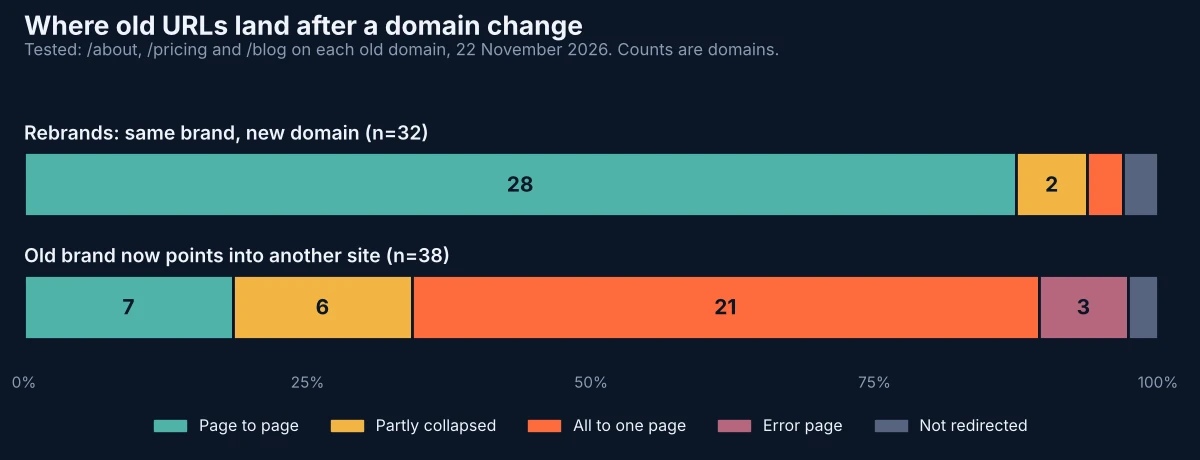
For a retired product, collapsing to one page can be deliberate, and Google's guidance allows redirects to a page that consolidates merged content. The problem is scale. When every URL on a domain, including ones that never existed, lands on one page with a 200 status, a real consolidation looks the same as a soft 404, and the signals on those old URLs have nowhere specific to go. A 404 for pages that have no successor is the cleaner signal, yet our earlier test of soft 404 handling on top sites found 15% of 546 top sites failing to return one.
What to do if you are planning or auditing a move
- Test inner URLs, not just the homepage. Every domain in this test forwarded its homepage. The failures were all on deeper paths.
- Build the URL map from real traffic. Google suggests starting with sitemaps, server logs, analytics and the Links report. Map those URLs one to one before switching anything on.
- Send unknown paths to a 404 on the new domain. A path-preserving wildcard rule (old.com/x to new.com/x) does this automatically: pages that exist resolve, pages that do not return 404.
- Use 301 or 308 on the cross-domain hop. Google's redirect documentation says temporary redirects keep the source page in results, which is the opposite of what a move needs. Our earlier test of redirect codes on top sites found 75 of 435 top sites using temporary codes, migration or not.
- Collapse chains. Point the old URL at the final destination, including the trailing slash, locale prefix and HTTPS version. In the chains above, trailing slashes, a locale prefix and protocol switches each added hops.
- Re-check long after the move. Google recommends keeping redirects for at least a year. Two of our 70 old domains forward only the homepage, so inner links pointing at them now hit a 404.
A quick way to audit a list of old URLs is a short shell loop that prints the status code, the number of redirects and the final address for each one:
while read u; do
  curl -s -o /dev/null -L --max-redirs 10 \
    -w "%{http_code} %{num_redirects} %{url_effective}  <- $u\n" "$u"
done < old-urls.txt
Fix any line where several old URLs share one final address, the redirect count is above 3, or curl reports too many redirects. If the redirects are clean and rankings still lag, Mueller's point applies: content quality, not the move, is the likelier cause. Google's own timelines for recrawling and re-ranking are a useful benchmark for how long to wait before drawing that conclusion.
Methodology
On 22 November 2026 we requested the homepages of 161 domains known to have been renamed, rebranded or retired, plus some control domains, using a desktop Chrome user agent and following each redirect manually with up to 15 hops. 79 homepages ended on a 200 page at a different registrable domain. We excluded nine (hosting roots, regional or short-link domains, sign-in apps and domains pointing to unrelated sites), leaving 70.
For each of the 70 we requested /about, /pricing, /blog and a made-up path, and recorded every hop's status code and the final URL. We classed a path as collapsed when it ended on the same page as the old homepage or on the new site's homepage. Domains were grouped by whether the same brand continued on the new domain (32) or the old brand now forwards into another company's site (38). "Error page" covers three domains whose inner URLs ended on an error page (a 403, a 404 page or an error page served with a 200). We ran the full crawl twice, about three minutes apart; both passes produced identical chains. We did not test with Googlebot's user agent, and sites can serve crawlers differently.
Conclusion
Mueller's reply is a reminder that a migration is not a ranking reset. It is equally true that a migration can lose what a site already earned if old URLs are not carried across one by one. In our test, brands that kept their identity mostly got this right, while brands folded into a parent site mostly did not: 22 of 70 old domains now send every URL to a single page.
For SEO teams, the order of checks matters: confirm that every important old URL reaches its equivalent in one permanent hop, then ask Mueller's question about whether the site gives Google a reason to rank it.
Questions and answers
Does moving to a new domain improve rankings?
No. Google's John Mueller wrote on Bluesky on 16 November 2026 that a site move does not improve a site's overall quality. In the case he answered, he said the likelier issue was Google's quality systems, not the migration.
Which redirect should I use for a domain move?
Google's site move documentation recommends server-side permanent redirects such as 301 or 308. Its redirect documentation says temporary redirects keep the source page in search results.
Can I redirect all old URLs to the new homepage?
Google advises against it. Its site move documentation says redirecting many old URLs to one irrelevant page such as the home page can confuse users and might be treated as a soft 404. Redirecting to a page that consolidates merged content is acceptable.
How many redirects in a chain does Google follow?
Google's site move documentation says Googlebot can follow up to 10 hops but advises redirecting straight to the final destination, ideally with no more than 3 hops and fewer than 5.
How long should redirects stay in place after a move?
Google recommends keeping them as long as possible, generally at least one year, so it can transfer signals to the new URLs. From a user's point of view it suggests considering keeping them indefinitely.
More releases
-
Studies
104 of 170 Page-One Black Friday Deal Results Predate 2026; One Dates to 2009
Five days before Black Friday, 61% of Google's page-one organic results for 20 "black friday deals" searches carried a pre-2026 date, and only 7 of the 20 No. 1 results were from this year. Retailer and brand deal hubs, the pages Google's recurring-URL advice targets, were the main exception.
-
Studies
Does Google Rank Subdomains Lower? They Held 15 of 50 No. 1 Spots in Our Test
Google's documentation says it sometimes treats a subdomain as a separate site, and John Mueller says the choice affects how new content ranks. But in 50 US Google searches pulled on 22 November 2026, subdomain results ranked as well as subfolders and took 15 of 50 top spots. Our verdict: unproven.
-
Industry news
Google Says Schools Can't Have Search Without AI; Its Web Filter Dropped AI on 20 of 20
New York, Los Angeles and Chicago schools are weighing other search engines after Google said K-12 students cannot get Search without AI Overviews. Google's own Web filter shows the split already exists: in our 20 homework searches it removed the AI Overview from all 20 results pages, along with every People also ask box.
Tell us the site and the goals.
Rankings in Google and visibility in AI answers, from one monthly plan. One call is enough to say which one fits. Email works just as well.