Google Says Let Dead Pages 404, but 15% of 546 Top Sites Don't Return One
Google's Gary Illyes and Cherry Sireetorn Prommawin said on 28 October that 404 errors carry no penalty and do not drain crawl budget. Our crawl of 573 top sites found 15.2% of usable responses to an invented URL were not a 404 or 410, led by 200 pages and homepage redirects that Google treats as soft 404s.
 Vibhu Dhariwal
Cofounder & CTO, Digital Gratified
- Published
- Section
- Studies
- Reading time
- 8 minutes
Ras Al Khaimah, United Arab Emirates, .
Google's Gary Illyes and Cherry Sireetorn Prommawin used a Google Search Central video published on 28 October 2026 to tell site owners that a 404 status code is a normal part of the web: it carries no penalty, does not hurt healthy pages and does not drain crawl budget. Their advice for a dead URL is simple: redirect it only to a true replacement, otherwise let it return a 404 or 410, and make the error page helpful. To see how closely large sites follow that advice, we requested two invented URLs on each of 573 unique top-ranked websites on 29 October. On the shallow test URL, 15.2% of usable responses were not a 404 or 410.
Key findings
- 463 of 546 sites (84.8%) answered the shallow invented URL with a 404 or 410. That fell to 444 of 547 (81.2%) for a deeper URL shaped like an old news article.
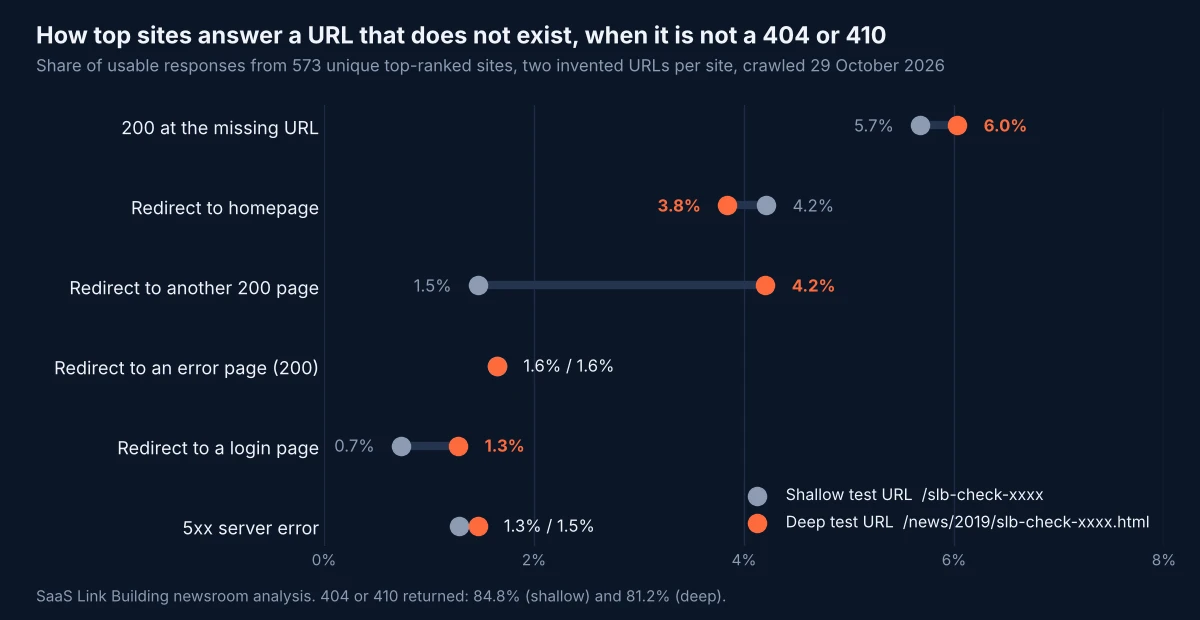
- 31 sites (5.7%) served a 200 status at the missing address itself, and in 22 of those the server's HTML contained neither "404" nor common "not found" wording, consistent with a JavaScript app shell that renders any error in the browser.
- 23 sites (4.2%) redirected the missing URL to their homepage, the exact pattern Prommawin called a lazy shortcut and that Google's help page lists as a soft 404.
- Only 6 of the 70 200 responses we could fetch a second time carried a noindex robots meta tag or X-Robots-Tag header, the fallback Google documents for single-page apps.
- 410 is rare: one site returned 410 for the shallow URL and three for the deep one. Google treats the two codes the same for removal.
- 50 of 539 sites (9.3%) gave a 404 for one invented URL and something else for the other, so a single spot check can miss a problem.
What Google said in the video
The episode is part of The Non-Canonical Cabinet, a Search Central series in which the two developer advocates answer edge-case technical SEO questions. Illyes said Googlebot sees a 404, concludes the page is gone and eventually drops it from the index. "There is no penalty, no secret Google jail," he said, adding that other pages on the site are not affected.
Prommawin framed the issue as one of user experience rather than Search. If a dead URL still draws visitors from old links or social posts, a redirect to a newer product can recover them; if nothing replaces the page, it should stay a 404. She warned against sending every dead page to the homepage because it confuses people and muddies analytics.
The pair then set out a three-step framework: one-to-one redirects only where a direct successor exists (an updated article or a newer model of the same product), a 404 or 410 when the page is permanently gone, and a custom 404 page with a friendly message, a search bar and links to top categories or recent content. Illyes said the idea that 404s drain crawl budget is not true, and the pair contrasted 404s with 500-class errors and 429 responses, which Google treats as signs of an overloaded server and which slow crawling.
How 546 top sites answered a page that does not exist
Every outcome for the shallow test URL, with what Google's documentation and video say about it:
| Response to the invented URL | Sites | Share | What Google says |
|---|---|---|---|
| 404 or 410 (directly or after a locale or slash redirect) | 463 | 84.8% | The expected answer for a page that is gone |
| 200 at the missing URL | 31 | 5.7% | Content that suggests an error can be reported as a soft 404 |
| Redirect to the homepage | 23 | 4.2% | Named as a soft 404 pattern |
| Redirect to an error URL that returns 200 | 9 | 1.6% | Single-page apps should redirect to a URL that returns 404 |
| Redirect to another page that returns 200 | 8 | 1.5% | Redirect only to a true replacement (28 October video) |
| 5xx server error | 7 | 1.3% | Server errors slow crawling |
| Redirect to a login page | 4 | 0.7% | Not addressed directly |
| Other 4xx | 1 | 0.2% | 4xx codes other than 429 are handled like a 404 |
The deeper URL, /news/2019/ followed by a random file name, exposed a different weakness. Redirects to some other 200 page almost tripled, from 8 sites to 23, as more sites answered a missing article address with some other live page rather than an error.
The 404 pages themselves
Returning the right code is only Google's second step. The third is making the page useful, and here the picture is weaker. Of the 463 sites that returned a 404 or 410 for the shallow URL, only 136 (29.4%) included a search field in the HTML the server sent. A third (154 sites) offered five links or fewer, and 31 served an error page smaller than 1 KB. The median 404 page carried 40 links.
These counts come from server HTML only, so elements added later by JavaScript are missed; treat them as a floor.
What Google said before, and what is new
Very little in the episode contradicts existing documentation. Google's Search Console help page on 404 errors already says most 404s are not worth fixing because they do not affect indexing or ranking, says a submitted URL that returns 404 is worth fixing, and states that Google treats 410 the same as 404. The same page says redirecting a missing page to another page, such as the homepage, creates a soft 404.
The status code documentation backs the crawl budget point: 4xx codes other than 429 have no effect on crawl rate, while 429 is treated as a server error. That is the same logic behind earlier guidance we reported on using Retry-After when you need Google to slow its crawl and John Mueller's advice to serve a 503 rather than a 404 or 500 during emergency downtime.
What the video adds is framing: fixing 404s is presented as a business and user experience choice rather than an SEO obligation. It follows Illyes' earlier advice on how to structure URLs.
What this means for SEO teams
- Test two invented URLs, not one. Request a short random path and a deep one inside a real section (a blog, news or product folder). Nearly one site in ten in our sample answered them differently.
- Replace homepage catch-all redirects. If a rewrite rule sends every unknown URL to the homepage, change it to return a 404, and keep one-to-one 301s only where a direct successor exists.
- Fix JavaScript apps that return 200 for everything. Google's JavaScript SEO guide gives two options: a JavaScript redirect to a URL whose server returns 404 (such as
/not-found), or a robots noindex tag added to the error view. The error URL itself must return 404, not 200. - Prioritise by traffic and submission, not by count. Check 404s that appear in your sitemap or still receive visits from links. Leave never-existing URLs alone unless they are common misspellings. A large count in the Search Console Page indexing report is not on its own a problem, as we noted when Mueller advised watching performance data first.
- Make the error page earn its keep. Add a search field and links to top categories or recent content, and keep the 404 status code on that page.
Methodology
On 29 October 2026 we took the first 1,200 domains of the public Tranco top-sites ranking and requested each homepage over HTTPS with a desktop Chrome user agent, following redirects. 630 domains returned a 200 HTML homepage; after merging domains that resolved to the same final homepage host (for example, a brand's alternate domains), 573 unique sites remained. For each site we requested two invented paths on the final homepage host: /slb-check- plus 10 random characters, and /news/2019/slb-check- plus 10 random characters and .html. We recorded the redirect chain and the final status code.
We excluded responses that ended in 401, 402, 403, 406, 418 or 429, connection errors and bot challenge pages, since they reflect bot protection rather than error handling (27 sites for the shallow URL, 26 for the deep one). A redirect counted as going to the homepage when the final URL matched the homepage host and path. Responses that reached a 404 or 410 after a locale or trailing slash redirect counted as 404s (89 sites). Search fields were detected from search inputs, common search parameter names or a search role in the server HTML. For the 71 responses that ended in a 200, we fetched a fresh invented URL a second time to check for a noindex robots meta tag or X-Robots-Tag header (70 succeeded). We did not crawl as Googlebot, so some sites may answer Google's crawler differently.
Conclusion
Google's message this week is that a 404 is not something to fear, and most of the largest sites already behave accordingly. The problems sit in the minority: about 15% of top sites answer a missing page with something other than a 404 or 410. A 200 at the missing URL and homepage redirects account for 54 of those 83 cases, and very few of these responses use the noindex fallback Google documents.
For SEO teams, the practical takeaway is to stop chasing 404 counts and instead check what a missing URL actually returns, at two depths, and whether the error page helps a visitor find their way back.
Questions and answers
Do 404 errors hurt Google rankings?
Google's Search Console help page says 404s don't harm a site's indexing or ranking. In a Search Central video published on 28 October 2026, Gary Illyes said there is no penalty and no negative effect on a site's other healthy pages.
Should deleted pages be redirected to the homepage?
No. Cherry Sireetorn Prommawin called it a lazy shortcut that confuses people and data, and Google's 404 help page says redirecting a missing page to another page, such as the homepage, can create a soft 404. Redirect only when a direct replacement exists; otherwise return a 404 or 410.
Is a 410 better than a 404 for removed pages?
Google's help page says it currently treats 410 the same as 404. In our 29 October crawl, only one of 546 top sites returned a 410 for the shallow invented URL, and three of 547 for the deep one.
Do 404s waste crawl budget?
Illyes said they do not. Google's HTTP status code documentation says 4xx codes other than 429 have no effect on crawl rate, while 5xx errors and 429 responses prompt Google's crawlers to slow down.
How can a single-page app avoid soft 404s?
Google's JavaScript SEO basics guide gives two options: use a JavaScript redirect to a URL for which the server returns a 404, such as /not-found, or add a robots noindex meta tag to the error view with JavaScript.
More releases
-
Explainers
AI Overview Citation Card Test Explained: How Hidden Sources Can Cut GSC Impressions
Google may be testing desktop AI Overviews without the citations card, Search Engine Roundtable reported on 29 October, though Google has not confirmed it. Under Search Console rules, links hidden behind a click may log no impression, and in our 28-search pull only 17.4% of cited pages ranked on page one.
-
Studies
Does Google Ignore Your Meta Description? It Rewrote 74% in Our 30-Query Test
Google replaced the publisher's meta description with its own snippet for 96 of 129 pages (74.4%) across 30 live US searches on 29 October 2026. It kept the description for nearly half of pages on short head terms but rewrote more than 85% on longer, more specific queries.
-
Studies
45% of Top-Site WordPress Installs Patched Within 12 Hours of the 7.1.4 Security Release
WordPress shipped security release 7.1.4, with backports to every branch back to 4.7, on 28 October. Our crawl of the 20,000 most popular domains about 12 hours later found 44.7% of the 729 WordPress homepages exposing a version already patched, while one in five were two or more releases behind.
Tell us the site and the goals.
Rankings in Google and visibility in AI answers, from one monthly plan. One call is enough to say which one fits. Email works just as well.