AI Overview Citation Card Test Explained: How Hidden Sources Can Cut GSC Impressions
Google may be testing desktop AI Overviews without the citations card, Search Engine Roundtable reported on 29 October, though Google has not confirmed it. Under Search Console rules, links hidden behind a click may log no impression, and in our 28-search pull only 17.4% of cited pages ranked on page one.
 Vibhu Dhariwal
Cofounder & CTO, Digital Gratified
- Published
- Section
- Explainers
- Reading time
- 7 minutes
Ras Al Khaimah, United Arab Emirates, .
Google may be testing AI Overviews on desktop without the citations card, the panel that shows the source links behind the AI answer. Search Engine Roundtable reported the possible test on 29 October 2026, after SEO consultant Brodie Clark posted screenshots on X and said the cards that used to show two or three source domains were appearing far less often. Clark tied the change to recent drops in visibility and impressions. Google has not said whether this is a test, a bug or a launch: Search Engine Roundtable's Barry Schwartz asked Google's Rajan Patel on X and had no reply at the time of publication.
This explainer sets out how AI Overviews credit sources today, why a hidden citation card can move Search Console impressions under Google's own counting rules, and what our pull of 30 live US searches shows about which pages actually get cited.
What changed
- The reported test: on some desktop searches, the AI Overview appears without its citations card. Schwartz could not reproduce it at first and noticed the card sometimes loads late, so a loading bug has not been ruled out. Clark said he was seeing the missing card consistently across many test queries.
- What has not changed: Neither Google's AI features documentation nor its Search Console counting rules mention the citations card. The AI features and your website page still says no special optimization is needed to appear in AI Overviews or AI Mode.
- Google confirmation: none. Treat the test as reported, not confirmed.
How AI Overviews credit sources
An AI Overview points to pages in two main ways. Inline links sit inside the answer text. The citations card lists the pages behind the answer, with a site name, title and short snippet. Our earlier work found that 74% of AI Overviews on 1,000 SaaS searches carried no inline link, which leaves the card as the main visible route to a source on many answers. We also found that the card does not always show the page's own words: 26% of citation snippets were rewritten as AI summaries in a 30-query test.
If the card goes, inline links are what remain on screen without a click. Pages that only ever appeared in the card would lose their visible slot.
Why a missing card can cut impressions
Search Console's performance report help page explains how AI Overviews are counted:
- Position: an AI Overview takes a single position in the results, and every link inside it gets that same position.
- Click: clicking a link to an external page in the AI Overview counts as a click.
- Impression: standard impression rules apply. In general an item counts if it is on the current page of results, even if not scrolled into view, as long as the user does not need to click to see it. Inside expanding sections, the item usually has to be expanded by a click to register.
Read together, those rules suggest a plausible mechanism for what Clark describes. This is our interpretation, not something Google has stated: if a source link is no longer shown until the user clicks, Search Console may stop logging an impression for that link on searches where nobody expands it. Average position would not change, because every link in the overview shares one position. The drop would show up as fewer impressions at a steady position, concentrated on desktop.
What our 30-search pull shows
To see which pages fill those source slots, we pulled 30 informational US Google searches on 29 October 2026 and compared each AI Overview's cited sources with the first page of organic results. Full method below.
| Measure | Result |
|---|---|
| Searches that showed an AI Overview | 29 of 30 |
| AI Overviews with a full source list analysed | 28 |
| Sources cited across those 28 | 259 (median 9 per overview, range 6 to 13) |
| Cited URLs that also ranked on page one | 45 of 259 (17.4%) |
| Cited domains that also ranked on page one | 68 of 259 (26.3%) |
| Overviews citing no page-one URL at all | 13 of 28 |
| Overviews citing the number one organic result | 7 of 28 |
| YouTube links among cited sources | 77 of 259 (29.7%), in 25 of 28 overviews |
| Inline links inside the answer text | 57, in 25 of 28 overviews |
The gap between the two lists is wide. Fewer than one in five cited pages also held a first-page organic slot, and in nearly half of the overviews not one cited URL did. The top organic result was cited only a quarter of the time. YouTube was the single most cited domain by a distance, appearing in 25 of 28 overviews, with Reddit in 10.
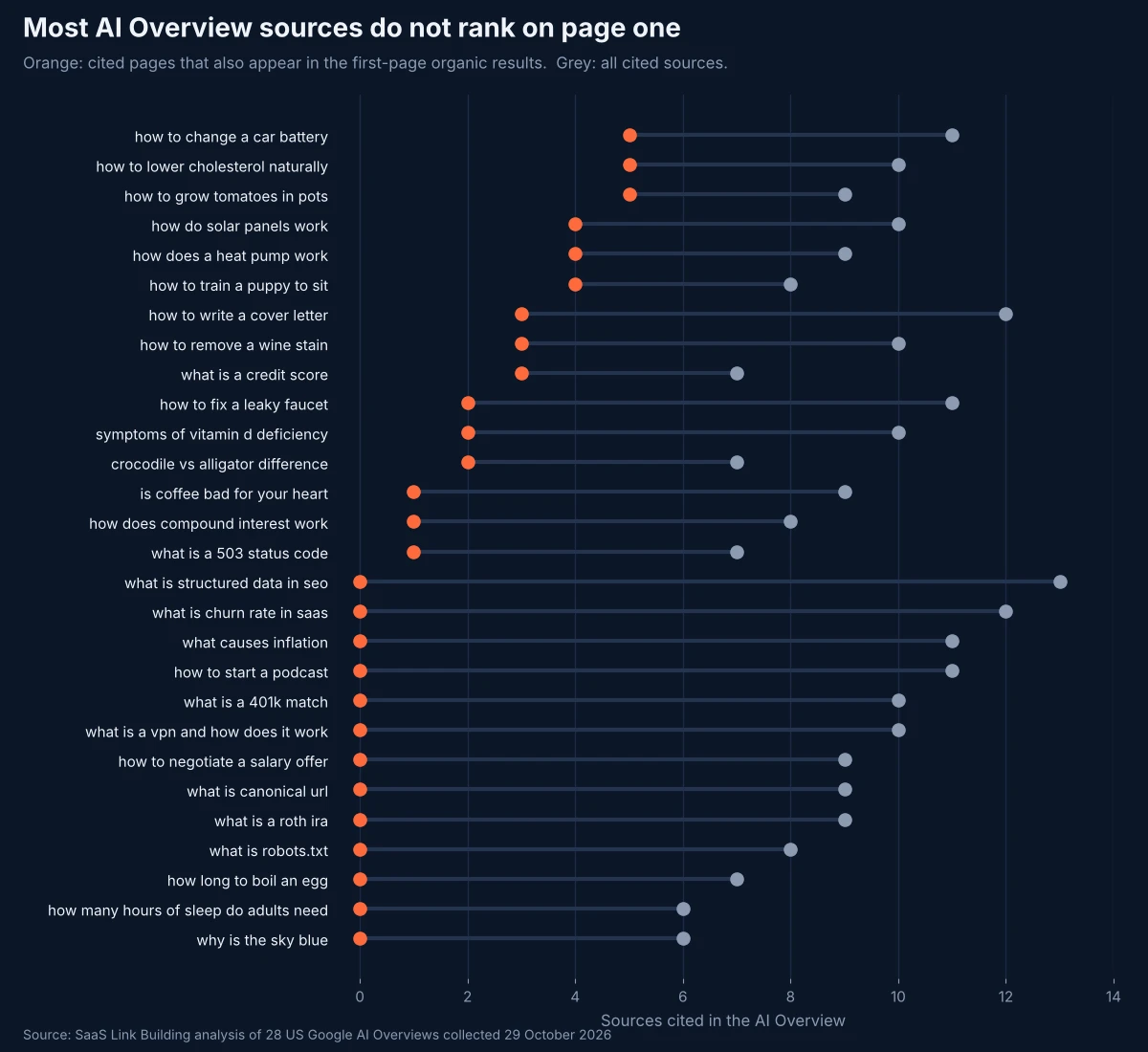
That matters for the card test. For many sites, the AI Overview source list is a separate route into the results page, reached by pages that do not rank in the top organic slots. If those sources become less visible, those are the pages that lose a route into view, and that loss would show up as fewer impressions rather than a lower position.
What SEO teams should do
- Split impressions by device. In the Search Console performance report, compare desktop and mobile impressions for your informational pages over the last two weeks. A desktop-only dip at a flat average position fits the reported test better than a ranking loss.
- Check the generative AI report. Google's generative AI performance report shows impressions from AI Overviews and AI Mode by page, country, device and date. Google announced it on 3 June 2026 and says it reached all sites on 31 August. Filter by device and look for a desktop change from late October.
- Annotate the date. Mark 29 October in your reporting so a later dip is not misread as a core update. Google's Search Status Dashboard lists no ranking update since the September spam update ended on 8 October.
- List pages that earn AI impressions but rank below page one. Compare the generative AI report's pages with your organic positions. Pages cited in overviews without strong organic rankings have the most to lose if the card stays hidden.
- Do not change snippet controls in response. Google lists nosnippet, data-nosnippet, max-snippet and noindex as the ways to limit what appears in AI features. None of them adds visibility, and our check of 799 top-site pages found nosnippet in none of them.
- Keep checking the live results. Run your own priority queries on desktop, signed out, on several days, and note whether the card appears. Because Schwartz saw the card load late, wait a few seconds before recording that it is missing.
Methodology
On 29 October 2026 we ran 30 informational queries through a SERP API using Google's US English results with a United States location. The queries covered how-to, definition, health, personal finance, home, technical SEO and SaaS topics. For each result we recorded whether an AI Overview appeared and, when it did, every entry in its reference list. One query (what is core web vitals) showed no AI Overview. One (what is an api) returned an overview that loads in a second request, so we excluded it from source counts, leaving 28 overviews. We compared each cited URL with the organic results on the first page, which held 5 to 9 organic listings per query, after removing "www", fragments and trailing slashes. Domain matches compare host names only. Inline links are links embedded in the answer text. The SERP data cannot show whether the citations card was visible on screen, so these figures describe which pages are cited, not how the card was displayed. A sample of 30 queries is small and shows direction, not a rate for all of Google.
Conclusion
Google has not confirmed that it is testing AI Overviews without the citations card, and a loading bug remains possible. But its own counting rules mean that any change hiding source links behind a click could lower impressions without moving average position, and our pull suggests the pages most exposed are the ones cited in AI Overviews without ranking on page one. Check desktop impressions and the generative AI report now, so you have a baseline if Google expands the change.
Questions and answers
Has Google confirmed it is removing citation cards from AI Overviews?
No. Search Engine Roundtable reported a possible desktop test on 29 October 2026 after SEO Brodie Clark shared screenshots, and Google had not replied to a question about whether it was a bug or a test.
How does Search Console count a link in an AI Overview?
Google's help documentation says an AI Overview occupies a single position and every link in it gets that position. A click on an external link counts as a click, and standard impression rules apply, so items inside expanding sections usually need to be expanded to register an impression.
Where can I see my AI Overview impressions?
Search Console's generative AI performance report shows impressions from AI Overviews and AI Mode by page, country, device and date. Google announced it on 3 June 2026 and says it was rolled out to all websites on 31 August 2026.
Do pages cited in AI Overviews usually rank on page one?
Not in our sample. Across 28 US AI Overviews collected on 29 October 2026, 45 of 259 cited URLs (17.4%) also appeared in the first-page organic results, and 13 overviews cited no page-one URL at all.
Can I opt out of AI Overviews?
Google says nosnippet, data-nosnippet, max-snippet and noindex limit what is shown from your pages in Search, including AI features. Robots.txt rules for Googlebot control crawling for Search.
More releases
-
Studies
Does Google Ignore Your Meta Description? It Rewrote 74% in Our 30-Query Test
Google replaced the publisher's meta description with its own snippet for 96 of 129 pages (74.4%) across 30 live US searches on 29 October 2026. It kept the description for nearly half of pages on short head terms but rewrote more than 85% on longer, more specific queries.
-
Studies
45% of Top-Site WordPress Installs Patched Within 12 Hours of the 7.1.4 Security Release
WordPress shipped security release 7.1.4, with backports to every branch back to 4.7, on 28 October. Our crawl of the 20,000 most popular domains about 12 hours later found 44.7% of the 729 WordPress homepages exposing a version already patched, while one in five were two or more releases behind.
-
Industry news
Google Search Revenue Rose 0.1% From Q2 as AI Mode Ads Expand to 10 New Countries
Alphabet's Q3 2026 results show Google Search & other revenue up 12% year on year to $63.35 billion but just 0.1% above Q2, as Google named lower AI Mode monetization as a drag and expanded AI Mode ads to 10 new countries. Google Network grew 1.4% after eight straight quarterly declines.
Tell us the site and the goals.
Rankings in Google and visibility in AI answers, from one monthly plan. One call is enough to say which one fits. Email works just as well.