AI Overviews Appeared on 97.8% of 1,000 SaaS Searches, but 74% Carried No Inline Link
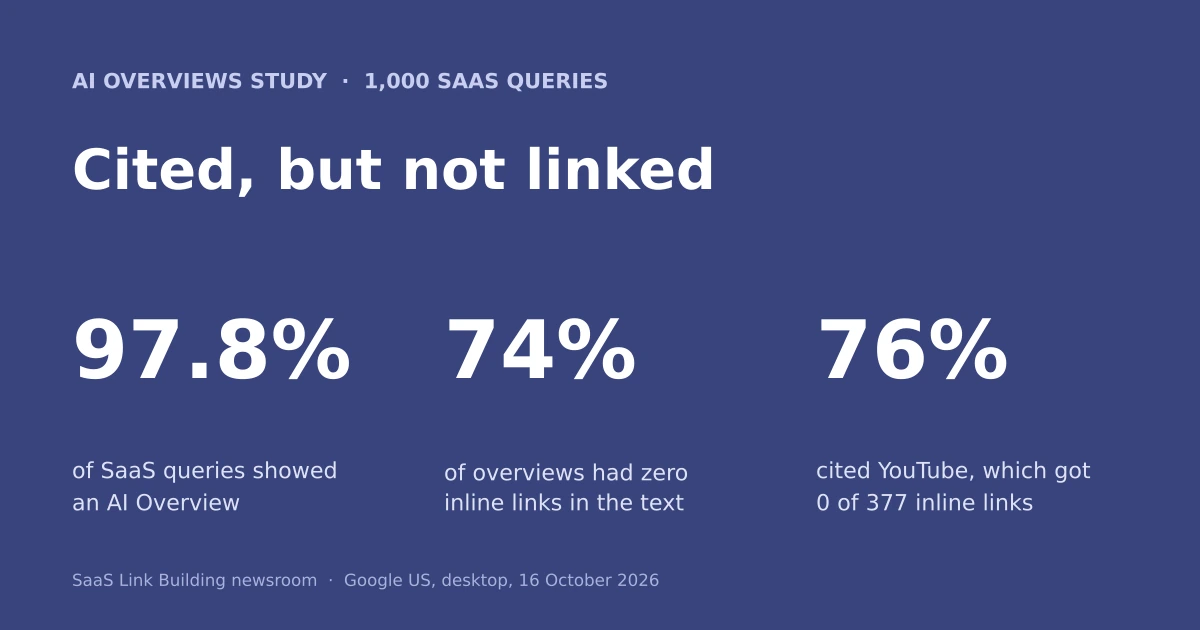
A SaaS Link Building newsroom analysis of 1,000 US Google searches across 40 software categories found an AI Overview on 978 of them. The typical answer cited 9 sources, but 74% of overviews carried no inline link, and YouTube was cited in 76% of answers without receiving a single inline link.
 Vibhu Dhariwal
Cofounder & CTO, Digital Gratified
- Published
- Updated
- Section
- Studies
- Reading time
- 8 minutes
Ras Al Khaimah, United Arab Emirates, .
Google showed an AI Overview on 978 of 1,000 SaaS searches (97.8%) that the SaaS Link Building newsroom ran in the United States on 16 October 2026. Across the 974 overviews we analysed, the typical answer listed 9 sources in its reference panel, but 719 of them (73.8%) carried no inline link at all in the answer text. In total the overviews cited 8,373 references and contained 377 inline links: roughly one inline link for every 22 cited sources.
The study ran the day after Google said it is adding more inline links to AI Overviews and AI Mode and placing them higher in responses, so the figures below serve as a baseline for tracking that change on software buying searches.
Note: this release replaces our earlier snapshot of 40 SEO and SaaS queries, which analysed 23 overviews and found a median of 1 inline link per answer. On a sample 25 times larger and focused on SaaS buying searches, the median is 0. The details are in the methodology section.
Key findings
- 978 of 1,000 SaaS queries (97.8%, 95% confidence interval 96.7% to 98.5%) returned an AI Overview, across 40 software categories from project management and CRM to payroll, ERP and endpoint security.
- The 974 overviews we analysed listed 8,373 references: a mean of 8.6 and a median of 9 per answer, drawn from 2,056 different domains.
- The same overviews contained only 377 inline links. The median was 0; 719 overviews (73.8%) had none, 155 had one, 84 had two and 16 had three or more.
- Searches for software lists such as "best crm software" or "top project management tools" were the least linked: 88.9% of those 387 overviews had no inline link.
- YouTube was cited in 744 overviews (76.4%) and supplied 22.2% of every reference in the study, yet it received none of the 377 inline links.
- Software review platforms made up 6.0% of references but received 17.0% of inline links, more than any other type of site.
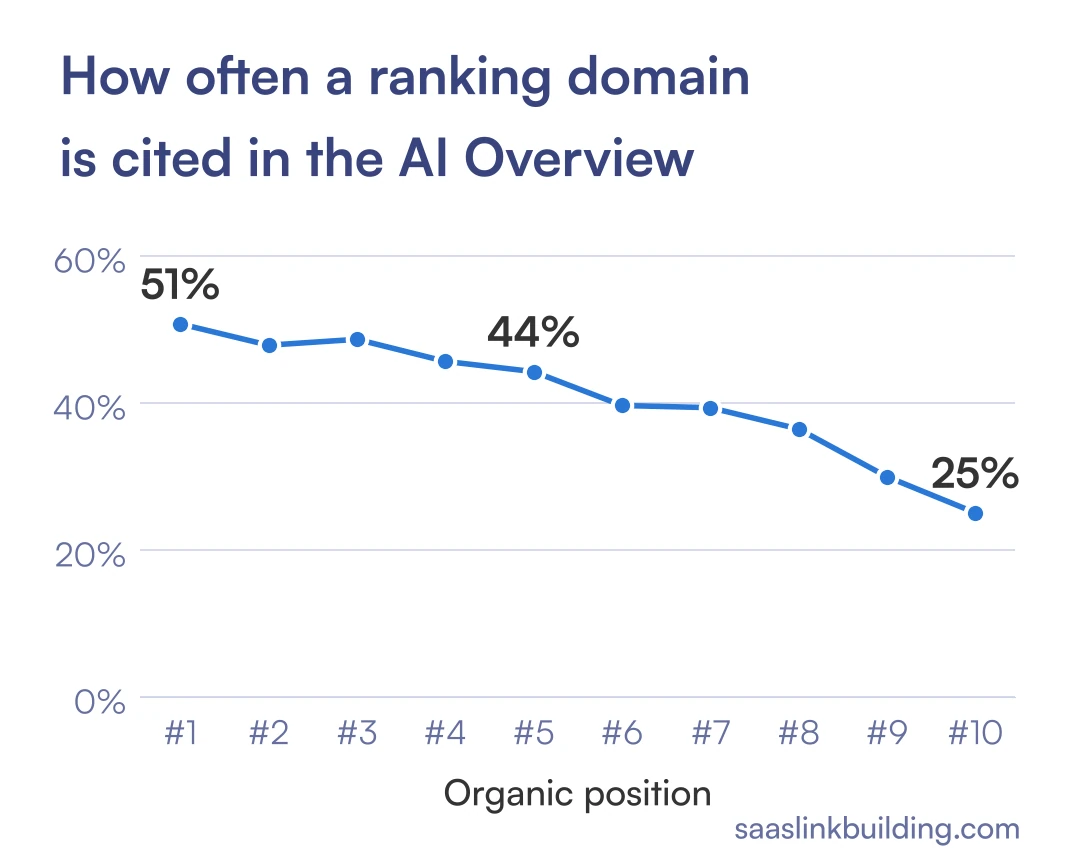
- The domain ranking first organically was cited in the overview for 50.7% of queries, falling to 25.0% for the domain in tenth place.
| Query type | Overview shown | No inline link | Cites YouTube |
|---|---|---|---|
| Best and top lists best crm software | 98% | 89% | 79% |
| Alternatives hubspot crm alternatives | 98% | 86% | 72% |
| What is, how to choose what is an hris | 95% | 72% | 76% |
| X vs Y comparisons zoom vs google meet | 100% | 70% | 79% |
| Pricing dropbox pricing | 95% | 49% | 36% |
| Brand reviews, how-tos asana review | 100% | 45% | 92% |
| All 1,000 queries | 98% | 74% | 76% |
Software list searches get the fewest inline links
The gap between query types is wide. When someone searched for a specific product, such as a review, a how-to or a pricing page, Google placed at least one inline link in roughly half of the answers. When someone searched for a category of software, the answer almost always listed its sources in the side panel only.
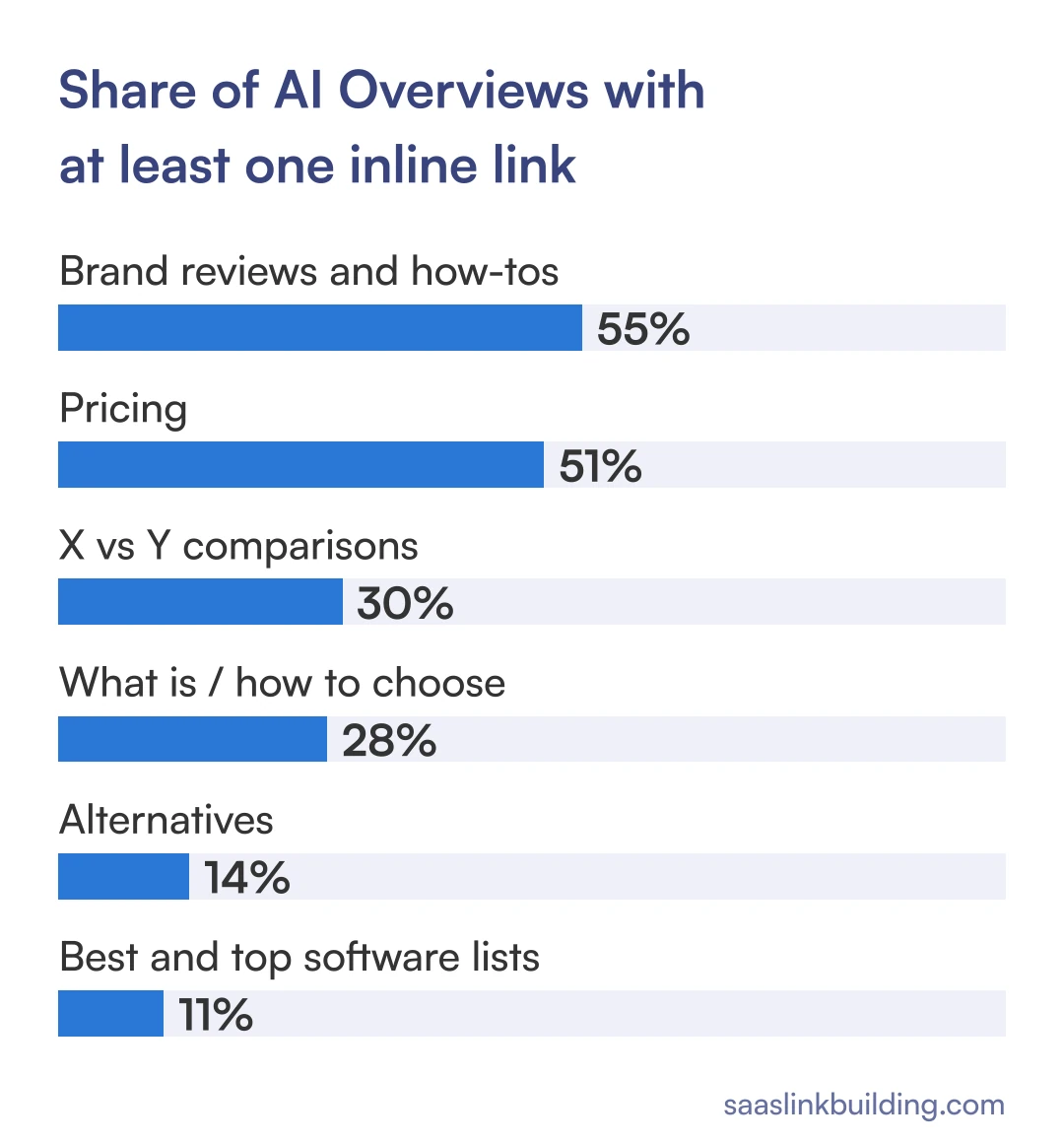
Alternatives searches behaved like category searches, with only 13.8% carrying an inline link. That matters for SaaS marketing teams because "best" and "alternatives" pages are where most vendors and affiliate publishers compete for visibility. On those queries, a citation in the source panel is usually the only placement available.
Software category made a smaller difference than query type. Team chat apps had the fewest inline links, at 0.12 per overview, while ERP software had the most, at 0.68. Overviews appeared on almost every query in every category; the 22 queries without one were scattered across 16 categories and were mostly long-tail variants such as "how to choose live chat software".
Cited is not the same as linked
The reference panel and the inline links drew on different sources. Video dominated the panel: YouTube appeared in more than three in four overviews and in 91.8% of brand review answers, usually as two or three clips. Reddit was the next most cited domain, in 36.3% of overviews and in about half of all alternatives answers.
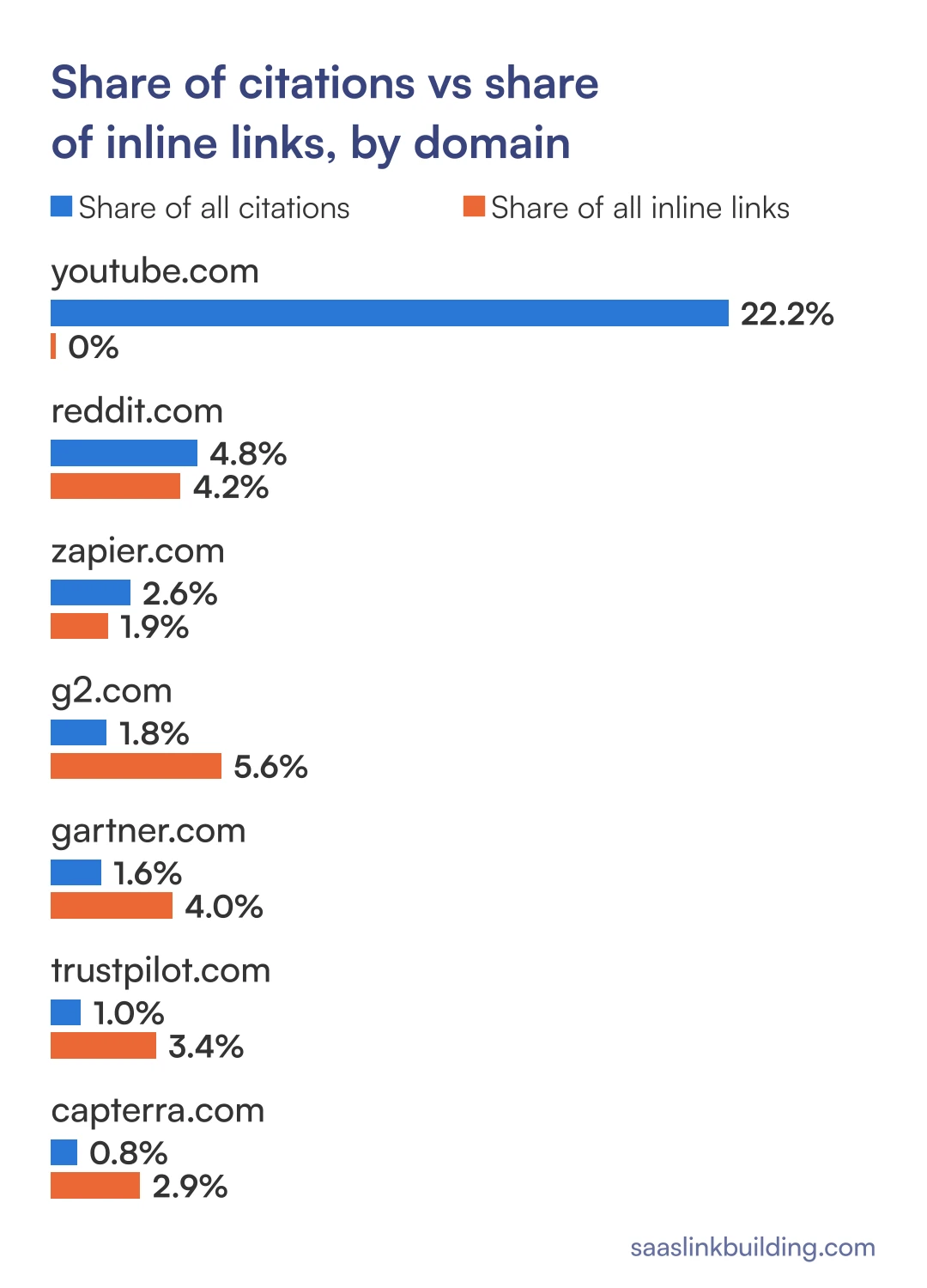
Inline links went elsewhere. G2 was the most linked domain, ahead of Reddit, Gartner, Trustpilot and Capterra, and review platforms as a group took 64 of the 377 inline links. When an inline link appeared, its domain was also in the reference panel 87.0% of the time, so the inline link is in most cases a promotion of a source Google had already chosen, not a separate pick.
Vendors are cited on their own brand searches less than half the time
On 445 comparison, alternatives, pricing and review queries that named a product, the product's own domain appeared in the reference panel for 41.3% and received an inline link for 24.0%. On the other queries, third parties such as review sites, video creators and comparison publishers described the product instead.
Organic rankings still feed the overview
For 50.7% of queries the domain ranked first in the organic results was also cited in the AI Overview, and the share fell steadily down the page to 25.0% at position ten. Overall, 47.9% of the domains cited in an overview also ranked in that query's top ten.
The other half of cited domains did not rank on page one for that query. YouTube accounted for 17.3% of those, more than any other domain, followed by G2, Zapier and Reddit. Inline links leaned more heavily on ranking pages: 70.0% pointed to a domain in the top ten.
What this means for SaaS marketing teams
- Measure citations and inline links separately. On this sample a citation was common and an inline link was rare. Reporting them as one number overstates how much traffic an AI Overview can send.
- Expect category and alternatives searches to send little direct traffic from the overview. Nearly nine in ten of those answers had no inline link, so visibility there comes mainly from the source panel and the organic results below it.
- Keep review profiles current. Review platforms punched above their citation share for inline links. Accurate listings, recent reviews and up-to-date pricing on those platforms shape how a product is described in the answer.
- Publish video for core product and comparison topics. YouTube was the most cited source by a wide margin. It earned no inline links, but it occupied a large share of the panel on brand searches.
- Keep organic ranking work in place. The top organic domain was cited about half the time, and the odds fell with every position.
- Track a fixed query set over time. Google has said inline links will increase and move higher in responses. Re-running the same list of category, comparison and brand queries is the simplest way to see whether that happens in your market.
Methodology
We built 1,000 queries from 40 SaaS categories, including project management, CRM, email marketing, accounting, payroll, HR software, help desk, video conferencing, website builders, ecommerce platforms, analytics, ERP, endpoint security and workflow automation, plus five general SaaS queries. Each category was searched with the same 25 templates covering six query types: best and top lists (398 queries), brand reviews and how-tos (160), comparisons (120), alternatives (120), what is and how to choose (122) and pricing (80). Product names in brand-led templates used well-known products in each category.
Each query was searched on Google in the United States, in English, on desktop and without a logged-in or personalised session, on 16 October 2026. For every query we recorded whether an AI Overview appeared and, where it did, its reference list, the links inside its answer text and the top ten organic results.
References are the entries in an overview's source panel. Inline links are hyperlinks inside the overview's answer text, including bulleted lists. Domains were grouped at the registrable domain level and counted once per overview when compared with organic results. Review platforms are G2, Capterra, TrustRadius, GetApp, Software Advice, Trustpilot and Gartner, and a vendor's own domain was identified by its brand name in the hostname. Per-overview figures cover 974 overviews, and comparisons with organic rankings cover 948 queries. Confidence intervals use the Wilson method.
Limitations: this is a single day of data from one country and one device type. Some product names are ambiguous, such as Drift, Guru and Greenhouse, and Google sometimes read them as something else. The query set was generated from templates rather than drawn from real search volumes, so it does not represent every SaaS search. AI Overview content varies between requests, and the earlier 40-query snapshot covered SEO topics as well as SaaS, so the two samples are not directly comparable. Results describe US desktop Google results for software queries, not all searches.
Conclusion
AI Overviews now sit on top of almost every SaaS search we tested, and they cite plenty of sources: nine in the typical answer. Inline links inside the answer are a different story. Three in four overviews had none, and on the "best software" and "alternatives" searches that drive much of SaaS discovery, nearly nine in ten had none.
Google says inline links are increasing and moving higher in responses. We will re-run this 1,000-query set to measure whether that holds for software searches.
Questions and answers
How many SaaS searches showed an AI Overview?
978 of the 1,000 SaaS queries we ran in Google US on 16 October 2026 (97.8%) showed an AI Overview. The 22 without one were spread across 16 software categories.
How many sources and inline links did a typical AI Overview include?
Across the 974 overviews we analysed, the median overview listed 9 references and contained 0 inline links. The totals were 8,373 references and 377 inline links, and 73.8% of overviews had no inline link at all.
Which SaaS searches were least likely to get an inline link?
Software list searches such as "best crm software": 88.9% of those overviews had no inline link. Alternatives searches were close behind at 86.2%. Brand review and pricing searches were the most likely to include one, at roughly half.
Which domain was cited most often?
YouTube. It appeared in 744 of the 974 overviews (76.4%) and supplied 22.2% of all references, but it received none of the 377 inline links.
Was the top organic result usually cited?
For 50.7% of queries, the domain ranked first was also cited in the AI Overview. The share fell to 25.0% for the domain ranked tenth.
How does this compare with your earlier 40-query snapshot?
The earlier snapshot of 40 SEO and SaaS queries analysed 23 overviews and found a median of 1 inline link. This study covers 1,000 SaaS-only queries and 974 overviews and finds a median of 0. The query sets differ, so the change reflects both the larger sample and the narrower SaaS focus.
More releases
-
Studies
Do Title Tag Keywords Still Rank? Only 27.5% of 262 Google Titles Held the Exact Query
Google says titles are a small ranking factor, but our pull of 262 US Google results for 30 queries found only 27.5% of title links held the exact query, and first place rarely had one. DOJ notes and leaked Google documents explain why titles still count.
-
Updates
Search Console AI Report Bug Hit Core Update Launch; 3 of 8 2026 Updates Overlapped
Google has logged an error that cut impressions in Search Console's Generative AI performance report for 9 to 11 November, the window in which the November 2026 core update began. Our timeline of Google's own records shows three of this year's eight ranking updates launched on a day with a logged data error.
-
Explainers
Bing's AI-Off Extension Just Adds noAI=1 to Searches; It Has 137 Chrome Users
Bing documented two ways to hide its AI answers on 11 November: a preview browser extension and a -ai query operator. Our read of the extension's code shows it appends a noAI=1 parameter, ships with AI off, and resets the default search engine and new tab to Bing. It has 137 Chrome users.
Tell us the site and the goals.
Rankings in Google and visibility in AI answers, from one monthly plan. One call is enough to say which one fits. Email works just as well.