Search Console AI Report Reportedly Gets Clicks; UK Rule on AI Metrics Starts in 3 Days
Google plans to add click data to Search Console's generative AI report in the coming weeks, Search Engine Roundtable reported on 29 November, citing an unnamed source. Google has not confirmed it. A UK rule requiring AI engagement metrics takes effect on 3 December, and none of 177 AI Overview links we pulled carried a referral marker.
 Vibhu Dhariwal
Cofounder & CTO, Digital Gratified
- Published
- Section
- Industry news
- Reading time
- 8 minutes
Ras Al Khaimah, United Arab Emirates, .
Google is preparing to add click data to the generative AI performance report in Search Console "in the coming weeks", Search Engine Roundtable reported on 29 November, citing an unnamed source. Google has not confirmed the change. The timing matters because a UK competition rule that obliges Google to give publishers "clear and detailed metrics on user engagement" with their content in AI Overviews and AI Mode comes into force on 3 December 2026, three days from now. We re-checked Google's documentation and the regulator's papers against what site owners can measure today, and pulled 17 UK searches to see whether an AI Overview click can be told apart from any other Google visit.
What changed
- The report: according to Search Engine Roundtable's Barry Schwartz, a source said clicks are coming to the generative AI report, probably rolling out gradually and possibly to a small group of Search Console users first. The mock-up published with the story is not a real screenshot. Google has made no statement.
- The report today: Google's help page for the Search version of the report still describes impressions only, grouped by page, country, date and device. The words "click" and "CTR" appear zero times in its main text.
- The UK deadline: the Competition and Markets Authority's Publisher Conduct Requirement notice, dated 3 June 2026, says the requirement comes into force six months after that date. Paragraph 7 covers engagement metrics.
The checklist Google has been working through
When we first reported the 3 December deadline on 2 November, Google analyst Gary Illyes had just said the team had nothing to announce on extra data, and John Mueller replied on Bluesky that reading this as a no was "an odd way of reading Gary's comment." Since then Google has published several pages that line up with other parts of the CMA's rules. On 24 November its Search Central changelog added a page on controlling how content is used for generative AI and a page on attribution and factuality in Search generative AI features. The same day it added a ranking section whose page on ranking notices names the CMA's fair ranking conduct requirement directly.
Set against the publisher requirement's paragraphs, the engagement metrics are the piece still missing in public. The mapping below is our reading of the documents; Google has not described its new pages as CMA compliance, apart from the ranking notice page.
| CMA Publisher Conduct Requirement | What it asks of Google | Public Google material we found |
|---|---|---|
| Paras 3 and 4 | Controls to withhold content from generative AI, with page-level grounding controls by 3 March 2027 | New page on controlling how content is used for generative AI (24 November) |
| Para 6 | Explain how content is used and what the controls do | New generative AI controls page (24 November) |
| Para 7 | Clear and detailed engagement metrics | Impressions-only report; clicks reported as coming, unconfirmed |
| Para 8 | Clear attribution, and explain how factuality is ensured and measured | Attribution and factuality page (24 November) |
| Final decision, para 3.39 | Referral information showing whether a visit came from an AI feature | None found; referrer documentation lists no AI-specific value |
Clicks alone would not meet the CMA's full expectation
The notice does not list metrics, but the CMA's final decision does. At consultation the regulator specified impressions, clicks and click-through rate for content in AI features, separated from Search as a whole (paragraph 3.29), and after hearing from Google it made no changes to that level of information (paragraph 3.34). It then added a separate expectation: referral information showing whether a specific visit came from a generative AI feature or another part of search, so publishers can judge click quality in their own analytics (paragraph 3.39).
That second item is where today's setup falls short. Google's referrer documentation, published on 12 November and covered in our report on Google's referer values, lists one set of values for Google Search on the web and in the Google app, and none for AI Overviews or AI Mode. To test the links themselves, we ran 17 informational searches on google.co.uk with a London location and pulled every source link the AI Overviews returned.
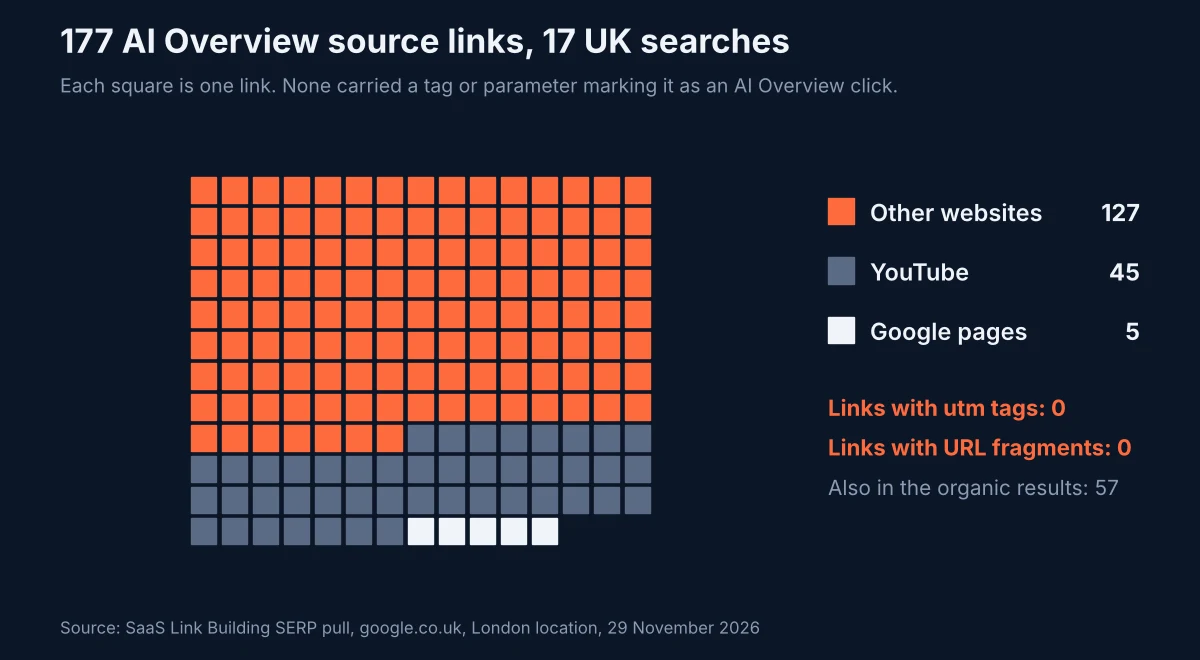
All 17 searches showed an AI Overview, with 177 source links between them. None carried a utm tag or a URL fragment. The 36 links that had any query string at all were YouTube video IDs and timestamps, Google Shopping parameters or language settings. 57 of the 177 links also appeared in the organic results on the same page, so a visit to those pages could have come from either spot with no way to tell from the URL. Combined with Google's single referrer value, a site's own analytics currently cannot separate an AI Overview visit from an ordinary organic one, which is exactly the gap paragraph 3.39 describes. We could not see whether Google wraps these links in its own redirect at click time, which is outside what this data shows.
How the other AI platforms report
Neither of Google's main rivals offers a like-for-like view. Bing's AI Performance report, opened in public preview on 10 February, reports citations, average cited pages, grounding queries and page-level citations, and a 16 June update added intents, topics, citation share and period comparison. Neither announcement mentions clicks. OpenAI's Business Hub, launched as a beta on 10 November, shows 28 days of mentions and website clicks for claimed businesses, VentureBeat reported. We covered how that ChatGPT click count depends on OAI-SearchBot access.
| Platform | Visibility metric | Clicks | Query detail |
|---|---|---|---|
| Google Search Console, generative AI report | Impressions | Not documented; reported as coming | None |
| Bing Webmaster Tools, AI Performance | Citations, cited pages, citation share | Not mentioned in launch posts | Sample of grounding queries |
| ChatGPT Business Hub (beta) | Mentions | Website clicks, past 28 days | Recurring topics |
Sources: Google Search Console Help; Bing Webmaster blog posts of 10 February and 16 June 2026; VentureBeat, 10 November 2026.
Context
Google launched the report on 3 June, the same date as the CMA notice, with impressions, pages, countries, devices and dates, and said in its launch post that it would keep working on data such as "adding additional metrics over time." The report reached all sites worldwide on 31 August. The CMA's compliance reporting notice sets the first reporting period as 3 June to 3 December 2026, with Google's report due by 3 January 2027. The requirement covers AI outputs shown to people in the UK, so it is possible, though speculation on our part, that any new metric appears first or only for UK traffic.
The report has also had reliability problems: a bug hit it during the November core update launch, as we covered in our report on the generative AI report bug.
What SEO teams should do
- Export impressions now. Save page and country data from the generative AI report for the last three months so any new click column can be compared with a clean baseline.
- Check the UK filter first. If clicks arrive for UK users only, sites with UK audiences will see them earliest.
- Do not expect analytics to split the traffic. Until Google adds a referral marker, AI Overview and AI Mode visits will look like ordinary Google organic visits in GA4 and server logs.
- Compare across platforms with care. Google impressions, Bing citations and ChatGPT mentions count different things, so track each against its own history rather than against each other.
- Watch 3 January. Google's first compliance report to the CMA must say which metrics it offers publishers, and the CMA expects to publish a summary.
Methodology
On 29 November 2026 (UTC) we ran 17 English-language informational searches on google.co.uk with a London, United Kingdom location through a SERP API and collected every source link listed in each AI Overview, plus the organic results. We parsed each URL for utm parameters, other query strings and fragments, grouped destinations by host, and matched AI Overview links against organic links on the same page after removing trailing slashes. The same day we downloaded the CMA notice, final decision and compliance reporting notice from GOV.UK, and fetched Google's help page, launch post, referrer documentation and the 24 November documentation pages, counting whole-word mentions of "click" and "CTR" in each page's main text. The sample is small and covers one location and one moment; it shows how links are built, not how often people click them.
Conclusion
A single anonymous report is not a launch, and Google has not said how it will meet the UK rule. But the pattern of the past week is clear: Google has published pages that track the CMA's controls, attribution and ranking notice duties, and engagement metrics are the visible gap three days before the deadline.
Clicks in Search Console would close part of that gap. The other part, a way for publishers to recognise AI feature visits in their own analytics, is not addressed by anything reported so far, and our 177-link sample shows why it matters.
Questions and answers
Has Google confirmed click data for the Search Console generative AI report?
No. Search Engine Roundtable reported on 29 November 2026, citing an unnamed source, that clicks will be added in the coming weeks. Google has made no statement, and its help page for the report still describes impressions only.
What does the generative AI performance report show today?
Impressions from AI Overviews and AI Mode, grouped by page, country, date and device, with a filter for text-based or multimodal searches. Google rolled the report out to all websites worldwide on 31 August 2026.
What does the UK rule require from Google?
Paragraph 7 of the CMA's Publisher Conduct Requirement requires clear and detailed metrics on user engagement with publisher content in search generative AI features. The CMA's final decision expects impressions, clicks and click-through rate, plus referral information showing whether a visit came from an AI feature. The requirement comes into force on 3 December 2026 for AI outputs shown to people in the UK.
Can I identify AI Overview visits in my own analytics?
Not reliably today. Google's referrer documentation lists no separate value for AI Overviews or AI Mode, and none of the 177 AI Overview source links in our 29 November pull of 17 UK searches carried a utm tag or URL fragment.
When will Google report to the CMA on compliance?
Google's first compliance report covers 3 June to 3 December 2026 and is due by 3 January 2027, according to the CMA's compliance reporting notice.
More releases
-
Studies
Google Wants Separate Cyber Monday Pages; 24 of 30 Top Retailers Rank One First
Google has advised dedicated Black Friday and Cyber Monday pages since 2020. Searching 30 US retailers on 29 November, we found 24 ranking a year-free Cyber Monday or Cyber Week page first. Kohl's, JCPenney and Dell, missing for Black Friday, now lead their results, while Old Navy has no result of its own.
-
Explainers
Google Says Wait a Week to Judge Core Updates; Thanksgiving Swung Demand by Up to 156%
Google says site owners should judge a core update by comparing the week after it ends with the week before it began. For the November 2026 update, that later week holds Thanksgiving, Black Friday and Cyber Monday. In our Google Trends pull, interest in eight common searches moved by between -37% and +156% across the two windows.
-
Studies
Do Shorter URLs Rank Higher on Google? They Won 512 of 1,051 Head-to-Heads in Our Test
Google has long said URL length is not a ranking factor, and a test of 40 live Google searches backs it. Across 306 page-one results, the shorter URL ranked higher in 512 of 1,051 head-to-head comparisons and the longer URL in 519, a result no better than chance.
Tell us the site and the goals.
Rankings in Google and visibility in AI answers, from one monthly plan. One call is enough to say which one fits. Email works just as well.