Google Says Wait a Week to Judge Core Updates; Thanksgiving Swung Demand by Up to 156%
Google says site owners should judge a core update by comparing the week after it ends with the week before it began. For the November 2026 update, that later week holds Thanksgiving, Black Friday and Cyber Monday. In our Google Trends pull, interest in eight common searches moved by between -37% and +156% across the two windows.
 Vibhu Dhariwal
Cofounder & CTO, Digital Gratified
- Published
- Section
- Explainers
- Reading time
- 8 minutes
Ras Al Khaimah, United Arab Emirates, .
Google's November 2026 core update finished rolling out at 14:03 UTC on 24 November, according to the Search Status Dashboard. Google's core updates guide tells site owners to wait at least a full week after completion, then compare that week with the week before the rollout began. For this update, that means 25 November to 1 December against 3 to 9 November. The catch: the later window contains Thanksgiving, Black Friday and Cyber Monday.
To show how much that matters, we pulled daily US Google Trends data on 29 November for eight common searches across retail, food, travel, software, health and finance. Between the same four weekdays in each window, search interest moved by anything from a 37% fall to a 156% rise, before any ranking change is counted.
What Google tells you to do
The core updates guide sets out three steps for anyone who suspects a core update moved their traffic:
- Confirm the rollout has finished on the Search Status Dashboard and note its start and end dates.
- Compare the right dates. Wait at least a full week after completion, then compare that week with a week before the rollout started.
- Judge the size of the move. Google calls a fall from position 2 to 4 small and says no drastic action is needed; a fall from position 4 to 29 calls for a deeper assessment of the whole site.
Google's new ranking updates notice page, added on 24 November, repeats the timing: wait until an update is marked complete, plus at least a week of post-rollout data, before evaluating traffic changes in Search Console. Its traffic drop debugging guide adds that seasonality can move traffic on its own and suggests checking affected queries in Google Trends.
The dates that apply to the November update
| Window | Dates (2026) | What falls inside it |
|---|---|---|
| Pre-update week | Tue 3 Nov to Mon 9 Nov | No dashboard-listed ranking update; the September spam update ended on 8 October |
| Rollout | Tue 10 Nov to Tue 24 Nov | November core update, 13.8 days |
| Post-rollout week | Wed 25 Nov to Tue 1 Dec | Thanksgiving (26 Nov), Black Friday (27 Nov), Cyber Monday (30 Nov) |
| Next update | "December 2026" | December core update, preannounced 59 minutes after the November rollout ended; no start date given |
Two practical limits follow. First, the post-rollout week is not finished until 1 December, and Search Console reports with a lag: in this newsroom's own Search Console property, the latest day available on 29 November was 27 November. A complete seven-day comparison will realistically be possible from around 3 December. Second, Google has said only that the December core update is scheduled for December. If it starts on 1 December, the final day of the clean window overlaps the next rollout. We covered the December core update preannouncement when it appeared on the dashboard.
How much demand moved between the two weeks
We compared Wednesday to Saturday in each window (4 to 7 November against 25 to 28 November), the latest four days available, so that each day of the week appears once on both sides.
| Search term | Change, Wed to Sat totals | Thursday vs Thursday | Friday vs Friday |
|---|---|---|---|
| recipe | +155.9% | +376% | +36% |
| tv | +55.3% | +72% | +92% |
| laptop | +32.3% | +8% | +52% |
| flights | 0.0% | -16% | 0% |
| hotels | -4.7% | -22% | -12% |
| crm software | -10.5% | -16% | +1% |
| symptoms | -12.3% | -26% | -17% |
| mortgage rates | -37.0% | -49% | -42% |
Three of the eight terms gained interest, one was flat and four lost it. None of that reflects a ranking change. A page holding the same position for "tv" all month would show more impressions in the post-rollout week; a page holding steady for "mortgage rates" would show fewer. Single days swing harder: interest in "recipe" on Thanksgiving was almost five times the level of the Thursday in the pre-update week, then dropped back to its pre-update range the next day.
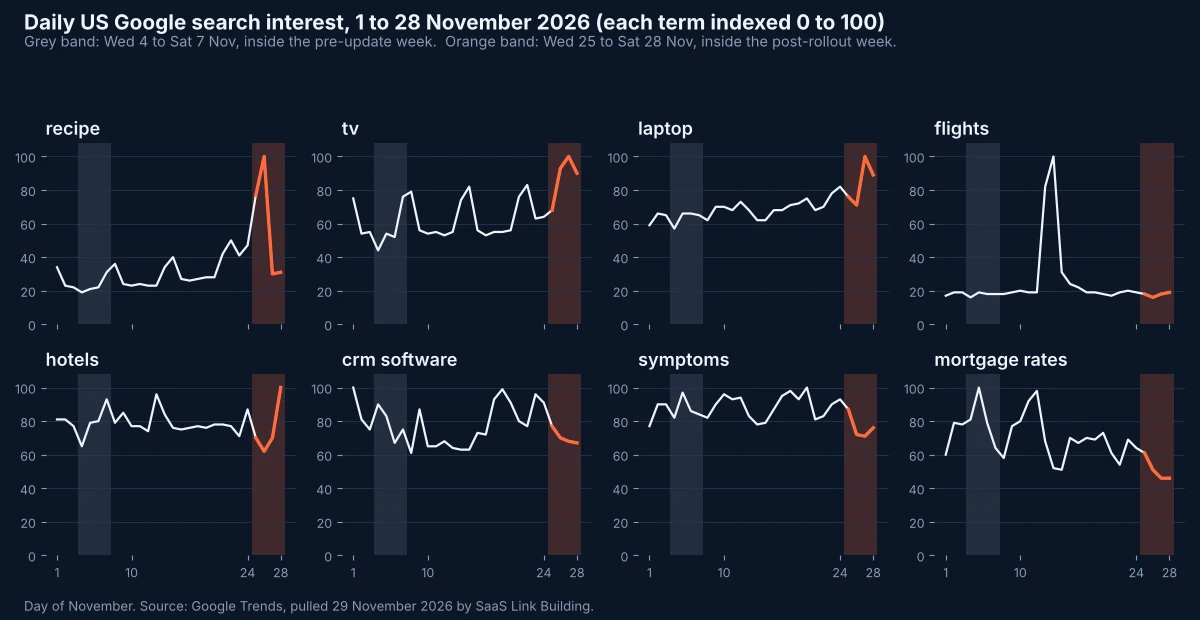
The chart also shows a hazard inside the rollout itself. Interest in "flights" jumped more than fourfold on 13 and 14 November, mid-rollout, then settled back. Comparing mid-rollout days against the week before could turn a demand spike into an apparent ranking gain. Our day 12 SERP churn study measured ranking movement directly, which avoids that problem but cannot tell you what happened to your own traffic.
How often Google leaves a clean week
Google's one-week rule assumes no other ranking update lands in the meantime. We checked every ranking entry in the dashboard's incident feed, which currently runs from December 2025.
| Update | Completed | Next ranking update began | Days between | Full week clear? |
|---|---|---|---|---|
| December 2025 core | 29 Dec 2025 | 5 Feb 2026 (Discover core) | 37.9 | Yes |
| February 2026 Discover core | 27 Feb | 24 Mar (spam) | 25.4 | Yes |
| March 2026 spam | 25 Mar | 27 Mar (core) | 1.8 | No |
| March 2026 core | 8 Apr | 21 May (core) | 43.1 | Yes |
| May 2026 core | 2 Jun | 24 Jun (spam) | 22.1 | Yes |
| June 2026 spam | 26 Jun | 18 Aug (spam) | 53.0 | Yes |
| August 2026 spam | 21 Aug | 24 Sep (spam) | 34.3 | Yes |
| September 2026 spam | 8 Oct | 10 Nov (core) | 33.4 | Yes |
| November 2026 core | 24 Nov | December core, date not given | At least 6.4 | Depends on start |
Seven of the eight completed updates with a known successor were followed by at least a week with no new ranking rollout. The exception shows the opposite risk: the March 2026 core update's pre-update week (20 to 26 March) contained the whole March spam update, so a site comparing against that week was comparing against a baseline that had already shifted. The November update is the first in the feed to be followed by a preannouncement rather than a quiet period, and Google has not said whether the December rollout will wait until the November data has settled. Our look at holiday-season update timing found that Google has run updates through peak shopping weeks before.
What to do: a worked method for this update
- Lock the dates now. Pre-update week: 3 to 9 November. Post-rollout week: 25 November to 1 December. Pull the data on or after 3 December, once the last day is in.
- Read position before clicks. Average position does not scale with search volume the way clicks and impressions do, though a shift in which queries you appear for can still move it. Apply Google's own thresholds: a slide from 2 to 4 is small; a fall from the top 10 to around 29 is large.
- Adjust volume for demand. For your top queries, pull Google Trends for both windows and divide your impression change by the demand change. Illustration: if a "mortgage rates" page went from 10,000 to 6,500 impressions while interest fell 37%, demand alone would predict about 6,300, so the page held its ground.
- Add a year-over-year check shifted by 364 days. A 364-day offset keeps weekdays aligned, and Thanksgiving fell on 27 November 2025, exactly 364 days before this year's. Compare 25 November to 1 December 2026 with 26 November to 2 December 2025 through the Search Console API or an export, then check that year's window against the dashboard for other updates.
- Split by search type and page group. Google's guide says to check Web, Images, Video and News separately. In our sample, the retail and food terms carried most of the holiday swing, so pages built around them need the most adjustment.
- Record the December start time. If the December core update begins before 2 December, note the overlap in your report and treat the last day of the window as mixed.
Methodology
Search interest: we pulled daily Google Trends interest for the United States, all categories, web search, on 29 November 2026 through a SERP API, one term per request so each series is indexed 0 to 100 within its own date range. Seven terms used 1 to 28 November 2026; "laptop" was pulled for 27 October to 28 November, so its index has a different scale, which does not affect its percentage changes. We summed the daily values for Wednesday 4 to Saturday 7 November and Wednesday 25 to Saturday 28 November and calculated the percentage change, plus single-day changes for the matching Thursdays (5 and 26 November) and Fridays (6 and 27 November). The eight terms are illustrations across six sectors, not a representative sample. Update timing: we downloaded Google's Search Status Dashboard incident feed on 29 November 2026, kept the 10 entries listed under Ranking, and measured the time from each completion to the next ranking update's start. Search Console lag: we requested daily data for this site's own property on 29 November 2026 and recorded the latest date returned.
Conclusion
Google's advice for judging a core update is simple: wait a week after it ends, then compare with the week before it began. For the November 2026 update, that recipe pits a quiet early-November week against Thanksgiving, Black Friday and Cyber Monday, when demand for common searches moved by as much as 156% in our sample with no ranking change at all.
Read positions first, adjust clicks and impressions for demand, and add a weekday-aligned year-over-year check. With the December core update announced but undated, pull the data as soon as the window closes.
Questions and answers
When can I evaluate the November 2026 core update in Search Console?
The rollout finished on 24 November 2026, according to Google's Search Status Dashboard. Google advises waiting at least a full week after completion, so the post-rollout week runs from 25 November to 1 December, compared with 3 to 9 November. Because Search Console data arrives with a short delay, the full comparison is realistically available from around 3 December.
Why does Thanksgiving affect core update analysis?
Google's recommended post-rollout week for the November 2026 update includes Thanksgiving (26 November), Black Friday and Cyber Monday. In our Google Trends pull, interest in eight common searches changed by between -37% and +156% between matching weekdays in the two windows, with no ranking change involved.
Has the December 2026 core update started?
No start has been posted. Google preannounced the December 2026 core update on the Search Status Dashboard on 24 November 2026 and said only that it is scheduled for December 2026.
How do I separate a ranking change from seasonal demand?
Start with average position, which does not scale with search volume the way clicks and impressions do. Then compare impression changes with Google Trends interest for the same queries, which Google's traffic drop debugging guide recommends, and add a year-over-year comparison shifted by 364 days so weekdays and Thanksgiving line up.
More releases
-
Industry news
Search Console AI Report Reportedly Gets Clicks; UK Rule on AI Metrics Starts in 3 Days
Google plans to add click data to Search Console's generative AI report in the coming weeks, Search Engine Roundtable reported on 29 November, citing an unnamed source. Google has not confirmed it. A UK rule requiring AI engagement metrics takes effect on 3 December, and none of 177 AI Overview links we pulled carried a referral marker.
-
Studies
Google Wants Separate Cyber Monday Pages; 24 of 30 Top Retailers Rank One First
Google has advised dedicated Black Friday and Cyber Monday pages since 2020. Searching 30 US retailers on 29 November, we found 24 ranking a year-free Cyber Monday or Cyber Week page first. Kohl's, JCPenney and Dell, missing for Black Friday, now lead their results, while Old Navy has no result of its own.
-
Studies
Do Shorter URLs Rank Higher on Google? They Won 512 of 1,051 Head-to-Heads in Our Test
Google has long said URL length is not a ranking factor, and a test of 40 live Google searches backs it. Across 306 page-one results, the shorter URL ranked higher in 512 of 1,051 head-to-head comparisons and the longer URL in 519, a result no better than chance.
Tell us the site and the goals.
Rankings in Google and visibility in AI answers, from one monthly plan. One call is enough to say which one fits. Email works just as well.