Do Shorter URLs Rank Higher on Google? They Won 512 of 1,051 Head-to-Heads in Our Test
Google has long said URL length is not a ranking factor, and a test of 40 live Google searches backs it. Across 306 page-one results, the shorter URL ranked higher in 512 of 1,051 head-to-head comparisons and the longer URL in 519, a result no better than chance.
 Vibhu Dhariwal
Cofounder & CTO, Digital Gratified
- Published
- Section
- Studies
- Reading time
- 13 minutes
Ras Al Khaimah, United Arab Emirates, .
Short URLs are one of the most repeated pieces of SEO advice. Checklists repeat it, content teams trim slugs before launch, and some site owners rewrite live URLs in the hope of a ranking lift. Google has said for years that URL length is not a ranking factor. To test who is right, we pulled 40 live Google searches on 29 November 2026, measured all 306 organic URLs on page one, and compared every pair of results that shared a SERP.
The short answer: in our sample, the shorter URL ranked above the longer one in 512 of 1,051 head-to-head comparisons, while the longer URL won 519 and 20 were ties. That is a coin flip. Below we set out the theory, the best evidence for it, the evidence against it, and our verdict.
The theory: shorter URLs rank higher
The idea has three roots. The first is a widely cited correlation study of 11.8 million Google results, first published in 2016, which reported "a very slight correlation between URL length and rankings". It found that URLs in position 1 were on average 9.2 characters shorter than URLs in position 10, and that the average page-one URL was 66 characters long. The study itself notes that it measures correlation, not cause, but the finding has been repeated in checklists ever since.
The second root is Google's own advice. Its URL structure documentation tells site owners to use simple, descriptive words and to shorten URLs by trimming parameters that do not change the content. Its SEO starter guide recommends descriptive URLs because parts of the URL can appear as breadcrumbs in results. Read quickly, both pages sound like ranking advice.
The third root is a real mechanism that looks like a ranking effect from the outside. When Google has two URLs with the same content, it has to pick one to show. Google's John Mueller has said more than once that, all else being equal, Google leans towards the shorter one. An SEO who shortens a URL and sees the new version appear in results can easily read that as a ranking win.
Closely related is the belief that keywords in the URL help a page rank. We covered Google's latest statements on that in our explainer on URL keywords, hyphens and emoji, and we test it again below because short-URL advice and keyword-slug advice usually travel together.
Evidence for the theory
The 2016 correlation
The strongest public evidence remains the 2016 study. A 9.2-character gap between positions 1 and 10 across millions of results is not nothing. Its weakness is that it is a raw correlation: the URLs that rank first for many queries are homepages and short category pages from large brands, and those pages win for reasons that have nothing to do with how many characters sit in the address bar.
A small gap in our own averages
Our data shows a faint version of the same pattern if you look only at averages by position. Position 1 URLs averaged 66.3 characters, while URLs in positions 7 to 9 averaged 70.4 characters, a gap of about 4 characters. Position 1 also had a median of 63 characters against 66 for all 306 results.
Google's canonicalization preference
Mueller has described a real preference for shorter URLs on the record, but only when Google is choosing between duplicates. In a Google hangout covered by Search Engine Roundtable in January 2016, he said that if Google sees two URLs with the same content and everything else is equal, it will try to pick the shorter one, and stressed that this does not make length a ranking factor. In September 2021 he wrote on Twitter (now X) that "we use URL length very lightly for canonicalization", adding that this can make shorter URLs look better for SEO when it is really a side effect. That statement was also reported by Search Engine Roundtable.
For sites with duplicate or parameter-heavy URLs, that preference matters: the clean version is more likely to be the one Google shows. It does not mean a short URL beats a longer URL on a different site.
Keyword coverage, weakly
Across all 40 searches, a URL containing every meaningful word of the query ranked above a URL that did not in 191 pairs, and below it in 162. That is a 54.1% win rate for the keyword-complete URL, a small edge in a sample this size. Google's own guidance acknowledges a minimal role here (see below), so this is the one place where the data leans slightly towards the folk wisdom.
Evidence against the theory
Google's statements
Google has been consistent. In February 2020 Mueller wrote on Twitter (now X) that URL length is not a ranking factor, as reported by Search Engine Roundtable. Google's SEO starter guide goes further on the keyword question: from a ranking perspective, it says, keywords in a domain name or URL path alone have "hardly any effect beyond appearing in breadcrumbs". In October 2026 Google's Search Central channel published a video on what can go in a URL that includes a chapter on whether keywords in a URL help ranking.
Google's URL structure page frames its advice about shorter URLs around crawling: unnecessary parameters create many URLs for the same content, which wastes crawling. That is a crawl efficiency argument, not a ranking one.
Our head-to-head test
Averages by position hide what happens inside each SERP. The fairer test is to compare results that compete for the same query. For every one of the 40 searches we compared each pair of organic results and asked a simple question: did the shorter URL rank higher?
| Test (40 SERPs, 306 URLs) | Result | What a length effect would predict |
|---|---|---|
| Pairs where the shorter URL ranked higher | 512 of 1,051 (48.7%) | Clearly above half |
| Pairs where the longer URL ranked higher | 519 of 1,051 (49.4%) | Clearly below half |
| Pairs with identical length | 20 of 1,051 | n/a |
| No. 1 result shorter than its SERP's median URL | 19 of 40 | Most of the 40 |
| SERPs where longer URLs tended to rank lower | 15 of 40 | Most of the 40 |
| SERPs where longer URLs tended to rank higher | 23 of 40 | Few |
| Median rank correlation per SERP | -0.10 | Clearly positive |
| URLs over 100 characters in the top 3 | 11 of 24 | Few |
Every head-to-head measure points the same way. The shorter URL won about as often as it lost. The No. 1 result was shorter than the typical URL on its own page in 19 of the 40 searches, slightly under half. In 23 of the 40 SERPs the rank correlation actually ran the other way, with longer URLs a little more likely to rank higher. Of the 24 URLs longer than 100 characters, 11 were in the top 3 and 3 were at No. 1.
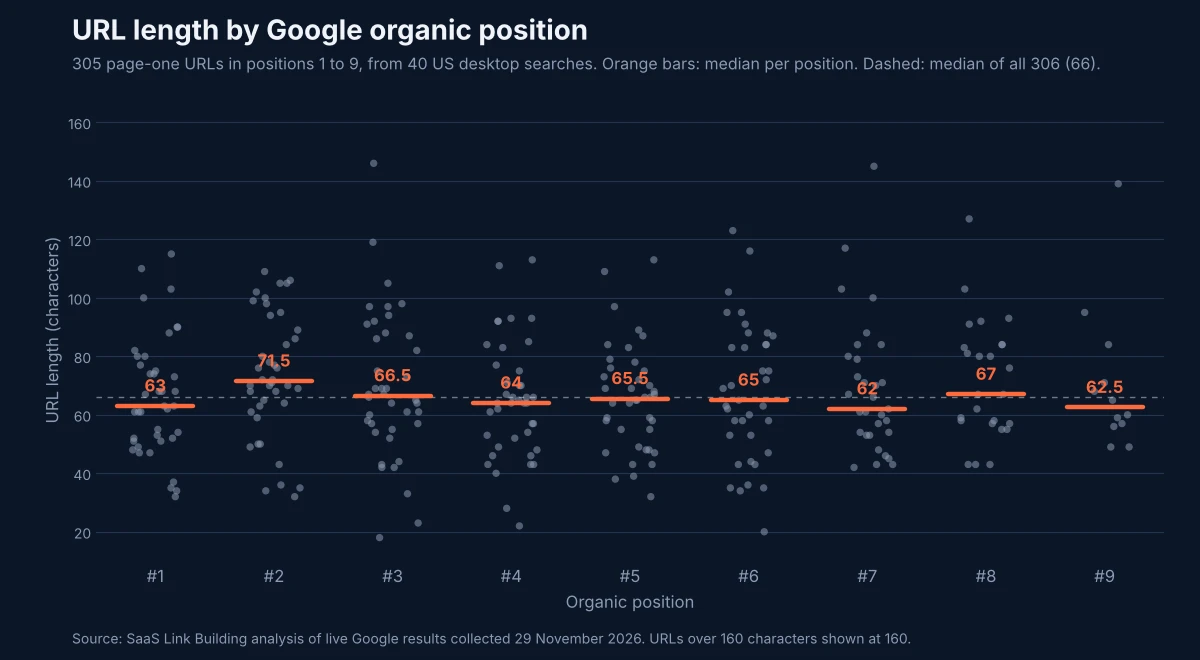
The chart makes the point visually. If short URLs had a ranking advantage, the orange medians would climb from left to right. Instead they bounce between 62 and 71.5 characters, and the longest median sits at position 2.
Query type changes the picture, not length
Splitting the sample by query type shows that URL patterns follow the kind of page Google wants, not a length preference.
| Query type (10 searches each) | Median URL length, top 3 | Median URL length, positions 4+ | Top 3 with all query words in URL | Positions 4+ with all query words in URL |
|---|---|---|---|---|
| How-to ("how to fix a leaky faucet") | 70.0 | 73.0 | 30% (9 of 30) | 31% (11 of 36) |
| Definition ("what is a roth ira") | 68.5 | 58.0 | 90% (27 of 30) | 83% (34 of 41) |
| Product reviews ("best electric toothbrush") | 68.5 | 63.0 | 67% (20 of 30) | 62% (33 of 53) |
| Software ("help desk software") | 62.5 | 66.0 | 30% (9 of 30) | 34% (19 of 56) |
For definition and product review queries, the top 3 URLs were longer at the median than the URLs below them. Only for how-to and software queries were the top 3 a little shorter, by 3.0 and 3.5 characters. Definition pages almost always carried the term in their URL (a page about compound interest tends to be called something like /compound-interest), which tells us more about how publishers name pages than about how Google ranks them. For software searches, where vendor homepages and product pages compete, under a third of top-3 URLs contained every query word.
Homepages, the shortest URLs of all, were rare. Only 5 of the 306 results were bare homepages, and all 5 came from software searches, where a vendor's homepage is the product page. One of them ranked No. 1. That pattern helps explain where raw correlation studies get their gap: a query set rich in navigational or vendor searches will put short homepages near the top.
An exact-match slug did not help
We also checked whether the URL contained the full query as a hyphenated phrase, for example /what-is-a-heat-pump. That was true for 23 of the 120 top-3 results (19%) and 49 of the 186 results in positions 4 and below (26%). If anything, the exact-match slug was more common lower down the page. This lines up with what we found when we tested exact-match keywords in title tags: matching the query word for word is uncommon and does not separate winners from the rest.
What we cannot rule out
Speculation, clearly labelled: a small length effect could exist and still be invisible in 40 SERPs. A gap of a few characters per position would need a far larger sample to detect reliably, and our query set is US-only, desktop-only and English-only. It is also possible that very long, parameter-heavy URLs perform worse because they create duplicate versions, split signals or get crawled less, which would show up as an indirect effect. Our sample had too few such URLs to test that: after cleaning, only 17 of the 306 links still carried a query string at all.
We also removed one source of noise before measuring. A srsltid parameter appeared on 21 of the 306 result links. It is added by Merchant Center auto-tagging rather than written into the site's own URLs, so counting it would have made merchant URLs look far longer than the addresses their owners actually publish.
Verdict: debunked as a ranking factor
On the evidence available, the claim that shorter URLs rank higher is debunked as a direct ranking factor. Google has denied it on the record more than once. Its documentation ties shorter URLs to crawling efficiency and usability, not ranking. The best public evidence for the theory is a slight raw correlation from 2016, and in our 2026 head-to-head test the shorter URL won 48.7% of comparisons, no better than chance.
Two narrower points survive. First, URL length does matter in canonicalization: when Google picks between duplicate URLs, it leans very lightly towards the shorter one, by Mueller's own description. Second, a URL that contains the words of the query was slightly more likely to win a head-to-head in our data (54.1% of pairs). That fits our reading of Google's guidance that such keywords have hardly any effect rather than none, and it probably also reflects the fact that pages about a topic tend to be named after it. Neither is a reason to rewrite live URLs.
What this means for SEO teams
- Do not migrate URLs to make them shorter. Redirects carry real cost and risk, and our data shows no ranking reward for a shorter address. If a URL works, leave it.
- Fix duplicates, not length. Where the same content lives at several URLs (tracking parameters, filters, sort orders), choose one clean version and point canonicals, internal links and sitemaps at it. That is where Google's light length preference actually applies; our canonical tag investigation shows how often Google follows a declared canonical.
- Keep new URLs readable. Use a few descriptive words, hyphens between them and no unnecessary parameters, as Google's documentation recommends. Our study of 677 top sites found most already use hyphens.
- Treat audit warnings on URL length as housekeeping. A "URL too long" flag is a usability and shareability note, not a ranking problem. Prioritise it below content, internal linking and duplicate handling.
- Expect srsltid in your own data. If you run Merchant Center auto-tagging, srsltid may be appended to links to your pages. Do not count those as different URLs when you analyse rankings.
Methodology
On 29 November 2026 we collected live Google results through a SERP API for 40 queries, with location set to the United States, language English, desktop results and 10 results requested per query. The queries were split evenly across four types: how-to questions, definition questions, product review searches beginning with "best", and software category searches. We kept only standard organic results, excluding AI Overviews, video carousels, People Also Ask and other features. That produced 306 organic URLs across 40 SERPs (fewer than 10 per page where features took space) from 234 distinct hostnames.
URL length is the number of characters in the full URL, including protocol and hostname, after removing the srsltid auto-tagging parameter (present on 21 links). For each SERP we compared every pair of organic results (1,051 pairs) and recorded whether the higher-ranked result had the shorter URL, the longer URL or an identical length. We also calculated Spearman's rank correlation between position and URL length for each SERP. "All query words in URL" means every word of the query, except the stop words how, to, a, an, the, is, what, for, of, from, under, best, and and in, appears in the URL path (plurals and other forms that contain the word count). "Exact-match slug" means the full query, joined with hyphens, appears in the path. This is an observational study: it cannot prove cause, and a small effect could be hidden by the sample size.
Conclusion
Short URLs are tidy, easier to share and help Google pick a clean version of duplicate pages. In our test of 40 Google searches, they did not rank better: the shorter URL won 512 head-to-heads and lost 519, and the No. 1 result was shorter than its page's median in fewer than half the searches. Combined with Google's repeated on-record denials, the case for URL length as a ranking factor does not hold up.
What do you think?
Have you ever shortened URLs on a live site and tracked rankings before and after, with redirects in place? Share the number of URLs changed and what happened to their positions over the following months, so we can compare your results with ours.
Questions and answers
Is URL length a Google ranking factor?
Google says no. John Mueller stated in 2020 that URL length is not a ranking factor, and in our test of 40 Google searches the shorter URL ranked higher in 512 of 1,051 head-to-head comparisons, no better than chance.
Does Google prefer shorter URLs at all?
Only lightly, when choosing a canonical between duplicate URLs with the same content. Mueller has said Google uses URL length very lightly for canonicalization, which is a selection signal, not a ranking factor.
Do keywords in the URL help rankings?
Very little. Google's SEO starter guide says keywords in a domain or URL path alone have hardly any effect beyond appearing in breadcrumbs. In our data, URLs containing every query word ranked higher in 54.1% of head-to-heads.
Should I shorten existing URLs for SEO?
Our data gives no ranking reason to. Google's URL documentation recommends trimming unnecessary parameters to avoid duplicate URLs and wasted crawling, which is a reason to clean up parameters, not to rewrite and redirect working URLs.
More releases
-
Industry news
Search Console AI Report Reportedly Gets Clicks; UK Rule on AI Metrics Starts in 3 Days
Google plans to add click data to Search Console's generative AI report in the coming weeks, Search Engine Roundtable reported on 29 November, citing an unnamed source. Google has not confirmed it. A UK rule requiring AI engagement metrics takes effect on 3 December, and none of 177 AI Overview links we pulled carried a referral marker.
-
Studies
Google Wants Separate Cyber Monday Pages; 24 of 30 Top Retailers Rank One First
Google has advised dedicated Black Friday and Cyber Monday pages since 2020. Searching 30 US retailers on 29 November, we found 24 ranking a year-free Cyber Monday or Cyber Week page first. Kohl's, JCPenney and Dell, missing for Black Friday, now lead their results, while Old Navy has no result of its own.
-
Explainers
Google Says Wait a Week to Judge Core Updates; Thanksgiving Swung Demand by Up to 156%
Google says site owners should judge a core update by comparing the week after it ends with the week before it began. For the November 2026 update, that later week holds Thanksgiving, Black Friday and Cyber Monday. In our Google Trends pull, interest in eight common searches moved by between -37% and +156% across the two windows.
Tell us the site and the goals.
Rankings in Google and visibility in AI answers, from one monthly plan. One call is enough to say which one fits. Email works just as well.