Do Title Tag Keywords Still Rank? Only 27.5% of 262 Google Titles Held the Exact Query
Google says titles are a small ranking factor, but our pull of 262 US Google results for 30 queries found only 27.5% of title links held the exact query, and first place rarely had one. DOJ notes and leaked Google documents explain why titles still count.
 Vibhu Dhariwal
Cofounder & CTO, Digital Gratified
- Published
- Section
- Studies
- Reading time
- 13 minutes
Ras Al Khaimah, United Arab Emirates, .
Few pieces of SEO advice are repeated as often as "put your exact keyword in the title tag, as close to the front as you can." Google has said on the record that titles count toward ranking, but it has also spent years building systems meant to rank pages that never use the searcher's exact words. To see which side the live results favour, we pulled 262 organic Google results for 30 US queries on 13 November 2026 and checked every displayed title link against the query. Only 27.5% contained the exact query phrase, and the share fell sharply as queries got longer.
We then set those results against what Google has said publicly, what a Google ranking engineer told US Department of Justice lawyers in February 2025, and what the 2024 leak of Google's internal API documentation shows about title signals.
Key findings
- Of 262 displayed title links, 72 (27.5%) held the exact query phrase and 155 (59.2%) held every meaningful query term in any order.
- The page ranked first carried the exact query in its title link on only 9 of 30 searches, and one of those was a bare URL Google showed in place of a title. For long-tail questions it did so on 1 of 10.
- Top-three results were only modestly more "matched" than results in positions 7 to 10: 32.2% versus 24.4% for exact phrases, and 58.9% versus 57.3% for all query terms.
- Four ranking titles contained none of the query's meaningful words, some relying on synonyms such as "self-employed" for "freelancers" and "unblock" for "unclog".
- Two results ranked first even though Google showed no snippet and linked to its help page for pages it cannot crawl. For one of them, the ranking URL matches a Disallow rule in the site's own robots.txt file.
The theory: exact-match titles are a lever you can pull
The belief has deep roots. In the early days of web search, the title element was one of the few reliable clues a search engine had about what a page covered, so matching the query word for word in the title was a cheap, visible way to signal relevance. That logic still runs through on-page SEO checklists, content briefs and plugin scorecards, many of which grade a page on whether the "focus keyword" appears at the start of the title.
The modern version of the theory, held by many practitioners, is narrower: Google uses titles as a relevance signal, so an exact or near-exact match between query and title gives a page a measurable push, especially for competitive head terms. Sceptics argue the reverse. Google, they say, has understood synonyms and intent for over a decade, rewrites the titles it displays anyway, and weighs the title as one small input among hundreds.
Both camps can point to evidence. Here it is.
The evidence for: Google says titles count, and its own documents agree
Google on the record
Google's John Mueller has addressed the question directly more than once. In an SEO office-hours session on 27 August 2021, days after Google changed how it generates title links, he said titles still matter for search and for rankings. Two months later, in the 29 October 2021 office hours, he put a size on it, describing titles as a tiny factor in Google's rankings. That is a confirmation, but a deliberately modest one.
Google's own title link documentation (last updated 10 December 2025) also treats the title element as important content. It tells site owners to write descriptive, concise titles, warns that lists of keyword variations amount to keyword stuffing that can make results look spammy, and lists the title element first among the sources Google uses to generate a title link.
What a Google ranking engineer told the DOJ
One of the most detailed public accounts of how Google scores relevance comes from the antitrust case. Notes from a 18 February 2025 DOJ call with Google engineer HJ Kim (trial exhibit PXR0356) describe three fundamental signals, which the notes call the ABC signals: Anchors (links pointing to a page), Body (the terms in the document) and Clicks. According to the notes, a topicality score called T* combines at least these three in a "relatively hand-crafted" way, and Kim defined the search index itself as the crawled content, "titles and bodies and nothing else."
That matters for this debate. If the inverted index is built from titles and bodies, then the words in a title are part of the raw material Google matches queries against. We covered the click evidence from the same case in our investigation into whether Google uses clicks to rank pages.
What the 2024 API leak shows
Google's internal Content Warehouse API documentation, which became public in May 2024 and which Google confirmed as authentic on 29 May 2024 while cautioning against "inaccurate assumptions," contains several title-related fields. We downloaded the published package and searched it for this piece. Two stand out:
titlematchScore, stored in the QualityNsrNsrData module, is described as a site-level "signal that tells how well titles are matching user queries."titleMatches, in the ExtraSnippetInfoResponseMatchInfo module, is a bitvector recording which query items match a result's title.
Speculation, clearly labelled: the first field suggests Google tracks, across a whole site, whether its titles tend to match what people search for. That would reward sites whose titles describe their pages accurately, rather than any single page that copies the query verbatim. The documentation does not say how either field is weighted, or whether it is used in ranking at all, and the second sits in a snippet-related module.
A weak signal in our own data
Our pull offers some support for the theory on short queries. For two- and three-word head terms such as "running shoes" and "sourdough bread," 8 of 10 first-place titles contained every query term, and top-three results contained all terms more often than results in positions 7 to 10 (86.7% versus 76.0%). On "email marketing," all nine titles contained the exact phrase.
The evidence against: Google ranks plenty of pages that don't repeat the query
Google's systems are built to look past exact words
Google's guide to its ranking systems describes RankBrain as a system that lets Google return relevant content even when it does not contain all the exact words used in a search. Neural matching, in the same guide, matches representations of concepts in queries and pages to one another. Those systems are the opposite of an exact-match title rule.
Exact matches were the minority, and the gap widened with query length
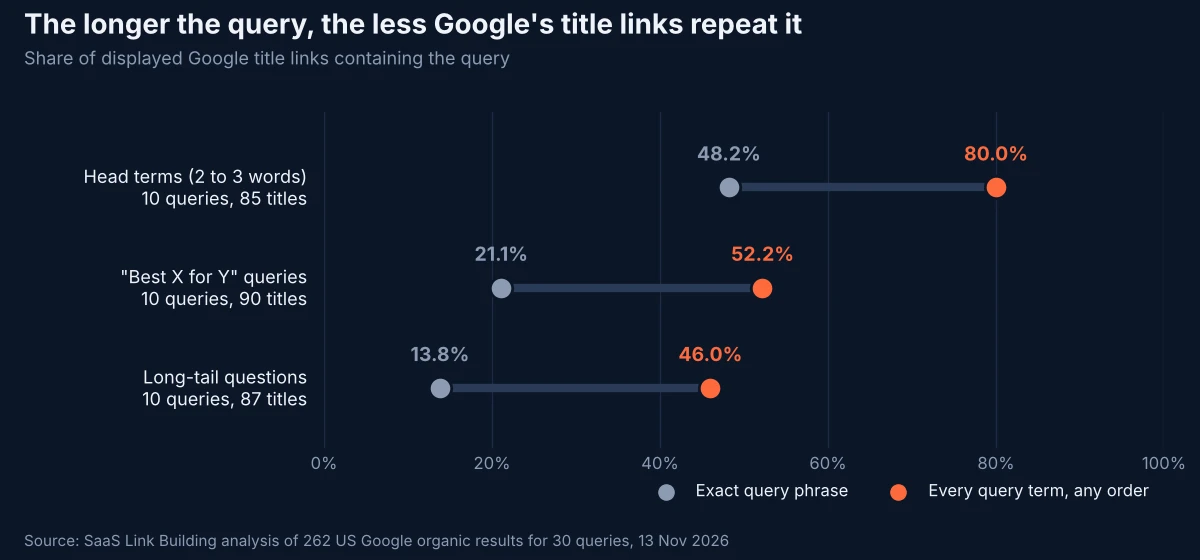
Across all three query types, most title links did not contain the exact phrase. Long-tail questions were the clearest case. For "how to unclog a bathroom sink drain," none of the eight titles contained every query term; the third result read "How to Unclog a Sink Drain," with no mention of a bathroom. For "what temperature to cook salmon," none of the nine titles held the exact phrase, and a Reddit thread titled "Optimal time and temp for baking..." ranked third.
Position barely tracked title matching
If an exact-match title gave a meaningful push, matched titles should cluster at the top. They did not, except mildly for head terms.
| Query type | Positions 1 to 3: exact / all terms | Positions 4 to 6: exact / all terms | Positions 7 to 10: exact / all terms |
|---|---|---|---|
| Head terms (10 queries) | 56.7% / 86.7% | 36.7% / 76.7% | 52.0% / 76.0% |
| "Best X for Y" (10 queries) | 26.7% / 56.7% | 16.7% / 50.0% | 20.0% / 50.0% |
| Long-tail questions (10 queries) | 13.3% / 33.3% | 23.3% / 56.7% | 3.7% / 48.1% |
| All 30 queries | 32.2% / 58.9% | 25.6% / 61.1% | 24.4% / 57.3% |
For long-tail questions the pattern runs backwards: titles in positions 4 to 6 contained all query terms more often than titles in the top three. On "how to lower ph in pool," the first result's title talked about pH being "too high or too low" without using the word "lower," while six lower-ranked titles did.
Synonyms and spelling variants ranked without trouble
Four of the 262 titles contained none of the query's meaningful words. For "best accounting software for freelancers," the top two titles were about "bookkeeping software," the first aimed at the "self-employed," and a FreshBooks page titled "Self Employed Professionals" ranked third. For "credit card," a page titled "Bread Financial Search Results" ranked eighth. The first result for "noise cancelling headphones" used the American spelling "Noise-Canceling," which our strict matching counted as a miss but Google plainly did not.
Two first-place pages Google showed without a snippet
The strongest counter-evidence came from two first-place results. For "how to unclog a bathroom sink drain," Google ranked a Family Handyman URL first under the title link "sink drains - Family Handyman," with no snippet and a "Learn why" link to its help page on pages with no information, which explains that this usually happens when robots.txt blocks crawling. The URL carried a customize_changeset_uuid parameter, and the site's robots.txt file disallows exactly that pattern. For "best vpn for streaming," Google ranked a page first and displayed only its bare URL as the title, again with no snippet and the same help link.
If Google cannot crawl a URL, it cannot read that URL's title element. Speculation, clearly labelled: these pages most likely ranked on signals Google could gather without fetching them, such as links and anchor text pointing at them, or signals consolidated from a crawlable version of the same page. Either way, the title the searcher saw was not the reason the page ranked first.
Google increasingly writes the title you see
The displayed title is not always the site's own. In a September 2021 Search Central post, Danny Sullivan said Google used the HTML title element for title links around 87% of the time, up from around 80% before a feedback-driven fix. In March 2026 Google went further, confirming a small experiment that used AI to change headlines and page titles in search results. According to 9to5Google's report, Google described the goal as better matching titles to users' queries, and said any launch based on the test would not use a generative model.
That cuts both ways for our numbers. Where Google rewrites a title toward the query, our match rates overstate how often site owners wrote matching titles themselves. The real share of exact-match HTML titles among ranking pages may be lower still.
The verdict: debunked as a rule, confirmed as a small input
Titles count: confirmed. Google has said on the record that titles are a ranking factor, a Google engineer described the index as titles and bodies, and the leaked documentation contains a site-level title-to-query match score.
You need the exact keyword in your title to rank: debunked. Across 30 searches, fewer than three in ten ranking titles held the exact query, first place went to an exact-match title link on only 9 of 30 queries (one of them a bare URL), matched titles were only modestly more common at the top, and two pages ranked first while Google showed no snippet for either, one of them from a URL its own site blocks from crawling.
The most consistent reading of all the evidence is that Google uses the title as one of several places to confirm what a page is about, rewards titles that accurately describe the page and the query's intent, and leaves the heavy lifting to body content, links and user signals. An exact-match title appears to help most where the query is short and the vocabulary is fixed, and to matter least for natural-language questions, where Google's language systems do the matching.
What this means for SEO teams
- Write titles for intent, not for string matching. Make sure the title clearly names the topic and the task, using the words your audience uses. For short head terms, that will often mean including the phrase naturally.
- Stop rewriting good titles to force an exact long-tail query in. For question-style searches, the first-place title in our sample held the exact phrase only once in ten. A clear, specific title is a safer bet than a stitched-together one.
- Treat sitewide title accuracy as the goal. If the leaked
titlematchScoreworks as described, a site whose titles routinely mislead or overpromise may be judged as a whole. Audit templates for vague, duplicated or boilerplate titles first. - Check robots.txt against the URLs that actually rank. A parameterised URL ranking first while blocked from crawling means Google shows a poor title and no snippet. Search your top queries, note any "Learn why" results, and point Google to a crawlable canonical version.
- Watch the displayed title, not just the HTML. Search your top Search Console queries and compare the title link Google shows with your title element, then follow Google's title link guidance on the usual causes such as half-empty, obsolete or boilerplate titles. Our earlier test found Google rewrote 74% of meta descriptions in a similar sample, so expect Google to replace weak titles too.
- Keep links in the plan. The ABC framework puts anchors alongside body terms; our investigation into whether Google still ranks on links drew on the same case.
Methodology
On 13 November 2026 we collected Google's US English organic results (location: United States) for 30 queries through a SERP API, recording the displayed title link and URL for each organic result. The queries were split evenly into three groups of 10: head terms of two to three words (for example "standing desk"), commercial "best" queries, nine of them in the "best X for Y" form (for example "best camera for beginners") and long-tail questions (for example "how to repot a snake plant"). The API returned between 8 and 10 organic results per query, 262 in total. Ads, AI Overviews, sitelinks and other SERP features were excluded.
For each title we lowercased the text and removed punctuation, then recorded whether it contained the full query as a contiguous phrase (exact match) and whether it contained every query term after removing common stopwords (to, a, an, the, for, in, is, my, how, what, why, of, on, do, you), with simple suffix stemming so that plurals and "-ed" or "-ing" forms counted. Spelling variants and synonyms were counted as misses. We measured displayed title links, not HTML title elements, because Google can rewrite titles and the HTML of every ranking page was not available to us. Results reflect a single snapshot, and 30 queries is a small sample, so the figures show direction rather than precise rates. We checked the Family Handyman robots.txt file on the same day. Leaked field descriptions come from version 0.4.0 of the published google_api_content_warehouse package.
Conclusion
Google's own statements, its engineer's account to the DOJ and its leaked documentation all agree that titles feed into ranking. None of them supports the idea that the exact keyword must appear in the title, and the live results we pulled argue against it: most ranking titles paraphrased the query, first-place titles were rarely exact matches for longer searches, and a page ranked first from a URL its site blocks from crawling, under a title Google assembled itself. Titles still deserve care, because they describe the page to both Google and the searcher. The exact-match habit is the part to retire.
The finding also fits Google's broader direction. With Google's Gary Illyes calling URL keywords a tiny signal and Google now testing its own query-matched titles, the words a site places in its metadata look less like ranking levers and more like labels that must stay accurate.
What do you think?
Have you rewritten titles to add or remove an exact-match keyword and tracked the ranking change in Search Console? Tell us what happened, including the query type and how long the change took to show.
Questions and answers
Are title tags a Google ranking factor?
Yes, but a small one. In an October 2021 SEO office-hours session, Google's John Mueller described titles as a tiny factor in Google's rankings, and notes from a February 2025 DOJ call with Google engineer HJ Kim describe the search index as built from titles and bodies.
Do you need the exact keyword in your title tag to rank?
Our test suggests not. Across 262 US Google results for 30 queries collected on 13 November 2026, only 27.5% of displayed title links contained the exact query phrase, and the first-place title link was an exact match on only 9 of 30 searches (one of them a bare URL).
How often does Google change the title shown in search results?
In September 2021 Google said it used the HTML title element for title links around 87% of the time, up from around 80%. In March 2026 Google confirmed a small experiment using AI to change headlines and page titles in search results.
What is titlematchScore in the Google API leak?
titlematchScore is a field in the QualityNsrNsrData module of Google's leaked Content Warehouse API documentation, described as a site-level signal of how well titles match user queries. The documentation does not say how, or whether, it is weighted in ranking.
More releases
-
Updates
Search Console AI Report Bug Hit Core Update Launch; 3 of 8 2026 Updates Overlapped
Google has logged an error that cut impressions in Search Console's Generative AI performance report for 9 to 11 November, the window in which the November 2026 core update began. Our timeline of Google's own records shows three of this year's eight ranking updates launched on a day with a logged data error.
-
Explainers
Bing's AI-Off Extension Just Adds noAI=1 to Searches; It Has 137 Chrome Users
Bing documented two ways to hide its AI answers on 11 November: a preview browser extension and a -ai query operator. Our read of the extension's code shows it appends a noAI=1 parameter, ships with AI off, and resets the default search engine and new tab to Bing. It has 137 Chrome users.
-
Updates
Gemini 4 Hydrogen Reaches All Searchers; Multi-Part AI Mode Queries Cited 24 Sources vs 14
Google made Gemini 4 Hydrogen the model behind Search for all users on 12 November, promising better handling of multi-part questions and a wider query fan-out. In 24 AI Mode searches we ran on launch day, detailed queries cited 24 non-Google sources against 14 for short ones, though the median answer cited just two.
Tell us the site and the goals.
Rankings in Google and visibility in AI answers, from one monthly plan. One call is enough to say which one fits. Email works just as well.