Gemini 4 Hydrogen Reaches All Searchers; Multi-Part AI Mode Queries Cited 24 Sources vs 14
Google made Gemini 4 Hydrogen the model behind Search for all users on 12 November, promising better handling of multi-part questions and a wider query fan-out. In 24 AI Mode searches we ran on launch day, detailed queries cited 24 non-Google sources against 14 for short ones, though the median answer cited just two.
 Vibhu Dhariwal
Cofounder & CTO, Digital Gratified
- Published
- Section
- Updates
- Reading time
- 8 minutes
Ras Al Khaimah, United Arab Emirates, .
Google made Gemini 4 Hydrogen the model behind Google Search on 12 November 2026, and unlike last month's Argon launch, it is not limited to paying subscribers. In a post on Google's Keyword blog, Robby Stein, VP of Product for Google Search, called it "the biggest model upgrade to Search yet" and said Hydrogen is now available globally for all users. The headline claims for site owners: better handling of long, multi-part questions, a stronger query fan-out that links to a broader range of sites, and more tables, images and custom tools in answers.
To see what that looks like in practice, we ran 24 AI Mode searches from the US in the hours after the announcement: 12 short queries and 12 detailed, multi-part versions of the same requests. The detailed versions cited 24 non-Google sources against 14 for the short ones, but the typical answer still cited only two.
What Google announced
Google's Search post lists four changes:
- Intent: Search should handle multi-part questions, hard-to-read typos and very specific requests, with what Google calls deeper instruction following and tool calling.
- Query fan-out and linking: Hydrogen runs simultaneous queries across the subtopics of a question, which Google says helps people find sites they might not have discovered before.
- Visual responses: more images, structured responses, comparison tables and custom tools.
- Languages: more nuanced answers across all supported AI Mode languages.
The model itself was introduced in a separate post by Koray Kavukcuoglu, SVP at Google DeepMind. Google positions Hydrogen as its fast execution model, below the frontier Gemini 4 Carbon and Gemini 4 Argon. It says Hydrogen scores 51 on the Artificial Analysis Intelligence Index at its default high thinking level, against 50 for Argon, finishes tasks 2.5 times faster than Gemini 3.8 Flash and cuts fabricated claims by more than five times. These are company-reported figures. The API price is $1.50 per million input tokens and $7.50 per million output tokens.
Neither post mentions AI Overviews by name. The Search post says Hydrogen is in Google Search for all users and refers to AI Mode languages, so the safest reading is that AI Mode is covered and AI Overviews may be. Google has not said how the model changes source selection or ranking of cited links.
How this differs from the Argon launch
| Gemini 4 Argon | Gemini 4 Hydrogen | |
|---|---|---|
| Search launch date | 13 October 2026 | 12 November 2026 |
| Who gets it in Search | Google AI Pro and Ultra subscribers | All Search users, globally |
| Google's stated focus | Deep, long-horizon reasoning | Fast execution, intent, fan-out, visual answers |
| API price per 1M input / output tokens | $2 / $10 introductory | $1.50 / $7.50 |
| AI Overviews named in announcement | No | No |
The audience is the big change. Argon reached only paying subscribers who chose it, so most searchers never saw it. Hydrogen reaches every Search user, which makes it the more consequential release for anyone tracking AI Mode visibility.
What our 24 AI Mode searches showed
We paired short queries such as "camping tent" with detailed versions such as a request for a four-person tent for rainy weather, under 15 pounds, that one person can set up. Topics covered travel, shopping and hobbies, the three areas Google's post uses as examples.
| Measure (12 queries each) | Short queries | Multi-part queries |
|---|---|---|
| Answers returned | 12 | 12 |
| Cited sources, all | 25 | 29 |
| Cited sources on Google-owned pages | 11 | 5 |
| Non-Google sources | 14 | 24 |
| Distinct non-Google domains | 12 | 22 |
| Median sources per answer | 1.5 | 2 |
| Answers with no cited source | 2 | 0 |
| Answers citing only Google pages | 2 | 1 |
| Text blocks / list items | 97 / 170 | 123 / 239 |
| Image thumbnails in the answer | 23 | 11 |
Four findings stand out:
- Detail brought in more outside sites, but not many. The multi-part set cited 22 distinct non-Google domains, close to double the short set. Yet the median answer cited two sources, and the most any single answer cited was six.
- Short queries leaned on Google's own pages. Eleven of the 25 sources behind short queries were Google-owned. The "lisbon hotels" and "camping tent" answers cited only Google pages (place listings and Shopping product pages). The detailed versions of both cited four and three outside sites respectively.
- More images did not show up. Google promises more visual answers, but the image thumbnails we counted (in product and place cards) fell from 23 to 11 when queries got longer, because the short queries triggered more shopping and local cards.
- Comparisons appeared where requests asked for them. Seven of the 12 multi-part answers carried a comparison heading such as "Quick Comparison", against one short answer. The structured content under those headings did not come through in our data, so we cannot confirm how many were rendered as tables.
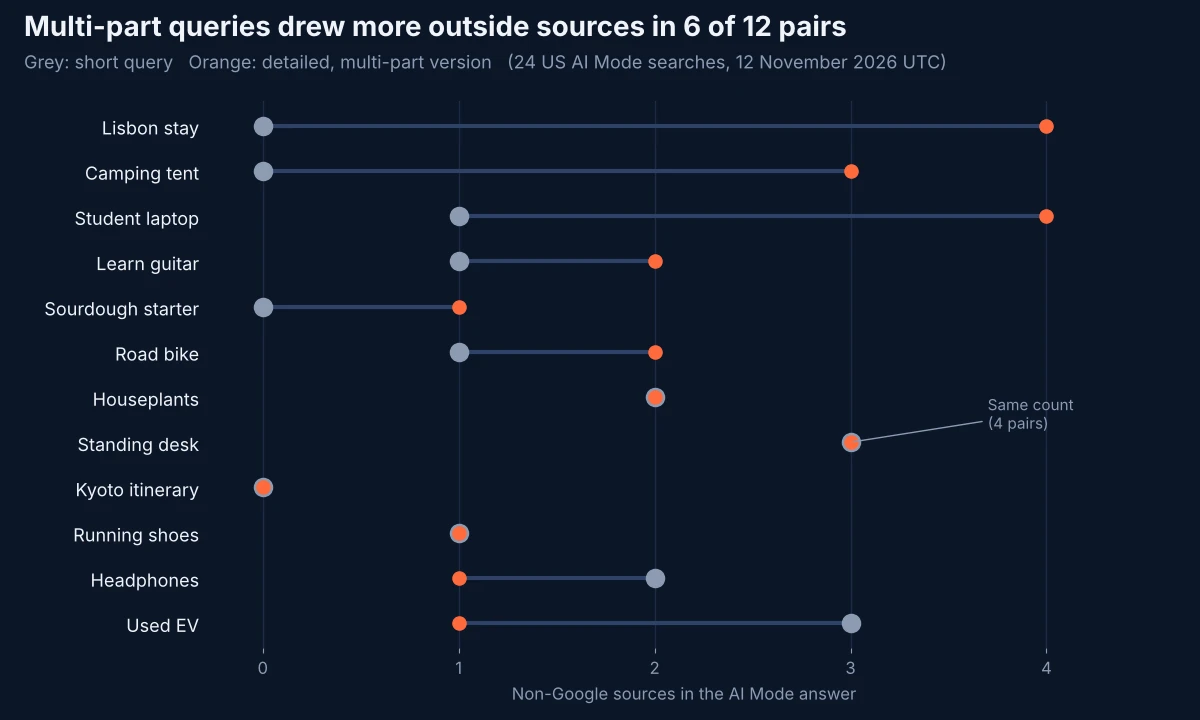
Pair by pair, the detailed query cited more outside sources in six cases, the same number in four and fewer in two (used electric cars and headphones). The Kyoto itinerary question cited no outside site in either form; the detailed version linked five Google place entries instead.
One caution: this is a snapshot taken on launch day with no matching pre-launch sample, and Google has not said whether every request is already served by Hydrogen. The numbers describe AI Mode as it behaved for these queries, not a measured before and after.
Context: a busy week to measure anything
Hydrogen arrives two days after the November 2026 core update began on 10 November, according to Google's Search Status Dashboard, and that update is still rolling out. We covered its start in our report on the end of the 173-day core update gap.
Search Console data is also muddied. Google's data anomalies page says a logging error reduced impressions in the Generative AI performance report in Search for 9 to 11 November, and that the issue "affects data logging only". A similar logging error hit the same report from 13 to 17 August, and Google later restored that data.
The typo claim is not new territory either. In our earlier test, Google corrected all 30 typos we searched, so the room for visible improvement there may be small.
What this means for SEO teams
- Annotate 9 to 12 November. A core update, a Generative AI report logging error and a Search model change overlap. Do not attribute shifts in this window to any one of them without more data.
- Track long queries, not only head terms. In our sample, the detailed queries were the ones that pulled outside publishers into AI Mode answers. Add a set of realistic multi-part prompts to your AI Mode monitoring and record cited domains for each.
- Answer the constraints, not just the topic. Fan-out splits a detailed question into subtopics such as weight, budget and fit. Pages that state specifications, prices and trade-offs plainly give those subqueries something to match.
- Publish comparisons in HTML tables. Google says comparison tables will appear more often. Clean, crawlable comparison tables on your own pages give the model structured facts to draw on.
- Expect Google's own pages in short-query answers. For broad shopping and travel terms, Shopping and place entries took a large share of citations in our test. Product feeds and Business Profiles matter alongside web pages.
Methodology
On 12 November 2026 between 21:17 and 21:21 UTC we ran 24 searches through a SERP API using Google's AI Mode with US English settings (gl=us, hl=en), one request per query and no location parameter. The queries were 12 pairs: a short head query and a detailed multi-part version of the same request, covering shopping (shoes, bikes, desks, headphones, laptops, tents, used cars), travel (Kyoto, Lisbon) and hobbies (sourdough, houseplants, guitar). For each response we counted text blocks, list items, image thumbnails inside product and place cards, and entries in the references list. We classed a reference as Google-owned when its host was google.com, a google.com subdomain or youtube.com. All 24 searches returned an answer. Two responses were fetched in a compact format that strips metadata; their answer and reference content was intact. Our parser did not return table content, so tables could not be counted directly. The sample is small and taken on a single day; treat the figures as indicative.
Conclusion
Gemini 4 Hydrogen is the first Gemini 4 model to reach every Google searcher, and Google is selling it on exactly the behaviour SEO teams care about: understanding long questions and fanning out to more sites. Our launch-day sample is consistent with the direction of that claim, as detailed queries drew more outside domains and fewer Google-owned citations, but the scale is modest, with a median of two sources per answer.
The open questions are whether Hydrogen also powers AI Overviews, and whether citation counts grow as the rollout settles and the November core update finishes.
Questions and answers
What is Gemini 4 Hydrogen?
Gemini 4 Hydrogen is a Google model announced on 12 November 2026 and built for fast execution of agentic tasks. Google says it scores 51 on the Artificial Analysis Intelligence Index at its default thinking level, against 50 for Gemini 4 Argon.
Who gets Gemini 4 Hydrogen in Google Search?
Google's Search post by Robby Stein says Hydrogen is available globally in Google Search for all users. Gemini 4 Argon, launched in October, reached AI Mode only for Google AI Pro and Ultra subscribers.
Does Gemini 4 Hydrogen power AI Overviews?
Google's announcements do not mention AI Overviews by name. They refer to Google Search generally and to AI Mode languages.
Why did Generative AI impressions drop in Search Console from 9 to 11 November?
Google's Search Console data anomalies page says a logging error reduced impressions in the Generative AI performance report in Search for 9 to 11 November 2026, and that it affects data logging only.
More releases
-
Studies
YouTube Out-Cites Dictionaries in Google's 'Define' AI Overviews, 66 to 60 in 31 Searches
Google now shows AI Overviews on definition searches fully expanded, according to an 11 November report. In our pull of 31 US 'define' searches, every result page carried an AI Overview, and YouTube drew 66 of 271 citations against 60 for dictionary sites, even though dictionaries held 32% of the organic top 10.
-
Updates
Google Documents Its Search Referer Values; 28% of Top-Site Redirects Dropped gclid
Google published a help page on 12 November explaining how to identify Google Search visits in analytics and server logs from the HTTP Referer header. Our crawl of 502 top-site homepages found that 108 of 389 redirect chains dropped a gclid parameter, one of the causes Google lists for mismatched data.
-
Updates
Google Adds Things to Do to EEA Aggregator Units; 45 of 50 Attraction Links Left Google
Google extended its EEA aggregator and supplier units to things-to-do searches on 9 November. In our ten-city check, EEA results showed attraction cards linking to official sites on five pages, while US results showed Google's own Top sights module on all ten, with every entry linking back to Google.
Tell us the site and the goals.
Rankings in Google and visibility in AI answers, from one monthly plan. One call is enough to say which one fits. Email works just as well.