Google's November 2026 Core Update Ends a 173-Day Wait, the Longest Since 2023
Google started the November 2026 core update on 10 November, its first core update since 21 May. Our review of the Search Status Dashboard finds the 173-day gap is the third longest since 2021, the announcement now specifies all languages, and a full rollout would end two days before US Thanksgiving.
 Vibhu Dhariwal
Cofounder & CTO, Digital Gratified
- Published
- Section
- Updates
- Reading time
- 6 minutes
Ras Al Khaimah, United Arab Emirates, .
Google began rolling out the November 2026 core update on 10 November at 18:06 UTC (10:06am Pacific), according to its Search Status Dashboard incident. The entry says the update applies globally and to all languages and that the rollout may take up to two weeks. It is the third core update of 2026 and the eighth ranking update Google has logged on the dashboard this year.
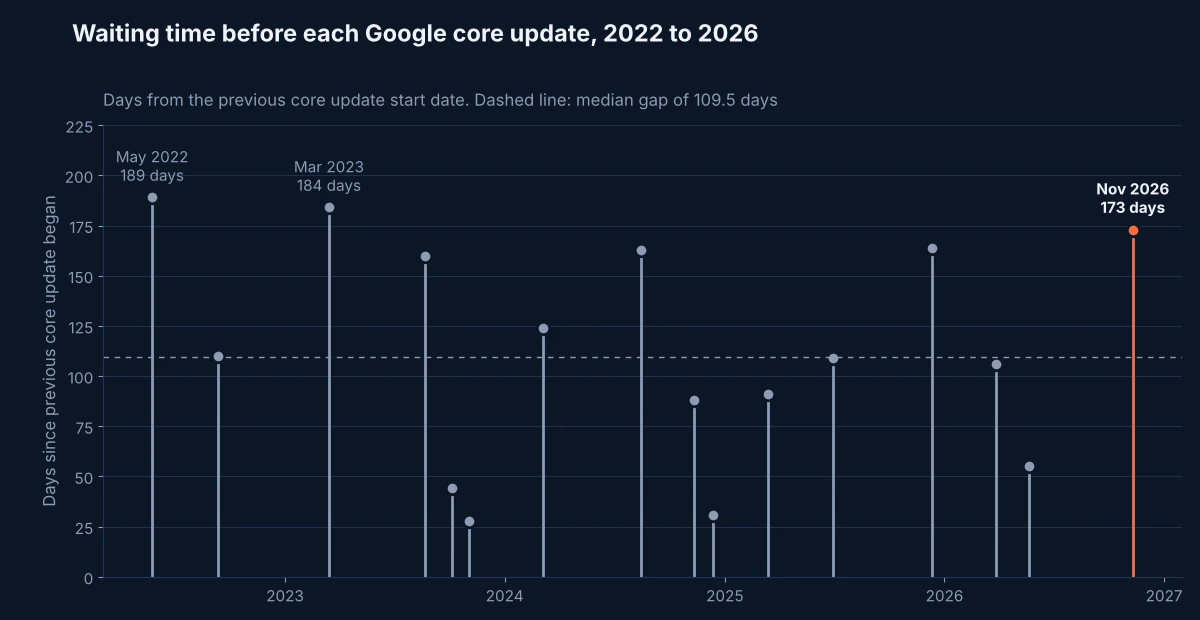
Our analysis of every core update on Google's ranking update history finds that this one arrived 173 days after the previous core update began on 21 May. That is the third longest wait between core updates since the dashboard's history starts in November 2021, and the longest since March 2023.
What changed
- Start: 10 November 2026, 18:06 UTC, logged under the dashboard's Ranking service as "November 2026 core update".
- Scope: global, all languages. Google gave no list of affected systems or content types.
- Expected length: up to two weeks, which would put completion on or around 24 November.
- Google's statement: in a Search Central LinkedIn post reported by Search Engine Journal and Search Engine Roundtable, Google called it a regular update meant to surface relevant, satisfying content from all types of sites. Search Engine Journal noted the wording matches the March 2026 announcement.
- No blog post: the Search Central blog carried no post about the update when we checked, and the core updates documentation still shows a last-updated date of 10 December 2025.
The dashboard wording changed
We compared the November entry with the earlier core update entries in the dashboard's public incidents JSON. Two details differ.
First, the November text adds that the update "applies globally and to all languages". The December 2025, March 2026 and May 2026 entries did not say this; they named the update, linked the documentation and gave the expected rollout time. Core updates have always been broad, so the added clause reads as a clarification rather than a change in scope, but it is new on the dashboard.
Second, the link now points to the documentation's current address, /search/docs/appearance/core-updates. The three earlier entries linked to /search/updates/core-updates, which now returns a 301 redirect to the new path. The expected rollout time is back to two weeks after December 2025's three-week estimate.
| Dashboard entry | Expected rollout | Scope line | Documentation link |
|---|---|---|---|
| December 2025 core update | Up to 3 weeks | None | /search/updates/core-updates |
| March 2026 core update | Up to 2 weeks | None | /search/updates/core-updates |
| May 2026 core update | Up to 2 weeks | None | /search/updates/core-updates |
| November 2026 core update | Up to 2 weeks | Global, all languages | /search/docs/appearance/core-updates |
A 173-day gap, in context
Google's ranking history lists 17 core updates from November 2021 to November 2026, which gives 16 gaps between start dates. The median gap is 109.5 days. Only May 2022 (189 days after November 2021) and March 2023 (184 days after September 2022) followed longer waits than November 2026.
The quiet stretch did not mean a quiet search results page. Google ran spam updates in June, August and September, and the September spam update took 13 days and 16 hours to finish on 8 October. Rank trackers also spiked several times in October without a confirmed update, which we covered when Google had logged no ranking update since 8 October and again after the 24 October tracker spike. Search Engine Roundtable reported tracker movement in the days before 10 November, but Google has not said the update began before the logged start time.
How long will it take?
The two 2026 core updates finished faster than Google's estimate: March took 12 days and 4 hours, May took 11 days and 21 hours. Across the 16 completed core updates on the dashboard, the median rollout was 14.5 days. November rollouts have run long, though. The November 2023 core update took 25 days and 21 hours and the November 2024 core update took 23 days and 13 hours.
| Core update | Start date | Rollout length | Days since previous core update |
|---|---|---|---|
| March 2024 | 5 March 2024 | 45 days | 124 |
| August 2024 | 15 August 2024 | 19 days, 4 hours | 163 |
| November 2024 | 11 November 2024 | 23 days, 13 hours | 88 |
| December 2024 | 12 December 2024 | 6 days, 4 hours | 31 |
| March 2025 | 13 March 2025 | 13 days, 21 hours | 91 |
| June 2025 | 30 June 2025 | 16 days, 18 hours | 109 |
| December 2025 | 11 December 2025 | 18 days, 2 hours | 164 |
| March 2026 | 27 March 2026 | 12 days, 4 hours | 106 |
| May 2026 | 21 May 2026 | 11 days, 21 hours | 55 |
| November 2026 | 10 November 2026 | In progress | 173 |
Timing matters for retail and SaaS sites with year-end campaigns. US Thanksgiving falls on 26 November, Black Friday on 27 November and Cyber Monday on 30 November. If the update runs to the full two weeks, it ends two days before Thanksgiving. If it runs as long as the last two November core updates, it will still be rolling out through the holiday weekend.
What this means for SEO teams
- Set the baseline now. Google's core updates guide recommends comparing a week after the rollout completes with a week before it started. For this update, the comparison week is 3 to 9 November. Export Search Console performance data for that week before it rolls out of easy reach.
- Wait for the completion notice. The same guide says to wait at least a full week after completion before analysing. If the rollout ends on 24 November, that means a first read around 1 December.
- Separate search types. Google suggests checking Web, Images, Video and News separately, which matters for publishers whose Discover and News traffic can move on its own schedule.
- Judge the size of the drop. Google distinguishes a small slip (its example is position 2 to 4) that needs no action from a large one (position 4 to 29) that warrants a site-wide review against its self-assessment questions.
- Avoid quick fixes mid-rollout. The guide warns against removing page elements because of SEO hearsay, and says improvements can take months to register, sometimes not until the next core update. Smaller, unannounced core updates also happen.
- Annotate holiday traffic. Seasonal demand will overlap the end of the rollout, so year-on-year comparisons will be cleaner than week-on-week ones for retail queries.
For the full 2026 calendar, including the four spam updates and the Discover update, see our analysis of Google's 2026 ranking updates.
Methodology
On 12 November 2026 we downloaded Google's Search Status Dashboard incidents JSON and the Ranking history page. We listed every entry named as a core update (17, from November 2021 to November 2026), took each start date and the duration Google published, and calculated the number of days between consecutive start dates. Discover, spam, helpful content and reviews updates were excluded from the gap count. We compared the opening text of the four core update entries present in the JSON feed and checked the HTTP response of the documentation link each one used.
Conclusion
The November 2026 core update ends the longest pause between core updates since early 2023 and lands just ahead of the busiest retail fortnight of the year. Google's guidance has not changed: wait for the completion notice, then compare a full week either side of the rollout. Teams that saved their 3 to 9 November data will be able to read the result cleanly; teams that react while it is still rolling out risk chasing movement that has not settled.
Questions and answers
When did the Google November 2026 core update start?
Google logged the start on its Search Status Dashboard at 18:06 UTC on 10 November 2026 (10:06am Pacific). It said the update applies globally and to all languages.
How long will the November 2026 core update take?
Google said the rollout may take up to two weeks, which points to completion around 24 November. The March and May 2026 core updates finished in about 12 days, but the November 2023 and November 2024 core updates each took more than 23 days.
How long was the gap since the previous core update?
173 days. The May 2026 core update began on 21 May 2026. Among the 16 gaps between core updates on Google's ranking history since November 2021, only the waits before May 2022 (189 days) and March 2023 (184 days) were longer.
When should I check Search Console for core update effects?
Google's core updates guide recommends waiting at least a full week after the rollout completes, then comparing that week with a week before the update began. For this update, the pre-update week is 3 to 9 November 2026.
More releases
-
Updates
Google Adds Things to Do to EEA Aggregator Units; 45 of 50 Attraction Links Left Google
Google extended its EEA aggregator and supplier units to things-to-do searches on 9 November. In our ten-city check, EEA results showed attraction cards linking to official sites on five pages, while US results showed Google's own Top sights module on all ten, with every entry linking back to Google.
-
Explainers
Google Warns CDN Moves Can Swamp Origins; 154 of 346 Top Homepages Skipped the Cache
Google says moving a site to a CDN can raise its crawl rate before edge caches warm up, sending crawler requests straight back to the origin server. Our check of top sites found 154 of 346 that expose cache headers did not serve their homepage from cache on either of two back-to-back requests.
-
Studies
Did Google Keep Its Promise to Small Sites? Their Share of 29 SERPs Tripled Since 2024
Google promised in August 2024 to show more small and independent sites. Across the same 29 searches, results from low-authority domains rose from 3.4% of top-10 listings in July 2024 to 10.8% now. A leaked small-site score and court notes on site-level quality complicate the picture. Our verdict: likely, but modest.
Tell us the site and the goals.
Rankings in Google and visibility in AI answers, from one monthly plan. One call is enough to say which one fits. Email works just as well.