No Google Ranking Update Since 8 October Despite Volatility Chatter; Core Update Gap Reaches 152 Days
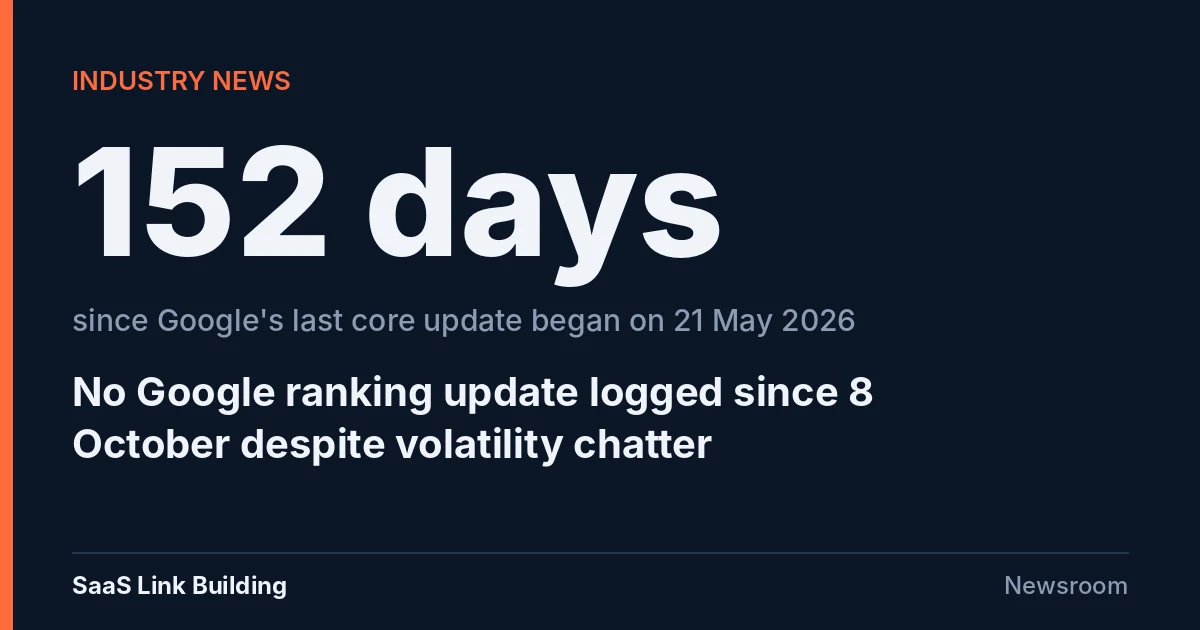
Google's Search Status Dashboard has logged no ranking update since the September 2026 spam update ended on 8 October, despite rising volatility reports from 15 October. Our analysis of the dashboard shows 152 days have passed since the May 2026 core update began, the second longest gap since August 2024.
 Vibhu Dhariwal
Cofounder & CTO, Digital Gratified
- Published
- Section
- Industry news
- Reading time
- 6 minutes
Ras Al Khaimah, United Arab Emirates, .
Google has not logged any ranking update on its Search Status Dashboard since the September 2026 spam update finished rolling out on 8 October, even as SEOs reported a fresh spike in ranking volatility and forum chatter from 15 October onwards. As of 20 October 2026, the dashboard's ranking history shows no October entry, and the last core update began 152 days ago, on 21 May.
The gap matters because many site owners read volatility as a sign of an unannounced core update. Google's own data, pulled for this report from the dashboard's public incident feed, shows that confirmed core updates have arrived between 55 and 164 days apart since August 2024.
What changed, and what did not
- No new ranking incident. The September 2026 spam update began at 16:15 UTC on 24 September and Google marked it complete on 8 October. The dashboard has no ranking, crawling, indexing or serving entry after that date.
- Volatility reports rose. Search Engine Roundtable reported on 16 October that ranking volatility and chatter had picked up over the previous 24 hours, and added on 19 October that the chatter continued over the weekend. Several third-party rank-tracking tools showed elevated readings for 15 and 16 October.
- No Google statement. No Google page, Search Central post or named Googler has confirmed a ranking update in October 2026.
- Search Console data notes are quiet. Google's data anomalies page lists no issue for September or October. Its most recent entries cover logging errors on 13 August (Discover) and 13 to 17 August (the Generative AI performance report in Search).
Our analysis of Google's ranking update calendar
The table below lists every confirmed core update since August 2024 from the dashboard, with the number of days between each start date. The final row counts from the May 2026 core update to today.
| Core update | Start date | Days since previous core update began |
|---|---|---|
| August 2024 core update | 15 Aug 2024 | n/a |
| November 2024 core update | 11 Nov 2024 | 88 |
| December 2024 core update | 12 Dec 2024 | 31 |
| March 2025 core update | 13 Mar 2025 | 91 |
| June 2025 core update | 30 Jun 2025 | 109 |
| December 2025 core update | 11 Dec 2025 | 164 |
| March 2026 core update | 27 Mar 2026 | 106 |
| May 2026 core update | 21 May 2026 | 55 |
| No core update yet (as of 20 Oct 2026) | n/a | 152 and counting |
The current 152-day run is the second longest in that period. Only the stretch between the June 2025 and December 2025 core updates, at 164 days, was longer. If no core update starts before 2 November, the current gap will become the longest since at least August 2024.
2026 has been busy on the spam side. The dashboard lists seven ranking incidents this year: the February Discover update, the March spam update, the March and May core updates, and spam updates in June, August and September. The September spam update ran for 13 days and 16 hours, the longest spam rollout of the year.
| 2026 ranking incident | Start (UTC) | Duration |
|---|---|---|
| February 2026 Discover update | 5 Feb | 21 days, 17 hours |
| March 2026 spam update | 24 Mar | 19 hours, 30 minutes |
| March 2026 core update | 27 Mar | 12 days, 4 hours |
| May 2026 core update | 21 May | 11 days, 21 hours |
| June 2026 spam update | 24 Jun | 2 days, 1 hour |
| August 2026 spam update | 18 Aug | 2 days, 16 hours |
| September 2026 spam update | 24 Sep | 13 days, 16 hours |
What site owners are reporting
The October 2026 Google observations thread on WebmasterWorld shows a mixed picture rather than a clear pattern. Members describe erratic Discover traffic, Google News surfacing stale stories, and Search Console data arriving late. One member reported traffic up more than 35%, while others reported sharp falls in news earnings and sales. WebmasterWorld founder Brett Tabke wrote on 3 October that across more than 100 Search Console accounts he pulled, traffic was down maybe 0.5 to 1% as a group, with most changes "unnoticeable other than normal flux."
Rank-tracking data also comes with a caveat this month. Several tools have reported problems collecting Google results since September, which makes tool-based volatility readings harder to interpret.
Context: what the dashboard does and does not cover
Google says its Search Status Dashboard shows issues that affect many sites or users, plus the latest ranking updates that are relevant to website owners. It is not a log of every change. Google's guide to debugging Search traffic drops says its results are dynamic because the web itself changes constantly, and that small position shifts can happen at any time. Its core updates guidance says Google makes broad core updates several times a year and gives notice when they happen.
In other words, an empty October column does not prove nothing changed, but it does mean there is no confirmed update to attribute traffic shifts to.
What this means for SEO teams
- Do not label this a core update in reports. Until Google posts an incident, describe the movement as unconfirmed volatility.
- Separate the September spam update from later movement. Google marked it complete on 8 October. Compare the week of 9 to 15 October against a week before 24 September to isolate its effect, following Google's advice to compare like-for-like weeks.
- Check for reporting gaps first. Review the data anomalies page and confirm your Search Console data is current before acting on a dip.
- Segment by surface. Split Web, Discover and News in Search Console. Much of the forum complaint concerns Discover and News rather than web rankings.
- Subscribe to the dashboard feed. Google offers an RSS feed for the dashboard, which is the fastest way to learn when an update starts.
Methodology
On 20 October 2026 we downloaded Google's public incidents feed at status.search.google.com/incidents.json and the Ranking history page of the Search Status Dashboard. We counted every incident whose service is Ranking, recorded start times and durations as Google reports them, and calculated the days between the start dates of consecutive core updates. The final gap runs from 21 May 2026 to 20 October 2026. We did not use third-party volatility scores in the calculations.
Conclusion
Ranking volatility picked up in mid-October, but Google has not confirmed any update since the September 2026 spam update ended on 8 October. With 152 days since the last core update began, the current gap is already the second longest since August 2024, which helps explain why so many SEOs are watching for the next one. Until Google posts on its dashboard, teams should treat October movement as unconfirmed and diagnose it surface by surface.
Questions and answers
Has Google confirmed a ranking update in October 2026?
No. As of 20 October 2026, Google's Search Status Dashboard lists no ranking incident after the September 2026 spam update, which Google marked complete on 8 October.
When did the last Google core update start?
The May 2026 core update started on 21 May 2026 and took 11 days and 21 hours to roll out, according to the Search Status Dashboard. That is 152 days before 20 October 2026.
How long was the longest gap between core updates recently?
Between the June 2025 core update (30 June 2025) and the December 2025 core update (11 December 2025), 164 days passed, the longest gap since August 2024 in the dashboard data.
How many ranking updates has Google confirmed in 2026?
Seven: the February Discover update, the March spam and core updates, the May core update, and spam updates in June, August and September.
More releases
-
Updates
Google Merchant Center Adds Warranty Attribute for All Products as Quebec's 3 to 6 Year Warranty Law Starts
Google Merchant Center now supports a warranty attribute for general products, letting merchants show warranty length in Shopping ads and free listings. Google cites Quebec's Bill 29, whose legal warranty of good working order took effect on 5 October 2026 and covers appliances and electronics for 3 to 6 years.
-
Industry news
AI Slop Sites Grew Over Fivefold Year on Year as Ad Requests Hit 834M in September, DoubleVerify Data Shows
Domains publishing low-quality AI-generated content rose more than fivefold in Q2 2026 versus Q2 2025 and their traffic quadrupled, according to DoubleVerify data reported by Axios on 17 October. Monthly ad requests to these pages climbed from 184 million in January to 834 million in September 2026.
-
Studies
AI Mode-Style Queries Rose 7x in Search Console at the Median Site, 155-Site GSC Wizard Study Finds
Conversational follow-up queries typical of AI Mode grew from 0.032% to 0.22% of impressions at the median site between June 2025 and September 2026, according to a GSC Wizard study of 155 Search Console properties. These queries had a 2.9% click-through rate, against 35.6% for all queries.
Tell us the site and the goals.
Rankings in Google and visibility in AI answers, from one monthly plan. One call is enough to say which one fits. Email works just as well.