Google Adds Things to Do to EEA Aggregator Units; 45 of 50 Attraction Links Left Google
Google extended its EEA aggregator and supplier units to things-to-do searches on 9 November. In our ten-city check, EEA results showed attraction cards linking to official sites on five pages, while US results showed Google's own Top sights module on all ten, with every entry linking back to Google.
 Vibhu Dhariwal
Cofounder & CTO, Digital Gratified
- Published
- Section
- Updates
- Reading time
- 7 minutes
Ras Al Khaimah, United Arab Emirates, .
Google has extended its aggregator unit and supplier unit, two of the search features it shows only to users in the European Economic Area (EEA), to "things to do" queries. The Search Central documentation changelog dates the change to 9 November 2026 and says both units now support these queries. Until then, the aggregator unit documentation covered hotels, flights, long-distance trains or buses, products and local businesses.
We compared the live page with an archived copy from 3 November and ran ten "things to do in [city]" searches from EEA countries and from the US. In the EEA, five of ten results pages carried a row of attraction cards that linked out to the attractions' own websites, and 45 of those 50 links pointed outside Google. In the US, the same queries showed Google's Top sights module on all ten pages, and all 200 of its entries linked to Google pages.
What changed in the documentation
Google's changelog entry is two lines long. A comparison with the archived 3 November version shows "things to do" was added in six places on the aggregator unit page:
| Section of the aggregator unit page | 3 November version | Live version (updated 9 November) |
|---|---|---|
| How the unit works | Hotels, flights, long-distance trains, products, local businesses | Adds things to do |
| Feature availability (EEA) | Hotels, flights, long-distance trains or buses, products, local businesses | Adds things to do |
| Express interest form | Ground transportation, flight, hotel and local business queries | Adds things to do queries to the same Search Aggregator Features form |
| Have relevant content | Hotels, flights, ground transportation, local businesses | Adds things to do |
| Data feed for the query type | Local Point of Interest Feed for local business queries | Renamed the Local and things to do Point of Interest Feed, covering both |
| Best practices | Lodging and local business units populated by direct data feeds | Adds things to do to the feed-populated list |
The supplier unit page was updated on the same day. The supplier unit is the feature for direct providers, such as an individual hotel or airline, a brick-and-mortar business or a plumber, and Google says it appears only when the aggregator unit appears. It now lists things to do among its query types. Google's regional differences page, also updated on 9 November, lists things to do for both units in the EEA.
How each unit is filled
The two units work differently, and that matters for who can appear in them:
- Aggregator unit: built for vertical search services such as online travel agencies, metasearch engines and directories. Each approved aggregator fills its own version of the unit, the top-ranked provider's results are expanded by default, and users can switch to another provider. Only one aggregator unit shows at a time. For things to do, Google says the unit is populated by direct data feed integrations.
- Supplier unit: for businesses that sell or provide the thing directly. Google says no data beyond what it can crawl is needed to appear, though supplier results can be enhanced with feeds.
- Eligibility: aggregators must be approved as a vertical search service, express interest through the form, provide the feed data and follow Google Search content policies.
What we saw on the results pages
On 12 November we ran "things to do in [city]" in English for ten European capitals and tourist cities, once from each city's own EEA country and once from the US. Three page elements separated the two sets of results:
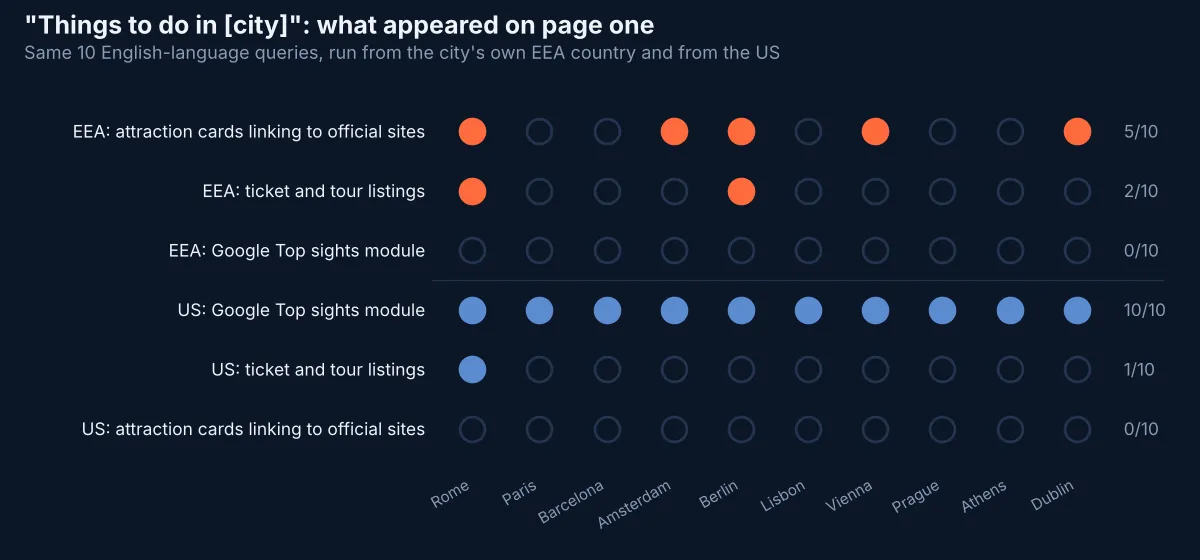
- Attraction cards linking to official sites appeared on five EEA pages (Rome, Amsterdam, Berlin, Vienna and Dublin), with ten cards each. Of the 50 card links, 45 went directly to websites outside Google, almost all of them the attractions' own sites, such as museum, palace or zoo ticket pages, or city tourism sites. The other five went through a Google redirect URL. This module never appeared in the US results.
- Google's Top sights module appeared on all ten US pages, 20 entries each, and every one of the 200 entries linked to a Google page. It appeared on none of the EEA pages.
- Ticket and tour listings with prices from resellers appeared on two EEA pages (Rome and Berlin) and on one US page (Rome), so they are not limited to the EEA.
The attraction cards behave the way Google describes the supplier unit: direct providers, linked straight to their own websites. That reading is ours; the parsed results do not label the modules with Google's internal names, and we could not confirm a separately labelled aggregator unit on these pages. The five EEA pages without attraction cards (Paris, Barcelona, Lisbon, Prague and Athens) showed refinement chips such as "Non touristy" and "For couples" instead. An AI Overview appeared on all 20 pages.
It is a small sample from one day. For a wider comparison of Google's EU and non-EU results pages, see our 69-SERP test of Google's EU results. The five card links that did not go straight to an outside site used Google's /goto redirect format, the same wrapper we found on 74.5% of top-100 organic URLs last month.
What this means for SEO teams
- Tour operators, attractions and ticketing sites serving the EEA should check whether they count as an aggregator or a direct supplier. Aggregators need approval and a feed; suppliers need crawlable pages.
- Aggregators should apply now. Google routes things to do through the same Search Aggregator Features form used for hotels and local businesses, and the data has to come from the Local and things to do Point of Interest Feed.
- Follow the feed best practices. Google asks for specific categories, rich entity details, title-case names without promotional text or emoji, original images without watermarks, and prices that match the landing page.
- Direct suppliers should make inner pages crawlable. In our sample, 39 of the 45 outside card links went to inner pages, such as ticket or visitor information pages, rather than homepages. Check that those pages are indexable and that prices and opening hours on them are current.
- Segment EEA traffic. Filter Search Console performance by EEA countries before and after 9 November for things-to-do queries. Google has not said when the units started showing for these queries, so expect gradual change.
- Publishers of city guides should watch EEA click-through rates. In our pull, travel blogs still held most organic positions in both markets, but the new modules compete with them for attention.
Methodology
On 12 November 2026 we read the live aggregator unit, supplier unit and regional differences pages and the Search Central changelog, and compared the aggregator unit page with an archived copy captured on 3 November 2026. We then collected Google results pages through a SERP API for "things to do in [city]" for Rome, Paris, Barcelona, Amsterdam, Berlin, Lisbon, Vienna, Prague, Athens and Dublin, in English, once with the country set to the city's own country and the matching Google country domain, and once with the country set to the US. We counted the page modules the API returned and the domains each module linked to. Module names in this article describe what the modules contained; Google does not label them on the page.
Conclusion
Google's 9 November documentation change brings things to do into the same EEA framework as hotels, flights and local businesses, with an application route for aggregators and a crawl-based route for direct suppliers. Our first look shows the visible difference already: EEA searchers saw attraction cards linking to official sites, US searchers saw Google's own Top sights module. Attractions and tour sellers that serve European visitors have a new surface to qualify for, and city-guide publishers have another module competing with their organic listings.
Questions and answers
When did Google add things to do to the aggregator unit?
Google's Search Central documentation changelog dates the change to 9 November 2026. It updated both the aggregator unit and supplier unit pages to say they support things to do queries.
Where do aggregator and supplier units appear?
Only for users in the European Economic Area. Google lists them for hotels, flights, long-distance trains or buses, products, local businesses and, since 9 November, things to do.
How does a tour or activity aggregator get into the unit?
It must be approved as a vertical search service, express interest through Google's Search Aggregator Features form, provide data through the Local and things to do Point of Interest Feed, and comply with Google Search content policies.
Does an attraction need a data feed to appear in the supplier unit?
No. Google says direct providers do not need to provide data beyond what is accessible through web crawling, although supplier results can be enhanced with data feeds. The supplier unit only appears when the aggregator unit appears.
More releases
-
Explainers
Google Warns CDN Moves Can Swamp Origins; 154 of 346 Top Homepages Skipped the Cache
Google says moving a site to a CDN can raise its crawl rate before edge caches warm up, sending crawler requests straight back to the origin server. Our check of top sites found 154 of 346 that expose cache headers did not serve their homepage from cache on either of two back-to-back requests.
-
Studies
Did Google Keep Its Promise to Small Sites? Their Share of 29 SERPs Tripled Since 2024
Google promised in August 2024 to show more small and independent sites. Across the same 29 searches, results from low-authority domains rose from 3.4% of top-10 listings in July 2024 to 10.8% now. A leaked small-site score and court notes on site-level quality complicate the picture. Our verdict: likely, but modest.
-
Updates
Google's November 2026 Core Update Ends a 173-Day Wait, the Longest Since 2023
Google started the November 2026 core update on 10 November, its first core update since 21 May. Our review of the Search Status Dashboard finds the 173-day gap is the third longest since 2021, the announcement now specifies all languages, and a full rollout would end two days before US Thanksgiving.
Tell us the site and the goals.
Rankings in Google and visibility in AI answers, from one monthly plan. One call is enough to say which one fits. Email works just as well.