Is Google Still Putting Itself First in EU Search? Our 69-SERP Test After the €460M Fine
Two months after Google documented a redesign of its European results under the DMA, our 69-page test found its flight units sent no clicks to Google Flights, but Google's own hotel search still sat inside European hotel units, listed first in six of nine, and every product unit labelled Comparison Sites showed only Google.
 Vibhu Dhariwal
Cofounder & CTO, Digital Gratified
- Published
- Section
- Studies
- Reading time
- 13 minutes
Ras Al Khaimah, United Arab Emirates, .
More than three months after the European Commission fined Google €460 million on 23 July 2026 for favouring its own services in Search, and eight weeks after Google documented a redesign of its European results pages on 8 September, the question rivals keep asking is simple: does Google still put itself first? We pulled 69 live Google results pages on 2 November 2026, the same 23 travel, shopping and sports queries from Berlin, Paris and New York, to see what changed and what did not.
The short answer is that the redesign is real but incomplete. Google's flight units in Germany and France sent no clicks to Google Flights in our sample. Its hotel units, however, still contain a tab for Google's own hotel search, listed first in six of the nine European units where we could see provider order, and every European product unit labelled "Comparison Sites" in our sample was filled by one provider: Google.
The theory: Google never stopped self-preferencing
The claim is an old one. In 2017 the Commission fined Google €2.42 billion for using its own comparison shopping service to gain an advantage over smaller rivals, and the Court of Justice of the European Union upheld that fine on 10 September 2024 in a ruling that cannot be appealed. Comparison sites argued for years that Google's remedies did not fix the problem.
The Digital Markets Act gave them a faster route. Under the regulation, designated gatekeepers must rank their own services and third-party services on fair and non-discriminatory terms. In December 2024 more than 20 European price comparison sites, including Idealo, billiger.de, Le Guide, PriceRunner, Kelkoo and Trovaprezzi.it, wrote an open letter that Reuters reported accused Google of ignoring their feedback, saying "Google is wilfully not complying with the DMA."
The Commission agreed. Its 23 July 2026 decision found that Google ranks its own services above comparable third-party services in shopping, hotel, transport and sports results, placing them at the top of the page with richer visuals and filters that rivals do not get. Reporting at the time, including coverage of Google's European rollout, put the compliance window at 60 days, with periodic penalties of up to 5% of worldwide turnover possible if Google failed to comply.
Rivals are now using the findings in court. Euronews reported that a Berlin court awarded Idealo €465 million in November 2025, that Italy's 7Pixel filed a €2.97 billion follow-on claim in May 2025, and that PriceRunner won roughly €1.7 billion from a Stockholm court in July 2026.
So the theory held by comparison sites, and by part of the SEO community that works with travel and retail clients, is that Google's September redesign is cosmetic: the boxes have new names, but Google's own products still sit in the best seats.
What Google documented on 8 September
Google documented its European redesign in Search Central. The Search documentation changelog lists a new page on "regional differences in Search experience" dated 8 September, followed on 18 September by local business support for the new units. The regional differences page lists five EEA features: an aggregator unit, a supplier unit, an ecosystem carousel for weather, sports, finance and translation, job sites features, and structured data carousels.
The aggregator unit documentation describes a multi-provider box for online travel agencies, comparison shopping services, metasearch engines and directories, covering hotels, flights, long-distance trains and buses, products and local businesses. Only one aggregator unit shows at a time, and Google says the "top-ranked provider's results are expanded by default", with other providers available from a list. The supplier unit gives direct providers such as individual hotels and airlines their own box, and only appears when an aggregator unit does.
Google has argued that its DMA changes hurt the businesses they are meant to help. In a November 2024 post, Oliver Bethell, Google's Director, Legal, wrote that airlines, hotels and small retailers had reported free direct booking clicks falling by as much as 30% since Google's first DMA changes. That figure is Google's summary of what businesses told it, not independently verified data.
Our test: the same 23 queries in Berlin, Paris and New York
We picked queries in the verticals the Commission named: five hotel searches, five flight searches, four rail and coach searches, five product searches and four sports searches. Each was run as an English-language desktop search from Berlin, Paris and New York, and every link inside Google's own result units was classified by where it leads: to a Google page (Google's hotel search, Google's shopping results or a Google search results page), or to a third-party site through Google's click redirect. The full method is at the end of this piece.
Hotels: Google is still in the box built for its rivals
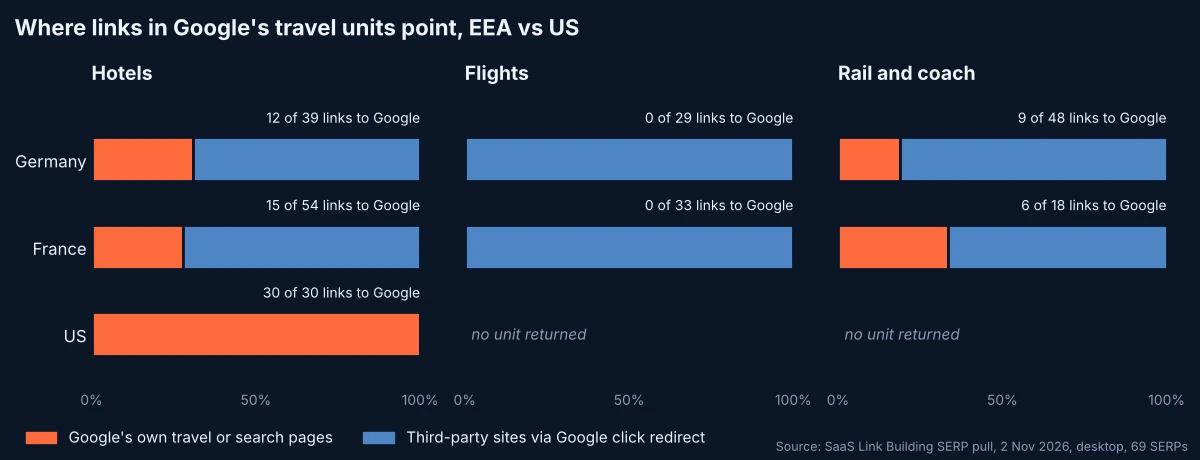
Every one of the ten European hotel searches returned a hotel unit. In nine of them the unit carried several provider tabs, the format Google's aggregator documentation describes. Google's own tab, linking to Google's hotel search, appeared in all nine. It was the first tab listed in six of them (Paris, Amsterdam and Barcelona, from both Berlin and Paris); Booking.com was listed first in the other three.
Across the ten European hotel units, 27 of 93 links (29%) went to Google's own hotel search. The rest went to Booking.com, Hotels.com, Tripadvisor, Vio.com, Bluepillow and other booking sites through Google's redirect. In New York the picture was the old one: all 30 links in the US hotel units pointed to Google's hotel search, and each US page carried a second "More Hotels" box further down.
Google's hotel search also still ranks as an ordinary organic result in Europe. Google Travel hotel pages appeared in the organic listings on six of the ten European hotel searches, including the top organic result for "hotels in berlin" from Berlin and "hotels in paris" from Paris, compared with four of five in New York.
Flights: no Google Flights links in the unit
Flights look very different. The eight European flight units we captured contained 62 links, and not one pointed to Google Flights. Every link went through Google's travel redirect to an airline site, such as Ryanair, Lufthansa, KLM or TAP Air Portugal. Our data does not label these boxes, so whether they are Google's documented supplier unit is our inference.
Our US flight searches returned no flight unit in the data we pulled, so we cannot compare like with like. What we can compare is organic ranking: Google Flights landing pages appeared in the organic results on four of ten European flight searches, including the top organic result for "flights paris to madrid" from both Berlin and Paris, and on two of five US searches.
Rail and coach: mostly third parties
The six European rail and coach units we captured held 66 links. Fifteen (23%) led to Google search pages and 51 went through Google's redirect to operators such as Deutsche Bahn, FlixBus (via an affiliate link) and BlaBlaCar Bus. None of the four US searches returned a transport unit.
Products: "Comparison Sites" with one comparison site
This is the result that most supports the rivals' case. Seven European product units in our sample were titled "Comparison Sites", four from Berlin and three from Paris, for queries such as "coffee machine" and "robot vacuum". In all seven, the only provider group in the data was Google. Of 49 entries, 43 linked to Google's own shopping results and none linked to a third-party comparison site; the other six carried no link in the data.
| Vertical | EEA units checked | Links to Google pages | Links to third parties | US equivalent |
|---|---|---|---|---|
| Hotels | 10 | 27 of 93 (29%) | 66 of 93 (71%) | 30 of 30 links to Google |
| Flights | 8 | 0 of 62 | 62 of 62 | No unit returned |
| Rail and coach | 6 | 15 of 66 (23%) | 51 of 66 (77%) | No unit returned |
| Product "Comparison Sites" units | 7 | 43 of 49 | 0 of 49 | No "Comparison Sites" unit |
Source: SaaS Link Building SERP pull, 2 November 2026. Links in sponsored blocks are excluded. Third-party links include Google redirect links that lead to booking and ticketing sites.
Sports: inconclusive
None of our 12 sports searches returned a score or standings widget in the data, in any location, so we cannot test the sports finding. What did differ: six of the eight European sports pages carried a "Related websites" carousel linking to third-party sports sites, a format that appeared on none of the four US pages. That is consistent with the ecosystem carousel Google lists for EEA sports queries.
The evidence for the theory
- A legal finding already exists. The Commission decided in July 2026 that Google gave its own services preferential treatment in shopping, hotels, transport and sports. That is not a theory; it is a binding decision, although Google can appeal it.
- Google's hotel search sits inside the rivals' unit. In our sample Google's hotel tab was present in every multi-provider European hotel unit and listed first in two thirds of them. Google's documentation says the top-ranked provider is expanded by default; since Google runs the ranking, that is our inference about who decides which tab leads.
- Product comparison units were Google-only. A unit labelled "Comparison Sites" that contains only Google's shopping results, on seven of seven occasions, is hard to square with a box meant to give comparison services visibility.
- Google's travel pages still rank organically. Google Travel hotel and flight pages ranked in European organic results on ten of 20 hotel and flight searches, and were the top organic result on four of them.
- The complaint has a long record. The 2017 Shopping decision survived every appeal, and national courts are now awarding damages.
The evidence against
- Flights look transformed. Zero of 62 European flight unit links led to Google Flights. If Google wanted to keep users inside its products, flights would be the obvious place to do it.
- Most European travel links now go to third parties. 71% of hotel unit links and 77% of rail and coach links went to other sites, against 0% of hotel unit links in New York.
- The design follows Google's published rules. The aggregator and supplier units work as Google's documentation describes, and nothing in that documentation says Google's own service is excluded from the provider list. Whether including it is compliant is a legal question the documentation does not answer.
- Google says its changes cost direct suppliers. Google has said earlier DMA changes cut free direct booking clicks to hotels, airlines and retailers, which, if accurate, means its redesigns shift clicks toward intermediaries rather than toward Google.
- Our view of the page is partial. The SERP data records the order of provider tabs, not which tab a real user sees expanded, and a data parser can miss modules. Our US flight and sports results show that gaps exist.
Verdict: likely, with flights the exception
On the narrow question of whether Google still gives its own services a privileged place in European results, our verdict is likely. Google's hotel search remains a provider inside the hotel units, usually listed first, and the product units labelled "Comparison Sites" in our sample showed only Google. Google's own travel pages also continue to rank organically.
On the wider claim that the September redesign is purely cosmetic, the evidence says no. Flights and ground transport now route the large majority of unit clicks to third parties, and even European hotel units send most clicks elsewhere, a sharp break from the US layout.
Whether what remains breaches the DMA is unproven and is for the Commission, not for a SERP sample, to decide. The following is speculation: if the Commission treats Google's hotel tab and Google-only comparison units as continued preferential treatment, its options include the periodic penalty payments that reporting put at up to 5% of worldwide turnover, and the "Comparison Sites" units are where we would expect the first change.
What this means for SEO teams
- Travel and retail sites selling into the EEA should check eligibility. Google's aggregator unit requires vertical search services to express interest through Google's forms and supply data feeds, while direct suppliers can appear in the supplier unit from crawlable website data.
- Track EEA and US results separately. The same query now produces structurally different pages. A rank tracker set to a US location will not show what a European user sees.
- Watch the redirect layer. Most links in the new European units pass through Google redirect URLs. Make sure your analytics attributes those visits correctly and that landing pages carry campaign parameters where Google's feeds allow it.
- Expect more change. The Commission's decision ordered Google to end the non-compliance, and Google kept updating its EEA documentation after launch, with the aggregator unit page last revised on 19 October.
This is not the first time our data has found Google sending users to its own pages. Earlier, our test found that AI Mode linked every product card in a 50-query sample to Google's own pages, and a separate check of Google's expanded links in AI Mode and AI Overviews tracked how Google is changing where its AI answers send traffic. Our earlier investigation into whether Google favours big brands found that YouTube and Reddit often won instead.
Methodology
On 2 November 2026, between 09:24 and 09:40 UTC, we requested Google desktop results for 23 English-language queries from three locations (Berlin, Germany; Paris, France; New York, United States) through a commercial SERP data API, top 10 depth, giving 69 results pages. The queries covered five hotel, five flight, four rail and coach, five product and four sports searches. Results were collected once, with no repeat runs except where a request was re-sent to obtain the full response format; in those cases the later response was used.
For each page we recorded the order of all result blocks, the position of the first organic result, and every link inside hotel, flight, product, shopping and sponsored units. Links were classed as Google pages (google.com/travel/search, Google shopping results and Google search pages), Google click redirects (google.com/travel/clk, which forward to third-party booking sites), ad redirects, third-party links, or no link. Sponsored blocks were excluded from the table. Organic results whose URL was a Google Travel hotel or flight page were counted as Google-owned organic listings; Google's generic /goto redirect links in organic results were not, because they lead to third-party sites. "Top organic result" means first among organic listings, not first on the page. Provider order inside hotel units was taken from the group labels in the API response. Limitations: a single snapshot, desktop only, an English interface, three locations, and a parser that does not record which tab is visually expanded and returned no flight or sports widget for some pages.
Conclusion
Google's European redesign moved most travel unit clicks in our sample to third-party sites, and its flight units sent none to Google Flights. But Google's hotel search still competes inside the hotel units, usually from the first tab, and the product units labelled "Comparison Sites" in our sample offered no comparison site except Google. The rivals' theory is partly right, and the Commission now has to decide whether partly is enough.
What do you think?
If you manage a travel, retail or comparison site in Europe, have you seen your clicks from Google's new aggregator or supplier units since 8 September, and does Google's own tab appear first for your key queries? Share your data with us.
Questions and answers
Why did the European Commission fine Google €460 million?
On 23 July 2026 the Commission found that Google gave its own services preferential treatment in shopping, hotel, transport and sports results in Search, placing them higher and with richer visuals and filters than comparable third-party services, in breach of the Digital Markets Act.
What are Google's aggregator and supplier units?
They are EEA search features Google documented on 8 September 2026. The aggregator unit shows results from vertical search services such as travel agencies and comparison sites for hotel, flight, rail and bus, product and local queries, with the top-ranked provider expanded by default. The supplier unit shows direct providers such as hotels and airlines and only appears alongside an aggregator unit.
Does Google Flights still appear in EU flight results?
Not inside the flight units in our 2 November 2026 sample: all 62 links in eight German and French flight units led to airline websites through Google's redirect. Google Flights landing pages still ranked as organic results on four of ten European flight searches.
Is Google's own hotel search still shown in Europe?
Yes, in our sample. Google's hotel search tab appeared in all nine multi-provider European hotel units and was listed first in six of them. Across all ten European hotel units, 27 of 93 links (29%) went to Google's hotel search, against 30 of 30 in New York.
How can travel and retail sites appear in Google's new EEA units?
Google says vertical search services must express interest through its forms, provide data feeds or APIs and meet Search content policies to join the aggregator unit. Direct suppliers serving EEA users can appear in the supplier unit from crawlable website data without applying.
More releases
-
Explainers
Search Console's Links Report Is a Sample: 12 SaaS Sites Hold 150,823 Spam-Scored Linkers
Google's John Mueller says site owners should ignore random spammy backlinks rather than check whether Search Console lists them. Google documents the Links report as a sample with 1,000-row tables, and all 12 SaaS sites we checked hold more than 1,000 spam-scored linking domains, with a median of about 12 new ones a day.
-
Industry news
Gemini Dropped Its utm_source Tag After 3 Weeks; None of 28 AI Mode Citations Carry One
Google's Gemini stopped adding utm_source=gemini to cited links around 29 September, about three weeks after it appeared, according to server logs shared by consultant Natzir Turrado. Google has not documented either change. Our pull of 10 AI Mode answers found no UTM tags on 28 citation links, and 24 routed through a Google redirect.
-
Studies
49% of Top Sites Using Schema Still Ship Markup for Rich Results Google Retired
A SaaS Link Building crawl of 1,567 top-site homepages found 839 using structured data, and 414 of them still carry markup for Google features that no longer exist. Sitelinks search box markup, retired in November 2024, remains on 23.2% of homepages, and FAQ markup on 66.
Tell us the site and the goals.
Rankings in Google and visibility in AI answers, from one monthly plan. One call is enough to say which one fits. Email works just as well.