Google AI Mode Linked All 180 Product Cards in Our 50-Query Test to Its Own Pages
Google's AI Mode linked every product card to its own pages in our test of 50 US searches on 30 October 2026. All 180 linked cards opened google.com product pages rather than retailers, Google pages made up 40% of source links, and 70% of all links stayed on Google.
 Vibhu Dhariwal
Cofounder & CTO, Digital Gratified
- Published
- Section
- Studies
- Reading time
- 7 minutes
Ras Al Khaimah, United Arab Emirates, .
Every product card that Google's AI Mode showed in our test of 50 US searches linked to a page on google.com, not to a retailer. We pulled AI Mode answers for 50 shopping and product-research queries on 30 October 2026 and classified all 360 links they contained. All 180 product cards that carried a link pointed to Google's own product pages, and 72 of the 180 source links in the answers did the same. Overall, 70% of the links in the answers went to Google.
The test follows a study reported by Search Engine Land this week under the headline "Google AI Mode sends 57% of product links to Google Shopping", and comes as Google pushes shoppers to stay inside its interface with Universal Cart, launched in the US on 15 October. That study's method may differ from ours: we counted product cards and source links separately, and in our sample the product cards never linked anywhere but Google.
Key findings
- 36 of 50 queries returned product cards. That included 23 of 25 "best" queries and 12 of 15 transactional queries, but only 1 of 10 informational product-research questions. The median answer with cards showed 4 of them.
- 0 product cards linked to a merchant. Of 193 product cards, 180 carried a link and every one opened a google.com product page (the URL uses Google's
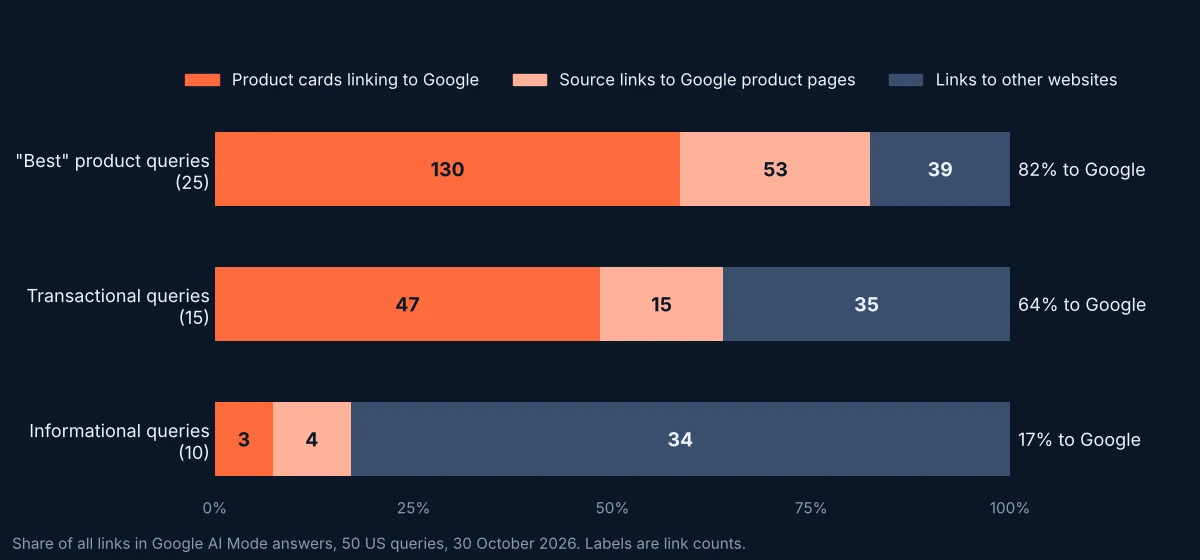
ibp=oshopshopping parameter). The other 13 had no link at all. - Google also dominates the source links. 72 of 180 source links (40%) pointed to the same Google product pages rather than to a review or retailer site. For "best" queries the share was 58% (53 of 92).
- 10 of 50 answers cited no outside website. Every source link in those answers went to a Google product page.
- Informational questions still send traffic out. For questions like "how to pick running shoes", 34 of 41 links (83%) went to other websites.
Where the outside links went
The 108 links that left Google went to 56 different hosts. Video and editorial review sites led, with retailers further down. The mix also shifted by intent: "best" queries leaned on editorial reviews, transactional queries on large retailers, and informational questions on YouTube and Reddit.
| Host | Source links | Where it appeared most |
|---|---|---|
| youtube.com | 15 | Informational questions (8) |
| nytimes.com (Wirecutter) | 11 | "Best" queries (9) |
| reddit.com | 8 | Informational questions (5) |
| walmart.com | 5 | Transactional queries (5) |
| bestbuy.com | 3 | Transactional queries (3) |
| amazon.com | 3 | Transactional queries (3) |
| rtings.com | 3 | "Best" queries (2) |
| bonappetit.com | 3 | Kitchen and food queries |
| All other hosts (48) | 57 | Mixed |
Source: SaaS Link Building analysis of 180 source links in 50 Google AI Mode responses, 30 October 2026. Counts are links, not queries.
Some answers relied on outside sources far more than others. "How to pick running shoes" cited 14 outside links and no Google pages, and "protein powder vanilla whey" cited 9 outside links. At the other end, answers for running shoes for flat feet, a 4K TV under $1,000, portable chargers, Lego Technic sets and an iPhone case cited only Google product pages, as did one informational question, "is a heat pump dryer worth it".
Context: Google's shopping push inside AI Mode
Google is building more of the shopping journey into AI Mode. Its Universal Cart announcement says shoppers can save items from AI Mode into one cart built on the Shopping Graph's "60+ billion continually refreshed product listings", then pay with Google Pay or move the cart to the merchant's site. We covered the details when Google launched Universal Cart in US Search and Gemini.
On the same day, Google's Hema Budaraju wrote that the company had substantially increased inline links in AI Mode and AI Overviews. That post did not mention shopping or product results, and our sample suggests product answers follow a different pattern: the link most prominently attached to a product is a Google page. Our earlier report on Google's expanded links in AI Mode and AI Overviews has the full list of those changes.
The commercial background matters too. Search Engine Roundtable reported this week that Google's chief business officer told investors on the earnings call that ads in AI Mode currently monetise at a lower rate than traditional search ads. We covered the quarter in our report on Google's Q3 search revenue. Our reading, which Google has not confirmed, is that keeping product clicks on Google-hosted pages gives Google more room to show listings and ads.
Google has not published how AI Mode chooses which products to show or why product cards open its own pages rather than a merchant page. Nothing in our data shows how many users click through from those Google pages to a retailer.
What this means for SEO and ecommerce teams
- Treat Merchant Center as the entry point. In our sample, every linked product card opened a Google product page, and Google says Universal Cart, which works in AI Mode, is built on the Shopping Graph. Accurate titles, prices, stock and images in your product feed decide what shoppers see before they reach your site.
- Do not count AI Mode product visibility as a site visit. A product card click lands on Google first. Expect AI Mode shopping traffic to arrive, if at all, as a second click, and check whether your analytics separates Google Shopping referrals from organic search.
- Earn the source links, not just the cards. Outside source links went mostly to editorial reviews, YouTube and Reddit. Brands that want to appear in "best" answers need to be covered by the review sites and video creators AI Mode already cites.
- Publish buying guides that answer real questions. Informational questions sent 83% of their links to other sites. Guides on sizing, specifications and trade-offs are where AI Mode still links out most.
- Re-test your own queries. AI Mode answers changed between repeat requests in our collection, so run your key product queries several times before drawing conclusions.
Methodology
On 30 October 2026, between 21:19 and 21:24 UTC, we collected Google AI Mode responses for 50 English-language queries with US settings through a third-party SERP data API. The queries were 25 "best" product queries (for example "best air fryer"), 15 transactional queries (for example "ninja creami sale") and 10 informational product-research questions (for example "how many lumens for a living room"). For each response we recorded every product card and every source link, and classified each link by host. Links whose host was google.com were counted as Google pages; all of them were product pages carrying the ibp=oshop parameter. Thirteen product cards with no link were counted as cards but not as links.
Five queries returned empty responses on the first attempt and were retried; two of these ("what to look for in a mattress" and "how to choose a coffee grinder") were text-only answers with no cards or links and are recorded as zero. Repeat requests for the same query returned different numbers of cards and links, so these figures are one snapshot of a changing system, not a stable rate. The sample is small and US-only, and it measures where links point, not where users click.
Conclusion
In our 50-query snapshot, Google AI Mode did not send a single product card directly to a retailer. All 180 linked cards opened Google's own product pages, and Google pages also made up 40% of the source links. Only informational product questions sent most of their links to the open web.
For merchants, the practical upshot is that product visibility in AI Mode now runs through Google's Shopping Graph first and the merchant's site second. The quality of the product feed, and coverage on the review and video sites AI Mode cites, will decide how much of that visibility turns into visits.
Questions and answers
Do Google AI Mode product cards link to retailer websites?
Not in our test. On 30 October 2026, all 180 linked product cards in 50 US AI Mode answers opened a google.com product page carrying Google's ibp=oshop shopping parameter. None linked directly to a merchant.
What share of all AI Mode links went to Google?
252 of the 360 links we classified (70%) pointed to Google product pages. The share was 82% for "best" product queries, 64% for transactional queries and 17% for informational product-research questions.
Which outside websites did AI Mode cite most for product queries?
Across 108 outside source links, YouTube appeared 15 times, the New York Times (Wirecutter) 11 times and Reddit 8 times, followed by Walmart with 5.
Is this a stable figure?
No. Repeat requests for the same query returned different numbers of cards and links, so the results are one snapshot of 50 US English queries collected on 30 October 2026, and they measure where links point, not where users click.
More releases
-
Updates
Google Will Honor a Shared AI Training Opt-Out in 2027; 128 of 531 Top Sites Block AI Bots
Google plans to treat a new cross-company robots.txt token, __usage_ai-training, as a Google-Extended opt-out from 2027, and Bing will honour it from 1 February 2027. Our crawl of 531 top-site robots.txt files found 128 already block AI tokens, most listing five or more companies.
-
Industry news
Gary Illyes Says AI Made Fake Googlebots Worse; 31 of 208 Google IPs Have No Reverse DNS
Google's Gary Illyes says AI scraping has made fake Googlebot traffic worse and urges reverse DNS checks. Our test of 208 addresses from Google's crawler IP files found Googlebot's ranges verify cleanly, but 31 of 40 Google Cloud fetcher addresses had no reverse DNS record.
-
Studies
Does Google Still Rank on Links? Court Files and 184 Top Results Say More Than It Admits
Google says links matter less than people think, yet its ranking guide, a US v. Google court opinion and leaked documentation still describe PageRank as core. In our pull of 184 top Google results, the top three pages had a median 74 linking domains, against 11 to 13 below them.
Tell us the site and the goals.
Rankings in Google and visibility in AI answers, from one monthly plan. One call is enough to say which one fits. Email works just as well.