Google Search Revenue Rose 0.1% From Q2 as AI Mode Ads Expand to 10 New Countries
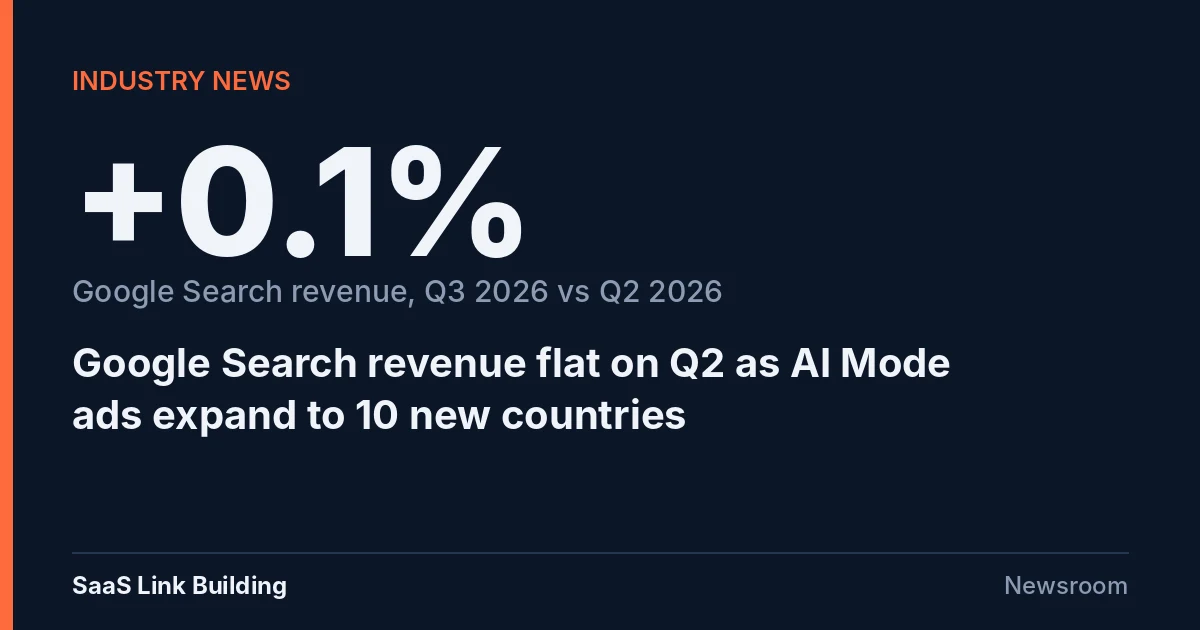
Alphabet's Q3 2026 results show Google Search & other revenue up 12% year on year to $63.35 billion but just 0.1% above Q2, as Google named lower AI Mode monetization as a drag and expanded AI Mode ads to 10 new countries. Google Network grew 1.4% after eight straight quarterly declines.
 Vibhu Dhariwal
Cofounder & CTO, Digital Gratified
- Published
- Section
- Industry news
- Reading time
- 7 minutes
Ras Al Khaimah, United Arab Emirates, .
Alphabet reported third-quarter 2026 results on 28 October, and Google Search & other revenue rose 12% year on year to $63.35 billion, according to the earnings release filed with the SEC. Measured against the previous quarter, though, Search revenue barely moved: up $79 million, or 0.1%, from $63.27 billion in Q2. On the same day Google said it is expanding ads in AI Mode to 10 new countries, and on the earnings call its Chief Business Officer named AI Mode's lower ad monetization as one reason Search growth slowed.
We pulled Alphabet's last nine quarterly earnings releases from SEC filings to put the quarter in context. The result shows the sharpest slowdown in Search growth in the period, and a small but notable turn for Google Network, the line that reflects ad revenue Google earns on publishers' sites and apps.
Key findings
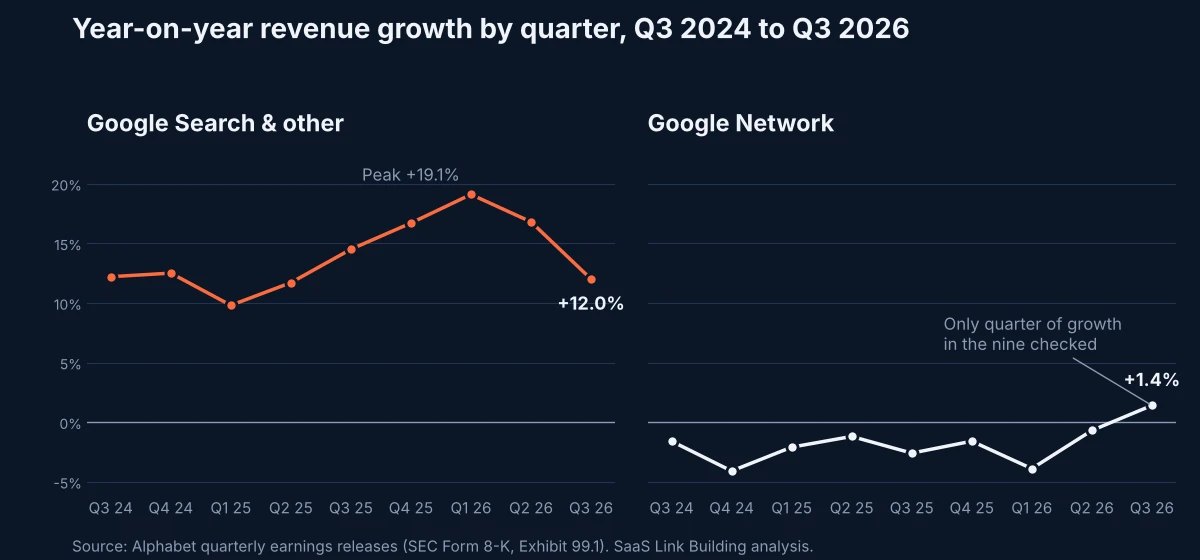
- Search growth slowed for a second straight quarter: from 19.1% in Q1 2026 and 16.8% in Q2 to 12.0% in Q3, the lowest rate since Q2 2025 (11.7%).
- The weakest Q2 to Q3 step in three years: Search revenue grew 0.1% from Q2 to Q3 in 2026, against 4.4% in 2025 and 1.8% in 2024, on our calculation from the filings.
- Google Network grew for the first time in our nine-quarter window: $7.455 billion, up 1.4% year on year, after eight straight quarters of decline.
- AI Mode ads are now scaling outside the US: Australia, Canada, India, Kenya, Malaysia, New Zealand, Nigeria, Pakistan, the Philippines and Singapore, with Brazil, Mexico and the UK named for Q4 2026.
- Google published no new AI Mode user or click figures: the Q3 CEO remarks cite AI Mode query length and input types, but drop the user count and the clicks-to-websites claim made in Q2.
The numbers, quarter by quarter
Each figure below comes from the "Revenues by type" table in Alphabet's quarterly release (Form 8-K, Exhibit 99.1). Year-on-year growth uses the prior-year figure printed in the same release.
| Quarter | Search & other ($M) | Google Network ($M) | Total TAC ($M) |
|---|---|---|---|
| Q3 2024 | 49,385 | 7,548 | 13,719 |
| Q4 2024 | 54,034 | 7,954 | 14,848 |
| Q1 2025 | 50,702 | 7,256 | 13,748 |
| Q2 2025 | 54,190 | 7,354 | 14,705 |
| Q3 2025 | 56,567 | 7,354 | 14,876 |
| Q4 2025 | 63,073 | 7,828 | 16,597 |
| Q1 2026 | 60,399 | 6,971 | 15,228 |
| Q2 2026 | 63,271 | 7,303 | 16,179 |
| Q3 2026 | 63,350 | 7,455 | 16,366 |
What Google said about the slowdown
On the call, Chief Business Officer Philipp Schindler gave currency movements as the largest reason Search growth fell back from Q2. He also pointed to Asia-Pacific retail advertisers hit by the EU ending its de minimis import exemption, and to media and entertainment spend settling after a Q2 lifted by the FIFA World Cup. The third factor he named was AI Mode: strong query growth there weighed on revenue because of "the lower monetization we were seeing in AI Mode," according to the call transcript. He did not quantify that effect. CFO Anat Ashkenazi added that Search is now lapping the acceleration that began in the second half of 2025, which she put at about three points of growth in Q3.
Schindler also said most AI Mode queries are incremental and many are upper-funnel, which he framed as a future monetization opportunity. Alphabet shares fell about 10% after hours as adjusted earnings per share missed forecasts; Investing.com attributed the profit decline mainly to an unrealised loss on Alphabet's SpaceX stake rather than to Search.
In his published remarks, CEO Sundar Pichai said Google is putting the Search experience first and monetization second, comparing the shift to the move to mobile. He said year-on-year query growth is at its highest in five years, that one in five AI Mode searches globally use voice, images or documents, and that Google now handles more than 50 billion visual searches a month.
What changed from Q2's message
We compared Pichai's Search remarks across the last two quarters. In Q2, he said AI Mode had passed 1 billion monthly active users and that Google was sending "billions of clicks to websites every week" through AI features in Search. Neither figure appears in the Q3 remarks. Q3 adds the query growth claim and the visual search count instead. Google has still not published a click-through rate from AI Mode or AI Overviews to websites; the only click metric in the Q3 announcements compares sponsored and organic product listings inside AI Mode, which Google says are now similar, based on US data from 20 August to 3 September 2026.
AI Mode ads: what the help page adds
The Ads & Commerce blog post from Shashi Thakur lists the 10 new countries and says multiturn ads, which can appear in follow-up questions in AI Mode, are launching in the US. The supporting Google Ads help page carries details the announcement leaves out. On our reading of it:
- Ads inside AI Overviews and AI Mode are served in English only, in the US plus the 10 named countries, with two caveats: Pakistan gets text ads only, and Indonesia appears in the list for AI Overviews only.
- Ads above or below AI Overviews can run in all of the 200+ countries and territories where AI Overviews are available.
- Existing Search, Shopping and Performance Max campaigns are eligible automatically. Advertisers cannot target AI Overviews or AI Mode on their own or opt out of them separately from Search.
- Reporting is aggregated into standard campaign and search terms reports, with no separate AI Mode breakdown.
- Google says paid ads do not influence organic AI Overviews or AI Mode answers, and that organic citations do not affect ad auction eligibility.
We covered the earlier US test of ads in AI Mode for Personal Intelligence users in our report on Gmail and Photos signals shaping AI Mode ads.
What this means for SEO teams
- Expect more sponsored units in AI answers outside the US. If you track AI Mode or AI Overview visibility in Australia, Canada, India or the other named markets, start logging whether a sponsored block sits above your organic citation, since that changes how much attention the citation gets.
- Don't read the Network uptick as a publisher recovery yet. One quarter of 1.4% growth follows eight quarters of decline, and Network's share of Google advertising revenue fell to 9.1% in Q3 2026 from 9.9% a year earlier on the filed numbers. Publisher search referrals are a separate trend; Chartbeat data showed search falling to 12% of North American publisher pageviews in Q3, as we reported last week.
- Watch for monetization changes, not just features. Google has now told investors AI Mode monetizes below traditional Search. Pressure to close that gap points toward more ad formats in conversational results, the area to monitor in Search Console query data and in manual SERP checks.
- Plan for longer, multimodal queries. With AI Mode queries three times longer and one in five using voice, images or documents, content that answers specific, multi-part questions has more surface area. Our earlier coverage of Google's link changes in AI Mode and AI Overviews covers how those answers cite sources.
Methodology
On 29 October 2026 we downloaded Alphabet's nine most recent quarterly earnings releases (Exhibit 99.1 to Form 8-K, Q3 2024 to Q3 2026) from the SEC's EDGAR system. From each release we took the current-quarter and prior-year-quarter figures for Google Search & other, Google Network and total TAC. Year-on-year growth is the current-quarter figure divided by the prior-year figure printed in the same release. The Q2 to Q3 sequential change compares each year's Q3 Search figure with the same year's Q2 figure as printed in the releases. Google Network's share is Network revenue divided by total Google advertising revenue for the same quarter. Statements were compared using the full text of Pichai's published Q2 and Q3 2026 remarks.
Conclusion
Google Search is still growing at double digits, but Q3 2026 was nearly flat on Q2, and Google has told investors that AI Mode's lower monetization is one of the reasons. Its answer is to scale AI Mode ads to 10 more countries now and more in Q4, with no way for advertisers to opt out and no new data for publishers on clicks from AI features. For SEO teams the practical takeaway is to expect the commercial layout of AI answers to keep changing quickly outside the US.
Questions and answers
How much did Google Search revenue grow in Q3 2026?
Google Search & other revenue was $63.35 billion in Q3 2026, up 12% from $56.57 billion a year earlier and up 0.1% from $63.27 billion in Q2 2026, according to Alphabet's earnings release.
Why did Google Search growth slow in Q3 2026?
On the earnings call, Philipp Schindler named currency movements as the largest factor, plus Asia-Pacific retail advertisers affected by the EU ending its de minimis exemption, normalised media spend after the World Cup, and lower monetization in AI Mode. CFO Anat Ashkenazi said Search is also lapping the acceleration that began in late 2025.
Which countries now get ads in AI Mode?
Google said on 28 October 2026 it is scaling ads in AI Mode in Australia, Canada, India, Kenya, Malaysia, New Zealand, Nigeria, Pakistan, the Philippines and Singapore, in addition to the US, with Brazil, Mexico and the UK planned for Q4 2026. Its help page says Pakistan gets text ads only and ads are served in English.
Can advertisers opt out of ads in AI Mode or AI Overviews?
No. Google's Ads help page says existing Search, Shopping and Performance Max campaigns are eligible automatically, and advertisers cannot target or opt out of AI Overviews or AI Mode separately from Search. Negative keywords and brand exclusions still apply.
More releases
-
Industry news
Google Opens Connected Apps Platform as Search Lists 5 Apps Against Gemini's 85
Google opened a preview of its Connected Apps Platform on 28 October, letting developers bring MCP-based apps into AI Mode in Search and the Gemini app. Google's help pages list 85 Connected Apps in Gemini but only 5 in Search, all US English, and the new developer policy bans tool descriptions written to win selection.
-
Updates
Google's Favicon Rules Now Cover Redirects; 76% of 541 Top Homepages Change Host First
Google has rewritten its favicon crawling guideline to say Googlebot must be able to follow any redirects from the home page to the page declaring the favicon. Our crawl of the 1,000 most popular domains found 412 of 541 working homepages (76.2%) redirect to a different hostname first.
-
Explainers
Google's 16 October Privacy Policy Lets Gmail and Photos Data Shape Ads: What Changed
Google's privacy policy, revised on 16 October 2026, now lets data from Gmail, Google Photos and Drive inform personalized ads when users connect those apps to Search. Google's own comparison shows five rewritten passages, and our archive check finds it came 15 days after the last version, the fastest revision in Google's archive.
Tell us the site and the goals.
Rankings in Google and visibility in AI answers, from one monthly plan. One call is enough to say which one fits. Email works just as well.