Google's 16 October Privacy Policy Lets Gmail and Photos Data Shape Ads: What Changed
Google's privacy policy, revised on 16 October 2026, now lets data from Gmail, Google Photos and Drive inform personalized ads when users connect those apps to Search. Google's own comparison shows five rewritten passages, and our archive check finds it came 15 days after the last version, the fastest revision in Google's archive.
 Vibhu Dhariwal
Cofounder & CTO, Digital Gratified
- Published
- Section
- Explainers
- Reading time
- 7 minutes
Ras Al Khaimah, United Arab Emirates, .
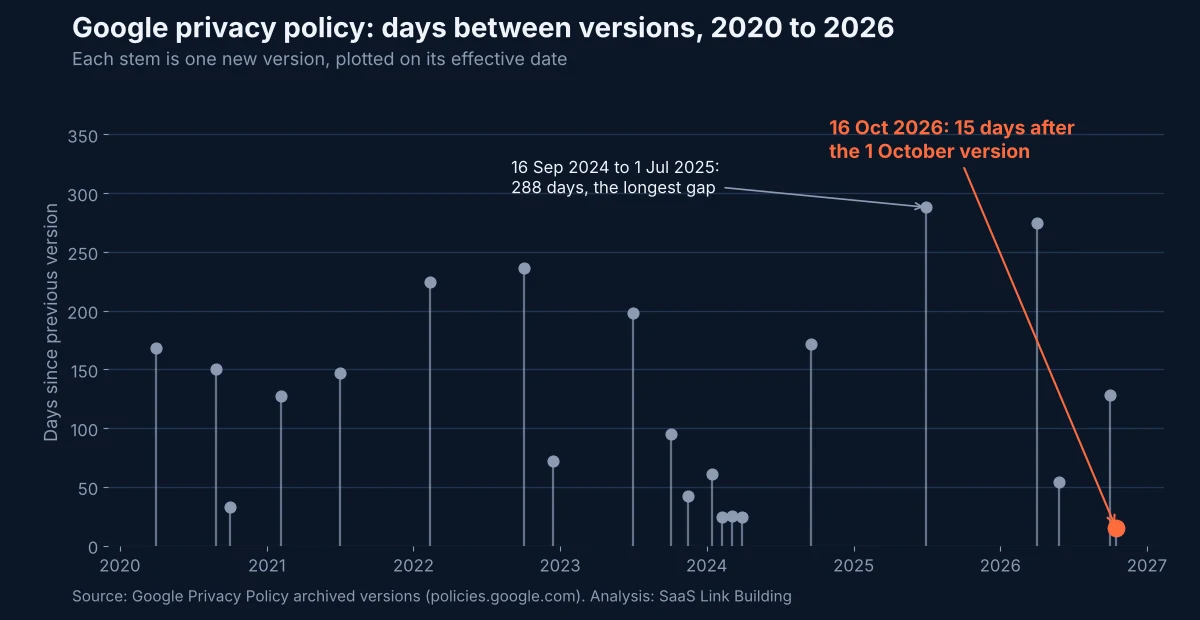
Google's privacy policy now allows information from Gmail, Google Photos and Drive to shape personalized ads when a user connects those apps to another Google service, such as Search. The revised policy took effect on 16 October 2026, and Google's own comparison of the 1 October and 16 October versions shows exactly which lines moved. Search Engine Journal reported the change on 27 October. Our check of Google's policy archive finds it is also the fastest revision in that record: 15 days after the previous version, the shortest gap between two versions in an archive that runs back to 1999.
This newsroom covered the start of Google's ad test inside Personal Intelligence in AI Mode on 18 October. What is new is that the rule now sits in the company-wide privacy policy rather than only in a Search Help answer, and the wording covers more than AI Mode.
What changed in the policy
Leaving aside the new date and some link text, Google's comparison page marks five passages as added or rewritten. Paraphrased, they are:
| Section | 1 October 2026 version | 16 October 2026 version |
|---|---|---|
| Personalized services | No mention of one Google service reading data from another | New paragraph: users may let services such as Search or Gemini Apps access Google Photos, Gmail and Drive data, and Search may use it to personalize content, including ads |
| What drives personalized ads | Interests and activity across Google services | Interests, activity, or personalized content from Google services |
| Drive, Gmail and Photos rule | No personalized ads based on content from Drive, Gmail or Photos | Same rule, with an exception when the user makes that data available to other services that support personalized ads |
| Personal Intelligence | Not named | New example: Search may use booking details from an email to suggest things to do near a hotel; links to Personal Intelligence |
| Ad example | A search for mountain bikes may lead to sports ads on YouTube | Same example, now specifying the search happens in Search |
The new personalization paragraph ends by saying Search may use connected data "to personalize content, including ads". The long-standing promise not to target ads using Drive, Gmail or Photos content stays in place, but it is now conditional on the user not connecting those apps.
The 1 October version, which the new one replaced, had made a smaller edit of its own. Google's comparison of the May and October versions shows one change: data held for signed-out users, tied to a browser or device identifier, can now tailor search results or ads based on activity across devices, where the earlier text said only activity.
How connected data reaches ads
The mechanics are spelled out in Google's Search Help page on connecting content apps, the page Google maintains for the connected-apps feature:
- What is used. When apps are connected, Search may draw on summaries, excerpts and inferences from them to personalize answers. The page adds: "That same info may be used to show you ads."
- What is not shared. Advertisers do not get access to a user's Gmail inbox or Google Photos, and Google says it does not personalize ads on sensitive categories such as health, religion or sexual orientation.
- Where it applies. Connecting apps opens them to all Search services, which the page defines as Google Search (including AI Mode and Discover), Maps (including Ask Maps), Shopping, Flights, Hotels, Translate and News.
- Training and review. The page says connected data may be used to improve Google services, including training generative AI models, and that a subset of AI Mode and Ask Maps data is read by human reviewers.
Google launched Personal Intelligence in AI Mode on 22 January 2026 as an opt-in Labs experiment for Google AI Pro and AI Ultra subscribers in the US, in English, according to Robby Stein's announcement on Google's blog. That post said nothing about ads.
Our check: where it is available, and how fast the policy moved
The help page lists the countries, territories and languages where Search users can connect content apps. We counted 191 countries and territories (46 in the Americas, 54 in Asia-Pacific, 91 in Europe, the Middle East and Africa) and 98 languages. None of the 27 EU member states appears, and neither do the UK, Norway, Iceland, Liechtenstein or Switzerland. The US, Canada, India, Japan, Australia, Brazil and Mexico are all listed.
The policy archive shows how unusual the October pace is. Google published four versions in 2026 (2 April, 26 May, 1 October and 16 October), after one in 2025.
What this means for SEO teams
- Treat personalized AI Mode answers as a commercial surface. For travel, restaurant, retail and software queries, a connected user may now see ads informed by their own bookings and purchases, sitting next to the organic sources AI Mode cites. Organic visibility in these answers competes with paid placements that use context no keyword tool can see.
- Do not expect rank trackers to see it. These responses depend on a signed-in user's email and photos. Sampled SERPs and AI visibility tools that query from clean sessions will not reproduce them, so judge AI Mode and Discover performance on Search Console and on-site conversion data.
- Check where you are testing from. Because the connected-apps option is not offered in the EU, EEA, UK or Switzerland, teams that run manual checks from European offices will not see the personalized experience their US, Indian or Australian audiences can get.
- Make booking and order emails useful. Google's own example is Search reading a hotel booking from email. Confirmation emails with clear business names, addresses, dates and product names give Google concrete facts to match against, and should agree with your Business Profile and product data.
- Brief paid search colleagues. Google has not announced new targeting options or reporting for these ads, so paid teams cannot yet isolate which impressions were shaped by connected data.
Context
The change continues Google's push to add commercial features around AI Mode. This newsroom has covered the expansion of links in AI Mode and AI Overviews and, on the publisher side, the opt-out control for generative AI features that Google added to its blocking guide. Rival assistants are moving the same way: OpenAI has expanded ChatGPT ads to 89 markets.
Methodology
On 28 October 2026 we downloaded Google's privacy policy archive page, the current policy, and Google's comparison pages for the 26 May to 1 October and 1 October to 16 October versions. We extracted every passage the comparison pages mark as inserted or deleted. We listed all archived effective dates, added the current 16 October version, and counted the days between consecutive versions. On the same day we downloaded Google's Search Help page on connecting content apps and counted the entries in its supported countries and territories and supported languages lists, then checked each EU member state, the UK, Norway, Iceland, Liechtenstein and Switzerland against the country list.
Conclusion
Google has written into its main privacy policy what its Search Help page already said: once a user connects Gmail or Google Photos to Search, information drawn from them may shape the ads that user sees across Search services, including AI Mode and Discover. The revision came 15 days after the last one, the fastest turnaround in the policy's archived history, and the connected-apps feature it supports is offered in 191 countries and territories but none in the EU, EEA, UK or Switzerland.
For SEO teams the practical effect is a class of AI Mode answers that are personalized, ad-bearing and invisible to outside measurement. Google has not announced when the AI Mode ad test will move beyond testing.
Questions and answers
What changed in Google's privacy policy on 16 October 2026?
Google added a paragraph saying users may let services such as Search or Gemini Apps access data from Google Photos, Gmail and Drive, and that Search may use it to personalize content, including ads. Its rule against personalized ads based on Drive, Gmail or Photos content now has an exception for users who connect those apps.
Can advertisers see my Gmail or Google Photos?
No. Google's Search Help page says advertisers do not get access to a user's Gmail inbox or Google Photos when apps are connected. Search may use summaries, excerpts and inferences from connected apps, and that information may be used to show ads.
Which Google products count as Search services?
Google's help page defines Search services as Google Search (including AI Mode and Discover), Maps (including Ask Maps), Shopping, Flights, Hotels, Translate and News.
Is connecting apps to Search available in Europe?
Not in the EU, EEA, UK or Switzerland. Our count of the help page's list found 191 supported countries and territories and 98 languages, with none of the 27 EU member states, the UK, Norway, Iceland, Liechtenstein or Switzerland listed.
How do users stop connected data shaping ads?
Google's help page says users choose whether to connect content apps and can disconnect them from Search services at any time. The privacy policy says ad personalization can also be controlled in My Ad Center.
More releases
-
Studies
Does Word Count Help You Rank? Our 40-SERP Test Finds Length Tracks Intent, Not Position
Google says content length alone does not matter for ranking. Our test of 237 pages ranking for 40 Google searches agrees: word count and position were barely related (rho -0.125), the direction flipped from keyword to keyword, and query type, not position, set how long top pages were.
-
Industry news
Semrush Confirms Poisoned Google SERPs; 12 of Our 24 Repeat Fetches Failed to Agree
Semrush said on 27 October that Google is serving some automated searches results that differ from what users see, joining AccuRanker and Nozzle. Our test of eight keywords, fetched three times within five minutes, found 12 of 24 fetches shared fewer than half their top-10 domains with the other two.
-
Industry news
ChatGPT Info-Seeking Hit a 20.7% High, Rising in 33 of the 35 Heaviest-Use Countries
OpenAI's Signals v3.0 data, released on 26 October, shows information requests reached 20.7% of consumer ChatGPT messages in August 2026, up from 16.7% in July 2024. Our analysis of the files finds the rise concentrated in heavy-use countries and among users aged 25 to 64.
Tell us the site and the goals.
Rankings in Google and visibility in AI answers, from one monthly plan. One call is enough to say which one fits. Email works just as well.