ChatGPT Info-Seeking Hit a 20.7% High, Rising in 33 of the 35 Heaviest-Use Countries
OpenAI's Signals v3.0 data, released on 26 October, shows information requests reached 20.7% of consumer ChatGPT messages in August 2026, up from 16.7% in July 2024. Our analysis of the files finds the rise concentrated in heavy-use countries and among users aged 25 to 64.
 Vibhu Dhariwal
Cofounder & CTO, Digital Gratified
- Published
- Section
- Industry news
- Reading time
- 7 minutes
Ras Al Khaimah, United Arab Emirates, .
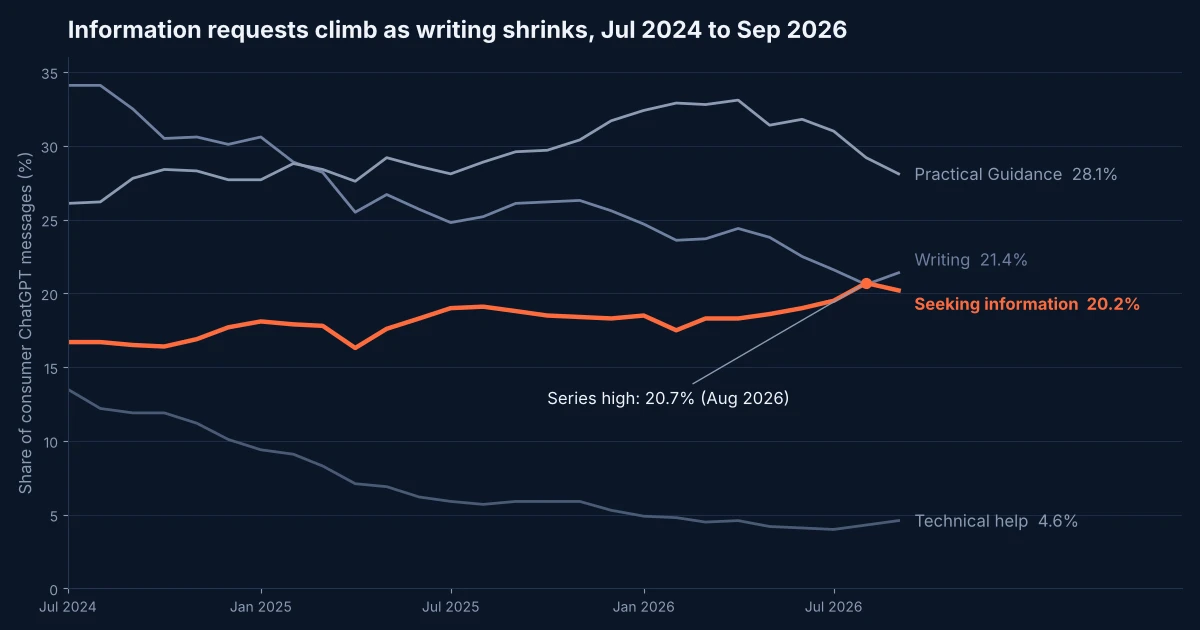
OpenAI released version 3.0 of its OpenAI Signals usage dataset on 26 October, covering about one million consumer ChatGPT messages a month from July 2024 to September 2026. We downloaded the full CSV package and found that "Seeking information", the category closest to a classic search query, reached a series high of 20.7% of consumer messages in August 2026, up from 16.7% in July 2024. The growth is concentrated in the countries that use ChatGPT most heavily per person, while several high-population emerging markets saw the share stall or fall.
Key findings
- Seeking information made up 20.2% of consumer ChatGPT messages in September 2026, against 16.7% in July 2024. The August 2026 reading of 20.7% is the highest in the 27-month series.
- In August 2026, Seeking information (20.7%) edged past Writing (20.6%) for the first time in the series. The gap is a single rounding step, so treat it as a tie rather than a lead.
- Across 139 countries with complete data, the share rose in 82 and fell in 57 between July to September 2024 and July to September 2026.
- Among the 35 countries with the highest per-capita ChatGPT use, it rose in 33. Among the 35 with the lowest per-capita use, it rose in only 8.
- Older users lean hardest on ChatGPT for information. By our calculation, Seeking information accounted for about 27% of messages from users aged 55 to 64 in September 2026, against about 17% for 18 to 24 year olds.
What OpenAI published
Signals is OpenAI's public window on how people use the consumer version of ChatGPT. The v3.0 package contains 24 CSV files and a README with a data dictionary. Each month's figures come from a sample of about one million messages from accounts with a declared age of at least 18, classified automatically by language models rather than read by people. OpenAI adds differential privacy noise before publishing and rounds most shares to three decimal places. Enterprise accounts, users who opted out of training and deleted accounts are excluded, so the data describes consumer use only. The dataset is released under a Creative Commons Attribution licence and builds on the method in the 2025 NBER working paper "How People Use ChatGPT".
The README states exactly what sits inside each topic. Seeking information combines three finer labels: specific information, purchasable products, and cooking and recipes. Practical Guidance covers how-to advice, tutoring, creative ideation and health, fitness and self-care. For SEO teams, these two groups map most closely to informational and commercial-investigation search. Together they accounted for 48.3% of consumer messages in September 2026, up from 42.8% in July 2024.
The gains come from heavy-use countries
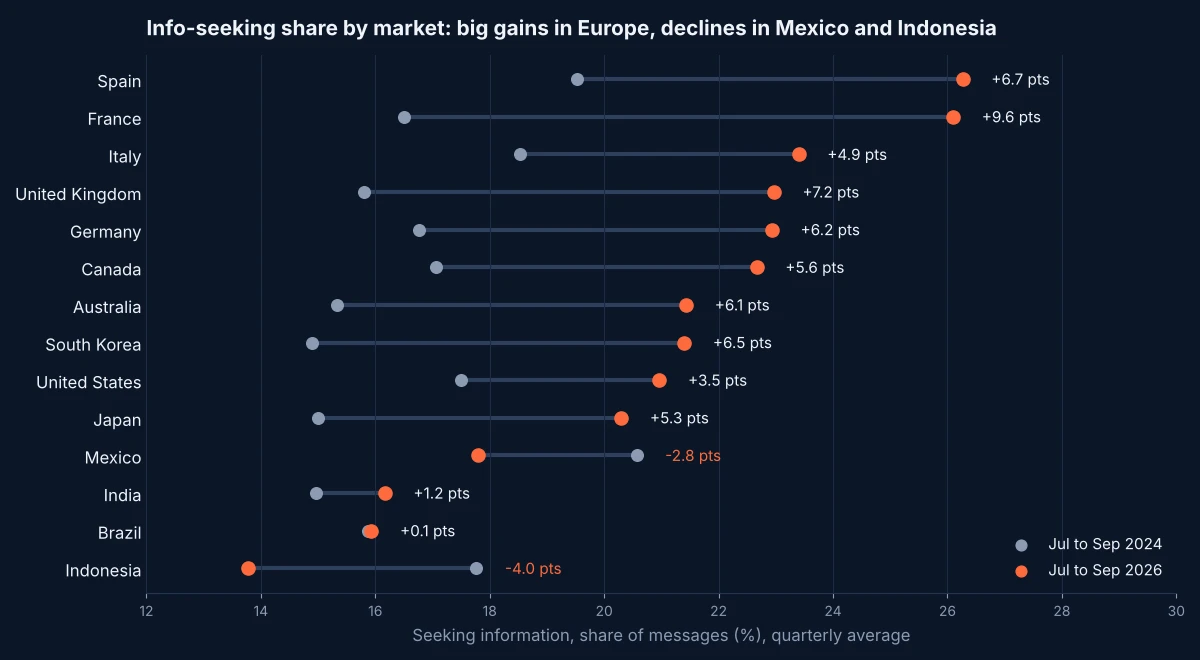
The global average hides a split. We grouped the 139 countries that have a full three months of data in both July to September 2024 and July to September 2026 into four equal bands, using OpenAI's own per-capita usage ranking for the third quarter of 2026. The countries where ChatGPT is most embedded in daily life are the ones where it has shifted most toward answering questions.
| Per-capita ChatGPT use (Q3 2026 rank) | Countries | Median share, Q3 2024 | Median share, Q3 2026 | Countries where share rose |
|---|---|---|---|---|
| Highest quarter | 35 | 17.5% | 24.5% | 33 |
| Second quarter | 35 | 17.5% | 19.9% | 28 |
| Third quarter | 34 | 18.0% | 16.5% | 13 |
| Lowest quarter | 35 | 18.1% | 16.0% | 8 |
Two years ago the four bands sat within a percentage point of each other. Now the gap between the top and bottom bands is 8.5 points. A rank correlation between per-capita usage rank and the change in the Seeking information share is strong (Spearman coefficient of about -0.71, where a lower rank number means heavier use).
The highest shares in the third quarter of 2026 were in Central and Northern Europe: Slovenia (31.2%), Croatia (30.0%), Slovakia (29.4%), Montenegro (28.7%) and Czechia (28.1%). France posted one of the largest rises among big markets, up 9.6 points to 26.1%. The United States moved from 17.5% to 21.0%. At the other end, Indonesia fell from 17.8% to 13.8% and Mexico from 20.6% to 17.8%, while Brazil was flat at about 15.9% and India rose only modestly, to 16.2%.
Older users ask more questions
Signals does not publish topic shares by age directly, but it does publish the age mix of each topic and the age mix of all messages. Combining the two gives the share of each age group's messages that are about seeking information. The result is noisy, because each input carries privacy noise, but the pattern is consistent.
| Age group | Seeking information share, Jul 2024 | Seeking information share, Sep 2026 |
|---|---|---|
| 18 to 24 | 17.8% | 17.3% |
| 25 to 34 | 15.0% | 19.7% |
| 35 to 44 | 16.3% | 21.9% |
| 45 to 54 | 17.4% | 24.3% |
| 55 to 64 | 19.6% | 26.8% |
| 65 and over | 22.3% | 23.2% |
Users aged 45 and over also make up a growing slice of ChatGPT traffic: 16.1% of consumer messages in September 2026, against 10.1% in July 2024, according to the age file. The youngest group has not changed how much it asks; most of the growth comes from people aged 25 to 64.
Seeking information is also mostly a personal activity. Only 24.3% of Seeking information messages in September 2026 were classified as work-related, compared with 33.1% in July 2024. Across all topics, the work-related share fell from 51.6% to 32.2% over the same period.
What this means for SEO teams
A rising share is not the same as rising volume taken from Google. Signals reports proportions of ChatGPT messages, not message counts, and says nothing about whether these users searched less elsewhere. Our earlier look at how little referral traffic ChatGPT sends compared with Google organic is a reminder that question volume in a chatbot and clicks to websites are different measures.
Still, the direction is useful for planning:
- Check your market before you act. If most of your audience is in the UK, France, Germany, the Nordics or Central Europe, informational queries are moving into ChatGPT faster than the global average suggests. If it is in Brazil, India, Indonesia or Mexico, the data shows little or no shift so far.
- Audit content for purchasable products. Product questions sit inside Seeking information. Our 20-prompt test of ChatGPT's searches found it added brand names to most unbranded product prompts, so being named on the pages it retrieves matters.
- Write for older readers too. The 45 to 64 groups show both the biggest rise in information requests and a growing share of usage. Clear, sourced answers suit that audience in search and in AI answers alike.
- Do not read the August crossover as a trend break. Seeking information fell back to 20.2% in September while Writing ticked up to 21.4%. Watch the next release before treating it as a lasting lead.
For context on how often ChatGPT actually goes to the web when it answers, see our coverage of a large fan-out study that found web search in a minority of answers.
Methodology
On 28 October 2026 we downloaded the OpenAI Signals v3.0 CSV package (data-download-csv.zip, 24 CSV files) from OpenAI's CDN and verified that it unpacked cleanly. Global topic shares come from share_of_messages_by_topic_month.csv. Country figures use share_of_messages_by_topic_country_month.csv: for each country we averaged the three monthly "Seeking information" values for July to September 2024 and for July to September 2026, keeping only the 139 countries with all six months present. Per-capita usage bands use the third-quarter 2026 rows of share_of_messages_by_country_quarter_rank.csv, split into quartiles of 35, 35, 34 and 35 countries. Age shares were derived with Bayes' rule from share_of_messages_by_age_group_topic_month.csv, share_of_messages_by_age_group_month.csv and the global topic share for the same month. Work-related shares come from share_of_messages_by_work_related_topic_month.csv and share_of_messages_by_work_related_month.csv. All source values are rounded to three decimals and include differential privacy noise, so differences of a few tenths of a point should not be over-read. The README notes that v3.0 restated earlier data with a larger sample, so figures may differ from those published in earlier Signals versions.
Conclusion
OpenAI's own data shows ChatGPT drifting from a writing assistant toward a question-answering tool, with Seeking information now about one in five consumer messages. The shift is real but uneven: it is strongest in heavy-use, mostly European and English-speaking markets and among users aged 25 to 64, and close to absent in several large emerging markets.
For SEO teams, the practical step is to weigh the data by where your audience lives. The next Signals release will show whether August's tie with Writing becomes a lead.
Questions and answers
What is OpenAI Signals?
OpenAI Signals is a public dataset on how people use consumer ChatGPT. Version 3.0, released on 26 October 2026, covers about one million classified messages a month from July 2024 to September 2026 and is published under a Creative Commons Attribution licence.
What counts as Seeking information in the Signals data?
According to the Signals README, Seeking information combines three finer labels: specific information, purchasable products, and cooking and recipes.
How much of ChatGPT use is now information seeking?
Seeking information was 20.2% of consumer ChatGPT messages in September 2026 and peaked at 20.7% in August 2026, up from 16.7% in July 2024.
Does the data show ChatGPT taking searches from Google?
No. Signals reports the share of ChatGPT messages in each topic, not message counts, and contains no data on Google use. It shows ChatGPT's own mix shifting toward information requests, not a measured loss of searches elsewhere.
Which countries saw the biggest rise?
Among countries with complete data, the highest shares in July to September 2026 were in Slovenia (31.2%), Croatia (30.0%) and Slovakia (29.4%). Among large markets, France rose 9.6 points to 26.1%, while Indonesia and Mexico fell.
More releases
-
Studies
0 of 799 Top-Site Pages Use Nosnippet, the Robots Rule That Also Limits AI Overviews
A SaaS Link Building crawl of 525 homepages and 274 inner pages from the world's top 1,000 domains found no page using nosnippet or a max-snippet limit, the page-level rules Google says also keep content out of AI Overviews and AI Mode. Only 17% of homepages asked for large image previews.
-
Industry news
Trackers Spike Again on 27 October, but Our 14-Keyword SERP Check Finds No Extra Churn
Rank trackers showed a second, larger Google volatility spike on 27 October 2026, but Google has logged no ranking update since 8 October. Our comparison of stored snapshots for 14 US keywords found 65% of top URLs survived across 24 October, against 58.5% in the previous window, with the biggest swings tied to location errors or one-off snapshots.
-
Explainers
Page Indexing Report Stuck Since 16 October? Mueller Says Watch Performance Data First
A Search Console user says the Page Indexing report has not updated since 16 October, and Google's John Mueller replied that indexing changes show up in Performance reports first. Our check of our own property found 54 of 55 recent posts indexed via URL Inspection and most new posts earning impressions within a day.
Tell us the site and the goals.
Rankings in Google and visibility in AI answers, from one monthly plan. One call is enough to say which one fits. Email works just as well.