ChatGPT Named Brands in 77 of 82 Searches for Unbranded Prompts, Our 20-Prompt Test Finds
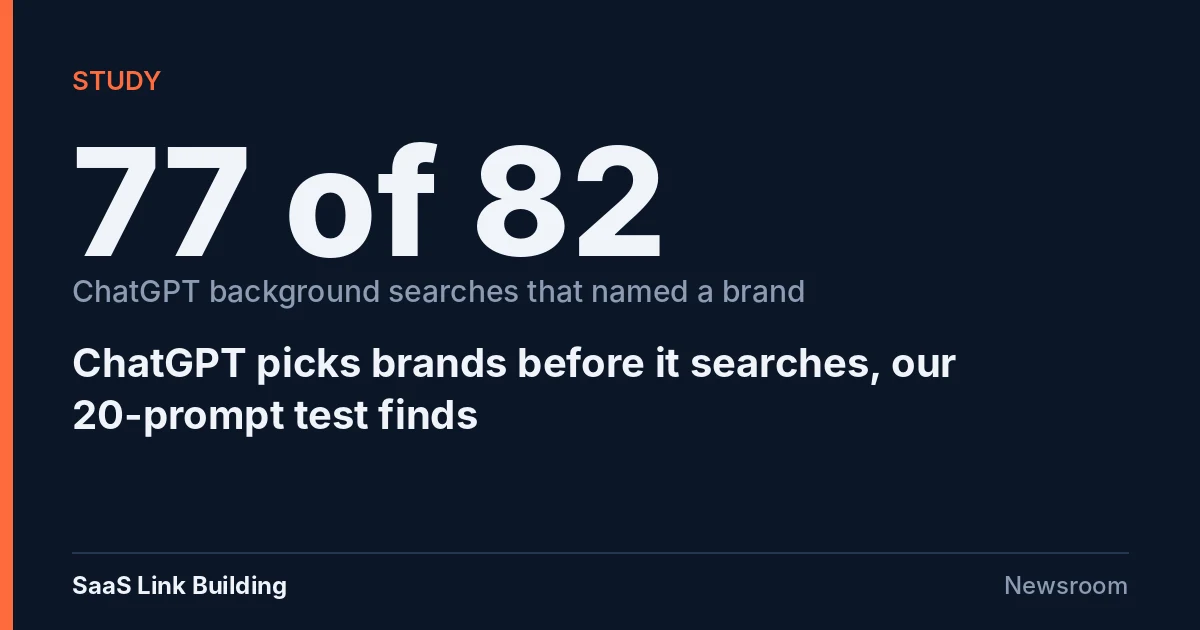
When ChatGPT searched the web to answer 20 unbranded "best tool" questions, 77 of its 82 background queries already named brands, and 74% of the products in its answers had appeared in those queries. Our 27 October test supports Graphite's finding that what a model already knows shapes what it searches for.
 Vibhu Dhariwal
Cofounder & CTO, Digital Gratified
- Published
- Section
- Studies
- Reading time
- 8 minutes
Ras Al Khaimah, United Arab Emirates, .
When ChatGPT searches the web to answer an unbranded "what is the best" question, it usually already knows which brands it wants to look up. In a test we ran on 27 October 2026, OpenAI's gpt-6-luna model put a product or brand name into 77 of the 82 background search queries it issued for 20 unbranded comparison prompts (93.9%), and 74% of the products in its search-enabled answers had already appeared in those queries. The test follows a 16 October analysis by the growth agency Graphite, which argued that what a model knows from training shapes what it finds when it searches.
Key findings
- Brands go in before results come back. None of our 20 prompts named a brand, yet 77 of 82 fan-out queries (93.9%) did. In 15 of the 20 prompts, the very first search query already listed specific brands, for example "best project management software small remote teams 2026 official pricing features Asana Trello ClickUp Basecamp".
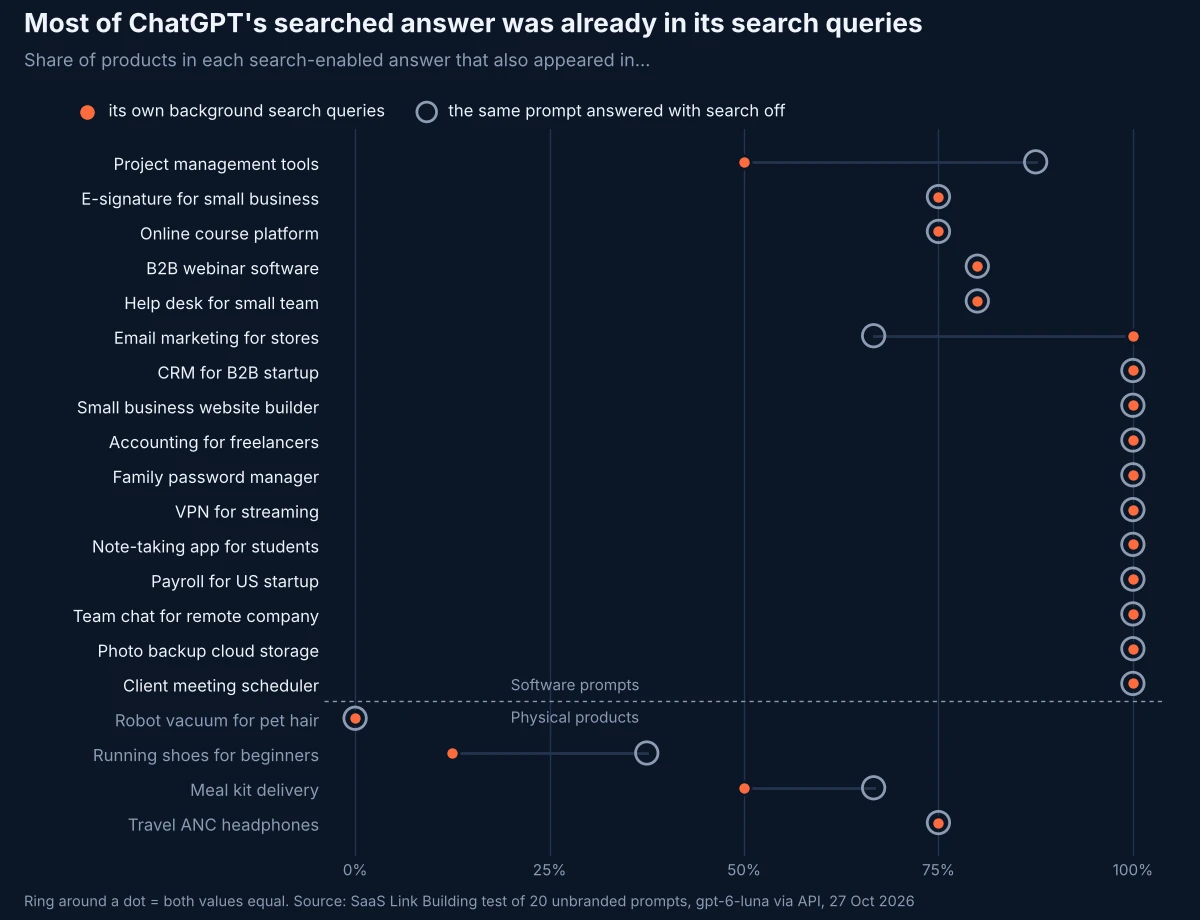
- Search mostly confirmed a shortlist. Of the 80 products named in the 20 search-enabled answers, 59 (73.8%) had appeared in that answer's own search queries, and 64 (80.0%) also appeared when we asked the same question with search switched off.
- Site-restricted lookups were common. 32 of the 82 queries (39.0%) used a
site:operator, almost always pointed at a vendor's own pricing or product page, such assite:freshbooks.com pricing. - The top pick rarely moved. The first product recommended with search on matched the first product recommended with search off in 15 of 20 prompts.
- Physical products behaved differently. For running shoes, robot vacuums, headphones and meal kits, only 7 of 20 answer products (35%) had been in the search queries, against 52 of 60 (86.7%) for software prompts.
Software shortlists barely changed; product models did
We split the 20 prompts into 16 about software and online services and 4 about physical products. The gap between the two groups was the clearest pattern in the data.
| Measure | 16 software prompts | 4 physical-product prompts |
|---|---|---|
| Fan-out queries that named a brand | 64 of 66 (97.0%) | 13 of 16 (81.2%) |
Fan-out queries using site: | 28 of 66 (42.4%) | 4 of 16 (25.0%) |
| First query already named brands | 14 of 16 | 1 of 4 |
| Answer products that were in the fan-out queries | 52 of 60 (86.7%) | 7 of 20 (35.0%) |
| Answer products also named with search off | 54 of 60 (90.0%) | 10 of 20 (50.0%) |
| Same first recommendation with search on and off | 13 of 16 | 2 of 4 |
The running shoe prompt shows why. With search on, the model's second query asked about "Brooks Ghost 17 ASICS Gel Cumulus 27 Nike Pegasus 41", model numbers it carried from training. The answer it then wrote, citing two review sites it had found, recommended the Brooks Ghost 18, ASICS Novablast 6 and Nike Winflo 12 instead. Only one of the eight shoes in the final answer, the Ghost, had appeared in its queries. For the robot vacuum prompt, the queries named Roborock, Dreame and iRobot, and the answer recommended a Roborock model and a MOVA model it had not searched for by name.
For software, search worked more like a fact check: the model looked up pricing pages for vendors it had already chosen and cited them for plan prices and limits. It added a few names it had not searched for (Cvent, Zendesk, SignNow, Jira) and dropped some it had searched for, including Pipedrive, Dashlane, ADP RUN and BigMarker.
What Graphite reported
Graphite's study, published on 16 October, analysed about 957,000 ChatGPT fan-out queries generated by 22,953 non-branded comparison prompts collected from August to early October. It found that 59.6% of those queries contained a brand name and 22.7% used a site: operator. In a separate analysis of 3,115 brand and question pairs across 57 questions, it reported that brands ChatGPT rarely named without search were also rarely named with search, even when cited pages mentioned them: brands that appeared on at least 15% of cited pages reached a median visibility of only 11% with search when their no-search visibility sat in the 0 to 25% band.
Graphite also tracked logged-out ChatGPT citation rates on comparison prompts rising from 56.6% to 88.5% between early August and late September. The agency sells answer engine optimization services, and its findings are correlational rather than causal.
How our test compares
Our small test points the same way as Graphite's large one, with two differences worth noting. First, our brand rate in fan-out queries (93.9%) and our site: rate (39.0%) are both higher than Graphite's (59.6% and 22.7%). Our prompts were narrow "best tool for X" questions sent through the API to one reasoning model, while Graphite sampled logged-out ChatGPT across many more prompts, so the figures are not directly comparable. Second, we ran each prompt only once in each mode.
OpenAI's own web search documentation describes how reasoning models handle search: the model runs searches as part of its reasoning, analyses the results and can "decide whether to keep searching". The documentation does not say how the first query is chosen, but our queries suggest it often starts from the model's own idea of which brands to check. We covered an earlier, larger dataset on how often ChatGPT searches at all in our report on ChatGPT fan-out query volumes, and research showing that search APIs recover only a minority of the pages ChatGPT cites.
Searched answers were also shorter: 80 products across the 20 answers (4.0 on average) against 110 with search off (5.5), under the same instruction to list up to eight. Attio, Mailchimp, Proton VPN and Microsoft Bookings appeared only in search-off answers.
What this means for SEO teams
- Treat model knowledge as the entry ticket. In our software prompts, nine in ten products in the searched answer were ones the model also named without search. If your product does not appear when you ask a model with search switched off, a ranking page alone may not get it into the shortlist the model searches for.
- Make vendor pages answer the lookup. The model's
site:queries went straight to pricing and plan pages and then cited them for prices, free-plan limits and seat counts. Keep those facts on a crawlable, server-rendered pricing page with current figures. - Check both crawlers separately. OpenAI's crawler documentation says OAI-SearchBot is used for search and GPTBot for training, and that each robots.txt setting is independent. Our robots.txt study of top sites found 12% of 465 top sites blocking Meta's AI training crawler; for a vendor that wants to be named, it is worth knowing which bot you are blocking.
- Expect more movement where products change yearly. Physical products with annual model numbers saw search replace stale model names with current ones. Review sites carried more weight in those answers than in software answers.
- Measure with search off, and repeat. A single run is noisy. Run the same unbranded prompts with search disabled many times (Graphite suggests at least 50 responses per prompt), and again after each new model release, to see whether your brand is in the model's default shortlist.
Methodology
On 27 October 2026, between 05:20 and 05:27 UTC, we sent 20 unbranded comparison prompts to OpenAI's gpt-6-luna reasoning model through a commercial LLM-response API that returns the model's text, cited URLs and background search (fan-out) queries. Each prompt was sent twice: once with web search enabled and the search location set to the United States, and once with web search disabled. Both runs used the same system message asking for up to eight options as a numbered list, each starting with the product name in bold. No prompt contained a brand name.
Sixteen prompts covered software and online services; four covered physical products (running shoes, robot vacuums, noise-cancelling headphones and meal kits).
We counted every product the model recommended by name in each answer, including alternatives named in running text. A fan-out query was counted as naming a brand when it contained the name of a product or company in the prompt's category; general terms such as "Netflix" in a VPN query did not count. Matches were made at product level for physical products (for example, Brooks Ghost 17 and Ghost 18 count as the same shoe line, but a Roborock Saros and a Roborock Qrevo do not) and at brand level for software (QuickBooks Online and QuickBooks Solopreneur count as QuickBooks). Shopify Email in a query was matched to Shopify Messaging in the answer.
Limitations: one run per prompt on one model, through the API rather than the ChatGPT app, so results will vary between runs, models and logged-in or logged-out use. Twenty prompts show a pattern, not a market-wide rate.
Conclusion
In our test, ChatGPT's searches for unbranded software questions were mostly lookups of brands it had already picked: almost every query named a brand, and the searched answer matched the search-off answer for nine in ten software products. Search changed more for physical products, where it replaced outdated model names with current ones from review sites.
For SEO teams, that supports Graphite's broader argument that visibility in AI answers starts with whether a model already knows a brand, with search pages serving as the evidence it cites. The practical test is simple and cheap to run: ask the model your category's unbranded questions with search off, then with search on, and compare.
Questions and answers
What are ChatGPT fan-out queries?
They are the background web searches a model runs when it decides to search before answering. In our test, the API returned these queries alongside the answer, so we could see which brands the model looked up for each prompt.
How often did ChatGPT's searches name a brand in this test?
77 of 82 fan-out queries (93.9%) named a product or brand, even though none of the 20 prompts did. In 15 of the 20 prompts, the first query already listed specific brands.
Did turning on web search change which products ChatGPT recommended?
Mostly not for software. 90% of products in the searched software answers also appeared with search off. For four physical-product prompts the figure was 50%, as search replaced older model names with current ones.
How does this compare with Graphite's study?
Graphite found 59.6% of about 957,000 fan-out queries contained a brand name and 22.7% used a site: operator. Our rates were higher (93.9% and 39.0%), but our sample was 20 narrow prompts on one model through the API, so the figures are not directly comparable.
How can a brand check whether a model knows it?
Ask the model unbranded category questions with web search turned off, repeat the runs, and compare the results with search on. Graphite suggests at least 50 responses per prompt and re-testing after new model releases.
More releases
-
Studies
AI Overviews Showed on 77% of 150 Google Searches but Only 2 of 15 Local Ones
Google showed an AI Overview on 116 of 150 US desktop searches (77.3%) in our 27 October check, and on 83.3% after rechecking those without one. Informational and shopping queries hit 97.8%, but only 2 of 15 "near me" searches showed one on the first pass.
-
Updates
Google Tells Platforms to Noindex Link-Shared Pages; 3 of 12 AI Share Tools Still Show Up
Google added an "Only index content meant for Search" section to its user-generated spam guide on 26 October 2026, telling platforms to noindex link-shared pages, generated outputs and tools by default. Our check of 12 AI share-link surfaces found three still showing shared content in Google results.
-
Studies
Category Pages Took 67% of Page One for Generic Shopping Terms in Our 48-Search Study
Category and listing pages took 67% of Google's page-one organic results for generic shopping terms in our analysis of 48 live US searches, and product pages took none. Product pages led only on exact model searches (32%), while reviews held 59% of page one for "best" queries.
Tell us the site and the goals.
Rankings in Google and visibility in AI answers, from one monthly plan. One call is enough to say which one fits. Email works just as well.