Category Pages Took 67% of Page One for Generic Shopping Terms in Our 48-Search Study
Category and listing pages took 67% of Google's page-one organic results for generic shopping terms in our analysis of 48 live US searches, and product pages took none. Product pages led only on exact model searches (32%), while reviews held 59% of page one for "best" queries.
 Vibhu Dhariwal
Cofounder & CTO, Digital Gratified
- Published
- Section
- Studies
- Reading time
- 8 minutes
Ras Al Khaimah, United Arab Emirates, .
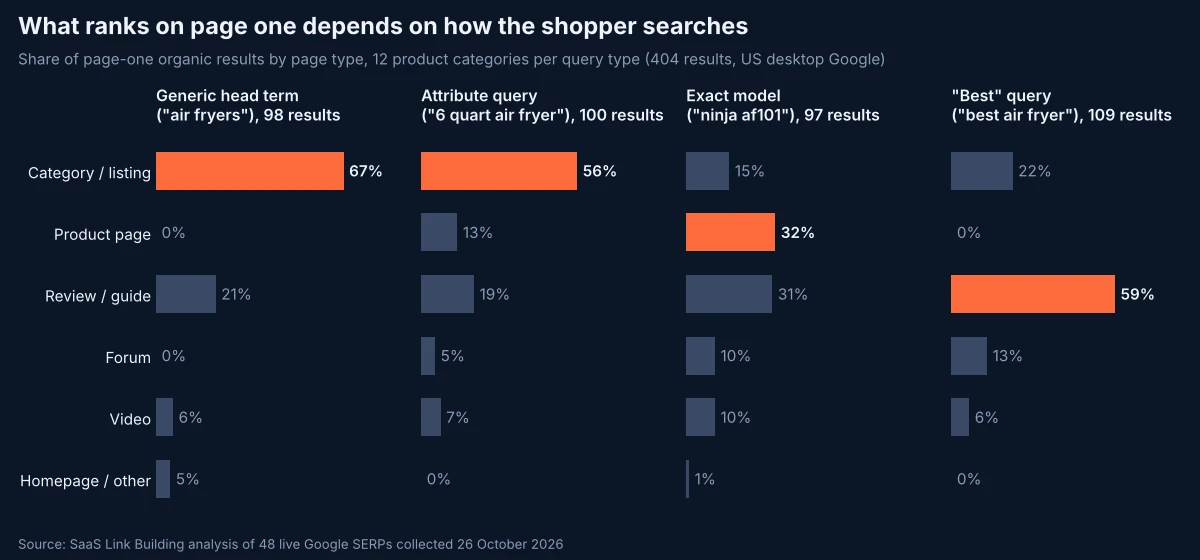
Category and listing pages took 67% of Google's page-one organic results for generic shopping terms such as "air fryers" and "sofas", while product pages took none, according to a SaaS Link Building analysis of 48 live US desktop search results pages collected on 26 October 2026. The picture flipped for exact model searches, where product pages were the most common page type at 32%, and again for "best" queries, where reviews and buying guides held 59% of page one and product pages again held none.
The question of whether Google "prefers" category pages or product pages comes up often in ecommerce SEO, most recently in a Search Engine Land column. Our data points to a narrower answer: the page type that ranks follows the wording of the query, and the same product category can produce a listing-heavy, product-heavy or review-heavy page one depending on a single modifier.
Key findings
- Generic head terms favour listings. Not one product detail page appeared on the 12 page ones for terms such as "backpacks" and "yoga mats". Retailer categories, brand collections and retailer search URLs filled most places.
- Attribute queries are still listing territory. For searches such as "queen memory foam mattress" and "l shaped standing desk", filtered and collection pages led. Product pages appeared on half of these searches, and took five of nine places for "12 cup programmable coffee maker".
- Exact model names are where product pages win. For searches such as "breville barista express" and "sony wf-1000xm5", product pages appeared on every page one, but reviews came within a single result of matching them (31 product pages against 30 reviews).
- "Best" queries belong to reviews. Not one of 109 page-one results for "best" queries was a product page. Publishers, specialist testing sites and forum threads took the space.
- Forums rise as queries get more specific or evaluative. Forum threads appeared on none of the generic-term pages but on 11 of 12 "best" pages and 9 of 12 model pages.
Who held position one
Share of page one tells you what Google considers relevant. The first organic position tells you what it ranks highest. The two lined up in every query type, which suggests the pattern is not just a long tail of listings sitting below a product page at the top.
| Query type (12 searches each) | Top organic result was a category or listing page | Top result was a product page | Top result was a review or guide | Pages with at least one product page in the organic results |
|---|---|---|---|---|
| Generic head term ("backpacks") | 7 | 0 | 3 | 0 of 12 |
| Attribute query ("17 inch laptop backpack") | 7 | 3 | 2 | 6 of 12 |
| Exact model ("osprey farpoint 40") | 2 | 6 | 3 | 12 of 12 |
| "Best" query ("best backpack") | 1 | 0 | 11 | 0 of 12 |
The remaining top positions went to a homepage (one generic search) and videos (one generic and one model search). Source: SaaS Link Building analysis, 26 October 2026.
What the pages looked like
The "listing" group was broader than a classic category page. On generic terms it included brand collection pages, department store category pages and retailer internal search URLs, several of them Amazon search results pages. On attribute queries the listings were often filtered views that matched the modifier exactly, such as a gray sectional filter on a furniture retailer, a packable rain jacket collection on an outdoor brand's store, and an "earbuds under 100" landing page on a big-box retailer. Those pages ranked for terms that a single product page could not fully match.
Product pages broke into page one in two situations. The first was a modifier precise enough to describe one item, such as "12 cup programmable coffee maker", where five of nine organic results were individual product pages from appliance makers and retailers. The second was the exact model search, where brand stores, independent retailers and marketplaces such as eBay and Walmart competed with independent reviews. For "tempur-pedic proadapt mattress", six of nine results were retailer product pages.
The "best" pages were dominated by publishers and specialist review sites with testing claims in their titles, plus Reddit and Facebook group threads. Retailers still appeared, but through best-seller lists and "highest rated" filters rather than product pages.
How this lines up with what Google says
Google has not said it ranks category pages above product pages or the reverse, and nothing in this data shows a fixed preference. What Google does publish is guidance that treats both as parts of one structure. Its ecommerce site structure documentation recommends linking from menus to category pages, from categories to subcategories, and from subcategories to every product page, and warns that products reachable only through an internal search box may not be found by crawling.
For the "best" queries, Google's guide to its ranking systems describes a reviews system that aims to reward "insightful analysis and original research". Its separate guidance on writing reviews asks for firsthand evidence, comparisons with alternatives, and an explanation of why a product is ranked best for a purpose. The pages that held position one on our "best" searches were overwhelmingly the kind of tested roundup that guidance describes.
The forum results fit a pattern we saw when we tested whether Google favours big brands, where Reddit and YouTube took places that might have been expected to go to large retailers. Google's own push to bring more discussion content into Search is covered in our report on the UGC Fresh Data Program.
What this means for ecommerce SEO teams
- Sort your target keywords by modifier before you assign them to pages. Generic terms and attribute terms should map to category or filtered listing pages, exact model names to product pages, and "best" or "top" terms to editorial guides. In our sample, assigning a "best" keyword to a product page meant competing for a page type that appeared 0 times in 109 results.
- Turn high-demand filters into indexable landing pages. Attribute queries rewarded listings that matched the modifier exactly. If shoppers search for a size, colour or price band, a crawlable filtered page with its own title and copy matches that query better than a broad category page or a single product.
- Give product pages the substance that reviews have. On model searches, product pages shared page one almost equally with reviews. Specifications, comparison with the previous version and honest limitations are the elements Google's review guidance highlights, and they help a product page compete on the queries where it can win.
- Link the structure the way Google describes. Category pages should link directly to every product they contain, and guides should link to the relevant categories. Products buried behind on-site search or JavaScript-only navigation may never be crawled.
- Report by query class, not just by page. In Search Console, filter queries with a regular expression for modifiers such as "best", model numbers or size terms, and compare which of your URLs earn impressions in each group. A product page earning impressions for "best" queries at low positions is usually a sign the keyword needs a guide.
Google is also changing how shopping journeys end. Its Universal Cart launch in US Search and Gemini draws on Shopping Graph listings, which makes product data quality a separate task from organic page targeting.
Methodology
We built a set of 48 English queries covering 12 product categories (running shoes, office chairs, earbuds, coffee makers, standing desks, backpacks, air fryers, mattresses, sofas, dog food, yoga mats and rain jackets). Each category had four queries: a generic head term, an attribute-modified query, an exact model name and a "best" query. We pulled live Google results for each query through a SERP data API on 26 October 2026, between about 17:20 and 17:50 UTC, using a United States location, English language and desktop device.
We counted only standard organic results returned on page one, which gave 7 to 10 organic results per search and 404 results in total. Ads, Shopping units, AI Overviews, People Also Ask boxes and other SERP features were excluded. Each result was classified by hand from its URL, title and snippet into one of six types: category or listing page (category, collection, filtered, brand collection, best-seller and retailer search pages), product page (a page for one purchasable item, including single-product review tabs and marketplace item pages), review or guide (editorial reviews, roundups and buying guides, including retailer blog posts), forum (Reddit and Facebook group threads), video (YouTube), and homepage or other.
Limits: this is one snapshot from one location on one device type, and results vary by time, place and personalisation. Twelve categories are not a census of ecommerce, and some pages could fit more than one type. The figures show what ranked for these queries on this day, not why Google ranked them.
Conclusion
Across 48 shopping searches, Google did not favour category pages or product pages as a rule. It favoured the page type that matched the query: listings for generic and attribute terms, product pages for exact models, and tested reviews for "best" searches. For ecommerce teams, the practical step is to decide the page type at the keyword research stage, then build and link each type so Google can find it.
Questions and answers
Does Google prefer category pages or product pages?
Google has not said it prefers either. In our 48-search analysis the page type that ranked followed the query: category and listing pages took 67% of page-one results for generic terms, product pages took 32% for exact model names, and reviews took 59% for "best" queries.
Did any product pages rank for "best" shopping queries?
No. Across 12 "best" queries and 109 page-one organic results, none were product detail pages. Reviews and buying guides held position one in 11 of the 12 searches.
What ranked for attribute queries like "6 quart air fryer"?
Listing pages still led with 56% of page-one results, often filtered or collection pages matching the modifier. Product pages appeared on 6 of 12 attribute searches and made up 13% of results.
What does Google recommend for linking category and product pages?
Google's ecommerce site structure documentation recommends linking from menus to category pages, from categories to subcategories and from subcategories to all product pages, and notes that products reachable only through on-site search may not be found by crawling.
How was the data collected?
We pulled live US English desktop Google results for 48 queries (12 product categories, four query types each) on 26 October 2026 and classified 404 page-one organic results by hand from URL, title and snippet.
More releases
-
Industry news
Google AI Overviews Cited Local News in 11 of 19 UK Local Searches, Our Check Finds
A study by Searchable found AI assistants such as ChatGPT bypass local newspapers on UK local queries. Our check of 24 Google UK searches found AI Overviews cited local news in 11 of 19 answers, but only once across five council-news answers, where the BBC and councils dominated.
-
Studies
Does Google Use Clicks to Rank Pages? Trial Files and 14,013 Leaked Fields Say Yes
Court findings from US v. Google and Google's own How Search Works page show that aggregated click data feeds ranking through Navboost and Glue. Our count of 14,013 leaked attributes finds 63 tied to clicks, dwell or Chrome, but no evidence that a site can lift rankings by gaming its own CTR.
-
Studies
39.5% of 339 Top-Site Sitemaps Skip Lastmod, the Date Google Uses to Schedule Crawls
A SaaS Link Building crawl of the 1,000 most visited domains on 26 October found that 39.5% of 339 page-level sitemaps carry no lastmod date, 19.5% of well-dated ones give every URL the same date, and 38.1% still use changefreq or priority, tags Google says it ignores.
Tell us the site and the goals.
Rankings in Google and visibility in AI answers, from one monthly plan. One call is enough to say which one fits. Email works just as well.