Does Google Use Clicks to Rank Pages? Trial Files and 14,013 Leaked Fields Say Yes
Court findings from US v. Google and Google's own How Search Works page show that aggregated click data feeds ranking through Navboost and Glue. Our count of 14,013 leaked attributes finds 63 tied to clicks, dwell or Chrome, but no evidence that a site can lift rankings by gaming its own CTR.
 Vibhu Dhariwal
Cofounder & CTO, Digital Gratified
- Published
- Section
- Studies
- Reading time
- 14 minutes
Ras Al Khaimah, United Arab Emirates, .
For more than a decade, one argument has kept coming back in SEO: does Google watch which results people click and use that behaviour to rank pages? Google representatives have long played the idea down. Yet federal court records from United States v. Google, Google's own explanation of how ranking works, and the Content Warehouse documentation that leaked in 2024 all point the same way. To test the claim, we went back to those primary sources and pulled the 2,593 module pages of the leaked documentation into our own dataset, counting every attribute that refers to clicks, dwell or Chrome.
Our short answer: Google does use aggregated click data in ranking, through a system called Navboost and a related log called Glue. The narrower claim that many SEO tactics rest on, that a single site can lift its rankings by pushing up its own click-through rate or time on page, is still unproven.
Key findings
- In his August 2024 liability opinion, Judge Amit Mehta found that Navboost pairs queries with documents by memorising user click data, and that Google has trained it on 13 months of user data since 2017, down from 18 months before that.
- Google's own How Search Works ranking page says it uses "aggregated and anonymized interaction data" to assess whether results are relevant to queries.
- Our count of the leaked documentation found 14,013 attributes. Of these, 63 have names that refer to clicks, dwell or Chrome data once unrelated interface fields are removed: 47 click attributes, 8 dwell attributes and 8 Chrome attributes.
- Navboost's click record stores separate counts for clicks, good clicks, bad clicks and "last longest" clicks, and stores an IP-based prior for the share of bad clicks. Our reading, which Google has not confirmed, is that the system is built to discount suspect clicks as well as count them.
- Eight attributes refer to dwell. The four that carry descriptions all count dwells on Google's own features (Knowledge Panels, WebAnswers and local results); the other four are undescribed companions in the same aggregator. None is described as measuring time on a publisher's page.
The theory: Google ranks on what searchers click
Put simply, the theory says Google treats the search results page as a vast feedback loop. Results that people click and stay on move up; results they skip, or bounce back from quickly, move down. Some practitioners take this further and argue that click-through rate (CTR), dwell time and "pogo-sticking" are direct ranking factors that any site can influence, whether through sharper titles or, at the cynical end, by paying for click traffic.
Google's public line has been more guarded. In a February 2019 Reddit AMA, Google's Gary Illyes called dwell time and CTR theories "generally made up crap", according to Search Engine Land's write-up of the session. In the same AMA he described Google using clicks when testing changes with raters and live experiments, and Search Engine Land summarised his position as clicks not being direct ranking inputs. When the Content Warehouse documents surfaced in May 2024, Google spokesperson Davis Thompson told The Verge that people should avoid assumptions based on "out-of-context, outdated, or incomplete information", as the company confirmed the documents were genuine.
So the dispute is less about whether clicks exist inside Google and more about what they do. That is the question this investigation tests. It is the third claim we have tested this way, after our checks on whether Google favours big brands and whether it rewards fresh dates.
Evidence for: what the court record says
The strongest evidence does not come from SEO folklore. It comes from sworn testimony and the findings of a federal judge.
In the August 5, 2024 memorandum opinion that found Google had illegally maintained a search monopoly, Judge Mehta set out how Navboost works (findings of fact, paragraph 96). It lets Google remember which documents users clicked after entering a query, and spot when one document is clicked in response to many different queries. Citing testimony from former Google search and AI executive John Giannandrea, the opinion records that NavBoost "was considered very important". Citing testimony from Pandu Nayak, Google's vice president of search, it says Google trained Navboost on 18 months of user data before 2017 and has used 13 months since. The court added that 13 months of Google data is the equivalent of more than 17 years of Bing data.
The same opinion makes clear that newer AI systems have not replaced click signals. It found that large language model signals did not replace Navboost and QBST in ranking, and that systems like Navboost can beat language models on some tasks, such as freshness.
Glue, Navboost's close relative, covers more than blue-link clicks. A rebuttal presentation by Professor Douglas Oard, an expert for the plaintiffs, dated November 15, 2023 and published by the Justice Department, quotes Google's own expert, Professor Edward Fox, describing Glue as aggregating interactions such as "clicks, hovers, scrolls, and swipes" into one metric. That metric decides whether a search feature appears and where it appears on the page. The same deck quotes a 2021 internal Google document describing "Instant Glue", which aggregates the same user-interaction signals from only the last 24 hours of logs, with a latency of about 10 minutes.
The September 2, 2025 remedies opinion went further. It described Glue as essentially a super query log holding the query, the results and search features shown, and interaction data such as clicks, hovers and time spent on the results page. Judge Mehta then ordered Google to share the Glue and RankEmbed training data with qualified competitors at least twice, calling this raw interaction data the core of Google's scale advantage.
Timeline: public statements against the documents
| Date | Source | What it says about clicks |
|---|---|---|
| February 2019 | Gary Illyes, Reddit AMA (as reported by Search Engine Land) | Dwell time and CTR theories dismissed; clicks used for evaluation and experiments |
| 2021 | Internal Google document quoted in the Oard deck | Instant Glue aggregates user-interaction signals from the last 24 hours, roughly 10 minutes behind |
| November 15, 2023 | Oard rebuttal deck, Justice Department | Google's expert describes Glue combining clicks, hovers, scrolls and swipes |
| March 28, 2024 | Hex package release record | Version 0.4.0 of the client library that carries the leaked documentation is published |
| May 29, 2024 | Google statement to The Verge | Documents confirmed as genuine; Google warns against reading them out of context |
| August 5, 2024 | Liability opinion | Navboost memorises click data; trained on 13 months of user data |
| September 2, 2025 | Remedies opinion | Google must share Glue click and interaction data with qualified competitors |
| Current | Google How Search Works | Google uses aggregated, anonymized interaction data to assess relevance |
Google's own wording matters most here. The How Search Works ranking page does not hide the practice: it says Google transforms that interaction data into signals that help its machine-learned systems estimate relevance. That is not the language of a company that uses clicks only to grade experiments.
Evidence for: what 14,013 leaked attributes show
The leaked material is reference documentation for Google's internal Content Warehouse API. It was preserved as an auto-generated Elixir client library on HexDocs. We downloaded every model page listed in the version 0.4.0 API reference, 2,593 in total, and parsed the attribute lists. We found 14,013 attributes, close to the 2,596 modules and 14,014 attributes that earlier reporting cited. That suggests our copy is near-complete.
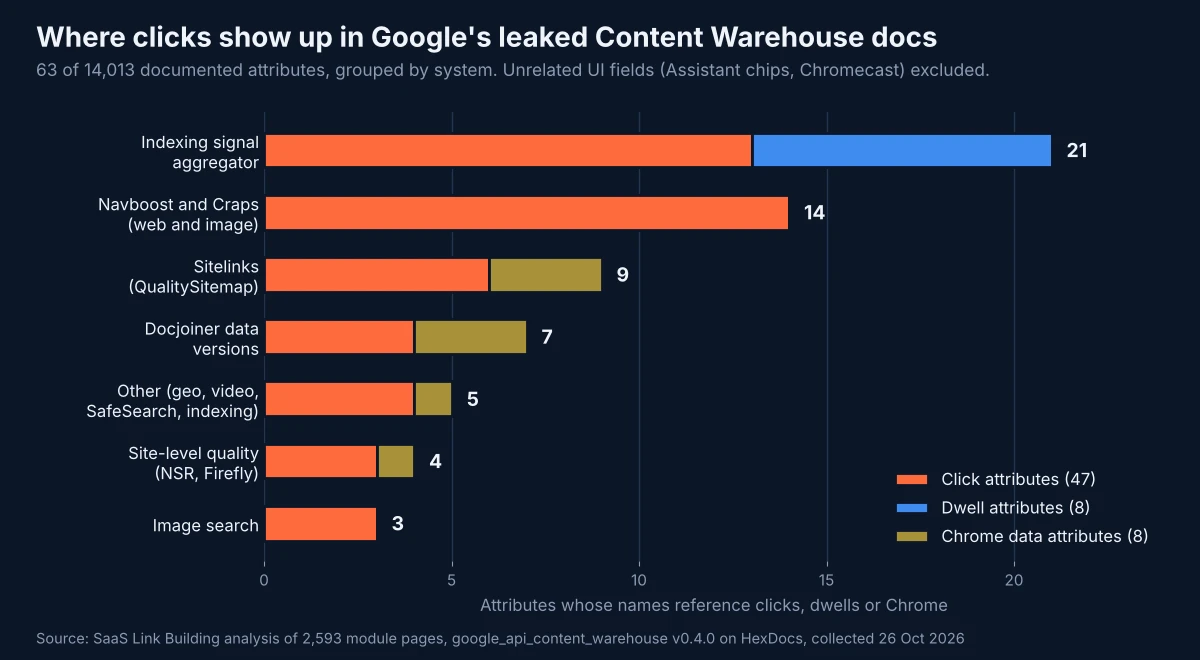
Only 63 of the 14,013 attributes, about 0.45%, have names that refer to clicks, dwell or Chrome data. But where they sit matters more than how many there are. The largest group is not Navboost but an indexing signal aggregator: its age-weighted coverage record stores good, bad, image, total and unclassified clicks per document, along with the date each document last received a good click. Navboost's own records come second. A sitelinks scoring record lists co-clicks, a longClicks field and Chrome transition counts, although the documentation says that record is currently intended only for debugging. A site-level quality record holds a field described as "Site-level Chrome views".
The Navboost click record itself is the clearest exhibit. These are the fields in CrapsClickSignals and the parent CrapsData record, with Google's own descriptions where it gave one:
| Field | Record | What the documentation says |
|---|---|---|
| clicks, impressions | CrapsClickSignals and CrapsData | Counts; the CrapsData impressions note says these top-level fields may be retired in favour of a squashed copy |
| goodClicks, badClicks | CrapsClickSignals and CrapsData | Clicks split by outcome; no description given |
| lastLongestClicks | CrapsClickSignals and CrapsData | Clicks that were last and longest in related user queries |
| unsquashedClicks, unsquashedImpressions | CrapsClickSignals | Marked as not populated in the current format; squashed and unsquashed copies are stored instead |
| unscaledIpPriorBadFraction | CrapsData | Used to assign a prior based on IP address; the stored value precedes a scaling step applied in a file named craps-penalty |
| country, language, device, mobileSignals | CrapsData | Click data sliced by country, language, device and mobile interfaces |
The documentation defines last longest clicks only as clicks that were last and longest in related user queries. Our interpretation is that this approximates the result that ended a search, which would make it a useful marker of satisfaction. The country and device slices show that click data is stored separately by market and device, not just by query.
Evidence against: what the records do not show
The case is weaker than it first looks in several places, and these limits matter for anyone tempted to treat CTR as a lever.
No weights. The leaked documentation lists fields. It does not say how much any field counts, whether it is still used, or which ranking stage reads it. Some fields are openly marked as not populated. Google's warning about out-of-context information is self-serving, but on this point it is accurate.
Navboost memorises; it does not reward tricks. The liability opinion describes Navboost as a memory of which documents users clicked for which queries, not as a live reward for each click. It also found that newer systems such as RankBrain, DeepRank, RankEmbed, RankBERT and MUM rely less on user data and were built to fill gaps where click data is thin (findings of fact, paragraph 97). The court added that these systems were still designed with user data and continue to be trained on it, in smaller volumes. Our inference is that for queries with little click history, these generalisation systems carry more of the load.
Clicks are filtered. The squashed and unsquashed copies and the IP-based bad-click prior look like what you would build if you expected click fraud. This part is our reading of the field names, not something Google has stated. A site that buys bot clicks is feeding a system designed to discount them.
Dwell time on your page is not in evidence. All eight dwell attributes we found sit in the signal aggregator. The four with descriptions count dwells on Knowledge Panels, WebAnswers and local results; the other four (intervals and prior weights) have no description. We found no attribute described as measuring time spent on a third-party page. The last longest clicks field comes closest, but it is defined in terms of related queries, not as a timer on the publisher's site.
Quality signals lean on more than clicks. In the remedies opinion, the court declined to order Google to share its quality scores, noting that they are built largely from sources other than user data, with PageRank as a key input. It also refused to order sharing of a popularity signal that two exhibits linked to Chrome visit data and anchor counts, because the plaintiffs offered no testimony on how much that signal depends on user data.
Verdict: confirmed, with a narrow exception
Confirmed: Google uses aggregated click and interaction data in ranking. A federal court found it as fact, Google's How Search Works page describes it, and the leaked documentation shows click counts held by Navboost and an indexing signal aggregator, plus a sitelinks debugging record. Statements suggesting clicks play no part in ranking do not match the record.
Unproven: that an individual site can raise its rankings by manipulating its own CTR or time on page. The evidence describes a system that pools 13 months of behaviour across many queries, slices it by market and device, and separates good clicks from bad ones. Nothing we found shows a direct, per-site CTR dial, and the described dwell attributes concern Google's own features, not publisher pages.
A fair reading of both sides: Illyes's 2019 comment rejected crude theories of CTR and dwell time as direct factors, and the documents do not prove those crude theories either. What they disprove is the broader impression, which many in the industry took from Google's messaging, that searcher behaviour plays no part in how pages are ranked.
What this means for SEO teams
- Optimise for the last click, not the first. A click that sends the searcher straight back to the results is unlikely to count as a good click. Make sure the page answers the query that earned the click, above the fold.
- Treat titles and snippets as a promise. In Search Console, filter Performance by query and look for pages with high impressions and low CTR at positions 1 to 5. That usually means the snippet does not match intent, which also undercuts the click signals Google collects.
- Do not buy clicks. Navboost already splits good clicks from bad ones and stores an IP-based prior, which in our reading points to suspect traffic being discounted. Bought clicks also distort your own analytics.
- Watch market and device splits. Navboost data is sliced by country, language and device, so compare Search Console performance by country and device before assuming a ranking change is site-wide.
- Keep navigation clear. A sitelinks record in the documentation lists co-clicks and Chrome transitions. It is marked as a debugging record, so treat this as a hint rather than a rule: pages users already reach easily from your home page are sensible sitelink candidates.
- Read ranking changes over months, not days. Navboost is trained on a 13-month window, so one week of better CTR is a small slice of the data it learns from. Pair Search Console trends with the update timelines in our analysis of Google's 2026 updates before crediting or blaming a change.
Methodology
On 26 October 2026 we downloaded the API reference page for version 0.4.0 of the google_api_content_warehouse package on HexDocs, extracted the 2,593 model module links it lists, and downloaded every module page. We parsed each page's attribute list (attribute name, type and description) and found 14,013 attributes across the 2,488 modules that have attribute lists. We matched attribute names case-insensitively against "click", "dwell" and "chrome". That returned 70 matches, from which we removed 7 unrelated interface fields (Assistant and ChromeOS settings, a page-rendering flag, Chromecast settings and two YouTube click-tracking fields), leaving 63. We grouped modules by their name prefix (for example, QualityNavboost, IndexingSignalAggregator, QualitySitemap). Package release dates come from the Hex package registry. Court findings are taken directly from the liability opinion (Document 1033) and remedies opinion (Document 1436) in case 1:20-cv-03010, and from the Oard rebuttal deck published by the Justice Department. Counting field names shows what Google documented, not what it uses or how much weight each field carries.
Conclusion
The record no longer leaves room for doubt on the broad question. Google has collected click data for ranking for years, a federal judge described how Navboost uses it, and Google's own help page describes interaction data turned into ranking signals. The leaked documentation adds a detailed picture of good clicks, bad clicks and last longest clicks, sliced by country and device, with fields that appear designed to discount bad clicks.
What the evidence does not support is the shortcut. Clicks act as a large, pooled, slow-moving measure of whether a result satisfied searchers across many queries, not a dial a single site can turn. The practical lesson is the dull one: earn the click with an accurate snippet, then make it the last click the searcher needs.
What do you think?
Have you ever seen rankings move after a change that only affected click-through rate, such as a new title tag with no content change, and if so, how long did it take and did it hold? Share your data with us; we would like to compare notes.
Questions and answers
Does Google use clicks as a ranking signal?
Yes, in aggregate. Judge Amit Mehta's August 2024 liability opinion in US v. Google found that Navboost pairs queries with documents by memorising user click data, and Google's How Search Works page says it uses aggregated and anonymized interaction data to assess relevance.
What is Navboost?
Navboost is a Google ranking system described in the US v. Google liability opinion. It remembers which documents users clicked after entering a query and when one document is clicked for many queries. Google trained it on 18 months of user data before 2017 and on 13 months since.
What is Glue in Google Search?
According to the September 2025 remedies opinion, Glue is essentially a super query log that records the query, the results and search features shown, and interactions such as clicks, hovers and time on the results page. The court ordered Google to share Glue data with qualified competitors at least twice.
Does the Google leak prove that dwell time on my page is a ranking factor?
No. In our count of the leaked Content Warehouse documentation, all eight dwell attributes sit in an indexing signal aggregator. The four that have descriptions count dwells on Knowledge Panels, WebAnswers and local results, and none is described as measuring time spent on a publisher's page.
Can I improve rankings by increasing click-through rate artificially?
There is no evidence for it. Navboost pools 13 months of data, splits good clicks from bad clicks and stores an IP-based prior for bad clicks, which suggests suspect traffic is discounted. Bought clicks also distort your own analytics.
More releases
-
Studies
39.5% of 339 Top-Site Sitemaps Skip Lastmod, the Date Google Uses to Schedule Crawls
A SaaS Link Building crawl of the 1,000 most visited domains on 26 October found that 39.5% of 339 page-level sitemaps carry no lastmod date, 19.5% of well-dated ones give every URL the same date, and 38.1% still use changefreq or priority, tags Google says it ignores.
-
Explainers
Google's Helpful Content Guide Adds 4 Rater Tests: Effort, Originality, Skill, Accuracy
Google has added a main content section to its Creating helpful content guide, listing the four attributes its quality raters assess: effort, originality, talent or skill, and accuracy. We compared the new wording with the rater guidelines line by line and mapped where each attribute appears across their 182 pages.
-
Industry news
Trackers Spike on 24 October, but Google Logs No Update as Core Gap Hits 158 Days
Rank trackers showed significant volatility on 24 October 2026, yet Google's Search Status Dashboard still lists no ranking update since 8 October. Our count of every core update since November 2021 puts the current 158-day gap sixth longest of 16, and the 189-day record would be matched on 26 November.
Tell us the site and the goals.
Rankings in Google and visibility in AI answers, from one monthly plan. One call is enough to say which one fits. Email works just as well.