Does Google Favor Big Brands? Our 40-Search Test Finds YouTube and Reddit Win Instead
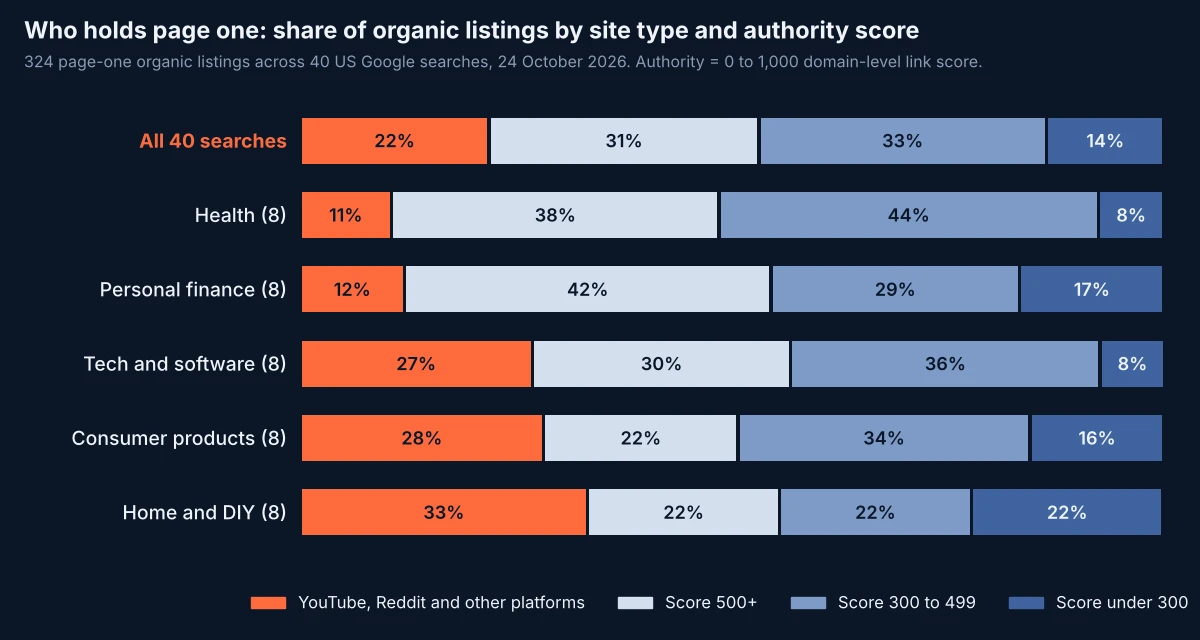
Does Google favour big brands? We pulled page one for 40 US searches, scored 211 domains and checked the API leak and DOJ trial record. Authority scores did not predict position within page one, while YouTube and Reddit took 59 of 324 listings. Verdict: unproven.
 Vibhu Dhariwal
Cofounder & CTO, Digital Gratified
- Published
- Section
- Studies
- Reading time
- 13 minutes
Ras Al Khaimah, United Arab Emirates, .
Does Google favour big brands? Few questions come up more often when independent sites lose rankings after an update. To test it, SaaS Link Building pulled the US Google page one for 40 searches across five verticals on 24 October 2026, scored all 211 ranking domains on a 0 to 1,000 domain-level link authority scale, and set the result against what Google's documentation, the 2024 Content Warehouse leak and the United States v. Google trial record actually say. The short answer: page one leans heavily toward established sites, but the clearest winners in our sample were not brands at all. They were platforms, led by YouTube and Reddit.
Key findings
- Of 324 organic page-one listings, 71 (21.9%) went to user-content and marketplace platforms: YouTube (33), Reddit (26), Amazon (6), Facebook (3), Quora (2) and Google Play (1). YouTube appeared on 24 of the 40 searches and Reddit on 21.
- Sites with an authority score of 500 or more held 31.2% of listings. Sites scoring under 300, the closest proxy for small independent publishers, held 13.6%.
- Once a site reached page one, its authority score told us almost nothing about where it ranked. Across the 253 non-platform listings, the rank correlation between authority and position was 0.01.
- Small sites were not shut out: 25 of 40 searches had at least one domain scoring under 300 on page one, and four of them held the top organic spot.
- Google's site diversity system says it generally shows no more than two listings per site. Five of the 40 pages showed three or more listings from one site, and four of the five were YouTube or Reddit.
- Our verdict on the claim that Google favours big brands because they are big: Unproven. The evidence points more strongly to a different bias, toward large platforms.
The theory: Google rewards size, not quality
The big-brand theory has circulated among SEOs and independent publishers for years and resurfaces with almost every core update. In its strongest form, it says Google keeps a hidden site-level authority score, that well-known companies score higher on it whatever the quality of an individual page, and that click-based ranking systems lock the advantage in because searchers click names they already recognise.
Three developments since 2024 gave the theory fresh material. The leak of Google's internal Content Warehouse API documentation in May 2024 named a site-level authority attribute. The liability opinion in the US Justice Department's search case described in detail how Google uses click data. And Google's own policies now openly discuss site reputation as something that can be exploited. Each is worth reading closely, because each cuts both ways.
Evidence for the theory
A site-level authority signal exists in Google's own documentation
Google's John Mueller once said in a video that "we don't have anything like a website authority score," as The Register reported when the leak broke. The leaked documentation complicates that line. The CompressedQualitySignals module lists an attribute called siteAuthority, described as converted from another quality signal and applied in Qstar, alongside an unauthoritativeScore used as a page quality signal. Google acknowledged that the roughly 2,500 leaked documents were authentic, while a spokesperson warned against assumptions built on material it described as out of context, outdated or incomplete.
Google's public guidance does not deny that sites are judged as a whole. Its guide to ranking systems says the systems work at page level but that site-wide signals and classifiers are also used and contribute to how pages are understood. It adds that good site-wide signals do not guarantee every page ranks well.
Clicks shape rankings, and recognisable names attract clicks
The August 2024 liability opinion by Judge Amit Mehta, Document 1033 in the court record, describes Navboost as a signal that pairs queries and documents by memorising user click data. Citing testimony from Google's Pandu Nayak, the court found that Google trained Navboost on 18 months of user data before 2017 and on 13 months since. Trial testimony quoted in the opinion describes Navboost as very important.
Speculation, clearly labelled: if searchers prefer to click names they know, a system that learns from clicks would tend to reinforce whichever sites already have recognition. Nothing in the trial record we reviewed says Navboost treats brands differently. The mechanism is plausible, not documented.
Google itself says reputation can be borrowed
Google's 28 August 2026 update to its site reputation policy describes the practice it targets as third-party content published on a trusted website to exploit that site's good reputation and rank higher. A policy against borrowing reputation only makes sense if a site's reputation carries weight for pages published on it. That implies the host matters, though not that size alone does.
Our data: established sites dominate page one
In our 40 searches, the median authority score across page-one listings was 511 on a 0 to 1,000 scale (463 excluding platforms), and at the top organic position it was 531 (453 excluding platforms). Fewer than one listing in seven went to a domain scoring under 300. In health and tech, only 7.6% and 7.5% of listings respectively went to those smaller sites, and the health results were filled largely by hospital systems, government agencies and universities.
Evidence against the theory
Authority did not predict order within page one
If Google simply ranked bigger sites higher, the strongest domains would cluster at the top of each page. They did not. Excluding platforms, the median authority score was 476 in positions 1 to 3, 435 in positions 4 to 6 and 471 in positions 7 to 10. The rank correlation between authority and position across 253 non-platform listings was 0.01, which is no relationship at all. Within individual pages that had at least five non-platform listings, the median correlation was minus 0.07, and 18 of 31 pages leaned toward stronger domains ranking higher while 13 leaned the other way, with individual pages ranging from strongly one way to strongly the other.
| Organic position | Listings | Platforms | Score 500+ | Score 300 to 499 | Score under 300 | Median score (non-platform) |
|---|---|---|---|---|---|---|
| 1 to 3 | 120 | 24.2% | 34.2% | 30.0% | 11.7% | 476 |
| 4 to 6 | 119 | 24.4% | 24.4% | 35.3% | 16.0% | 435 |
| 7 to 10 | 85 | 15.3% | 36.5% | 35.3% | 12.9% | 471 |
Source: SaaS Link Building analysis of 324 page-one organic listings for 40 US Google searches, 24 October 2026. Position counts organic listings only; ads and SERP features are excluded.
Sites scoring 500 or more were slightly more common at positions 1 to 3 (34.2%) than at 4 to 6 (24.4%), but they were most common of all at positions 7 to 10 (36.5%). That pattern does not fit a simple size advantage.
Small sites won top spots
Four of the 40 searches had a domain scoring under 300 in the first organic position: forecom-solutions.com for "best crm for small business", crinacle.com, an independent earphone review site, for "best wireless earbuds", usmile.us, a toothbrush maker's own blog, for "best electric toothbrush", and clackamasproviders.org for "how to fix a leaky faucet". Eleven searches had a sub-300 domain somewhere in the top three. Home and DIY was the most open vertical, with 22.2% of listings going to sub-300 sites, often niche blogs and local trade businesses.
The same leak also documents a small-site boost
The leaked documentation that named siteAuthority also lists, in the QualityNsrNsrData module, an attribute called smallPersonalSite, described as a score of small personal site promotion. The documentation does not say how either attribute is weighted, whether they are in current use, or how they interact. Anyone citing one as proof of bias should cite the other too.
Google's rater guidelines tell raters not to penalise obscurity
Section 3.3.5 of Google's Search Quality Rater Guidelines (11 September 2025 edition) says raters should expect reputation information for large websites, but that small websites may have little or none, and that this is "not indicative of high or low quality." The same document says no single rating directly affects how a page ranks. Raters calibrate Google's systems rather than rank pages, but the instruction shows what Google says it is aiming for.
Site diversity limits any single winner
Google's ranking guide says its site diversity system generally shows no more than two listings from the same site in top results, unless the systems judge more to be especially relevant. That caps how much page one any one brand can take. In our sample, the 10 most frequent domains held 28.7% of listings, and 175 of the 211 domains appeared only once.
What the data shows instead: a platform advantage
The most consistent pattern in our pull was not brand size but platform presence. YouTube and Reddit together held 59 of 324 listings (18.2%), and they appeared in every vertical. Platforms held a third of all listings for home and DIY searches and 28.2% for consumer products.
The exceptions to site diversity tell the same story. Five pages showed three or more listings from one site. Reddit took four of nine listings for "best air fryer"; YouTube took three each for "how to speed up windows 11", "best exercises for lower back pain" and "how to grow tomatoes". The fifth was a technology publisher whose US and Australian editions both ranked for "best antivirus", which Google's guide would count as one site because it generally treats subdomains as part of the root domain.
This complicates the brand debate. A Reddit thread or a YouTube video sits on one of the most authoritative domains on the web, yet the person behind it is often an individual. Four of the 33 YouTube listings showed fewer than 3,000 views, including one with about 490 views ranking on page one for "best electric toothbrush". Our snapshot suggests Google is comfortable sending searchers to individual voices hosted on platforms; whether that share is growing is beyond what one day of data can show. Google has also built tools for that audience: in July 2026 it made Search Console platform properties available globally, so creators can track how their Instagram, TikTok, X and YouTube posts perform in Google Search, Discover and News.
We have covered the same shift from other angles, including Pew's data on how many US adults use forums like Reddit and Google's UGC Fresh Data Program for forum content.
Verdict: Unproven
The strong claim, that Google ranks pages higher because they belong to big brands, is unproven. Google does keep site-level signals, and the leak and the reputation policy both show that the host site matters. Click data feeds a ranking system the court described as important. But our sample found no relationship between authority and position once a site reached page one, small sites took top spots in a tenth of searches, and the same leak that named a site authority score also named a small personal site promotion score.
A narrower claim fares better: page one is a hard place for small, unknown websites to reach, and the beneficiaries are large platforms as much as large brands. Our data cannot separate cause from effect. Established sites may rank because Google favours them, or because they have accumulated the links, content and user satisfaction that any fair system would reward. Settling that would need data no outsider has: Google's own signal weights.
What this means for SEO teams
- Treat authority as an entry ticket, not a ranking lever. In our sample, a higher authority score did not move a page up within page one. Once a page is competitive, relevance and how well it satisfies the query matter more.
- Audit the platform share for your own keywords. Count how many page-one slots go to YouTube, Reddit and marketplaces. If it is a third, as in our home and DIY set, a video or an active community presence may reach searchers that another article cannot.
- Pick verticals where small sites already rank. Home and DIY and personal finance gave sub-300 domains 22.2% and 16.7% of listings respectively; health and tech gave them under 8%.
- Do not rent reputation. Google's site reputation policy targets third-party content placed on trusted sites to borrow their standing. Since 30 August, a manual action under it affects results only for searchers outside the European Economic Area; for searchers inside the EEA, the affected section may instead be separated so that over time it ranks independently.
- Read leak attributes in pairs. For every attribute that seems to confirm a bias, check whether a counterweight sits in the same documentation, as
smallPersonalSitedoes forsiteAuthority.
Methodology
On 24 October 2026 we collected live Google organic results for 40 English-language searches with US location settings through a SERP data API, requesting the first page of results. The searches were chosen by hand, eight in each of five verticals (tech and software, consumer products, health, personal finance, and home and DIY), mixing "best" commercial queries and "how to" informational queries. They are not a random sample of all searches. We recorded only organic listings in their organic order (1 to 10), excluding ads, AI Overviews and other SERP features, which gave 324 listings, between five and ten per search.
Each listing's host name was reduced to its registrable domain (for example, au.pcmag.com counted as pcmag.com), giving 211 distinct domains. We scored every domain on the same day with a commercial backlink index's domain-level rank, a 0 to 1,000 score based on link data. Third-party authority scores are not Google signals; they are a proxy for how established a site is. YouTube, Reddit, Amazon, Facebook, Quora and Google Play were classed as platforms and counted separately, since their domain scores describe the host rather than the person who posted. Tiers were set at 500 and above, 300 to 499, and under 300. Correlations are Spearman rank correlations between organic position and domain score.
Limitations: one day, one country, one device type and 40 searches. Results vary by location and personalisation, and one industry analysis has reported that since September 2026 some results served to automated rank trackers were altered (Google has not commented), a risk we discussed in our report on poisoned SERPs served to rank trackers. Treat these figures as a snapshot, not a census.
Conclusion
Google's own records show that it judges sites as well as pages, learns from clicks and recognises that reputation can be exploited. They do not show a rule that bigger brands win, and our 40-search sample found that once a site reached page one, its authority score did not predict its position. The stronger pattern is that platforms, above all YouTube and Reddit, hold more than a fifth of page one and win most of the exceptions to Google's own diversity limit.
For independent sites, the practical lesson is less about competing with brands and more about competing with the platforms where Google now finds individual voices.
What do you think?
If you track rankings for a small site, have you seen YouTube or Reddit listings take page-one slots you used to hold, and in which vertical? Share your data with us.
Questions and answers
Does Google have a site authority score?
Google's John Mueller once said Google has nothing like a website authority score, but the Content Warehouse API documentation leaked in 2024 lists a siteAuthority attribute in its CompressedQualitySignals module. The same documentation also lists a smallPersonalSite attribute described as a score of small personal site promotion, and it does not show how either is weighted.
Did authority scores predict ranking position in this investigation?
No. Across 253 non-platform page-one listings for 40 US Google searches collected on 24 October 2026, the Spearman rank correlation between domain authority score and organic position was 0.01.
How much of page one did YouTube and Reddit hold?
YouTube held 33 and Reddit 26 of the 324 organic page-one listings in our sample, 18.2% combined. YouTube appeared on 24 of the 40 searches and Reddit on 21.
What does the DOJ trial record say about Navboost?
Judge Amit Mehta's August 2024 liability opinion describes Navboost as a signal that pairs queries and documents by memorising user click data, trained on 18 months of user data before 2017 and 13 months since, citing testimony from Google's Pandu Nayak.
What do Google's rater guidelines say about small websites?
Section 3.3.5 of the Search Quality Rater Guidelines (11 September 2025 edition) says small websites may have little or no reputation information and that this does not indicate high or low quality.
More releases
-
Explainers
Chrome 155 Decodes JPEG XL, but Google Images and Discover Still Don't Support It, Google's Mueller Says
Google Images and Discover do not support JPEG XL, Google's John Mueller said on 15 October, even though Chrome 155, stable since 6 October, now decodes the format. Google's documentation lists seven supported image formats. Serving JPEG XL inside a picture element with a supported img fallback keeps images eligible.
-
Industry news
Meta Delays Its Website Crawling Terms 3 Weeks to 20 November as Publishers in 120 Countries Object
Meta has pushed the start of its updated Commercial Terms, which let it crawl websites of businesses that use its products, from 30 October to 20 November 2026. WAN-IFRA, representing more than 20,000 media brands, confirmed the delay on 23 October but says it does not address publishers' concerns about the clause.
-
Studies
Search Fell to 12% of North American Publisher Pageviews in Q3 2026, From 21%, Chartbeat Data Shows
Search engines drove 12% of pageviews at North American publishers in Chartbeat's network in Q3 2026, down from 21% a year earlier. Our comparison of Chartbeat's quarterly charts finds nine of ten regions lost search share, with a median fall of 8 points, while Chartbeat says overall publisher traffic is steady.
Tell us the site and the goals.
Rankings in Google and visibility in AI answers, from one monthly plan. One call is enough to say which one fits. Email works just as well.