Google Is Serving Rank Trackers Altered Results: 8% of SERPs "Poisoned" Since September, New Data Shows
A study of 27.5 million SERPs by rank tracking provider Nozzle finds Google has been returning normal-looking results pages with most of the usual sites swapped out to suspected scrapers since September 2026, leaving tracked sites missing from the top 10 on 58.6% of affected pages.
 Vibhu Dhariwal
Cofounder & CTO, Digital Gratified
- Published
- Section
- Industry news
- Reading time
- 4 minutes
Ras Al Khaimah, United Arab Emirates, .
If your rank tracker showed a sudden, one-day collapse in late September or early October 2026, there is a good chance nothing happened to your site. New research published on October 10 by SERP data provider Nozzle shows Google has been answering suspected automated queries with complete, normal-looking results pages whose organic listings have been largely replaced, a practice the study calls SERP poisoning.
What the data shows
Nozzle compared 27.5 million SERPs across 49 countries, collected from August 20 to October 9, 2026, against each keyword's own history. A SERP counted as poisoned when fewer than half of the keyword's usual top-10 sites appeared anywhere on it and then returned on a later collection. The study's headline numbers:
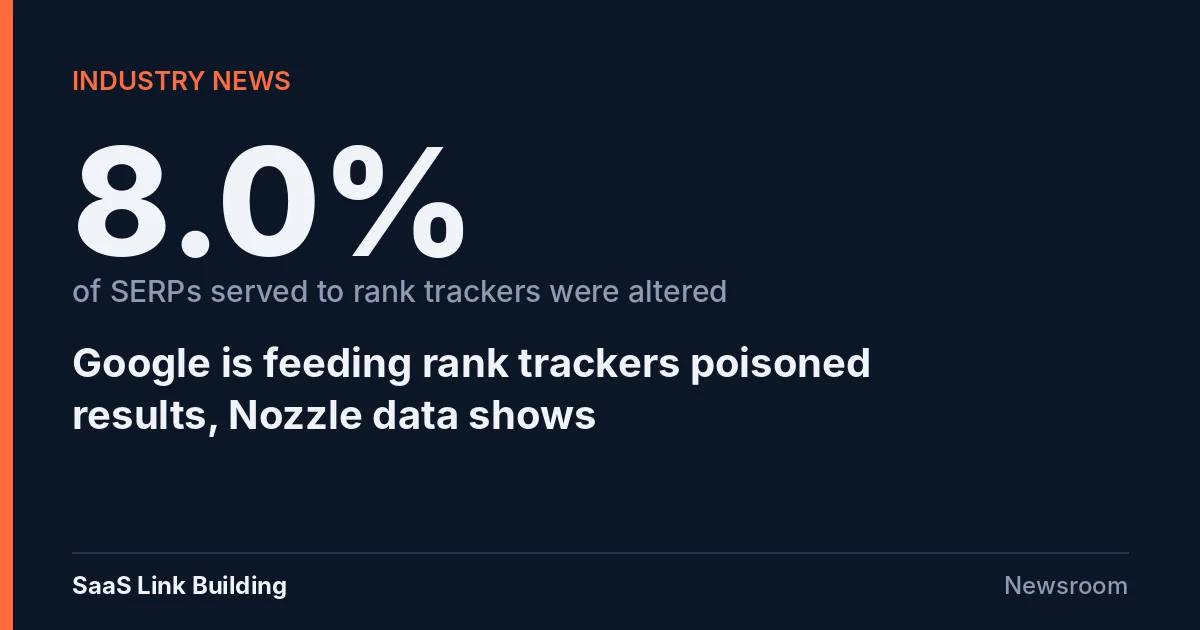
- 8.0% of SERPs were poisoned from September 13 onward, against a baseline of 0.17%. On the worst days, September 27 to 29, it reached roughly a quarter of all SERPs.
- Blocking came first, poisoning second. Requests to Google began failing in large numbers on September 13. From September 20, many of the requests that got through returned altered pages.
- The organic results kept only 20.7% of the previous SERP's sites on poisoned pages, against 88.5% normally.
- Tracked sites fell out of the top 10 on 58.6% of poisoned SERPs, compared with 2.7% in the baseline.
- It passes quickly. 80% of poisoning spells lasted a single collection, and 77.9% of keywords had their usual sites back within three days.
Who replaces the usual sites
Social platforms and forums gain the most on poisoned pages. Reddit appeared in the top 10 of 28.8% of poisoned SERPs against 20.8% of the same keywords' other SERPs, with Facebook, LinkedIn, Instagram and Quora also gaining. YouTube, Yelp and MapQuest appeared less often. Paid placements were barely touched: shopping results held steady and ads were actually more stable than usual, while AI Overviews appeared on 34.9% of poisoned pages against 54.2% in the baseline.
Where and on which searches
| Segment | Share of SERPs poisoned since Sep 13 |
|---|---|
| All SERPs | 8.0% |
| United States | 8.5% |
| United Kingdom | 3.0% |
| Canada | 10.5% |
| Australia | 11.5% |
| India | 10.9% |
| "Near me" searches | 11.4% |
| Long-tail (under 100 searches/month) | 9.4% |
| Most navigational brand searches | 5.3% |
| US legal SERPs | 15.9% (51.3% on Sep 27) |
| US software and technology SERPs | 8.8% |
Why Google is doing it
Google has not commented publicly on the practice. Nozzle's view is that it is a response to bulk scraping of Google results to ground AI answers, and that rank trackers are caught in the same net because they collect SERPs the same way. Search Engine Roundtable reported on October 12 that Nozzle's Derek Perkins describes three tactics running together: very wide IP blocking aimed at residential proxy networks, much heavier use of CAPTCHAs, and injecting wrong results into suspect SERPs.
It follows a run of anti-scraping changes. Google dropped the num=100 results parameter in 2025, began testing google.com/goto redirects on result links in July 2026 and later confirmed deploying them, and has been testing more human verification checks on search. Advanced Web Ranking, writing in September, described the same split as a "dual-SERP" reality in which suspected automated queries can receive a different page from the one people see.
Several vendors, including Sistrix, DataForSEO, SE Ranking, Advanced Web Ranking and Morningscore, have posted notices about data collection problems. Practitioners have reported mismatches between tools: Glenn Gabe noted on X that a site hit on September 29 showed the drop in Ahrefs promptly, in Semrush late, and not at all in Sistrix.
How to tell poisoning from a real ranking drop
- Check Search Console first. If a keyword "disappears" in your tracker but impressions and clicks in Search Console are steady, the site did not move.
- Compare against the keyword's history, not just yesterday. Yesterday's SERP may also have been poisoned. A result set that shares almost nothing with the keyword's usual page-1 sites over prior weeks is a data problem, not a ranking change.
- Wait three days. Most poisoning clears within one to three collections. Real ranking changes persist.
- Look at the page, not the number. Open the stored SERP snapshot if your tool keeps one. Poisoned pages tend to show shallower pagination, more image packs and social sites, and fewer AI Overviews.
- Annotate late September in client reports. September 27 to 29 was the worst stretch, and it overlapped with the September 2026 spam update, which makes careless attribution easy.
Conclusion
Third-party rank tracking has always been an approximation of what users see. What changed in September 2026 is that the approximation can now be silently wrong: a full, valid-looking page with the wrong results, which a tool will store as real unless it checks. Until vendors adapt their collection and validation, SEO teams should report rankings as trends and ranges, confirm any sharp movement against Search Console, and treat single-day swings with suspicion.
Questions and answers
What is a poisoned SERP?
A results page Google returns to a suspected automated query that looks complete and normal but has most of the keyword's usual organic results replaced. Nozzle defines it as a SERP missing more than half of a keyword's usual top-10 sites, which return on a later collection.
Which rank trackers are affected?
The issue affects any tool that collects Google results through automated queries. Sistrix, DataForSEO, SE Ranking, Advanced Web Ranking and Morningscore have all posted notices about collection problems since September 2026.
Did Google confirm it is poisoning SERPs?
No. Google has not commented. The finding comes from Nozzle's analysis of 27.5 million SERPs, published October 10, 2026.
How can I check if my ranking drop is real?
Compare the tracked drop with Search Console impressions and clicks, check whether the result set matches the keyword's usual sites, and see whether the drop persists beyond three days.
More releases
-
Updates
Google Adds Retry-After Guidance to Its Crawl Rate Documentation
Google has restructured its guide to reducing crawl rate and now spells out how site owners can pair a 503 or 429 response with a Retry-After header to tell Google's crawlers when to come back. The behavior is not new, but it is now documented where site owners look during an emergency.
-
Explainers
How Long Google Takes to Crawl, Index and Re-Rank: All 23 Timelines Gary Illyes Shared in Barcelona
Google's Gary Illyes showed internal timing ranges for 23 crawling, indexing and serving processes at Search Central Live Deep Dive Europe, from about 20 hours to discover a new URL to three to six months to recover from a core update. Here is every figure, and what it means for planning SEO work.
-
Studies
Google's 2026 Update Calendar: Four Spam Updates, Two Core Updates and the Shortest Rollouts on Record
An analysis of all 40 named ranking updates on Google's Search Status Dashboard shows 2026 is the first year spam updates have outnumbered core updates two to one, while both kinds of update are rolling out faster than in any previous year on record.
Tell us the site and the goals.
Rankings in Google and visibility in AI answers, from one monthly plan. One call is enough to say which one fits. Email works just as well.