Pew: Nearly 4 in 10 US Adults Are in an Online Community, and 15% Belong to Forums Like Reddit
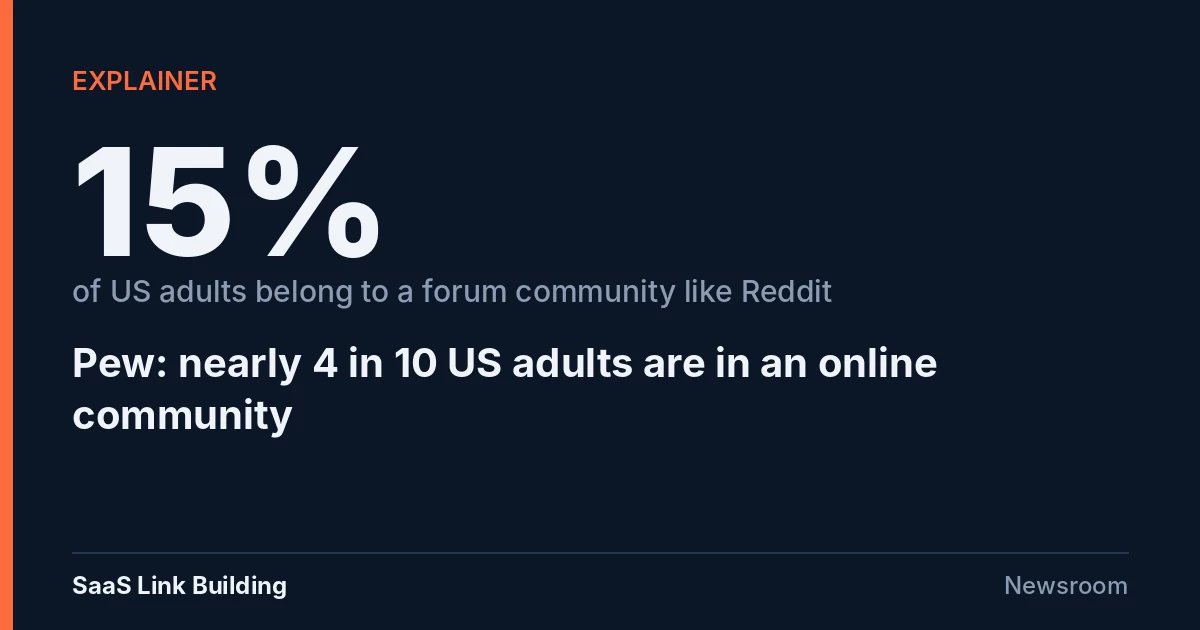
A Pew Research Center survey of 9,750 US adults, published on 14 October, found nearly four in ten belong to an online community and 15% are part of one on discussion forums such as Reddit, Nextdoor or Discord. About eight in ten members go to stay informed, for fun or for advice.
 Vibhu Dhariwal
Cofounder & CTO, Digital Gratified
- Published
- Section
- Explainers
- Reading time
- 4 minutes
Ras Al Khaimah, United Arab Emirates, .
Nearly four in ten US adults belong to an online community, and 15% are part of one on discussion forums such as Reddit, Nextdoor or Discord, according to a Pew Research Center report published on 14 October 2026. The survey of 9,750 adults, run from 26 May to 1 June 2026 through Pew's American Trends Panel, also found that about eight in ten members visit their main community to stay informed, for fun or for advice.
The findings matter to SEO teams because forum and community content now appears across Google Search, and Google has opened a dedicated pipeline for it. They show how many people are creating that content, how often, and why.
Key findings
- Reach. Nearly four in ten US adults are in an online community, rising to 48% of adults aged 18 to 29.
- Platforms. About a quarter are in a community on social media. Discussion forums come next at 15%, then video sites, online games and messaging apps. 5% are in one on hobby sites such as Goodreads, Strava, Ravelry or Letterboxd.
- Topics. Hobbies and local areas lead, at about one in five adults each. About one in ten are in communities about entertainment, video games or their profession. 8% are in one about politics.
- Motives. About eight in ten members or more say they go to their most-visited community to stay informed, for fun or for advice and recommendations.
- Unique value. About six in ten members say their most-visited community offers something they could only find online.
- Daily habit. 56% of members visit their main community every day, about one in five US adults. 74% say they post or share there.
- Churn. About a third of US adults have left an online community. Of those, 57% cite too much arguing and 43% harassment.
| Measure | Share | Base |
|---|---|---|
| Part of an online community | Nearly 4 in 10 | US adults |
| Part of an online community (ages 18 to 29) | 48% | US adults aged 18 to 29 |
| Community on discussion forums (Reddit, Nextdoor, Discord) | 15% | US adults |
| Community on hobby sites or apps | 5% | US adults |
| In more than one community | 85% | Community members |
| Post or share in main community | 74% | Community members |
| Visit main community daily | 56% | Community members |
| Ever left an online community | About a third | US adults |
Why this matters for search
Google has made forum content a defined part of Search. In October it published documentation for the UGC Fresh Data Program, which lets approved platforms that primarily host user-generated content, social postings or forum discussions send content and interaction signals to Google through a dedicated pipeline, separate from the Indexing API and normal crawling. Google says the programme does not guarantee that content will appear in Search. We covered the programme's launch and review process when it was announced.
Pew's data shows the demand side of that content. Information and advice are the leading reasons people visit communities, the same needs that informational and commercial searches serve. Pew also found that 68% of members knew few or none of the other members before joining, which suggests these spaces are built around topics rather than existing relationships.
Age shapes the picture. Adults under 30 are more likely than older groups to be in communities about video games, beauty, entertainment and hobbies, and 27% of them are in a gaming community, against 4% of those 50 and older. Brands whose audience skews young should expect more of their category conversation to happen in these spaces.
What SEO teams can do
- Map the communities in your category. Hobbies and local topics lead participation. Find where your audience asks questions, and track which threads rank for your target queries.
- Answer the questions communities ask. With information and advice the main motives, recurring forum questions are a direct source of content topics and FAQs.
- Take part as a named expert, not a marketer. Pew found that too much arguing and harassment drive people away. Helpful, disclosed participation fits how members use these spaces.
- Check eligibility if you run a community. Platforms with a high volume of UGC on stable public URLs can review Google's UGC Fresh Data Program criteria.
- Segment by age. If your buyers are under 30, community presence is likely to matter more, given that 48% of that group belongs to one.
Conclusion
Pew's survey puts numbers on a shift SEO teams already see in results pages: a large share of Americans, and about half of young adults, spend time in online communities, mostly for information and advice, and many visit daily and post. With Google building a dedicated ingestion route for fresh user-generated content, those communities are both an audience to understand and a source of the content that competes for search visibility.
Questions and answers
How many Americans are part of an online community?
Nearly four in ten US adults, according to a Pew Research Center survey of 9,750 adults conducted from 26 May to 1 June 2026. Among adults aged 18 to 29, the share is 48%.
Where do online communities form?
About a quarter of Americans are in an online community on social media. 15% are in one on discussion forums such as Reddit, Nextdoor or Discord, and 5% on hobby sites or apps.
Why do people use online communities?
About eight in ten members or more say they go to their most-visited community to stay informed, for fun, or to get advice or recommendations.
How often do members visit?
56% of members visit their most-visited community every day, which Pew says equals about one in five US adults. 74% say they post or share there.
More releases
-
Studies
Google and OpenAI's API Recovered Only 28% of the Pages ChatGPT Cited, arXiv Study Finds
A preprint from researchers at Xi'an Jiaotong University and the National University of Singapore found that Google results and OpenAI's Responses API together recovered only 28.3% of the pages ChatGPT cited for GPT-5.3 Instant and 26.2% for GPT-5.5 Instant, but about half of the cited sites.
-
Industry news
Cloudflare Will Score Verified Bots on Robots.txt and 429 Compliance, With Trust Bands Coming to Radar
Cloudflare said on 16 October that it now measures whether Verified bots honour robots.txt and slow down after HTTP 429 responses. The results will form a trust band published on Cloudflare Radar, and customers will later be able to set a trust threshold for how Verified bot traffic is handled.
-
Studies
20.8% of 514 Top Sites Now Publish llms.txt, a File Google Says Search Can Ignore
Our analysis of the 1,000 most popular domains on the Tranco list found that 107 of 514 sites with a valid robots.txt (20.8%) serve an llms.txt file, while 18 (3.5%) declare Content Signals AI preferences. Google's AI optimisation guide says sites can ignore llms.txt for Google Search.
Tell us the site and the goals.
Rankings in Google and visibility in AI answers, from one monthly plan. One call is enough to say which one fits. Email works just as well.