Google's Helpful Content Guide Adds 4 Rater Tests: Effort, Originality, Skill, Accuracy
Google has added a main content section to its Creating helpful content guide, listing the four attributes its quality raters assess: effort, originality, talent or skill, and accuracy. We compared the new wording with the rater guidelines line by line and mapped where each attribute appears across their 182 pages.
 Vibhu Dhariwal
Cofounder & CTO, Digital Gratified
- Published
- Section
- Explainers
- Reading time
- 8 minutes
Ras Al Khaimah, United Arab Emirates, .
Google has added a new main content section to its Creating helpful, reliable, people-first content guide. The section defines what Google Search counts as "main content" and lists four attributes its search quality raters are trained to assess in it: effort, originality, talent or skill, and accuracy. Search Engine Roundtable reported the additions on 2 October, and the page footer now gives 5 October as its last update.
The edit landed in the same week Google revised its guidance on using generative AI content, which its Search documentation changelog records on 1 October as an update "with information from the Search Quality Raters guidelines". Our check of that changelog found no entry for the helpful content page itself, so anyone tracking Google's documentation through the changelog alone would have missed it. It is the kind of silent edit our analysis of Google's 2026 documentation changelog could not capture.
Because the four attributes come from the Search Quality Rater Guidelines, we compared the two texts line by line and counted where each attribute appears across the guidelines' 182 pages.
What changed
The new material sits in the guide's E-E-A-T and quality rater section and has three parts.
- A framing sentence. Beyond E-E-A-T, the rater guidelines treat main content quality as one of the most critical page quality factors.
- A definition of main content. Any part of a page that directly helps it achieve its purpose. Google lists five kinds: primary text and media; interactive features such as calculators, tools, games or search; user-generated contributions where they fulfil the page's purpose; tabbed or expanded sections such as specifications or reviews; and visible page titles and headings.
- Four attributes raters evaluate. Effort, originality, talent or skill, and accuracy, each with a short definition.
The page keeps its statements that raters have no control over rankings and that rater data is not used directly in ranking algorithms.
How the public wording differs from the rater guidelines
The definitions are close to section 3.2, "Quality of the Main Content", of the rater guidelines (the 11 September 2025 edition Google currently links to). They are not identical. The table sets out what Google added or left out when it moved the text into Search Central.
| Attribute | Rater guidelines, section 3.2 | Search Central guide | What the change signals |
|---|---|---|---|
| Effort | How far a human worked to create satisfying content, from translating a poem to building systems. Mass machine translation without oversight has none. Forum participation counts. | Adds original analysis and a custom game map as examples, names unsupervised generative AI text as little to no effort, and says attribution does not replace original effort. | Generative AI is now named in the public definition, and citing a source is explicitly not a substitute for work. |
| Originality | Unique content not available elsewhere. If similar content exists, raters consider whether the page is the original source. | Unique information or perspectives not already available on other websites. The test of whether the page is the original source is not repeated. | The public bar is framed around adding something new, not around who published first. |
| Talent or skill | Enough talent and skill to give visitors a satisfying experience. | Adds examples (clear writing, well-produced video, working tools) and says not all content needs specialised expertise. | Skill covers execution and usability, not only credentials. |
| Accuracy | Informational pages: factually accurate. YMYL pages: accurate and consistent with well-established expert consensus. | Same split, worded more firmly: YMYL content must be highly accurate and consistent with established expert consensus. | The YMYL standard reads as a requirement rather than a consideration. |
Where each attribute shows up in the rater guidelines
We counted mentions of the four terms across every page of the rater guidelines and grouped them by section. The pattern is uneven.
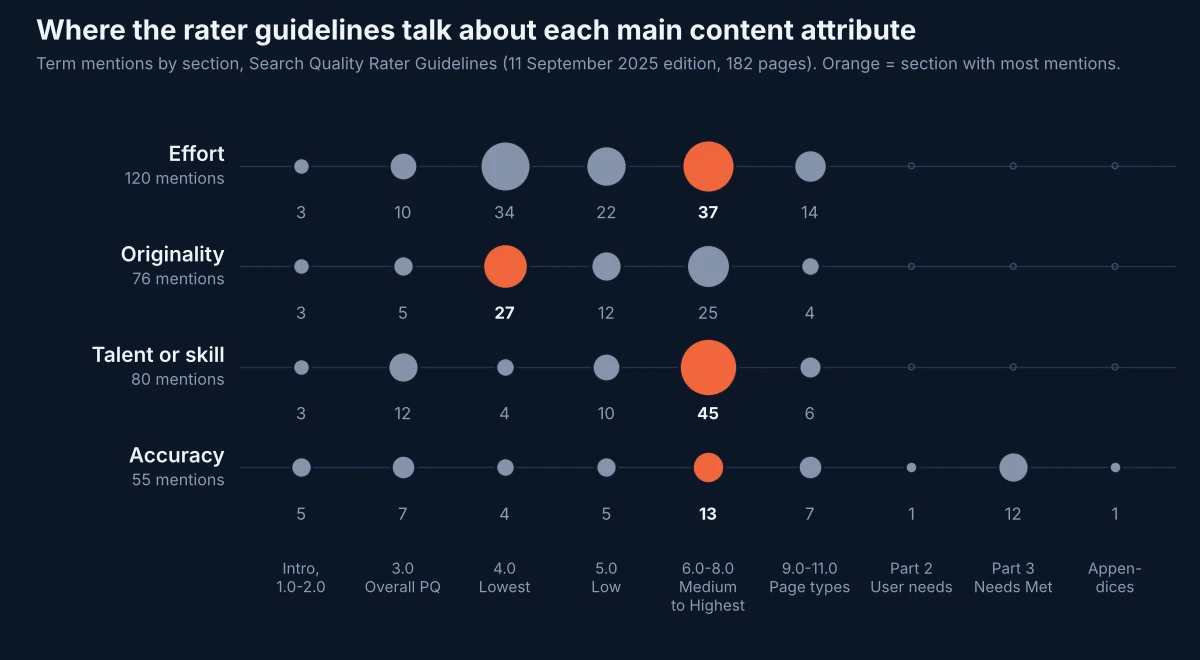
Three things stand out:
- Effort and originality are mostly failure language. Nearly half of all effort mentions (56 of 120) and just over half of originality mentions (39 of 76) sit in the Lowest and Low quality sections. Raters meet these words most often when deciding what to mark down.
- Talent or skill is mostly praise language. 45 of its 80 mentions fall in the Medium, High and Highest quality sections, where raters look for what lifts a page.
- Accuracy is the only attribute that reaches the Needs Met rating. 14 of its 55 mentions appear outside the Page Quality part (12 in Part 3, Needs Met). Effort, originality and talent or skill do not appear in Parts 2 or 3 at all.
Section 4.6.6 also closes a loophole: copied, paraphrased or AI-generated main content that adds little to no value is rated Lowest even if the page credits its source, and the test means "little to no effort of any type". Google's public guide now carries the same line: "Attribution or giving credit to other sources doesn't replace the need for original effort."
Worked examples: applying the four tests
The scenarios below are illustrative page types, not real sites.
1. A news page that rewrites one source
A site publishes a 600-word version of another outlet's story, credits it with a link, and adds nothing else. The rater guidelines describe content paraphrased from a single source as copied or paraphrased content, and section 4.6.6 says crediting the source does not rescue it. To pass the originality test it needs something the source lacks, such as a primary-document check, a timeline or a count.
2. Programmatic location or comparison pages
Hundreds of pages are generated from a feed with only the place or product name swapped. The new guide names automatically generating pages from feeds as little to no effort, and section 4.6.5 of the rater guidelines, which Google's AI content guide points to directly, lists scraping feeds and stitching content together as scaled content abuse. The fix is per-page data or functionality, or fewer pages.
3. A calculator or tool page with thin text
Google's definition lists interactive features as main content, and its effort definition counts the human work that went into the systems powering a page. A working mortgage calculator with a short explanation can therefore score well on effort and skill. Raters are told to test functionality themselves, so the tool has to work.
4. An AI-drafted article that a person reviewed
The AI content guide says it is critical to fact-check and review AI output before publishing, metadata included. The new helpful content wording targets generative AI used to produce large amounts of text without oversight or curation, so the review step is what separates the two cases.
5. A forum thread
The rater guidelines count participation and depth of discussion as effort, and the new definition of main content includes user contributions that fulfil the page's purpose. Google is building separate routes for this content too, such as its UGC Fresh Data Program for forums.
What this means for SEO teams
- Audit main content, not word count. The guide still says Google has no preferred word count. Score each template on the four attributes.
- Add one original element per page. Original analysis, first-party data, a working tool or a primary-source check meets the effort and originality definitions; a link to someone else's work does not.
- Put human review into the workflow for AI drafts. Fact-check figures, titles, meta descriptions, structured data and alt text, as the AI content guide asks, and say how automation was used where readers would expect to know.
- Treat accuracy as the attribute with the widest reach. It is the one attribute raters also apply when judging whether a result meets the searcher's need, and the YMYL wording is now a requirement.
- Do not fake freshness or authorship to compensate. The same guide warns against changing dates without substantial changes (see our 35-search test on fresh dates) and calls fabricated creator profiles, such as AI-generated headshots or false credentials, a form of deception.
Methodology
On 26 October 2026 we downloaded the live Creating helpful content and Using generative AI content pages from Google Search Central and the Search Quality Rater Guidelines PDF that both pages link to (182 pages, dated 11 September 2025 on its cover). We searched the Search documentation changelog for any October entry covering the helpful content page and found none; the page's own footer gives 5 October 2026 as its last update.
For the chart, we extracted the PDF text page by page and counted case-insensitive matches for "effort"; "originality" or "original content"; "talent" or "skill" (including "skills" and "skilled"); and words beginning "accura" (accurate, accuracy, accurately). Pages were grouped using the guidelines' own table of contents (for example, section 4.0 is pages 29 to 58 and Part 3 is pages 113 to 174). Counts include every use of each word, so they show emphasis rather than a tally of rules.
Conclusion
Google has not changed how raters work: the four attributes were already in section 3.2 of the rater guidelines it links to. What changed is that its main public guide to helpful content, the page that asks site owners to audit traffic drops, now states them, with generative AI named in the effort definition.
Raters mostly invoke effort and originality to mark pages down, talent or skill to lift them up, and accuracy across both quality and Needs Met ratings. Teams producing content at scale should treat the first two as the minimum bar, as low-effort AI sites multiply: ad verification data showed AI slop sites growing more than fivefold in a year.
Questions and answers
What are the four main content attributes in Google's helpful content guide?
Effort, originality, talent or skill, and accuracy. Google's Creating helpful content page says search quality raters are trained to evaluate these attributes of a page's main content, drawing on section 3.2 of the Search Quality Rater Guidelines.
Does Google count AI-generated content as low effort?
Not automatically. The guide says using generative AI to produce large amounts of text without manual oversight or curation represents little to no effort. Google's separate generative AI guidance says AI output should be fact-checked and reviewed before publishing.
Does crediting or linking to a source make rewritten content acceptable?
No. The guide states that attribution or giving credit to other sources does not replace the need for original effort, and section 4.6.6 of the rater guidelines says such pages are rated Lowest even when the source is credited.
Do quality rater scores directly affect rankings?
No. Google's guide says raters have no control over how pages rank and rater data is not used directly in its ranking algorithms. Google uses the ratings as feedback on whether its systems are working.
What does Google count as main content?
Any part of a page that directly helps it achieve its purpose, including primary text and media, interactive features such as calculators, user contributions that fulfil the page's purpose, tabbed or expanded sections, and visible titles and headings.
More releases
-
Studies
Does Google Use Clicks to Rank Pages? Trial Files and 14,013 Leaked Fields Say Yes
Court findings from US v. Google and Google's own How Search Works page show that aggregated click data feeds ranking through Navboost and Glue. Our count of 14,013 leaked attributes finds 63 tied to clicks, dwell or Chrome, but no evidence that a site can lift rankings by gaming its own CTR.
-
Studies
39.5% of 339 Top-Site Sitemaps Skip Lastmod, the Date Google Uses to Schedule Crawls
A SaaS Link Building crawl of the 1,000 most visited domains on 26 October found that 39.5% of 339 page-level sitemaps carry no lastmod date, 19.5% of well-dated ones give every URL the same date, and 38.1% still use changefreq or priority, tags Google says it ignores.
-
Industry news
Trackers Spike on 24 October, but Google Logs No Update as Core Gap Hits 158 Days
Rank trackers showed significant volatility on 24 October 2026, yet Google's Search Status Dashboard still lists no ranking update since 8 October. Our count of every core update since November 2021 puts the current 158-day gap sixth longest of 16, and the 189-day record would be matched on 26 November.
Tell us the site and the goals.
Rankings in Google and visibility in AI answers, from one monthly plan. One call is enough to say which one fits. Email works just as well.