AI Slop Sites Grew Over Fivefold Year on Year as Ad Requests Hit 834M in September, DoubleVerify Data Shows
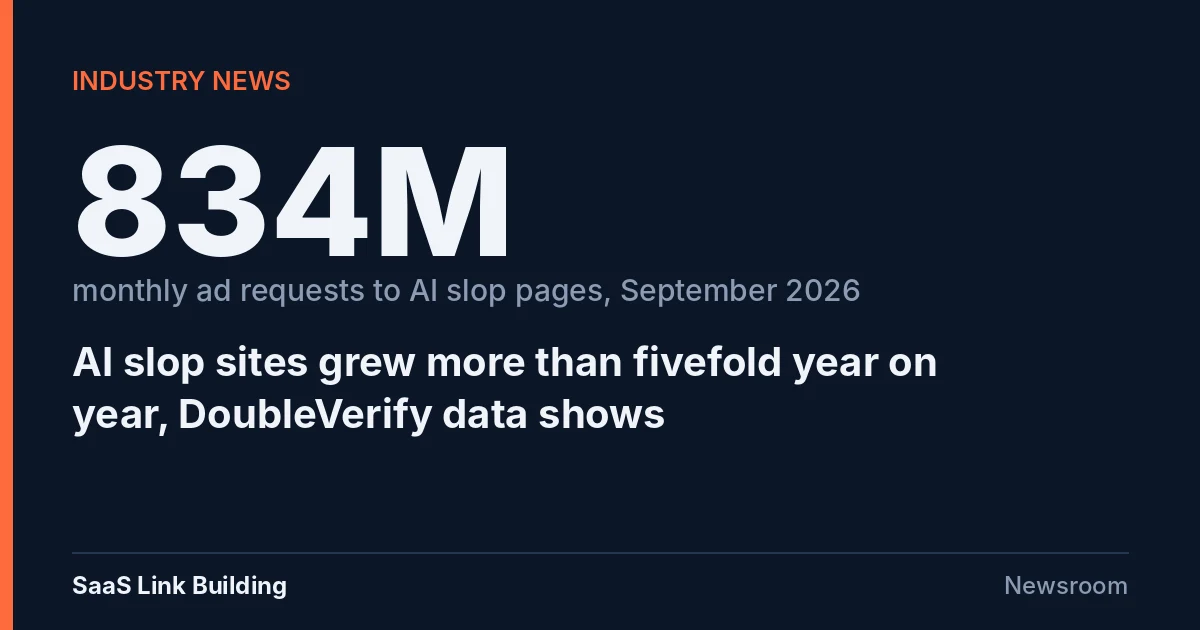
Domains publishing low-quality AI-generated content rose more than fivefold in Q2 2026 versus Q2 2025 and their traffic quadrupled, according to DoubleVerify data reported by Axios on 17 October. Monthly ad requests to these pages climbed from 184 million in January to 834 million in September 2026.
 Vibhu Dhariwal
Cofounder & CTO, Digital Gratified
- Published
- Section
- Industry news
- Reading time
- 4 minutes
Ras Al Khaimah, United Arab Emirates, .
The number of domains publishing low-quality AI-generated content rose more than fivefold in the second quarter of 2026 compared with the same quarter a year earlier, according to data from ad verification firm DoubleVerify reported by Axios on 17 October 2026. Traffic to those sites quadrupled over the same period, and monthly ad requests to AI slop pages climbed from 184 million in January to 834 million in September.
The figures put numbers on a trend SEOs have watched in search results all year: cheap generative AI makes it easier to run content farms built to capture advertising revenue, and some of those operations now aim at AI answer engines as well as classic search.
Key findings
- More than 5x more slop domains. DoubleVerify counted over five times as many domains with low-quality AI content in Q2 2026 as in Q2 2025.
- 4x more traffic. Visits to those sites quadrupled year on year.
- Ad requests up about 4.5x in nine months. Monthly ad requests to AI slop pages rose from 183.9 million in January 2026 to 834.2 million in September 2026.
- The steepest jump came late. Ad requests rose 47% from July to August and a further 58% from August to September.
| Month (2026) | Ad requests to AI slop pages |
|---|---|
| January | 183.9 million |
| February | 218.2 million |
| March | 271.1 million |
| April | 296.2 million |
| May | 257.6 million |
| June | 303.8 million |
| July | 358.9 million |
| August | 528.4 million |
| September | 834.2 million |
Added together, the chart shows about 3.25 billion ad requests to AI slop pages in the first nine months of 2026. The third quarter alone accounted for about 1.72 billion, roughly 2.6 times the 673 million recorded in the first quarter.
Context: the AutoBait network
This is not DoubleVerify's first look at the problem. In March 2026 the firm shared research with Axios on a network of more than 200 websites run by a single group, which it called AutoBait. The operators generated articles from templated prompts sent to a large language model, spent less than $2.25 per article page, and filled each site with multiple ad banners. Many of the domains had hosted legitimate content before their registrations lapsed, and the prompts were left exposed in the sites' JavaScript.
The October figures cover AI slop sites in general rather than a single network. Axios framed the rise against SEO's incentive problems in the AI answer era, in which brands and publishers compete to influence what chatbots recommend.
Where Google stands
Google's spam policies already cover the main tactics described in the research. Scaled content abuse is defined as generating many pages mainly to manipulate rankings rather than help users, and Google lists using generative AI tools to create many pages without adding value as an example. The same page covers expired domain abuse, where a lapsed domain is bought and repurposed to exploit its past reputation with low-value content.
Google updated its guidance on using generative AI content on 1 October 2026 to align it with the Search Quality Rater Guidelines, according to its documentation changelog. Google has also run four spam updates in 2026, the most recent completing on 8 October, according to its Search Status Dashboard. We found no public comment from Google on the DoubleVerify figures.
Limitations
The Axios report does not describe how DoubleVerify defines or detects an AI slop domain, and it does not link to a full DoubleVerify report. DoubleVerify measures ad traffic, so its figures reflect sites that serve programmatic ads and may not capture slop sites that monetise in other ways. The domain count and traffic growth are reported as year-on-year multiples, without absolute numbers.
What this means for SEO teams
- Expect more low-quality competitors in long-tail results. Cheap generation lowers the cost of targeting niche queries, including SaaS comparison and how-to terms.
- Audit your backlink profile for slop domains. Sites built on lapsed domains often carry old link equity and can link out at scale. Review new referring domains with recent ownership changes and thin, templated content.
- Vet guest post and placement targets. A domain with real history but new, generic AI articles is a common pattern in this research. Check archive history and editorial quality before pursuing a link.
- Keep your own AI use within Google's guidance. Google's policy targets scale without value, not the use of AI itself. Add original data, first-hand experience and editing to anything produced with AI tools.
Conclusion
DoubleVerify's data shows AI slop sites multiplying fast in 2026, with domain counts up more than fivefold year on year and monthly ad requests rising about 4.5 times between January and September. For SEOs, the practical effects are more noise in search results, more questionable domains in link prospecting lists, and a stronger case for content that carries evidence of real expertise. Google's spam policies already address the core tactics, and how well its systems keep pace with the growth will be worth watching through the rest of the year.
Questions and answers
How fast are AI slop sites growing?
DoubleVerify data reported by Axios on 17 October 2026 shows domains with low-quality AI-generated content rose more than fivefold in Q2 2026 compared with Q2 2025, and traffic to them quadrupled.
How many ad requests did AI slop pages receive?
Monthly ad requests rose from 183.9 million in January 2026 to 834.2 million in September 2026, according to the DoubleVerify figures in the Axios chart. The nine-month total is about 3.25 billion.
Does Google penalise AI-generated content?
Google's spam policies target scaled content abuse, defined as generating many pages mainly to manipulate rankings rather than help users. Using generative AI to create many pages without adding value is listed as an example.
What was the AutoBait network?
In March 2026 DoubleVerify described a network of more than 200 AI-generated websites run by one group, built partly on lapsed domains, with article pages costing less than $2.25 each to produce, according to Axios.
More releases
-
Updates
Google Merchant Center Adds Warranty Attribute for All Products as Quebec's 3 to 6 Year Warranty Law Starts
Google Merchant Center now supports a warranty attribute for general products, letting merchants show warranty length in Shopping ads and free listings. Google cites Quebec's Bill 29, whose legal warranty of good working order took effect on 5 October 2026 and covers appliances and electronics for 3 to 6 years.
-
Studies
AI Mode-Style Queries Rose 7x in Search Console at the Median Site, 155-Site GSC Wizard Study Finds
Conversational follow-up queries typical of AI Mode grew from 0.032% to 0.22% of impressions at the median site between June 2025 and September 2026, according to a GSC Wizard study of 155 Search Console properties. These queries had a 2.9% click-through rate, against 35.6% for all queries.
-
Industry news
No Google Ranking Update Since 8 October Despite Volatility Chatter; Core Update Gap Reaches 152 Days
Google's Search Status Dashboard has logged no ranking update since the September 2026 spam update ended on 8 October, despite rising volatility reports from 15 October. Our analysis of the dashboard shows 152 days have passed since the May 2026 core update began, the second longest gap since August 2024.
Tell us the site and the goals.
Rankings in Google and visibility in AI answers, from one monthly plan. One call is enough to say which one fits. Email works just as well.