Does Google Reward Fresh Dates? Our 35-Search Test Finds It Depends on the Query
Google runs freshness systems, but there is no evidence that moving a page's date lifts it. In 35 Google searches pulled on 25 October 2026, product results leaned heavily recent, fresher product pages sat lower on page one, and Google overrode the title year on six results.
 Vibhu Dhariwal
Cofounder & CTO, Digital Gratified
- Published
- Section
- Studies
- Reading time
- 15 minutes
Ras Al Khaimah, United Arab Emirates, .
Few habits are as widespread in SEO as refreshing the date. Product round-ups get a new year in the title every January, "last updated" stamps move forward after a light edit, and some publishers re-date old articles wholesale. The belief behind it is simple: Google prefers fresh content, so a fresh date should help. Google has long said that changing a date without changing the page does nothing. To test who is closer to the truth, we pulled 35 Google US searches on 25 October 2026, recorded the date Google displayed for each of 316 organic results, and set that data against Google's own documentation, the 2024 leaked Content Warehouse API documentation and what Google's John Mueller has said on record.
Our verdict comes at the end. The short version: freshness is real and Google says so itself, but it behaves like a property of the query, not a reward for the page. Nothing in our data, or in anything Google has published, shows that bumping a date lifts a page.
Key findings
- Google showed a date on 174 of the 316 results (55%) across 13 "best X" product searches, 11 evergreen how-to searches and 11 time-sensitive searches.
- Product searches leaned heavily toward recent dates: 48% of the dated results in "best X" searches carried a date from the last 90 days, against 14% in evergreen how-to searches.
- The year in the title is a product-search habit: 56% of results in "best X" searches put 2026 in the title. Not one result in the evergreen group did.
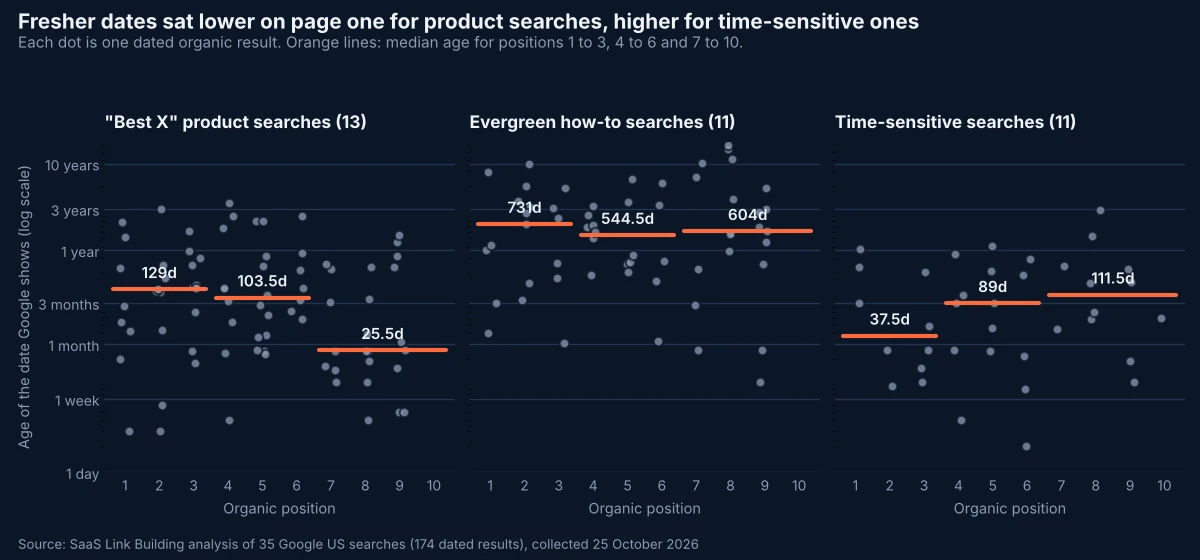
- Freshness did not decide the order within product results. In "best X" searches, the dated results at positions 7 to 10 were far fresher than those in the top three. In time-sensitive searches the pattern ran the other way.
- Google does not take the title year at face value. Six results had 2026 in the title while Google displayed a 2024 or 2025 date for them, one of them at position 1.
- Evergreen answers age well: 25 of the 58 dated evergreen results (43%) were more than two years old, including a 2012 video and a 2010 video on page one.
The theory: fresh dates win
The freshness theory has two layers, and they need to be separated because the evidence treats them very differently.
The first layer is that Google favours recent content for some searches. That is not a theory at all. Google says it outright, and the strongest version of the SEO belief rests on it.
The second layer is the one that drives behaviour: that the date a page shows, or the year in its title, is itself a lever. If Google likes fresh pages, the reasoning goes, then a page that looks fresh will be treated as fresh. This is why affiliate and review publishers update title years on a schedule, why content teams treat "updated" dates as a ranking task, and why some sites have re-dated old articles in bulk. It is also the layer Google has said does not work.
The appeal of the second layer is understandable. Updating a date costs seconds; rewriting a buying guide costs days. And because rankings move constantly, almost any re-dated page will eventually rank better at some point, which makes the tactic feel proven to the people who use it.
What Google has said about freshness
Google's own guide to its ranking systems lists freshness systems by name and describes them as "query deserves freshness" systems: built to show fresher content for searches where fresher content would be expected. Its examples are a newly released film, where people want recent reviews, and a recent earthquake, where news coverage should surface.
The idea is old. When Google announced its freshness update in November 2011, Google Fellow Amit Singhal wrote that it affected about 35 percent of searches, a figure Google later clarified meant at least one result changed, with 6 to 10 percent of searches noticeably affected. That post named three kinds of query that benefit: recent events and hot topics, regularly recurring events such as elections or annual conferences, and information that changes often, illustrated with searches such as [best slr cameras] and [subaru impreza reviews].
That last category matters for this investigation. Google has said, in writing, that someone searching for the best of something probably wants the most up-to-date information. The SEO instinct that product round-ups need to stay current is consistent with Google's own description of its systems. What Google has never said is that the displayed date is what makes a page current.
The same 2011 framing still shows up in newer work. Our earlier coverage of a Google paper on Discover's staleness filter described a system that removes stale stories before ranking, which is again a judgement about the content and its context rather than a stamp on the page.
Evidence for the theory
The leaked documentation shows Google tracks several kinds of date
In May 2024, internal documentation for Google's Content Warehouse API became public. Google confirmed the documents were authentic; spokesperson Davis Thompson told The Verge the company would "caution against making inaccurate assumptions about Search" based on out-of-context or outdated information. The documentation lists attribute names and short descriptions. It does not say how, or whether, each one is weighted in ranking, and anything beyond the descriptions below is inference.
With that caveat, the date-related attributes are extensive. The PerDocData module, which holds per-document signals, includes:
- semanticDate: described as the estimated date of a document's content, based on parsing the content, anchors and related documents.
- lastSignificantUpdate: described as the last significant update of the document, computed "from various signals".
- datesInfo: described as dates-related information such as whether a page is old based on its date annotations, and noted as used in something called FreshnessTwiddler.
- freshboxArticleScores: described as scores from freshness-related classifiers, including an article score and a live blog score.
A separate module, QualityTimebasedSyntacticDate, covers dates parsed from the page itself. It includes a bylineDate field, a flag for whether a date is suitable to display as the snippet byline, and a flag named trustSyntacticDateInRanking, set when a date is high confidence but does not qualify as a byline date.
For believers, this is the strongest documentary support available. A field that mentions ranking, a re-ranking component with "freshness" in its name and a dedicated set of freshness classifiers suggest that dates feed into how results are ordered, at least in some systems.
Our data: product searches are full of recent dates
The SERP data backs up the first layer of the theory clearly. In the 13 "best X" searches we pulled, almost half of the dated results were less than 90 days old and 85% were less than a year old. In 11 evergreen how-to searches covering subjects such as photosynthesis, compound interest and DNS, only 14% were less than 90 days old and 38% were less than a year old. Same engine, same day, same position range: the age profile of page one depends heavily on what is being searched.
The time-sensitive group, which included searches for the Social Security cost-of-living adjustment, NBA and NFL power rankings and the iPhone release date, also leaned recent: 59% of its dated results were within 90 days. Within that group, the top three positions carried the freshest dates of the three position bands.
Evidence against the theory
Google has said re-dating does not help
Google's guidance on creating helpful content lists, among the questions site owners should ask themselves, whether they are changing the date of pages to make them seem fresh when the content has not substantially changed. The same page asks whether a site is adding or removing large amounts of content mainly to seem fresh, and answers its own question: it won't help.
In a Google Search Central office-hours session on 1 April 2021, Mueller answered a site owner who had been updating the dates on photo galleries after small changes. He said he did not expect it to change anything for search, suggested updating dates only when a page changes significantly, and described re-dating a gallery after merely reordering pictures as potentially misleading to users.
Google's byline date documentation adds an important technical point: Google does not rely on a single date factor. Its systems weigh several signals, and a visible date and structured data are things site owners can provide to help, not instructions Google must follow.
The leak cuts both ways
The same leaked fields that believers cite also undercut the cheap version of the tactic. The documentation separates the date parsed from the page (syntactic), the estimated date of the content itself (semantic) and the last significant update. Speculation: if those fields are used the way their names suggest, a system that tracks when content last changed significantly has little reason to accept a moved byline as evidence of a significant change. The documentation does not confirm this, and Google warned against reading too much into it, but the existence of separate fields is hard to square with the idea that the visible date is the whole story.
Our data: Google overrides the title year, and freshness did not set the order
Two results from our pull are hard to reconcile with the date-as-lever theory.
First, six of the 85 results with 2026 in the title were displayed with a date from 2024 or 2025. These included a tools round-up at position 1 for "best email marketing software" with 2026 in its title and a May 2025 date in the snippet, and another result in the same search with 2026 in the title and an August 2024 date. Whatever Google used to choose those dates, it was not the year in the title.
Second, within the product searches, fresher pages were not ranking higher. Dated results in positions 7 to 10 were much fresher than those in positions 1 to 3. In the evergreen group, the top three carried the oldest dates of any band. Only the time-sensitive group showed fresher dates at the top. Across all three groups, the rank correlation between a result's position and the age of its date was weak (between -0.16 and 0.09), and none was statistically significant, meaning age explained very little about the order of page one.
The year in the title told a similar story. In product searches, 20 of the 39 top-three results (51%) carried 2026 in the title, compared with 46 of 79 results at positions 4 and below (58%). If a fresh title year were a strong ranking lever, it should be more common at the top, not less.
| Search type | Searches | Organic results | Results showing a date | Dated within 90 days | Dated within a year | Dated more than 2 years ago | Current or next year in title |
|---|---|---|---|---|---|---|---|
| "Best X" product searches | 13 | 118 | 79 (67%) | 38 (48%) | 67 (85%) | 7 (9%) | 66 (56%) |
| Evergreen how-to searches | 11 | 98 | 58 (59%) | 8 (14%) | 22 (38%) | 25 (43%) | 0 (0%) |
| Time-sensitive searches | 11 | 100 | 37 (37%) | 22 (59%) | 33 (89%) | 1 (3%) | 23 (23%) |
Percentages for date age are shares of dated results. Source: SaaS Link Building analysis of Google US results, 25 October 2026.
Many winning pages show no date at all
Time-sensitive searches had the lowest share of dated results (37%), because the pages that won them were often live data pages: rate tables from lenders and Freddie Mac for "mortgage rates", AAA's fuel price pages for "gas prices", and pharmacy and CDC pages for "flu shot". Not one of the ten mortgage results or nine flu shot results carried a snippet date. Those pages are fresh in the sense that matters (their data changes daily or seasonally) without displaying a byline. That is consistent with Google's description of freshness as being about whether the information is current, not whether a date is shown.
The verdict
We split the verdict the same way we split the theory.
"Google rewards fresh content for some searches": confirmed. Google documents freshness systems by name, has described them publicly since 2011, and our pull shows the age profile of page one changing sharply with the type of search.
"Updating a page's date or title year lifts its rankings": unproven, and the available evidence leans against it. Google's guidance flags re-dating without substantive change as a warning sign, and Mueller has said it would not change anything for search. The leaked documentation shows Google tracking several separate dates, including a last significant update. Our data shows Google ignoring the title year for six results, fresher product pages sitting lower on page one rather than higher, and the current-year title slightly less common at the top of product searches than below it.
What our data cannot do is rule out a small effect. We measured correlation on one day, not a controlled experiment, and the samples per position band are small. A page whose date and content were both refreshed may well rank better, because the content improved. That is the outcome Google's guidance describes, and it is not the same thing as the date doing the work.
What this means for SEO teams
- Classify the query before you refresh. Pull the live results and check how old the displayed dates are. If page one for your target search is dominated by dates from the last few months, as with many "best X" searches we pulled, staying current is part of competing. If page one is full of results that are years old, a refresh calendar is unlikely to matter.
- Update the substance, then the date. For product round-ups, the work that matches Google's description of fresh content is new testing, current prices, discontinued products removed and new models added. Change the visible date when that work is done, and keep the date in structured data consistent with the page, as Google's byline guidance asks.
- Do not rely on the title year. Google displayed an older date for pages carrying 2026 in their titles. A title year that the content does not support may also cost trust with readers when the snippet shows an older date beside it.
- Audit bulk re-dating. If your CMS or a plugin moves "last updated" stamps on every save, check whether it is producing changes that are not significant. Mueller's 2021 answer suggests automatic CMS dates are not a problem in themselves, but they also should not be mistaken for a freshness strategy.
- Read volatility with this in mind. Fresh-leaning searches reshuffle as new pages appear, which can look like an update. Before attributing a drop to a Google change, check our record of 2026's confirmed ranking updates and the crawling, indexing and re-ranking timelines Gary Illyes shared.
Methodology
On 25 October 2026 we collected Google US organic results (English, gl=us) for 35 searches through a SERP data API, using its lightweight Google results endpoint, and recorded for each organic result its position, title and the date Google displayed in the snippet, if any. Relative dates such as "4 days ago" were converted to days. Searches were assigned in advance to three groups: 13 "best X" product searches (for example project management software, VPN, robot vacuum, running shoes and phones), 11 evergreen how-to and definition searches (for example photosynthesis, compound interest, tides, heat pumps and DNS) and 11 time-sensitive searches (for example mortgage rates, Google core update, ChatGPT pricing, Social Security COLA, gas prices and NFL power rankings). Two planned evergreen searches ("how to change a tire" and "what is a roth ira") returned results that did not match the query and were excluded. One result whose date field contained a rating label instead of a date was treated as undated. A title was counted as carrying the current or next year if it contained 2026 or 2027. Positions are organic positions only; ads, AI Overviews and other features were not counted. Rank correlations are Spearman coefficients between position and date age, pooled within each group. This is a single-day snapshot of one location and is not a controlled experiment; correlations do not show what caused a ranking. This is the same approach we used in our earlier test of whether Google favours big brands.
Conclusion
The freshness debate usually collapses two different claims into one. Google plainly runs systems that favour fresher content where searchers want current information, and product searches are firmly in that category. But the evidence that a moved date or a new title year does the work is missing: Google says it does not, its leaked documentation includes a separate field for a page's last significant update, and on page one the freshest product pages sat lower, not higher.
The practical reading is that freshness is earned by the content and judged by the query. Teams that refresh what is on the page for searches that reward currency are doing what Google describes. Teams that only refresh the date are, on this evidence, spending effort on a label.
What do you think?
Have you tested a date-only change against a full content refresh on comparable pages, and did either move rankings or clicks in Search Console? We would like to see the before and after numbers.
Questions and answers
Does Google use freshness as a ranking factor?
Google's guide to its ranking systems lists freshness systems, described as query deserves freshness systems that show fresher content for searches where it would be expected, such as a newly released film or a recent earthquake.
Does changing the date on a page improve its Google rankings?
Google's helpful content guidance lists changing the date of pages to seem fresh, without substantial changes, as a warning sign, and John Mueller said in an April 2021 office-hours session that he did not expect re-dating after minor edits to change anything for search.
How does Google choose the date it shows in search results?
Google's byline date documentation says its systems do not depend on a single date factor. Site owners can help by showing a clearly labelled visible date and using datePublished or dateModified structured data that matches it.
Does putting the current year in a title help rankings?
Our 25 October 2026 test found no sign of it. In 13 product searches, 51% of top-three results had 2026 in the title against 58% of results below position 3, and Google displayed a 2024 or 2025 date for six results whose titles said 2026.
More releases
-
Explainers
Pichai Says Agents Will Use Pages and Protocols; 6 of 699 Top Sites Publish Agent Files
Google CEO Sundar Pichai says AI agents will reach websites both by browsing pages and by calling sites through protocols such as UCP and MCP. Google already documents its Google-Agent browser, but our 25 October crawl found only 6 of 699 responding top domains publish a UCP profile or A2A agent card.
-
Industry news
Chrome Adds Lower-Confidence Suspicious Site Warnings, Backed by Server-Side Gemini Checks
Google said on 20 October that Chrome's Enhanced Protection mode now splits site warnings into suspicious and dangerous tiers, so it can show more warnings, and runs a server-side Gemini scam model for all those users. Google has not said how site owners will be notified about the new lower tier.
-
Studies
AI Overviews Rewrote 26% of Citation Snippets as AI Summaries, Our 30-Query Test Finds
Google's AI Overviews are replacing some citation card excerpts with AI-written summaries. In our test of 30 queries on Google US, 40 of 153 checkable citation cards (26.1%) showed text that does not appear on the cited page, and 23 of the 30 overviews carried at least one. Google has not commented.
Tell us the site and the goals.
Rankings in Google and visibility in AI answers, from one monthly plan. One call is enough to say which one fits. Email works just as well.