AI Overviews Rewrote 26% of Citation Snippets as AI Summaries, Our 30-Query Test Finds
Google's AI Overviews are replacing some citation card excerpts with AI-written summaries. In our test of 30 queries on Google US, 40 of 153 checkable citation cards (26.1%) showed text that does not appear on the cited page, and 23 of the 30 overviews carried at least one. Google has not commented.
 Vibhu Dhariwal
Cofounder & CTO, Digital Gratified
- Published
- Section
- Studies
- Reading time
- 8 minutes
Ras Al Khaimah, United Arab Emirates, .
Google's AI Overviews are now describing some cited pages in their own words. The citation cards that sit beside an AI Overview, which normally show a short excerpt from the linked page, are carrying AI-written summaries for some sources, a change SEO consultant Brodie Clark spotted and shared on X and Search Engine Roundtable reported on 23 October. Google has not commented, and Barry Schwartz wrote that he saw it on some of his test queries but not all.
To measure how far the change reaches, we pulled the AI Overviews for 30 informational queries on Google US on 24 October, collected all 274 citation cards they carried, and checked each card's text against the live page it cited. Of the 153 cards we could check, 40 (26.1%) showed a condensed summary that does not appear on the cited page. At least one such card appeared in 23 of the 30 AI Overviews.
Key findings
- Every query triggered an AI Overview. All 30 queries returned one, with 274 citation cards in total, an average of 9.1 per overview.
- Most cards still quote the page. 97 of the 153 checkable cards (63.4%) matched the cited page word for word, and 13 more (8.5%) partly matched it.
- About a quarter were rewritten. 40 cards (26.1%) carried a summary we could not find on the page. Three more (2.0%) did not match for other reasons, such as a Knowledge Graph notice in place of page text.
- The rewritten cards share a format. Each opened with a short label and a colon, typically followed by compressed notes with semicolons, abbreviations and figures in brackets. 17 of the 40 opened with "Definition" or "Definitions".
- The same site can get both treatments. One page on a domain was quoted verbatim while another page on the same domain was summarised, including on Google's own developer site.
What the AI-written cards look like
A traditional citation card shows the opening of a passage, cut off with an ellipsis. The new cards read like study notes. For "what causes inflation", the card for the Reserve Bank of Australia's explainer began with a "Categories:" label followed by demand-pull and cost-push inflation, each explained in brackets. For "best time to visit Japan", three travel sites were each reduced to a "Best Time:" or "Best seasons:" line with month ranges such as "Mar-May".
The table below shows how the same check played out on pages from public bodies and documentation sites, where we can show the comparison without promoting a vendor.
| Query | Cited page | Card opened with | Card text found on page |
|---|---|---|---|
| how does compound interest work | CFPB: How does compound interest work? | "Definition:" | 0% (AI summary) |
| what is a credit score | CFPB: What is a credit score? | The page's own question and answer | 100% (verbatim) |
| how does google crawl budget work | Google Search Central blog, 2017 crawl budget post | "Crawl Budget Definition:" | 33% (AI summary) |
| how does google crawl budget work | Google crawl budget management guide | The guide's opening paragraph | 100% (verbatim) |
| what is kubernetes | Kubernetes documentation home | "Kubernetes Documentation:" | 0% (AI summary) |
| what is kubernetes | Kubernetes Pods page | The page's definition of a Pod | 100% (verbatim) |
| why is the sky blue | NOAA NESDIS explainer | "Mechanism:" | 35% (AI summary) |
Two of those rows come from Google itself. For the crawl budget query, the card for Google's 2017 Search Central blog post was rewritten into labelled notes, while the card for the current crawling guide on the same domain quoted the guide directly. The rewriting does not appear to be a site-level setting.
The pattern holds across topics
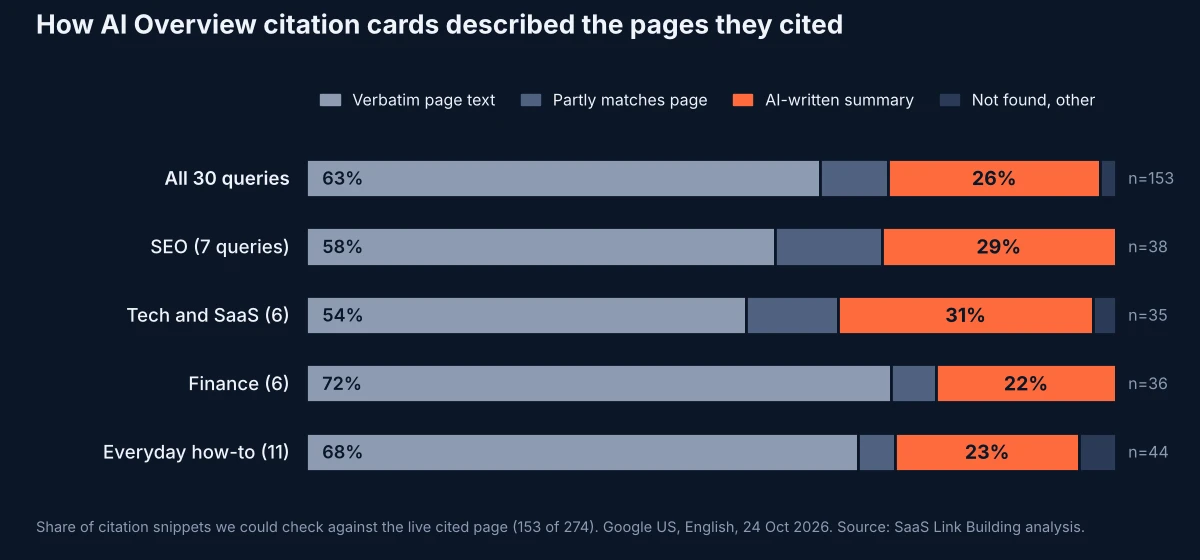
We grouped the 30 queries into four sets: technical SEO, tech and SaaS, personal finance, and everyday how-to questions. The share of rewritten cards ranged from 22% in finance to 31% in tech and SaaS, so this is not limited to one vertical.
The 121 cards we could not check are worth noting too. 78 pointed to YouTube, TikTok, Instagram, Pinterest or Facebook, and most showed a video title followed by transcript text. One Instagram card instead carried a written description that opened "The video discusses". Of the other 43, which linked to pages that blocked our fetcher or returned too little text, 21 used the same label-and-colon format, 11 of them for Reddit or Quora threads, which suggests discussion threads are also being condensed into notes.
Why this matters
For years, the text Google showed for a page came from that page. Google's snippet documentation still says Google "primarily uses the content on the page" to choose a snippet, with the meta description as an occasional alternative. An AI-written citation card breaks that link: the words a searcher reads beside your link are Google's paraphrase, not your copy, and you cannot fix them by editing a sentence on the page.
That matters for clicks. Our earlier study of 1,000 SaaS searches found AI Overviews on 97.8% of them, with 74% carrying no inline link, which leaves the citation cards as the main route from an overview to a site. A card that already answers the question in compressed notes gives the searcher less reason to click than a cut-off excerpt does. Google has also been changing how links appear in these features, as we covered when it expanded links in AI Mode and AI Overviews.
There is an accuracy question as well. Several rewritten cards we saw carried specific figures, such as percentage weightings and month ranges, set out in a structure the cited page does not use. We did not audit whether each summary was faithful to its source, but a paraphrase can drift in a way a quote cannot.
What SEO teams can do
- Check your own citations. Search the informational queries where you know you are cited and read your card. Compare it with the page. If the card is a label-and-colon summary, note the query, the date and a screenshot, because this looks like a test and may change.
- Look for misstatements. If a summary gets a figure, price or policy wrong, use the feedback option on the AI Overview to report it, and keep the screenshot.
- Know which controls exist. Google's AI features documentation says site owners can limit what is shown from their pages with nosnippet, data-nosnippet, max-snippet or noindex, and Google's control what you share guide lists a site-wide Search generative AI control in Search Console that manages inclusion in AI Overviews and AI Mode, as we reported when it was added. We have not tested whether any of these change citation card summaries specifically, and each one can cost visibility, so treat them as a last resort.
- Keep key facts unambiguous on the page. When a card paraphrases, it works from what the page says. Clear, self-contained statements of definitions, figures and dates give a summary less room to drift, and they still serve readers who click through.
Methodology
On 24 October 2026, between 21:19 and 21:22 UTC, we requested Google results for 30 informational queries (US location, English) through a SERP API and stored the full AI Overview for each, including every citation card's title, link and snippet text exactly as returned. The 30 queries were chosen to span technical SEO (7), tech and SaaS (6), personal finance (6) and everyday how-to topics (11). All 30 returned an AI Overview, giving 274 citation cards.
We then fetched each cited URL once with a standard browser user agent, removed scripts, styles and HTML tags, and normalised the text to lowercase letters and digits. For each card we removed any trailing ellipsis, split the card text into overlapping six-word sequences and measured the share found on the cited page. A card was counted as verbatim at 80% or more, a partial match at 20% to 79%, and an AI-written summary when it opened with a short label followed by a colon and fewer than half of its sequences appeared on the page (this test was applied first). Cards below 20% that did not open with a label were counted as not found for other reasons. 153 cards linked to pages we could fetch with more than 2,000 characters of text and had at least eight words; the other 121 (video and social platforms, pages that blocked automated requests, and very short cards) were excluded from the percentages. Results reflect one location, one language and one point in time, and Google may be showing this format only to some users or for some queries.
Conclusion
Google's AI Overviews are now paraphrasing a meaningful share of the pages they cite: about one in four checkable citation cards in our 30-query sample carried an AI-written summary instead of the page's own words, across every topic group we tested and including Google's own documentation. Google has not announced or explained the change.
For publishers, the practical step is to look at how your cited pages are being described today and keep a record, so that if the format spreads, or if a summary misrepresents your content, you have evidence of what Google showed and when.
Questions and answers
What are AI-written citation summaries in AI Overviews?
They are citation cards beside an AI Overview that describe the linked page in Google's own condensed words, usually opening with a label such as "Definition:" followed by notes, instead of quoting text from the page. SEO consultant Brodie Clark spotted them and Search Engine Roundtable reported them on 23 October 2026.
How common are they?
In our check of 30 informational queries on Google US on 24 October 2026, 40 of the 153 citation cards we could compare with the live cited page (26.1%) carried a summary we could not find on that page. 23 of the 30 AI Overviews had at least one.
Has Google confirmed the change?
No. Google has not announced or explained it. Search Engine Roundtable's Barry Schwartz reported seeing it on some of his test queries but not all, which suggests a test or gradual rollout.
Can site owners stop Google summarising their page in a citation card?
Google's documentation says nosnippet, data-nosnippet, max-snippet and noindex limit what is shown from a page in Search, and a Search generative AI control in Search Console manages inclusion in AI Overviews and AI Mode. We have not tested whether these change citation card summaries specifically, and each can reduce visibility.
More releases
-
Studies
24.6% of Top Sites' Robots.txt Files Use Fields Google Ignores, 2,000-Domain Crawl Finds
Our crawl of robots.txt files from the 2,000 most visited domains found that 249 of 1,012 valid files (24.6%) use fields Google ignores, led by crawl-delay. Three, including chatgpt.com, name Perplexity-User with a look-alike hyphen, and 13 still write non-ASCII paths raw.
-
Studies
Does Google Favor Big Brands? Our 40-Search Test Finds YouTube and Reddit Win Instead
Does Google favour big brands? We pulled page one for 40 US searches, scored 211 domains and checked the API leak and DOJ trial record. Authority scores did not predict position within page one, while YouTube and Reddit took 59 of 324 listings. Verdict: unproven.
-
Explainers
Chrome 155 Decodes JPEG XL, but Google Images and Discover Still Don't Support It, Google's Mueller Says
Google Images and Discover do not support JPEG XL, Google's John Mueller said on 15 October, even though Chrome 155, stable since 6 October, now decodes the format. Google's documentation lists seven supported image formats. Serving JPEG XL inside a picture element with a supported img fallback keeps images eligible.
Tell us the site and the goals.
Rankings in Google and visibility in AI answers, from one monthly plan. One call is enough to say which one fits. Email works just as well.