Trackers Spike on 24 October, but Google Logs No Update as Core Gap Hits 158 Days
Rank trackers showed significant volatility on 24 October 2026, yet Google's Search Status Dashboard still lists no ranking update since 8 October. Our count of every core update since November 2021 puts the current 158-day gap sixth longest of 16, and the 189-day record would be matched on 26 November.
 Vibhu Dhariwal
Cofounder & CTO, Digital Gratified
- Published
- Section
- Industry news
- Reading time
- 6 minutes
Ras Al Khaimah, United Arab Emirates, .
Third-party rank-tracking tools showed significant volatility on Saturday, 24 October 2026, but Google's Search Status Dashboard still lists no ranking update after the September 2026 spam update, which ended on 8 October. Our check of the dashboard on 26 October found no new incident, and the gap since the last core update began has now reached 158 days. Measured against every core update Google has logged since November 2021, that is the sixth longest wait of 16.
This is a follow-up to our 20 October report on the missing October update, which compared gaps back to August 2024. The new angle: a heavier tracker spike on 24 October, and a full gap history going back to the dashboard's first core update entry.
What changed since 20 October
- A heated spike. Search Engine Roundtable's Barry Schwartz wrote on 25 October that tracking tools showed significant volatility on 24 October after a couple of days of heavy chatter, and concluded that Google likely pushed a ranking adjustment on Friday, 23 October. His roundup embedded charts from 15 trackers, without numeric readings, and several of those charts were dated before 24 October.
- Still no Google confirmation. No Google page, Search Central post or named Googler has confirmed a ranking update in October 2026. The dashboard's public incidents feed shows the September 2026 spam update as the latest entry.
- No Search Console reporting notice. Google's data anomalies page still lists no product-wide issue, and its latest performance report entry covers a Discover logging error on 13 August 2026.
- Forum reports turned more negative. In the October 2026 observations thread on WebmasterWorld, members posting on 22 and 23 October described Discover traffic fading within hours, old stories in Google News and broad traffic falls across monitored sites. One member said large publishers and public broadcasters were filling the top results for most queries. None of those posts gave a percentage.
Our analysis: core update gaps since November 2021
The Ranking history page of the dashboard lists 16 core updates, from the November 2021 core update to the May 2026 core update. We counted the days between the start dates of each consecutive pair. Across the 15 completed gaps the median was 109 days, and the range ran from 28 days (October to November 2023) to 189 days (November 2021 to May 2022).
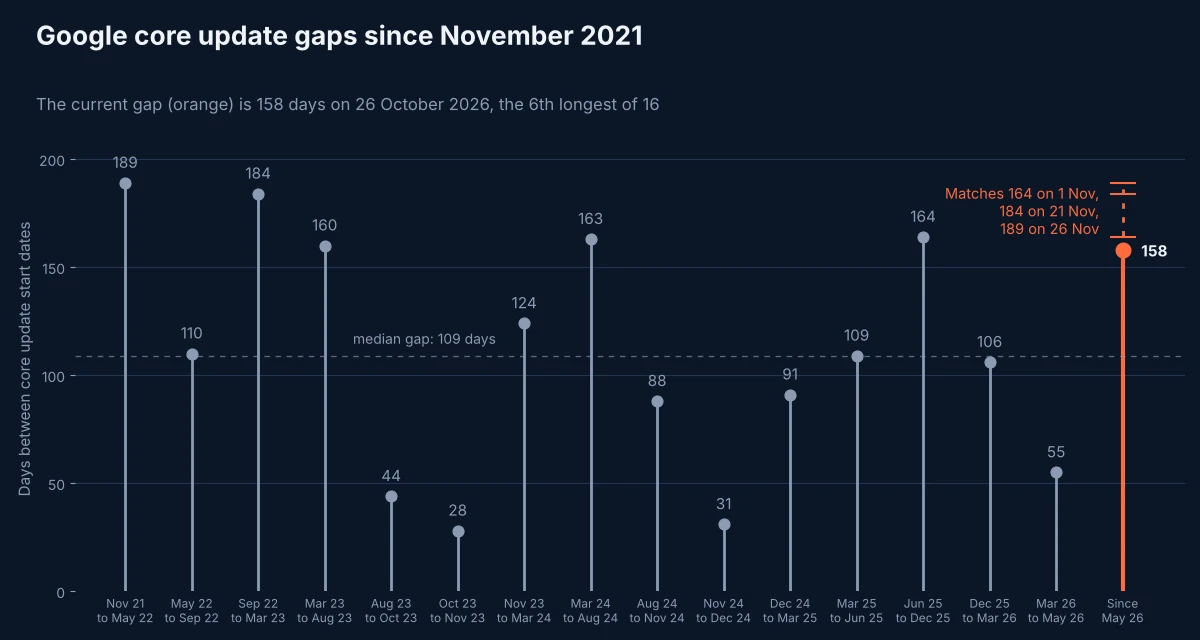
Only five completed gaps were longer than the current one: 189, 184, 164, 163 and 160 days. If no core update starts first, the current gap will equal the June to December 2025 wait of 164 days on 1 November, the September 2022 to March 2023 wait of 184 days on 21 November, and the dashboard-era record of 189 days on 26 November.
The long gaps have not followed a season. The five longest ended with core updates in May 2022, March 2023, August 2023, August 2024 and December 2025, and at least one gap of 160 days or more ended in every year from 2022 to 2025. The data shows long waits are routine. It does not show that a core update is due on any particular date.
The recent timeline, confirmed and not
Since early September, the confirmed and unconfirmed events have overlapped, which makes traffic changes hard to attribute. The table separates what Google logged from what trackers and forums reported.
| Dates (2026) | Event | Status |
|---|---|---|
| 4 to 13 September | Unusual ranking activity reported | Unconfirmed |
| 15 September | Volatility reported | Unconfirmed |
| 23 to 24 September | Update chatter reported | Unconfirmed |
| 24 September to 8 October | September 2026 spam update | Confirmed by Google (13 days, 16 hours) |
| 16 October | Volatility reported | Unconfirmed |
| 20 to 21 October | Volatility reported | Unconfirmed |
| 24 October | Significant volatility across trackers | Unconfirmed |
That adds up to three unconfirmed episodes in the 18 days since the spam update finished, and six since 4 September.
Why tracker readings deserve extra caution this month
Schwartz's roundup itself noted that third-party trackers had struggled for about a month, although many said they had fixed the problems. We have covered two of those faults: Google serving altered results to rank trackers, and a second issue in which Google ignored query words on a share of tracked SERPs. Either can move a volatility score without any change in what real searchers see.
Much of the forum complaint also concerns Discover and Google News, which Search Console reports separately from web search. Discover has its own freshness machinery: a recent research paper describes how it filters stale stories before ranking. A Discover drop on its own therefore says little about a web ranking change.
What Google says about unannounced changes
Google's core updates guide says it makes broad core updates several times a year and gives notice when they happen. The same page says Google also makes smaller core updates that it does not announce because they "aren't widely noticeable." So an unannounced change on 23 or 24 October is possible, but Google has not said one happened. Its dashboard help page says the dashboard shows issues that affect many sites or users and the ranking updates relevant to site owners, not every change.
What this means for SEO teams
- Label it correctly. In client and internal reports, call 23 to 25 October unconfirmed volatility. Do not attribute it to a core update unless Google posts one.
- Wait for Search Console data. Give the Performance report a few days to fill in 24 October, then compare Saturday 24 October with Saturday 17 October and Saturday 10 October rather than with weekdays.
- Split by surface. Filter the Performance report by Search, Discover and Google News separately before deciding whether rankings moved.
- Check real queries, not just tools. Spot-check your top 20 money queries by hand in a clean browser and compare with your tracker. A gap between the two points to a tracking fault.
- Plan for a core update in November. The data does not predict one, but with the gap passing 164 days on 1 November, set dashboard RSS alerts and freeze large site changes you would struggle to separate from an update.
Methodology
On 26 October 2026 we downloaded the Ranking history page of Google's Search Status Dashboard and its public incidents feed at status.search.google.com/incidents.json. We listed every incident Google named as a core update, took the start date shown on the history page, and counted calendar days between the start dates of consecutive core updates. The open gap runs from 21 May 2026 to 26 October 2026. The dashboard's history begins in November 2021, so earlier core updates are not included. Unconfirmed volatility dates come from Search Engine Roundtable's published coverage; we did not compute tracker scores of our own.
Conclusion
Trackers lit up on 24 October, but Google has logged nothing since the September 2026 spam update ended on 8 October. The 158 days since the May 2026 core update began already make this the sixth longest wait since November 2021, and it would match the dashboard-era record of 189 days on 26 November if no core update starts before then.
Until Google posts an incident, treat the late October movement as unconfirmed, check it surface by surface, and verify tracker readings against live results before changing anything on site.
Questions and answers
Did Google confirm a ranking update on 24 October 2026?
No. As of 26 October 2026, Google's Search Status Dashboard lists no ranking incident after the September 2026 spam update, which ended on 8 October, and no Google page or named Googler has confirmed an October update.
How long has it been since the last Google core update?
The May 2026 core update began on 21 May 2026, which is 158 days before 26 October 2026, according to the dates on Google's Search Status Dashboard.
What is the longest gap between Google core updates on record?
Among the core updates listed on the Search Status Dashboard since November 2021, the longest gap was 189 days, between the November 2021 and May 2022 core updates. The median gap is 109 days.
Does Google make core updates without announcing them?
Yes. Google's core updates guide says it also makes smaller core updates that are not announced because they are not widely noticeable. It announces broad core updates, which happen several times a year.
More releases
-
Studies
78% of 677 Top Sites Separate URL Words With Hyphens; 4% Still Lead With Underscores
A SaaS Link Building crawl of 265,311 sitemap URLs from 677 top sites, run two days after Google added hyphen guidance to its URL documentation, found hyphens are the main word separator on 78.3% of sites. Only 27 sites (4.0%) rely mainly on underscores, mostly documentation, archives and long-standing platforms.
-
Industry news
Second Rank Tracker Fault: Google Ignored Query Words on 13.9% of SERPs, Nozzle Finds
Google has served rank trackers results pages that answer only one word of the query on 13.9% of SERPs judged since 16 September, Nozzle research published on 22 October shows. Its weekly one-word measure fell from 25.0% to 1.5% by mid October, and our check of 12 live searches found no affected page.
-
Studies
Does Google Reward Fresh Dates? Our 35-Search Test Finds It Depends on the Query
Google runs freshness systems, but there is no evidence that moving a page's date lifts it. In 35 Google searches pulled on 25 October 2026, product results leaned heavily recent, fresher product pages sat lower on page one, and Google overrode the title year on six results.
Tell us the site and the goals.
Rankings in Google and visibility in AI answers, from one monthly plan. One call is enough to say which one fits. Email works just as well.