Second Rank Tracker Fault: Google Ignored Query Words on 13.9% of SERPs, Nozzle Finds
Google has served rank trackers results pages that answer only one word of the query on 13.9% of SERPs judged since 16 September, Nozzle research published on 22 October shows. Its weekly one-word measure fell from 25.0% to 1.5% by mid October, and our check of 12 live searches found no affected page.
 Vibhu Dhariwal
Cofounder & CTO, Digital Gratified
- Published
- Section
- Industry news
- Reading time
- 8 minutes
Ras Al Khaimah, United Arab Emirates, .
Google has been serving rank trackers a second kind of faulty results page, according to research published on 22 October by SERP data provider Nozzle. Alongside the "poisoned" pages we reported on 13 October, where the usual sites are swapped out, Google has returned pages that show the full query in the title while the organic results answer only one word of it. Since 16 September, page 1 or page 2 ignored part of the query on 13.9% of the SERPs Nozzle judged on both pages, against 0.06% before. Ahrefs said the same day that, depending on the data provider, 5% to 20% of results were affected by what it also calls poisoning. Google has not commented on either report.
Nozzle's own weekly figures show the fault falling sharply from its late September peak. Our check of 12 live searches on 25 October, including all six keywords Nozzle used as examples, found no page that met its definition of the fault.
What the new data shows
- One word, not the query. For "easy strawberry jam" on 30 September, the AI Overview still gave a jam recipe, but the organic results were about the TV series Easy. Five of the six usual page-1 sites were gone, and the next day the page was back to jam recipes.
- Page 2 went first. Page 2 began ignoring query words on 16 September and page 1 followed on 20 September. Since 16 September the rate is 12.6% for page 2 and 2.2% for page 1, against baselines of 0.05% and 0.02%. Of the affected page 2s, 93.6% sat under a page 1 that answered the query normally.
- The page hides it. The title still showed the full query on 99.8% of affected pages, and none carried a "Showing results for" notice that would signal a rewrite.
- Any word can survive. Of 497,362 affected page-1 SERPs, 66.2% dropped one word, 21.6% dropped two and 12.3% dropped three or more. On 51.5%, the results carried exactly one word of the query.
- It reads as a one-day ranking crash. A tracked site that normally ranks for the keyword was out of the top 10 on 69.8% of affected pages, against 2.0% in the baseline. Nine in ten spells lasted one SERP, and the next SERP within three days was normal 85.8% of the time.
The fault is fading, but page 1 has not returned to normal
Nozzle's headline figures cover the whole period since 16 September. Its weekly table, which tracks the stricter measure of pages left with only one word of the query, tells a different story about where things stand now: the share fell from 25.0% in the week of 28 September to 1.5% in each of the two most recent weeks.
| Week starting | Page 1 or 2 affected | Page 1 | Page 2 |
|---|---|---|---|
| 7 September | 0.03% | 0.01% | 0.02% |
| 14 September | 6.7% | 0.55% | 6.5% |
| 21 September | 20.0% | 1.2% | 19.2% |
| 28 September | 25.0% | 0.84% | 24.6% |
| 5 October | 6.2% | 1.3% | 4.9% |
| 12 October | 1.5% | 0.65% | 0.66% |
| 19 October | 1.5% | 0.80% | 0.48% |
The page 2 problem behind the September spike has largely receded, but page 1 has not recovered: at 0.80% in the week of 19 October it is more than ten times the highest weekly page 1 rate before September (0.07% in early June). Most rank tracking reports rely on page 1, so this residual problem matters more day to day than the headline spike.
How it differs from poisoning
Nozzle separates the two faults by the words on the page. A poisoned SERP still answers the query but swaps out the keyword's usual sites. A page that ignores part of the query answers a different, shorter query. The two overlap: 54.0% of the word-ignoring pages also lost most of the keyword's usual sites. They share other marks: pagination stopping by page 4 (43.0% of affected pages, against 0.2% normally, on keywords that usually run to page 8) and one domain filling three or more spots (32.2% against 10.0%).
The damage reaches beyond rankings. On normal SERPs, 49.5% of "People also ask" questions were about the full query; on affected pages, 29.5% were. For "People also search for" suggestions, the share fell from 69.5% to 18.7%. Ads were the exception: 88.4% of the previous SERP's advertisers reappeared on affected pages, compared with 74.5% in the baseline.
Our check: 12 live SERPs on 25 October
We pulled pages 1 and 2 for the six example keywords and six long-tail queries of our own, then applied Nozzle's core test as closely as a single pull allows: for each query word, the share of organic results carrying it.
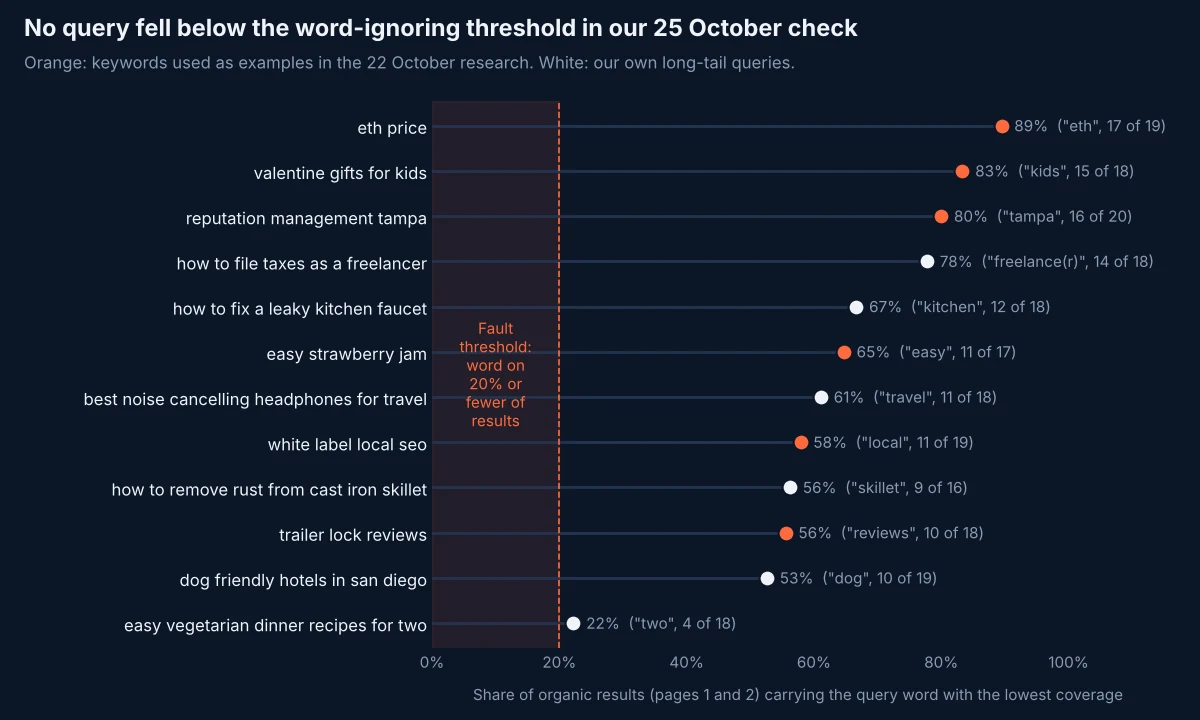
- No page met the fault definition. The least-covered word in every query appeared on more than 20% of results. All six of Nozzle's examples, including "easy strawberry jam" and "white label local seo", returned results about the full query.
- 213 of 218 organic results (97.7%) addressed the full query's topic. The exceptions were two Ethereum Classic pages on "eth price" and three general cast iron cleaning pages on the rust query.
- One query came close for an ordinary reason. "Two" appeared on 4 of 18 results (22%) for "easy vegetarian dinner recipes for two", yet every result was a vegetarian dinner page. Google routinely relaxes modifiers like this, which is why Nozzle's test only counts a word as dropped if at least 60% of the keyword's results normally carry it. A single snapshot cannot establish that history.
A clean sample of 12 does not show the problem has ended; Nozzle's own data puts the current rate near 1.5% of SERPs, which a sample this size would rarely catch.
Why Google might be doing this
Google has not said. Its spam policies define machine-generated traffic as including scraping results for rank-checking purposes without express permission, and say it violates both the policies and the Google Terms of Service. Both Nozzle and Ahrefs describe the altered pages as served to suspected SERP data providers. The following is speculation, not confirmed: serving plausible but wrong pages, rather than blocking outright, makes automated collection harder to detect and repair. Nozzle notes that another SERP data provider first reported the fault publicly on 4 May, months before the September spike.
Ahrefs said it is cleaning up past results that may have been affected and warned that collection methods that work now may stop working. The timing also overlaps with the ranking volatility chatter of October, when Google's dashboard showed no ranking update; some tool-reported swings in that period may reflect collection faults rather than real movement.
What SEO teams should do
- Check Search Console before reacting. A keyword that "drops out" for a day while Search Console impressions hold steady is almost certainly a data fault. Allow for Search Console's own reporting delays before comparing the most recent days.
- Read the stored SERP, not just the title. The full query in the title proves nothing here. Check whether the results are about every word you searched.
- Ask your vendor two questions. Does it validate that results match the query's topic, not only that the usual sites are present? And has it reprocessed data from 16 September onward?
- Re-check research datasets. "People also ask" and related-search exports from late September may be about one word of your keyword.
- Annotate reports. Flag 16 September to mid October as a period of unreliable third-party ranking data, and keep watching page 1 figures, where the residual rate is still above its spring level.
Methodology
On 25 October 2026 we requested Google organic results for 13 queries (United States, English, desktop, top 20 positions, covering pages 1 and 2) through a SERP data API. One query failed with a server error on two attempts and was excluded, leaving 12 SERPs and 218 organic results (99 on page 1, 119 on page 2). Six queries were the examples published in Nozzle's 22 October research; six were long-tail queries of five or more words chosen by us across food, travel, finance, home repair and electronics. For each query we counted, by hand, how many organic results carried each meaningful query word (stop words excluded) in the title or snippet, accepting inflected forms (easy and easiest, review and reviews, travel and traveling, freelance and freelancer) but not synonyms (pet for dog). We report the least-covered word per query and compare it with Nozzle's threshold of 20% or fewer. Because we had no four-week history per keyword, we could not apply Nozzle's 60% "usual word" condition. Topic relevance was judged manually. Weekly figures are transcribed from Nozzle's published table.
Conclusion
The September disruption to third-party rank tracking had two faces: pages with the wrong sites, and pages answering the wrong question. The second is harder to spot because the page looks right, and it hit page 2 far harder than page 1. The worst has passed, by Nozzle's own weekly numbers, and our spot check found its public examples back to normal.
Page 1 is still affected at a rate well above anything seen before September, and Google has not explained what it is doing. Teams should keep Search Console as the reference for anything that matters and treat sudden single-day tracker drops as unverified until they persist.
Questions and answers
What does it mean when Google ignores part of the query?
Nozzle counts a results page as ignoring part of the query when a word that at least 60% of the keyword's results normally carry appears on 20% or fewer of its results. The title still shows the full query, but the organic results are about a shorter query, often a single word.
How is this different from a poisoned SERP?
A poisoned SERP still answers the query but swaps out most of the keyword's usual sites. A word-ignoring page answers a different query. Nozzle found 54.0% of word-ignoring pages also lost most of the usual sites, so the two often appear together.
Has Google confirmed it is doing this?
No. Google has not commented on the Nozzle or Ahrefs reports. Its spam policies say scraping results for rank-checking without express permission is machine-generated traffic that violates its policies and Terms of Service.
Is it still happening?
At a lower level. Nozzle's weekly share of SERPs left with one word of the query fell from 25.0% in the week of 28 September to 1.5% in the weeks of 12 and 19 October, though page 1 was still at 0.80%. Our check of 12 searches on 25 October found no affected page.
More releases
-
Studies
Does Google Reward Fresh Dates? Our 35-Search Test Finds It Depends on the Query
Google runs freshness systems, but there is no evidence that moving a page's date lifts it. In 35 Google searches pulled on 25 October 2026, product results leaned heavily recent, fresher product pages sat lower on page one, and Google overrode the title year on six results.
-
Explainers
Pichai Says Agents Will Use Pages and Protocols; 6 of 699 Top Sites Publish Agent Files
Google CEO Sundar Pichai says AI agents will reach websites both by browsing pages and by calling sites through protocols such as UCP and MCP. Google already documents its Google-Agent browser, but our 25 October crawl found only 6 of 699 responding top domains publish a UCP profile or A2A agent card.
-
Industry news
Chrome Adds Lower-Confidence Suspicious Site Warnings, Backed by Server-Side Gemini Checks
Google said on 20 October that Chrome's Enhanced Protection mode now splits site warnings into suspicious and dangerous tiers, so it can show more warnings, and runs a server-side Gemini scam model for all those users. Google has not said how site owners will be notified about the new lower tier.
Tell us the site and the goals.
Rankings in Google and visibility in AI answers, from one monthly plan. One call is enough to say which one fits. Email works just as well.