78% of 677 Top Sites Separate URL Words With Hyphens; 4% Still Lead With Underscores
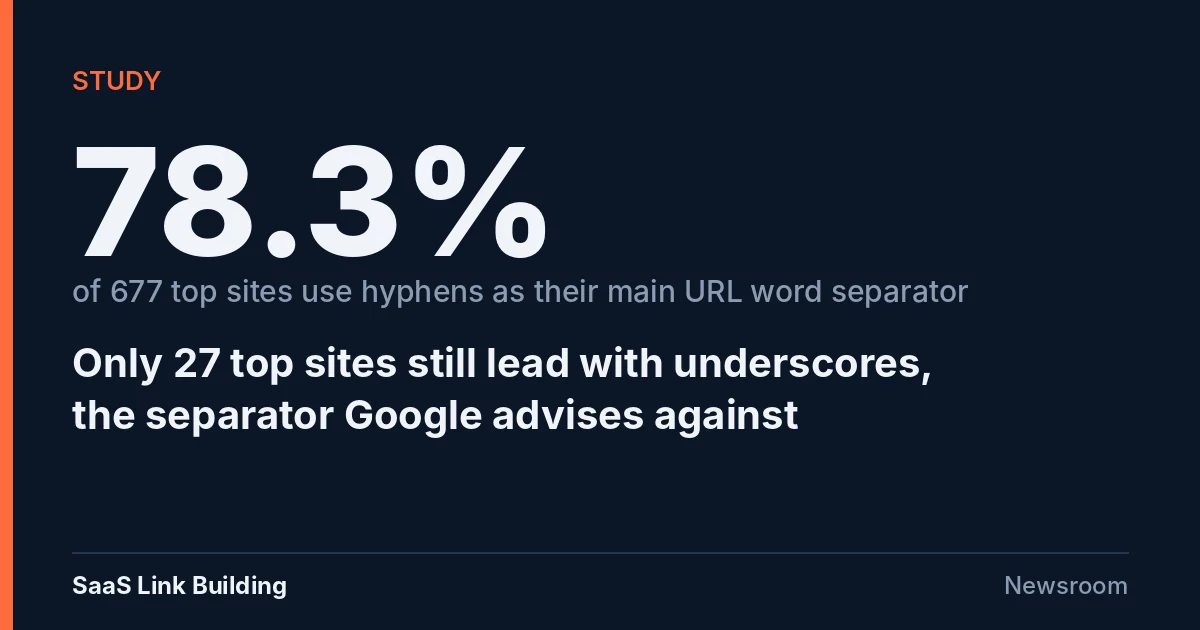
A SaaS Link Building crawl of 265,311 sitemap URLs from 677 top sites, run two days after Google added hyphen guidance to its URL documentation, found hyphens are the main word separator on 78.3% of sites. Only 27 sites (4.0%) rely mainly on underscores, mostly documentation, archives and long-standing platforms.
 Vibhu Dhariwal
Cofounder & CTO, Digital Gratified
- Published
- Section
- Studies
- Reading time
- 8 minutes
Ras Al Khaimah, United Arab Emirates, .
Two days after Google added a "Use hyphens to separate words" section to its URL structure best practices, the SaaS Link Building newsroom checked how the web's most visited sites actually build their addresses. On 25 October 2026 we crawled the XML sitemaps of the top 2,000 domains in the Tranco top sites list and classified 265,311 page URLs from 677 distinct sites. Hyphens are the main word separator on 530 of those sites (78.3%). Only 27 (4.0%) rely mainly on underscores, the separator Google's page now says it does not recommend.
The result suggests Google's 23 October edit, logged in its Search documentation updates, describes what most large sites already do rather than asking for a change. The exceptions are informative, though: underscore URLs cluster in documentation sites, legacy archives and a handful of large platforms, and an underscore URL ranks near the top of Google for "search engine optimization" itself.
Key findings
- Hyphens dominate. 60.1% of the 265,311 URLs we classified joined words with hyphens. Only 3.7% joined words with underscores, and 0.6% used both.
- Most sites never use underscores between words. 547 of 677 sites (80.8%) had no URL in our sample with an underscore between two words.
- Underscore-first sites are rare. 27 sites (4.0%) used underscores more often than hyphens, and in at least 10% of their URLs. A further 120 sites (17.7%) had no dominant separator, for example because their URLs use IDs, single words or non-Latin scripts.
- Mixing is uncommon. 23 sites used each separator in at least 10% of their URLs, which can point to two systems running side by side or an unfinished migration.
- Other parts of Google's guide are followed less consistently. 89 sites (13.1%) had capital letters in at least 10% of URL paths, and 16 sites listed raw non-ASCII characters in sitemap URLs rather than the percent-encoded form Google recommends.
Separator use barely changes with site size
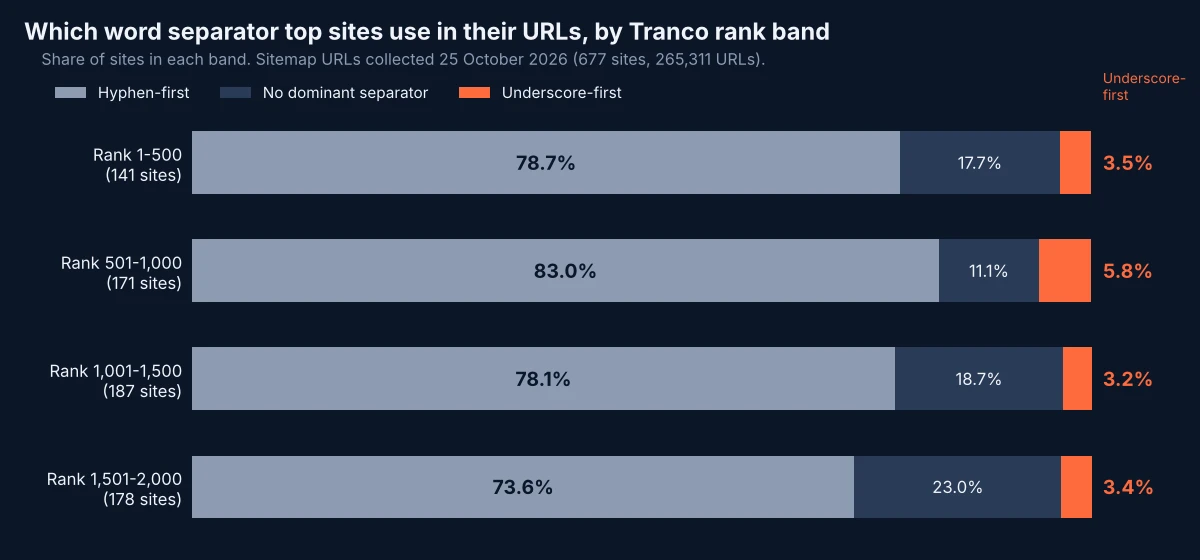
Splitting the sample into four rank bands shows no clear link between popularity and separator choice. The share of hyphen-first sites ranges from 73.6% to 83.0%, and underscore-first sites never exceed 6% of any band. The biggest variation is in the "no dominant separator" group, which ranges from 11.1% to 23.0% and is largest in the lowest band.
How top sites measure up against Google's URL guide
Google's URL structure page covers more than separators. It also asks for readable words, percent-encoded non-ASCII characters, as few parameters as possible and consistent letter case, because Google treats URLs as case sensitive. We checked each of those points in the same sample.
| Google recommendation | What we measured | Sites (of 677) | Share |
|---|---|---|---|
| Use hyphens to separate words | Hyphen is the main word separator | 530 | 78.3% |
| Avoid underscores as separators | Underscore is the main word separator | 27 | 4.0% |
| Avoid underscores as separators | At least one underscore-joined URL in the sample | 130 | 19.2% |
| Percent-encode non-ASCII characters | Raw non-ASCII characters in sitemap URLs | 16 | 2.4% |
| Percent-encode non-ASCII characters | Percent-encoded non-ASCII characters present | 63 | 9.3% |
| URLs are case sensitive; keep one case | Capital letters in at least 10% of URL paths | 89 | 13.1% |
| Use as few parameters as you can | Query strings in at least 10% of sitemap URLs | 33 | 4.9% |
Capital letters in paths are more than three times as common as underscore-first schemes (89 sites against 27). Of the 89, 57 had uppercase in most of their sampled paths, which points to a site-wide convention rather than occasional slips. That is not a problem in itself; Google's page says only that a server which treats upper and lower case the same should pick one form so Google can tell the URLs refer to the same page.
Where underscores survive
The underscore-first group is small, and many of its members fall into three patterns.
| Pattern | Examples in our sample | Typical URL shape |
|---|---|---|
| Technical documentation | nginx.org, git-scm.com | /en/docs/beginners_guide.html |
| Legacy or archive sections | bbc.com (BBC Afrique archive), who.int | /afrique/region/2014/09/140924_south_sudan_hunger_crisis.shtml |
| Platform naming conventions | ted.com, goodreads.com, repubblica.it, gsmarena.com | /talks/speaker_name_talk_title |
Documentation sites are the clearest case of the "historical reasons" Google gives. The page explains that programming languages use underscores to keep concepts together, as in format_date, and developer documentation often mirrors the names of functions and settings. The BBC URLs in our sample are 2014 BBC Afrique archive pages, and the WHO URLs use an older address pattern on the organisation's site. Several underscore-first sites are also adult video platforms, which appear in the Tranco list and were left in the sample.
Google's own properties went the other way. None of the four Google-owned hosts in our deduplicated sample (google.com, youtube.com, android.com and safety.google) had a URL with an underscore between two words. Some do use underscores in locale codes such as /intl/en_au/, which our method does not count as a word separator.
Underscores do not stop pages ranking
Google's documentation presents hyphens as a recommendation, not a requirement, and the search results reflect that. In a US Google search for "search engine optimization" that we pulled on 25 October, the second organic result was Wikipedia's Search engine optimization article, whose address joins words with underscores. Google's own SEO Starter Guide ranked first.
That fits what Google staff have said recently. As we reported, Gary Illyes described keywords in URLs as a tiny signal while recommending hyphens, and John Mueller warned that different encodings of the same characters create different URLs. The 23 October edit, which we covered in our report on Google's two help page updates, puts the separator advice in writing; it does not describe a penalty.
What this means for SEO teams
- Use hyphens for anything new. New templates, sections and parameters should follow Google's documented preference, which is also what 78% of large sites already do.
- Leave working underscore URLs alone unless you are migrating anyway. Changing URLs means redirects and reprocessing. The ranking benefit Google staff describe is small, and a page like Wikipedia's shows underscore URLs can rank well.
- Fix mixed systems first. If your site is one of the minority that uses both separators heavily, standardise the newest templates and keep internal links, canonicals and sitemaps consistent with whichever form each URL already uses.
- Check your sitemaps for case drift and raw non-ASCII. Our crawl found heavy use of capital letters on more than three times as many sites as underscore-first schemes. Export your sitemap and look for unencoded characters and for the same path appearing in more than one case.
- Treat documentation as a special case. If developer docs mirror function names with underscores, consider whether readers search for the exact identifier before renaming.
Methodology
On 25 October 2026 we downloaded the Tranco top 1 million list (ID GQ32K) and took the first 2,000 domains. For each, we read robots.txt on the www host (or the bare domain) and followed up to three declared sitemaps, falling back to /sitemap.xml. Sitemap index files were followed one level down, to up to three randomly selected child sitemaps. We kept up to 500 URLs per site. We dropped homepages, image, video, document, script and feed files, and sites with fewer than 20 remaining URLs. Because many domains redirect or point to another domain's sitemap (for example, Google's country domains), we kept only the highest-ranked domain for each dominant URL host. That left 677 sites and 265,311 page URLs.
A URL counted as using a separator when any path segment, after removing a file extension, contained two adjacent ASCII alphabetic tokens of at least three letters joined by that character. This excludes IDs such as E_g_11r7 and two-letter locale codes such as en_au. A site was "hyphen-first" or "underscore-first" when that separator appeared in more URLs than the other and in at least 10% of its sampled URLs; other sites were classed as having no dominant separator. Sitemaps show the URLs a site submits, not every URL it serves, and samples of up to 500 URLs may miss sections that use a different pattern. The search result check was a single US English query pulled from a SERP data provider on 25 October 2026.
Conclusion
Google's new hyphen guidance matches the habits of most large sites: in our crawl, nearly four in five top sites use hyphens as their main URL separator and only one in 25 lead with underscores. The underscore holdouts are mostly documentation, archives and platforms with long-standing naming schemes.
For most SEO teams, the practical work is to apply hyphens to new URL patterns and to tidy sitemap hygiene issues such as raw non-ASCII characters and inconsistent case, rather than to rewrite underscore URLs that already rank.
Questions and answers
How many top sites use underscores in their URLs?
In our 25 October 2026 crawl of 677 top sites, 27 (4.0%) used underscores as their main word separator, and 130 (19.2%) had at least one URL with an underscore between two words. The other 547 sites (80.8%) had none in our sample.
What does Google say about hyphens and underscores in URLs?
Google's URL structure best practices page recommends hyphens instead of underscores to separate words, because hyphens help users and search engines identify concepts. It says underscores are commonly used in programming to keep concepts together, as in format_date. Google logged the change on 23 October 2026.
Can URLs with underscores still rank in Google?
Yes. In a US search for "search engine optimization" pulled on 25 October 2026, Wikipedia's article, whose URL joins words with underscores, was the second organic result. Google presents hyphens as a recommendation.
How was the data collected?
We took the top 2,000 domains in the Tranco list (ID GQ32K), followed sitemaps declared in robots.txt or at /sitemap.xml, kept up to 500 page URLs per site, removed duplicates and media files, and classified URLs by whether two words of at least three letters were joined by a hyphen or an underscore.
More releases
-
Industry news
Second Rank Tracker Fault: Google Ignored Query Words on 13.9% of SERPs, Nozzle Finds
Google has served rank trackers results pages that answer only one word of the query on 13.9% of SERPs judged since 16 September, Nozzle research published on 22 October shows. Its weekly one-word measure fell from 25.0% to 1.5% by mid October, and our check of 12 live searches found no affected page.
-
Studies
Does Google Reward Fresh Dates? Our 35-Search Test Finds It Depends on the Query
Google runs freshness systems, but there is no evidence that moving a page's date lifts it. In 35 Google searches pulled on 25 October 2026, product results leaned heavily recent, fresher product pages sat lower on page one, and Google overrode the title year on six results.
-
Explainers
Pichai Says Agents Will Use Pages and Protocols; 6 of 699 Top Sites Publish Agent Files
Google CEO Sundar Pichai says AI agents will reach websites both by browsing pages and by calling sites through protocols such as UCP and MCP. Google already documents its Google-Agent browser, but our 25 October crawl found only 6 of 699 responding top domains publish a UCP profile or A2A agent card.
Tell us the site and the goals.
Rankings in Google and visibility in AI answers, from one monthly plan. One call is enough to say which one fits. Email works just as well.