39.5% of 339 Top-Site Sitemaps Skip Lastmod, the Date Google Uses to Schedule Crawls
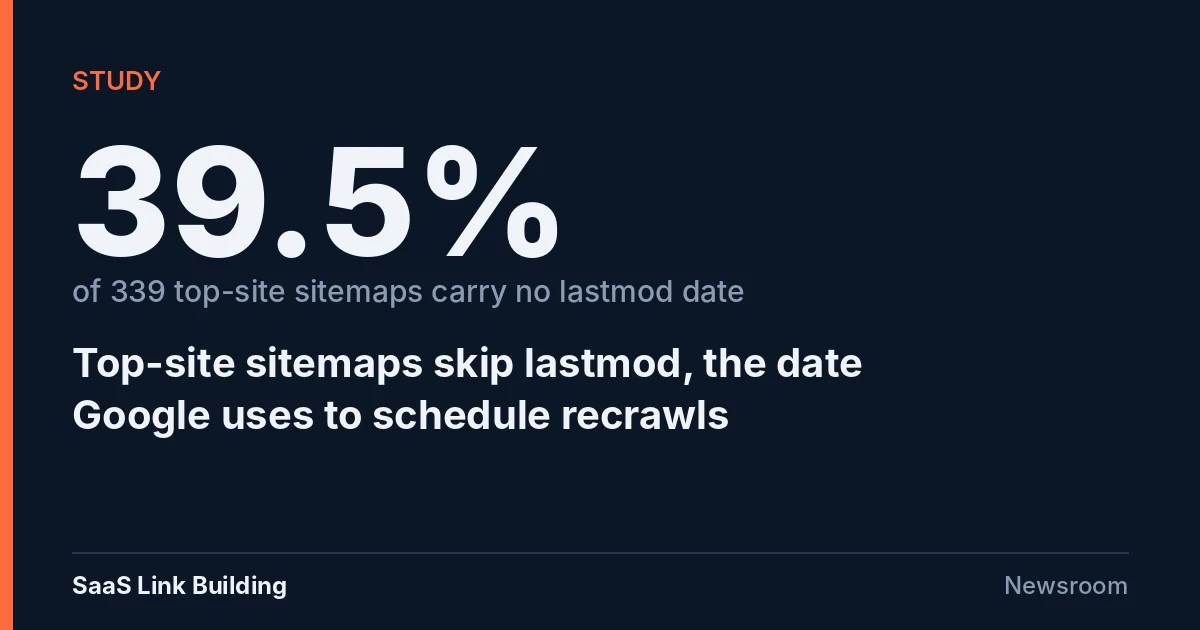
A SaaS Link Building crawl of the 1,000 most visited domains on 26 October found that 39.5% of 339 page-level sitemaps carry no lastmod date, 19.5% of well-dated ones give every URL the same date, and 38.1% still use changefreq or priority, tags Google says it ignores.
 Vibhu Dhariwal
Cofounder & CTO, Digital Gratified
- Published
- Section
- Studies
- Reading time
- 8 minutes
Ras Al Khaimah, United Arab Emirates, .
Four in ten page-level sitemaps published by the world's most popular domains give search engines no lastmod date at all, and about one in nine stamps an identical date on every URL, according to a SaaS Link Building crawl of the top 1,000 domains on the Tranco research ranking carried out on 26 October 2026. The gap matters because lastmod is the only one of the three optional sitemap tags that Google says it acts on: its sitemap documentation says Google uses the value when it is consistently and verifiably accurate, and ignores priority and changefreq. More than a third of the sitemaps we examined still carry those two ignored tags.
Key findings
- 555 of 1,000 domains returned a robots.txt file, and 345 of those (62.2%) declared at least one sitemap in it. The median site declared one; the largest declared 434.
- We retrieved and parsed a sitemap for 351 domains. Two thirds of them (231) were sitemap index files that point to other sitemaps rather than listing pages directly.
- Across the 339 page-level sitemaps we could analyse, 134 (39.5%) carried no
lastmodon any URL. 171 (50.4%) dated every URL and 34 dated only some. - 129 sitemaps (38.1%) still used
changefreq,priorityor both, fields Google and Bing both say they ignore. - Of 185 sitemaps with 10 or more dated URLs, 36 (19.5%) gave every URL exactly the same
lastmod. In 14 of those, the shared date was the day of our crawl or the day before. - In 64 of the 205 sitemaps that used
lastmod(31%), the median URL had not been marked as changed for more than two years.
What Google and Bing say about lastmod
Google's position has been stable since June 2023, when Gary Illyes used a Search Central post retiring the sitemaps ping endpoint to set out how the date is used. Google treats lastmod as a signal for scheduling recrawls of URLs it already knows, on two conditions: the value must be in a supported date format, and it must match reality. Illyes warned that a site claiming yesterday's date for a page that changed years ago will eventually stop being believed. He also said Google uses neither changefreq nor priority "at all", and that it is fine to leave lastmod off pages, such as home or category pages, whose real modification date the CMS cannot tell.
The same post says only significant changes, such as new primary text, structured data or links, should move the date.
Bing goes further. In a July 2025 Bing Webmaster blog post, Fabrice Canel and Krishna Madhavan called the field "a key signal" for deciding which URLs to recrawl, asked for ISO 8601 dates with a time component, and told site owners not to set lastmod to the time the sitemap file was generated unless the page itself changed. They also confirmed that Bing ignores changefreq and priority.
How the top 1,000 sites date their URLs
The split barely changes with rank. The top 100 domains are no more likely to date their URLs than sites ranked 501 to 1,000, although the top-100 tier is small: only 25 of those domains served a sitemap our crawler could read, because many are infrastructure, CDN or API hosts with no public pages to list.
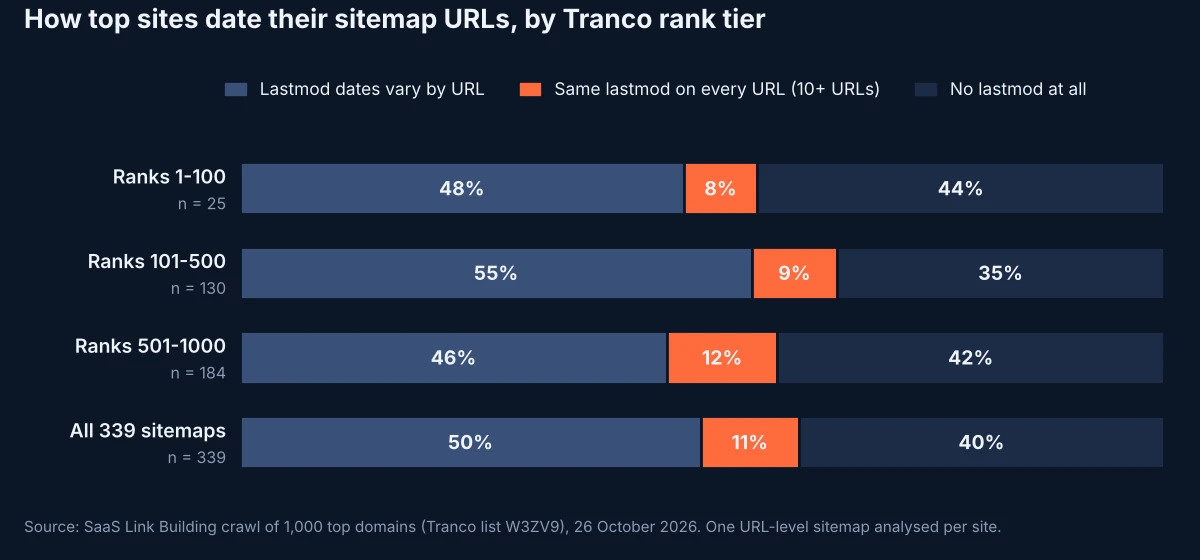
Use of ignored fields did vary. Only 4 of the 25 top-100 sitemaps (16%) used changefreq or priority, against 43.8% of sitemaps from sites ranked 101 to 500 and 37.0% from sites ranked 501 to 1,000.
| Measure | Sitemaps | Share |
|---|---|---|
| Page-level sitemaps analysed | 339 | 100% |
| No lastmod on any URL | 134 | 39.5% |
| Lastmod on every URL | 171 | 50.4% |
| Lastmod on some URLs only | 34 | 10.0% |
| Uses changefreq or priority | 129 | 38.1% |
| Same lastmod on every URL (of 185 with 10+ dated URLs) | 36 | 19.5% |
| Date-only lastmod values, no time (of 205 dated) | 58 | 28.3% |
| Values not in W3C Datetime format (of 205 dated) | 3 | 1.5% |
Source: SaaS Link Building crawl, 26 October 2026. One page-level sitemap analysed per domain.
The uniform-date problem
A sitemap in which hundreds of URLs share one lastmod is the pattern both search engines describe as unhelpful. Unless every page changed at the same moment, the value records something else, such as the file build time or an old migration date.
Both kinds appeared in our sample. In the sitemap file we fetched from cloudflare.com, all 1,013 URLs carried 26 October 2026, the date of our crawl. Shopify's main sitemap listed 557 URLs, all dated 25 October 2026. The first 5,000 entries in xiaomi.com's sitemap all carried 21 October 2018. These are snapshots of single files on one day; the sites may date other sitemaps differently.
Fourteen of the 36 uniform sitemaps carried the crawl date or the day before, which is consistent with the file generation time that Bing asks site owners not to use. The other 22 carried older single dates, some of them years old. Neither tells a crawler which pages changed.
News sitemaps are the exception that looks similar but is not: eight of the 185 sitemaps with ten or more dates used Google News sitemap markup, where every listed article is recent by design. None of them used a single shared date.
How old the dates are
Where sites did date their URLs, the values were more often old than fresh. We took the median URL date in each of the 205 dated sitemaps and measured its age at the time of the crawl.
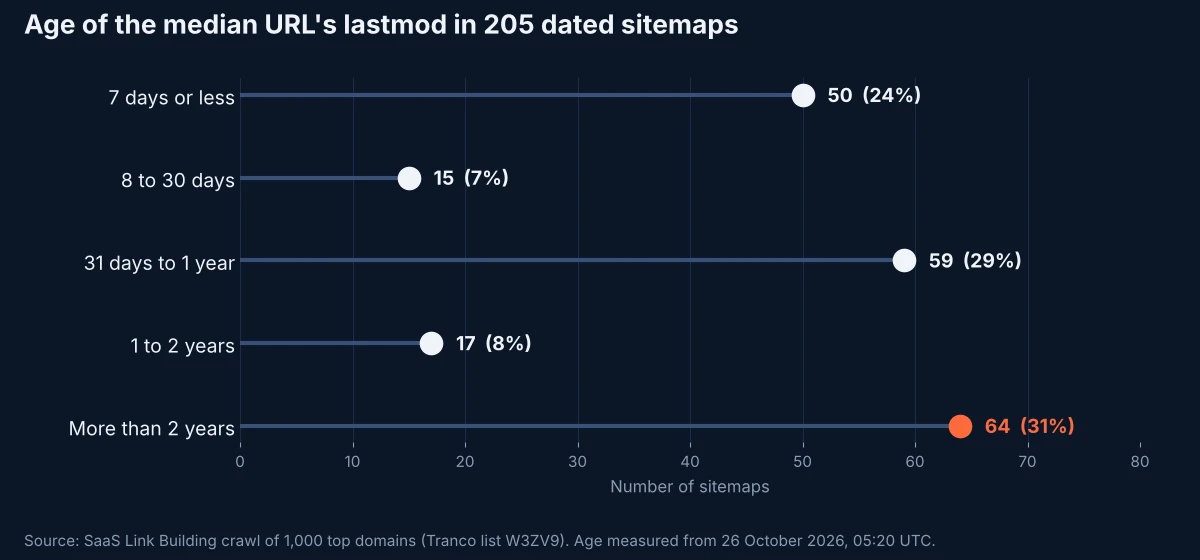
Old dates are not a fault in themselves. A reference page that has not changed since 2022 should say 2022, and an accurate old date is exactly what Illyes asked for. The risk sits with the opposite case, which our earlier test of whether Google rewards fresh dates also examined from the ranking side: dates that move without the content moving.
What this means for SEO teams
- Check what your CMS writes. Open your page-level sitemaps, not just the index file, and look for a single repeated
lastmod. If every URL shows today's date, the generator is stamping build time, and Google's own guidance says it will learn to ignore the field. - Tie the date to real edits. Update
lastmodwhen primary text, structured data or links change. Leave it out for aggregated pages whose real change date you cannot determine, as Google explicitly allows. - Add a time component. 28.3% of dated sitemaps in our sample used date-only values. Bing asks for full ISO 8601 timestamps, and a time helps on sites that publish several updates a day.
- Drop
changefreqandpriority. Neither Google nor Bing reads them. - Declare sitemaps in robots.txt. With the ping endpoint gone, robots.txt and Search Console are Google's remaining submission routes. Our earlier robots.txt crawl of 2,000 domains found that 24.6% of files used fields Google ignores; a correct
Sitemap:line is one of the few additions that does something. - Use accurate dates to speed recovery. When you fix pages after a quality or technical problem, an honest
lastmodis how a sitemap tells Google which known URLs have changed and are worth recrawling. Our summary of Gary Illyes' crawl and re-ranking timelines covers how long the rest takes.
Methodology
On 26 October 2026, between 05:19 and 05:22 UTC, we took the top 1,000 domains from the Tranco list with ID W3ZV9 and requested https://<domain>/robots.txt for each with a standard browser-style user agent identifying the crawler as research. We recorded every Sitemap: line. For domains that declared sitemaps, we fetched up to the first three declared URLs until one returned a parseable XML sitemap; for domains that declared none, we tried /sitemap.xml. Gzipped files were decompressed.
When the sitemap was an index file, we followed its first one or two child sitemaps until we reached a page-level urlset, and analysed that one file. This gave 339 page-level sitemaps. For each, we counted URLs with lastmod, changefreq and priority, checked lastmod values against the W3C Datetime format, and parsed them to measure age. A sitemap was classed as "same lastmod on every URL" when it had at least 10 dated URLs and every value was identical. We read at most 5,000 lastmod values and 30 MB per file.
Limits: one page-level file per site may not represent the whole site; 40 domains that declared sitemaps did not return a parseable file to our crawler (several large platforms block unfamiliar bots); and Tranco ranks domains, so many top entries are CDNs, ad servers or API hosts with no sitemap. Percentages are of the sitemaps we could parse, not of all 1,000 domains.
Conclusion
Most of the busiest sites publish sitemaps, but the field that matters after discovery is often missing or unreliable. Four in ten page-level sitemaps in our crawl carried no lastmod, a fifth of the well-dated ones gave every URL the same date, and more than a third still spent bytes on tags Google stopped reading years ago.
For SEO teams, the fix is cheap: make lastmod follow real page changes, or leave it out. Google has said plainly that it stops trusting dates that do not match reality, and Bing has said the same about dates that only record when the file was built.
Questions and answers
Does Google use the lastmod date in XML sitemaps?
Yes, conditionally. Google's sitemap documentation says it uses lastmod when the value is consistently and verifiably accurate, and Gary Illyes wrote in June 2023 that Google uses it as a signal for scheduling recrawls of URLs it already knows.
Does Google use changefreq or priority in sitemaps?
No. Google's documentation says it ignores priority and changefreq, and Bing said in July 2025 that it ignores both as well. In our crawl, 38.1% of 339 page-level sitemaps from top domains still used one or both.
Should lastmod be set to the time the sitemap was generated?
No. Bing's July 2025 guidance tells site owners not to set lastmod to the sitemap generation time unless the page actually changed, and Google says the value should reflect the last significant update to the page.
Is it acceptable to leave lastmod off some URLs?
Yes. Google's 2023 Search Central post says sites can use lastmod on all pages or only on those they are confident about, and that leaving it off aggregated pages such as home or category pages is fine.
How many top sites declare a sitemap in robots.txt?
In our 26 October 2026 crawl of the Tranco top 1,000 domains, 555 served a robots.txt file and 345 of those (62.2%) declared at least one sitemap.
More releases
-
Studies
Does Google Use Clicks to Rank Pages? Trial Files and 14,013 Leaked Fields Say Yes
Court findings from US v. Google and Google's own How Search Works page show that aggregated click data feeds ranking through Navboost and Glue. Our count of 14,013 leaked attributes finds 63 tied to clicks, dwell or Chrome, but no evidence that a site can lift rankings by gaming its own CTR.
-
Explainers
Google's Helpful Content Guide Adds 4 Rater Tests: Effort, Originality, Skill, Accuracy
Google has added a main content section to its Creating helpful content guide, listing the four attributes its quality raters assess: effort, originality, talent or skill, and accuracy. We compared the new wording with the rater guidelines line by line and mapped where each attribute appears across their 182 pages.
-
Industry news
Trackers Spike on 24 October, but Google Logs No Update as Core Gap Hits 158 Days
Rank trackers showed significant volatility on 24 October 2026, yet Google's Search Status Dashboard still lists no ranking update since 8 October. Our count of every core update since November 2021 puts the current 158-day gap sixth longest of 16, and the 189-day record would be matched on 26 November.
Tell us the site and the goals.
Rankings in Google and visibility in AI answers, from one monthly plan. One call is enough to say which one fits. Email works just as well.