Google AI Overviews Cited Local News in 11 of 19 UK Local Searches, Our Check Finds
A study by Searchable found AI assistants such as ChatGPT bypass local newspapers on UK local queries. Our check of 24 Google UK searches found AI Overviews cited local news in 11 of 19 answers, but only once across five council-news answers, where the BBC and councils dominated.
 Vibhu Dhariwal
Cofounder & CTO, Digital Gratified
- Published
- Section
- Industry news
- Reading time
- 8 minutes
Ras Al Khaimah, United Arab Emirates, .
A study of UK local news queries published by Press Gazette on 22 October found that AI assistants such as ChatGPT tend to skip local newspapers and go straight to councils, police forces and national outlets. The research, by the AI search visibility firm Searchable, pooled five assistants, including Google's AI Overviews and AI Mode, but the figures reported by Press Gazette are mostly ChatGPT's. To see how Google's own AI answers behave on the same kind of query, we ran 24 local searches on Google UK on 26 October and classified every source cited in the AI Overviews that appeared.
The short answer: Google's AI Overviews are less hostile to local publishers than the ChatGPT figures suggest, but the result depends heavily on the topic. Local news sites were cited in 11 of the 19 AI Overviews we captured. On council queries, though, local newspapers almost vanished, and the BBC took their place.
Key findings
- AI Overviews appeared on 19 of 24 local searches (79%). Three of the five misses were council queries, where the council's own site held at least six of the page-one organic results.
- Official sources led, but did not dominate. Council, police and other public sites supplied 23 of the 87 cited pages (26.4%) and appeared in 13 of the 19 AI Overviews.
- Local news was cited in 11 of 19 AI Overviews, accounting for 18 citations (20.7%). That is a very different picture from the ChatGPT figure Searchable reported, where local news sources were used for 0.9% of questions.
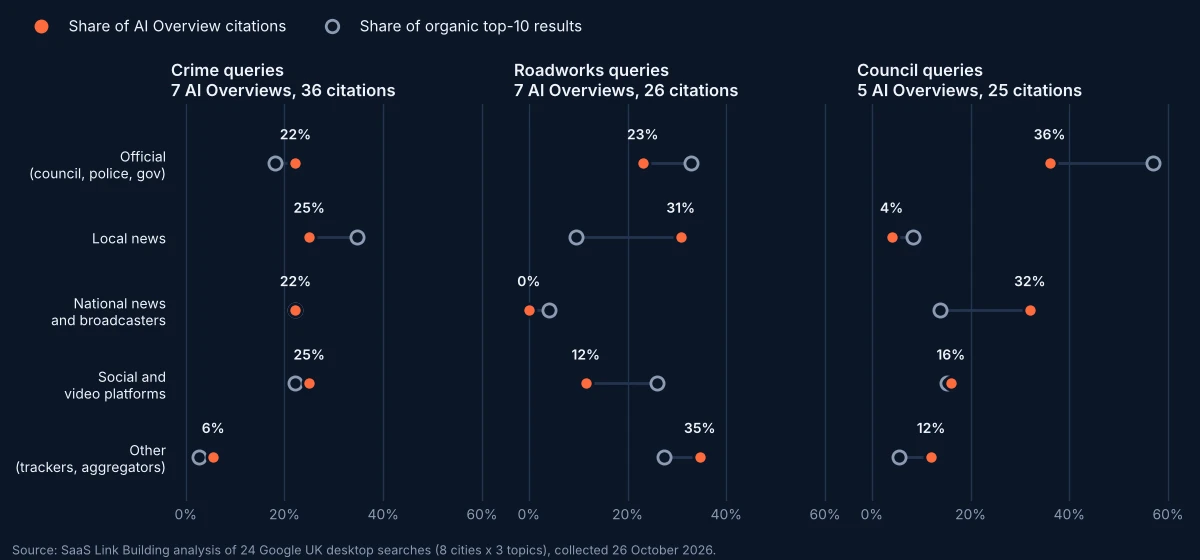
- Council queries were the exception. Only 1 of 25 citations on council searches came from a local newspaper. National outlets supplied 8, and all 8 were BBC pages.
- Roadworks queries favoured local publishers more than the organic results did. Local news made up 31% of AI Overview citations on roadworks searches but only 9.6% of the organic top 10.
- Social platforms supplied 16 citations (18.4%), from Facebook, YouTube, Instagram and X. Four of those were police or council accounts, and three were local publishers' own Facebook posts (WalesOnline twice, Plymouth Plus once).
What Searchable found
According to Press Gazette's report, Searchable sent about 30,000 prompts to five AI assistants: ChatGPT, Perplexity, Google Gemini, Google AI Mode and Google AI Overviews. The prompts covered 20 questions about 100 UK towns and cities, on topics such as crime, planning, housing, roads, council decisions, sport and events. The answers drew 244,725 citations from about 10,000 websites.
The headline numbers Press Gazette gives are for ChatGPT. It cited national newspapers 18.8% of the time against 21.2% for local ones on local queries. It went to council or government sources for 81.3% of questions and to local news for 0.9%. Only one local title, Wales Online, made ChatGPT's top 20 news sources, in 18th place. On crime queries, police force websites supplied 57.8% of the answers, the report says.
Chris Donnelly, Searchable's chief executive, told Press Gazette that for a regional title, AI "is not yet making up for the search traffic publishers are losing". The full dataset has not been published, so the per-assistant split for AI Overviews is not public.
Our check: what Google's AI Overviews cite
We picked eight UK cities (Leeds, Bristol, Sheffield, Nottingham, Cardiff, Norwich, Plymouth and Newcastle) and three topics from Searchable's list: crime ("latest crime news [city]"), roads ("[city] roadworks this week") and council decisions ("[city] council latest news"). For each AI Overview we recorded every cited page. We also recorded the organic top 10 on the same results page, so the two could be compared.
| Source type | AI Overview citations | Share of citations | AI Overviews citing it (of 19) | Share of organic top 10 |
|---|---|---|---|---|
| Official (council, police, government) | 23 | 26.4% | 13 | 35.9% |
| Local news | 18 | 20.7% | 11 | 17.5% |
| National news and broadcasters | 16 | 18.4% | 6 | 13.4% |
| Social and video platforms | 16 | 18.4% | 9 | 21.2% |
| Other (roadworks trackers, aggregators, misc.) | 14 | 16.1% | 10 | 12.0% |
| Total | 87 | 100% | 19 | 217 results |
Across all three topics, local news earned a slightly larger share of AI Overview citations (20.7%) than of organic top-10 positions (17.5%). Official sites went the other way: they held 35.9% of organic positions but only 26.4% of citations.
Crime: an even split, with old stories
On the seven crime queries with an AI Overview, citations were spread almost evenly across official, local, national and social sources. Police sites were cited in four of them, well short of the 57.8% police share Searchable reported, although the two numbers measure different things. Freshness was uneven. The Plymouth answer to a "latest crime news" search cited BBC reports from November 2024 and January 2025, and the Nottingham answer leaned on three YouTube videos.
Roadworks: local titles and tracker sites
Roadworks answers cited local news in five of seven AI Overviews, often through a publisher's weekly list of closures. Third-party roadworks trackers were the other big winner: one tracker domain appeared 12 times across organic results and citations. National outlets were not cited at all.
Council news: the BBC replaces the local paper
All five council AI Overviews cited the council's own site or newsroom. Three cited the BBC, which supplied all 8 national citations on this topic. Only one cited a local newspaper. For publishers that rely on council reporting, this is the pattern closest to Searchable's ChatGPT finding.
A note on Facebook "answers" pages
Facebook's "fb-answers" topic pages ranked in the organic top 10 for three of our searches (Sheffield crime, Bristol roadworks and Cardiff roadworks), and one was cited in the Cardiff roadworks AI Overview. Each presents a short summary answer on a local topic, and they now compete with the original reporting both in organic results and as AI Overview sources.
What this means for SEO teams and local publishers
Google says there are no special requirements for AI Overviews: a page must be indexed and eligible to show with a snippet, and the usual AI features guidance applies. Its documentation also says AI Overviews are shown only when its systems judge them "additive to classic Search", which fits the five local queries where none appeared.
- Publish recurring local utility pages. Weekly roadworks lists and crime section pages were the local pages most often cited. A stable URL that is updated every week gives the AI Overview a page to return to.
- Add reporting that the council page lacks. On council queries, Google cited the council's own announcement and the BBC. A local story that only restates the press release has little reason to be cited alongside it.
- Put dates where they can be read. Google cited pages nearly two years old for "latest" queries. Clear publication and update dates in the visible text and structured data help readers and systems tell current reporting from archive pieces.
- Watch your own social pages. Local publishers were cited three times through Facebook posts rather than their websites. That is visibility, but the click goes to Facebook.
For background, our earlier test found that AI Overviews rewrote 26% of citation snippets as AI summaries, and a larger study of 1,000 SaaS searches found that 74% of AI Overviews carried no inline link. On the traffic side, search fell to 12% of North American publisher pageviews in Q3 2026, according to Chartbeat data.
Methodology
On 26 October 2026, between 13:33 and 13:47 UTC, we pulled live Google results from a SERP data API for 24 queries: three query templates ("latest crime news [city]", "[city] roadworks this week" and "[city] council latest news") across eight UK cities. Settings were Google UK, English, desktop, location United Kingdom, top 10 organic results, with AI Overviews loaded. Two queries failed on the first attempt with a server error and were re-run successfully a few minutes later.
For each AI Overview we counted every distinct cited page listed in its reference blocks (a page cited twice in one answer counts once). We classified each domain by hand into five groups: official (council, police, government and public transport bodies, including council-run news sites), local news (city and regional publishers), national news and broadcasters (BBC, ITV and national papers; BBC regional pages count as national), social and video platforms (counted by platform, whoever owns the account), and other. Organic results were classified the same way, excluding special result blocks such as video carousels and People Also Ask.
This is a small, single-day snapshot of one country, one device and three topics, so the percentages are indicative rather than representative. AI Overviews vary by user, time and location, and our sample is not comparable like for like with Searchable's 30,000-prompt, five-assistant study.
Conclusion
Searchable's finding that AI assistants sideline local publishers holds most strongly for ChatGPT and, in our check, for council news on Google. On crime and roadworks queries, Google's AI Overviews cited local news sites in most answers, sometimes more often than the organic results ranked them. The opening for local publishers is narrow but real: regularly updated, dated pages that add something the official source does not.
Questions and answers
How often did Google show an AI Overview on UK local news searches?
In our check of 24 Google UK desktop searches on 26 October 2026, AI Overviews appeared on 19 (79%). Three of the five searches without one were council-news queries.
Do Google AI Overviews cite local newspapers?
Often, depending on the topic. Local news sites were cited in 11 of the 19 AI Overviews we captured and supplied 20.7% of the 87 cited pages. On council-news queries, only 1 of 25 citations came from a local newspaper.
What did the Searchable study find?
According to Press Gazette, Searchable sent about 30,000 prompts about 100 UK towns and cities to five AI assistants. ChatGPT went to council or government sources for 81.3% of questions and to local news sources for 0.9%.
Are there special requirements to appear in AI Overviews?
Google says no. Its AI features documentation states that a page must be indexed and eligible to be shown in Google Search with a snippet, and that there are no additional technical requirements.
More releases
-
Studies
Does Google Use Clicks to Rank Pages? Trial Files and 14,013 Leaked Fields Say Yes
Court findings from US v. Google and Google's own How Search Works page show that aggregated click data feeds ranking through Navboost and Glue. Our count of 14,013 leaked attributes finds 63 tied to clicks, dwell or Chrome, but no evidence that a site can lift rankings by gaming its own CTR.
-
Studies
39.5% of 339 Top-Site Sitemaps Skip Lastmod, the Date Google Uses to Schedule Crawls
A SaaS Link Building crawl of the 1,000 most visited domains on 26 October found that 39.5% of 339 page-level sitemaps carry no lastmod date, 19.5% of well-dated ones give every URL the same date, and 38.1% still use changefreq or priority, tags Google says it ignores.
-
Explainers
Google's Helpful Content Guide Adds 4 Rater Tests: Effort, Originality, Skill, Accuracy
Google has added a main content section to its Creating helpful content guide, listing the four attributes its quality raters assess: effort, originality, talent or skill, and accuracy. We compared the new wording with the rater guidelines line by line and mapped where each attribute appears across their 182 pages.
Tell us the site and the goals.
Rankings in Google and visibility in AI answers, from one monthly plan. One call is enough to say which one fits. Email works just as well.