Google Tells Platforms to Noindex Link-Shared Pages; 3 of 12 AI Share Tools Still Show Up
Google added an "Only index content meant for Search" section to its user-generated spam guide on 26 October 2026, telling platforms to noindex link-shared pages, generated outputs and tools by default. Our check of 12 AI share-link surfaces found three still showing shared content in Google results.
 Vibhu Dhariwal
Cofounder & CTO, Digital Gratified
- Published
- Section
- Updates
- Reading time
- 8 minutes
Ras Al Khaimah, United Arab Emirates, .
Google has added a new section, "Only index content meant for Search", to its guide on preventing user-generated spam, telling platforms that let people create shareable pages, generated outputs or interactive tools to keep that content out of the index by default when it exists for direct sharing rather than search discovery. The change is dated 26 October 2026 in Google's Search documentation updates log, which says it is meant to help platforms keep user-created pages that are not meant for Search out of the index and detect spam earlier. Search Engine Roundtable reported the update the same day.
To see how far the guidance is from current practice, we checked 12 share-link surfaces run by AI assistants and AI app builders: their robots.txt rules, the robots meta tags on sampled pages, and what a live Google site: search returns for each share path. Three of the 12 showed shared content, with titles and snippets, on the first page of Google results.
What changed in Google's guide
- Wider scope. The opening of the page now names hosting platforms and tools that let users publish shared pages, generated content or web apps as open to the same abuse as comment forms, and says spammers may create large numbers of such pages that break Google's spam policies.
- New "Only index content meant for Search" section. Platforms are asked to consider whether user-created content is meant to be found through search engines or only reached by people holding a link. Where pages are made for direct sharing, collaboration or utility, Google recommends applying
noindex(robots meta tag orX-Robots-Tagheader) or blocking crawling in robots.txt "by default". - Expanded monitoring advice. According to Search Engine Roundtable's comparison, the "Monitor your service for abuse" list now asks site owners to verify the site or subdomain in Search Console for manual action and security alerts, to watch the Page Indexing and Search performance reports for unexpected spikes in indexed pages, impressions or off-topic queries, and to track platform-level creation and indexing metrics, alerting on bursts of new public pages or a small number of users producing a large share of indexable URLs.
The page's other sections still cover abuse policies, reputation systems, nofollow or ugc on untrusted links, moderation, blocklists, reCAPTCHA and language checks. Google's changelog entry does not mention AI tools by name, and we found no public comment from a Googler on what prompted the change.
Our check: how 12 share-link surfaces handle Google today
We pulled robots.txt for each platform and tested its share path against the Googlebot rules, fetched sample share pages where Google returned one, and ran a site: query for each path on Google (US, English). A site: query shows only a sample of what Google holds, so a zero means nothing surfaced, not that nothing is indexed.
| Surface (share path) | Robots.txt lets Googlebot crawl it | Robots meta on a sampled page | Google site: results, page one |
|---|---|---|---|
| Grok (/share/) | Yes | index, follow | 10, with conversation titles |
| Perplexity Pages (/page/) | Yes | None set | 10, with page content |
| v0 by Vercel (/chat/) | Yes | None set | 10, with project content |
| ChatGPT (/share/) | Yes | Not checked (our fetch was refused) | 8, sign-in screens only |
| Gemini (/share/) | Yes | noindex, nofollow | 1, bare URL with no title or snippet |
| Claude (/share/) | Yes | No sample found | 0 |
| Claude artifacts (/public/artifacts/) | Yes | No sample found | 0 |
| Microsoft Copilot (/shares/) | Yes | No sample found | 0 |
| Poe (/s/) | Yes for Googlebot; blocked for other crawlers | No sample found | 0 |
| Meta AI (/share/) | Yes | No sample found | 0 |
| DeepSeek (/share/) | robots.txt not served to us | No sample found | 0 |
| Lovable (/projects/) | Yes | No sample found | 0 |
Four details stand out:
- Grok asks to be indexed. The sampled Grok share page carries
index, follow, the opposite of Google's new default. Three of the 10 Grok results on page one had snippets saying the shared chat "has been deleted or is no longer available", so removed conversations can keep their titles in Google after the content is gone. - Google's own product follows the advice, mostly. The sampled Gemini share page carries
noindex, nofollow. One Gemini share URL still appeared, as a bare address with no title or snippet. - ChatGPT's indexed URLs are login walls. The eight ChatGPT results were the share root and workspace links under
/share/e/, titled with sign-in prompts or the generic ChatGPT name, with no conversation text in the results. - Robots.txt is not doing the work. Every platform whose robots.txt we could read lets Googlebot crawl its share path. Where shares stay out of Google, it is because of page-level signals, access controls or the way links are generated, not robots.txt. Poe is the odd one out: its robots.txt blocks
/s/for unnamed crawlers but gives Googlebot full access.
Why Google is pointing at share links now
Indexed share links have caused two privacy incidents in the past 14 months. At the start of August 2025, OpenAI removed the "Make this link discoverable" option from ChatGPT sharing after shared chats surfaced in Google, and said it was working to remove indexed conversations. Weeks later, Forbes reported that Google had indexed more than 370,000 Grok conversations created with the share button.
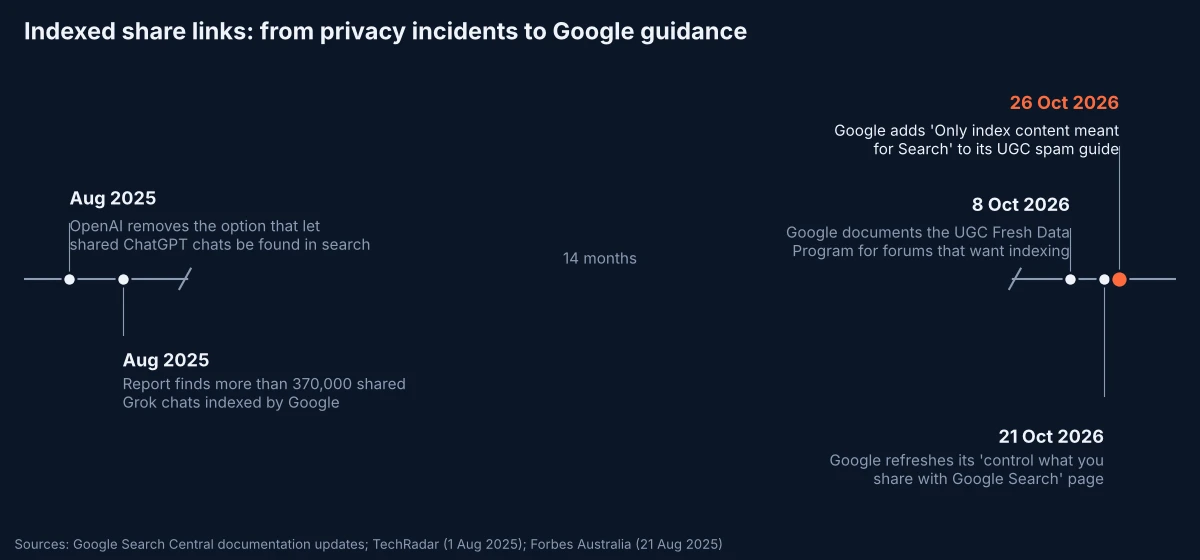
The 26 October edit is one of several Google Search documentation changes this month about what gets indexed. On 8 October Google documented the UGC Fresh Data Program, which lets forums push posts to Search faster, and on 21 October it refreshed its guide to controlling what you share with Google Search to list the robots meta tag, data-nosnippet, X-Robots-Tag and the Search generative AI control together. We counted 52 Search and crawling documentation changes in 2026 before mid-October.
Speculation, not confirmed by Google: some SEO commentators on X asked whether the wording signals manual actions against AI app builders. The documentation describes best practices; it does not announce an enforcement change.
One catch in Google's advice
The new section offers noindex or a robots.txt block as alternatives, but Google's own documentation says they do not do the same job. Its noindex guide warns that the rule only works if the page is not blocked by robots.txt, because a crawler that cannot fetch the page never sees it. Its robots.txt introduction says a disallowed URL can still be indexed without a description if other pages link to it. Share links are designed to be posted elsewhere, so a robots.txt block alone can leave bare URLs in the index. Choose one method per URL pattern: noindex when you want pages out of results, robots.txt when crawl load is the concern.
What to do
- Platforms with share, publish or generate features: make
noindexthe default for share, preview and generated-output URLs, set it as anX-Robots-Tagheader so it covers non-HTML outputs, and make indexing an explicit opt-in for pages users want found. - Do not combine the two blocks. If a share path is disallowed in robots.txt, Googlebot cannot see a
noindexon it. Remove the disallow until the noindexed URLs drop out, then decide whether to block crawling. - Set up the alerts Google lists. Verify every user-content subdomain in Search Console, watch Page Indexing for sudden growth in indexed pages, and alert when a few accounts generate a large share of indexable URLs.
- Clean up deleted shares. When a user deletes a shared page, return 404 or 410, or keep
noindexon the "deleted" placeholder, so the old title does not stay in Google, as several Grok results showed. - Audit your own pattern with a
site:query. Search for your share path, read the titles and snippets, and compare against your robots meta tags. Test robots rules against Google's parser: our robots.txt study found 24.6% of top sites use fields Google ignores.
Methodology
On 26 October 2026 (UTC) we selected 12 public share or publishing surfaces run by AI assistants and AI app builders. For each, we fetched /robots.txt with a Googlebot user agent and evaluated a sample share URL against the Googlebot rules with an open-source parser modelled on Google's robots.txt matching rules. We ran a Google site: query for each share path (two for ChatGPT and Gemini, whose counts come from the lighter results page) from a US English location through a SERP data service and recorded the organic results on page one. Where Google returned share URLs, we fetched one per platform with Googlebot and desktop browser user agents and recorded any X-Robots-Tag header and robots meta tag. No X-Robots-Tag headers were found on the pages we could fetch. ChatGPT refused our page fetch and DeepSeek refused our robots.txt request, so those cells are marked. Results reflect a single point in time and a single location.
Conclusion
Google's guide now states a clear default for platforms: content made for sharing by link should stay out of Search unless someone chooses otherwise. Most of the AI share surfaces we checked already keep their links out of Google's results, but three still expose shared content, and one of them explicitly asks Google to index it.
For SEO teams, the update matters most on sites that let users create pages at scale. Treat every user-generated URL pattern as non-indexable until it earns indexing, use noindex rather than robots.txt to keep it out, and add the Search Console checks Google now lists so spam on your platform is spotted before it becomes a site-wide problem.
Questions and answers
What did Google change in its user-generated spam guide?
On 26 October 2026 Google updated its guide to preventing user-generated spam with a new section, "Only index content meant for Search", which advises platforms to apply noindex or block crawling by default for shareable pages, generated outputs and interactive tools made for direct sharing, plus extra advice on monitoring abuse in Search Console.
Is noindex or robots.txt the better way to keep share links out of Google?
Google's own documentation says noindex only works if the page is not blocked by robots.txt, and that a URL disallowed in robots.txt can still be indexed without a description if other pages link to it. For keeping share links out of results, noindex (in a meta tag or X-Robots-Tag header) is the method Google describes for that purpose.
Which AI share links still appear in Google?
In our check on 26 October 2026, Google site: searches returned shared content with titles and snippets for Grok share links, Perplexity Pages and v0 chats. Gemini share pages carried noindex, nofollow, ChatGPT results were sign-in screens, and Claude, Copilot, Poe, Meta AI, DeepSeek and Lovable share paths returned no results.
Does the update mean Google will issue manual actions against AI tools?
Google has not said so. The change is to a best-practices page for platforms, and its changelog entry describes the goal as keeping user-created pages that are not meant for Search out of the index and detecting spam earlier.
More releases
-
Studies
Category Pages Took 67% of Page One for Generic Shopping Terms in Our 48-Search Study
Category and listing pages took 67% of Google's page-one organic results for generic shopping terms in our analysis of 48 live US searches, and product pages took none. Product pages led only on exact model searches (32%), while reviews held 59% of page one for "best" queries.
-
Industry news
Google AI Overviews Cited Local News in 11 of 19 UK Local Searches, Our Check Finds
A study by Searchable found AI assistants such as ChatGPT bypass local newspapers on UK local queries. Our check of 24 Google UK searches found AI Overviews cited local news in 11 of 19 answers, but only once across five council-news answers, where the BBC and councils dominated.
-
Studies
Does Google Use Clicks to Rank Pages? Trial Files and 14,013 Leaked Fields Say Yes
Court findings from US v. Google and Google's own How Search Works page show that aggregated click data feeds ranking through Navboost and Glue. Our count of 14,013 leaked attributes finds 63 tied to clicks, dwell or Chrome, but no evidence that a site can lift rankings by gaming its own CTR.
Tell us the site and the goals.
Rankings in Google and visibility in AI answers, from one monthly plan. One call is enough to say which one fits. Email works just as well.