AI Overviews Showed on 77% of 150 Google Searches but Only 2 of 15 Local Ones
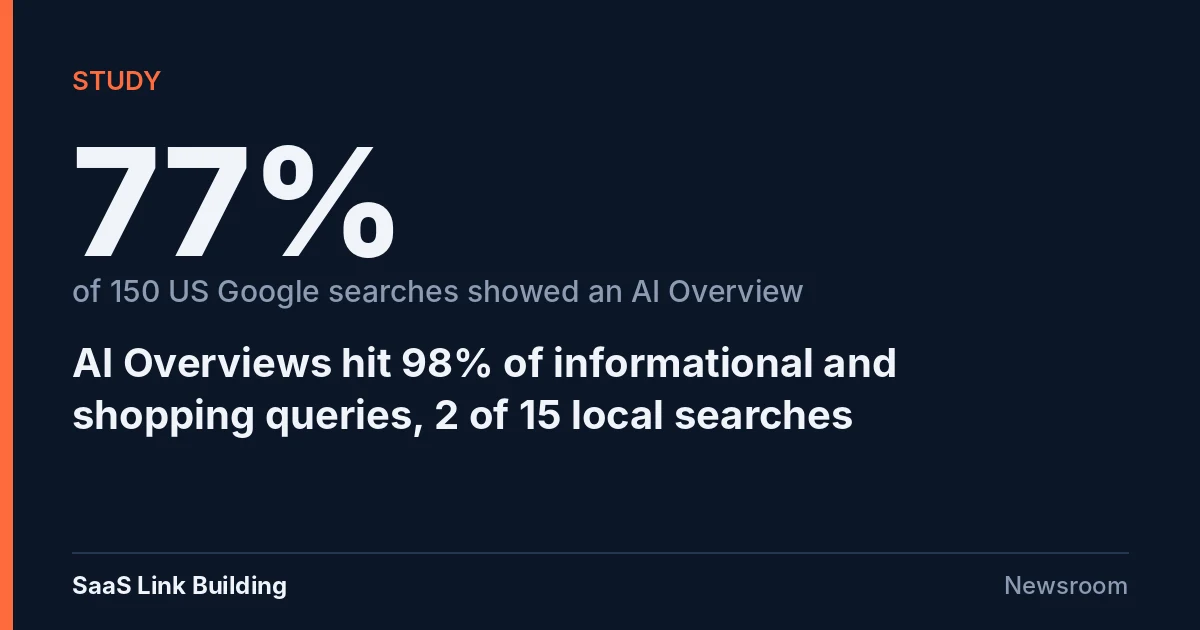
Google showed an AI Overview on 116 of 150 US desktop searches (77.3%) in our 27 October check, and on 83.3% after rechecking those without one. Informational and shopping queries hit 97.8%, but only 2 of 15 "near me" searches showed one on the first pass.
 Vibhu Dhariwal
Cofounder & CTO, Digital Gratified
- Published
- Section
- Studies
- Reading time
- 7 minutes
Ras Al Khaimah, United Arab Emirates, .
Google showed an AI Overview on 116 of 150 US desktop searches (77.3%) in a check SaaS Link Building ran on 27 October 2026, and on 125 (83.3%) when the searches without one were run a second time a few minutes later. The headline share hides a split by query type: AI Overviews appeared on 88 of 90 informational and commercial searches, but on only 2 of 15 "near me" searches in the first check.
The test was designed to explain why industry figures for AI Overview coverage disagree. Search Engine Roundtable reported on 26 October that recent data from three SEO tool vendors puts AI Overviews on "over 80%" of Google searches, while Google's own AI features documentation for site owners says AI Overviews "often don't trigger". Our results suggest both can be true, depending on which queries are counted.
Key findings
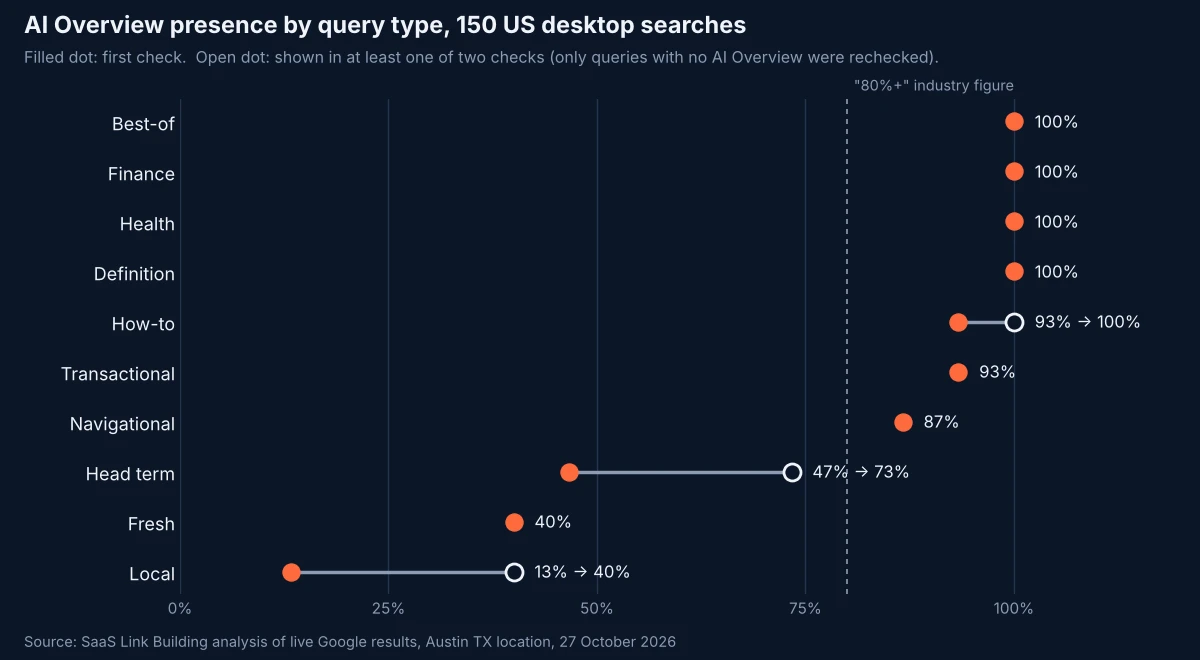
- Overall: 77.3% of 150 searches showed an AI Overview on the first check; 83.3% showed one in at least one of two checks.
- Informational and commercial queries are close to saturated: how-to, definition, health, finance, "best" and product searches showed an AI Overview 97.8% of the time (88 of 90).
- Local intent is the big exception: 2 of 15 "near me" searches had an AI Overview on the first check, rising to 6 of 15 across both checks. Every one of the 15 showed a local pack.
- Live data queries go to Google's own widgets: 9 of 15 time-sensitive searches, such as weather, sports standings and a cryptocurrency price, showed no AI Overview.
- Presence is unstable: 9 of the 34 searches with no AI Overview on the first pass showed one on the second, about 26%.
- YouTube is the most cited source: 143 of the 705 citation links we captured (20.3%) pointed to YouTube, rising to 42% for how-to searches.
Why the published figures disagree
The vendor numbers now circulating measure different query sets. SE Ranking, in a study published on 22 October, found AI Overviews on 82.5% of 1,000 US brand keywords across three desktop checks, and on 40.4% of the same kind of keywords in Germany. Semrush's fixed panel of 400 US commercial keywords showed an AI Overview 88% of the time in August, as we reported in our coverage of that study. Search Engine Roundtable's summary also cites seoClarity data putting AI Overviews on more than 62% of queries, ranging from 55% to 84% by industry.
Each figure can be accurate for its panel. A sample weighted to commercial and branded queries will land near 85% to 90%; one that includes local, sports, weather and single-word queries will land lower. In our sample, removing the 15 local searches lifts the first-check rate from 77.3% to 84.4% (114 of 135).
Google does not publish a coverage rate. Its Search Help page on AI Overviews says they appear when its systems determine generative AI can be especially helpful, which does not tell site owners how often that is.
Where AI Overviews did not appear
Local packs and AI Overviews shared a page far less often in the first check. Of the 39 searches that showed a local pack, 16 (41%) also had an AI Overview, against 100 of the 111 searches (90%) without one. The local pack appeared on all 15 "near me" searches and on 14 of the 15 single-word head terms, such as "camping", "paint" and "shoes".
The time-sensitive group split by whether Google had its own answer format. "Weather tomorrow" returned a weather result, "bitcoin price" a currency converter and "earthquake today" a public alerts box, with no AI Overview on either check. Sports standings and scores also showed none. In contrast, "stock market today", "mortgage rates today", "world series score" and "flight status" all carried an AI Overview built from news and live-coverage pages.
Among navigational queries, 13 of 15 brand and login searches showed an AI Overview, including "facebook login", "chase bank login" and "paypal login". Only "espn" and "home depot" had none on either check.
Who gets cited
For the 89 AI Overviews where Google returned the citation list in the first response, we recorded every linked source. The other 27 loaded their content in a second request, which we did not make, so they count towards presence but not towards citations.
| Query type | AI Overviews with citations captured | Citation links | Average per AI Overview | YouTube share of links |
|---|---|---|---|---|
| How-to | 13 | 112 | 8.6 | 42.0% |
| Definition | 15 | 131 | 8.7 | 25.2% |
| Health | 14 | 124 | 8.9 | 13.7% |
| Finance | 13 | 108 | 8.3 | 12.0% |
| Best-of | 10 | 76 | 7.6 | 17.1% |
| Transactional | 8 | 58 | 7.2 | 12.1% |
| Navigational | 8 | 37 | 4.6 | 8.1% |
| Fresh | 5 | 38 | 7.6 | 13.2% |
| Head term | 3 | 21 | 7.0 | 23.8% |
| All | 89 | 705 | 7.9 | 20.3% |
At least one YouTube video was cited in 56 of the 89 AI Overviews (62.9%). On "best" and product searches, 19 of 134 citation links pointed back to Google's own shopping product pages rather than to a retailer or publisher. Navigational AI Overviews cited the fewest sources, mostly the brand's own pages plus Wikipedia.
Health and finance AI Overviews leaned on institutional sources such as the CDC, MedlinePlus, Mayo Clinic, Cleveland Clinic, the CFPB and the IRS, alongside bank and brokerage education pages. For how source choice shifts on local news topics, see our check of AI Overview citations in UK local searches.
What this means for SEO teams
- Measure your own query mix, not the industry average. A local service business and a software publisher face very different exposure. Tag your tracked keywords by intent and record AI Overview presence for each group.
- Check twice before concluding a query is safe. About a quarter of our "no AI Overview" results flipped within minutes. One check is a snapshot; weekly sampling gives a usable rate.
- Treat local packs as the main battleground for "near me" terms. The local pack appeared on all 15 of our "near me" searches, while an AI Overview appeared on at most 6 of them.
- Plan video for how-to topics. With 42% of how-to citations going to YouTube, a written guide competes with videos for the same slots in the summary.
- Use Search Console's generative AI reports for real exposure. They show impressions on your own site, which a third-party panel cannot.
For context on how those summaries link out once they appear, see our earlier 1,000-search test of inline links.
Methodology
We built a list of 150 English-language queries in ten groups of 15: how-to, definitions, health, personal finance, "best" product and software queries, transactional product queries, local "near me" queries, navigational brand and login queries, time-sensitive queries, and single-word head terms. Queries were chosen by hand to represent each intent and were not weighted by search volume.
Each query was run once through a SERP API on 27 October 2026 between 01:20 and 01:25 UTC, as a Google desktop search in English with the location set to Austin, Texas, United States. We recorded whether the response contained an AI Overview (including AI Overviews whose content Google loads in a second request), the citation links where provided, and whether a local pack, ads or top stories appeared. The 34 queries with no AI Overview were run a second time between 01:24 and 01:26 UTC; queries that did show one were not rechecked, so the two-check figure records whether a query showed an AI Overview at least once, not an average across checks.
Limitations: the sample is small and hand-picked, covers one location, one device type and one day, and uses one data provider's parsing of Google's results. Citation figures cover only the 89 AI Overviews that returned a citation list in the first response. We did not measure clicks or traffic.
Conclusion
Across 150 searches, AI Overviews appeared about four times in five, which is close to the 80%-plus figures vendors are now quoting. But the average depends on the query mix. Informational, health, finance and shopping research queries almost always triggered one, while local searches, live-data queries and short head terms were where Google's own description of AI Overviews as often not triggering still held.
For most SEO teams the useful number is not the industry average but the rate for their own keyword set, measured more than once, split by intent.
Questions and answers
How often do AI Overviews appear in Google Search?
In our check of 150 US desktop searches on 27 October 2026, 116 (77.3%) showed an AI Overview on the first run. After rechecking the 34 searches without one, 125 (83.3%) had shown an AI Overview at least once. Google does not publish an official coverage rate.
Which searches are least likely to show an AI Overview?
Local "near me" searches: only 2 of 15 showed an AI Overview on the first check and 6 of 15 across two checks. Time-sensitive searches answered by Google's own widgets, such as weather, sports standings and a cryptocurrency price, also showed none.
Why do industry studies report different AI Overview rates?
They measure different keyword sets. SE Ranking found 82.5% on 1,000 US brand keywords, and Semrush found 88% on 400 US commercial keywords. Samples that include local, live-data and single-word queries come out lower, as ours did at 77.3%.
Which sites do AI Overviews cite most?
YouTube was the most cited domain in our sample, with 143 of 705 citation links (20.3%) and 42% of how-to citations. Health and finance AI Overviews leaned on institutional sources such as the CDC, MedlinePlus, Mayo Clinic and the CFPB.
Is AI Overview presence stable for the same query?
Not fully. Of the 34 searches with no AI Overview on the first check, 9 (about 26%) showed one when run again a few minutes later from the same location and device.
More releases
-
Studies
ChatGPT Named Brands in 77 of 82 Searches for Unbranded Prompts, Our 20-Prompt Test Finds
When ChatGPT searched the web to answer 20 unbranded "best tool" questions, 77 of its 82 background queries already named brands, and 74% of the products in its answers had appeared in those queries. Our 27 October test supports Graphite's finding that what a model already knows shapes what it searches for.
-
Updates
Google Tells Platforms to Noindex Link-Shared Pages; 3 of 12 AI Share Tools Still Show Up
Google added an "Only index content meant for Search" section to its user-generated spam guide on 26 October 2026, telling platforms to noindex link-shared pages, generated outputs and tools by default. Our check of 12 AI share-link surfaces found three still showing shared content in Google results.
-
Studies
Category Pages Took 67% of Page One for Generic Shopping Terms in Our 48-Search Study
Category and listing pages took 67% of Google's page-one organic results for generic shopping terms in our analysis of 48 live US searches, and product pages took none. Product pages led only on exact model searches (32%), while reviews held 59% of page one for "best" queries.
Tell us the site and the goals.
Rankings in Google and visibility in AI answers, from one monthly plan. One call is enough to say which one fits. Email works just as well.