ChatGPT Sent 0.62% as Many Sessions as Google Organic Across 100 Sites, Marie Haynes GA4 Study Finds
A GA4 analysis of 100 websites and more than 145 million sessions, published by SEO consultant Marie Haynes on 21 October, found ChatGPT sessions equalled 0.62% of Google organic volume. ChatGPT visitors converted at 13.8% against 3.02% for Google organic, yet Google drove 27 times more conversions than all LLMs combined.
 Vibhu Dhariwal
Cofounder & CTO, Digital Gratified
- Published
- Section
- Studies
- Reading time
- 4 minutes
Ras Al Khaimah, United Arab Emirates, .
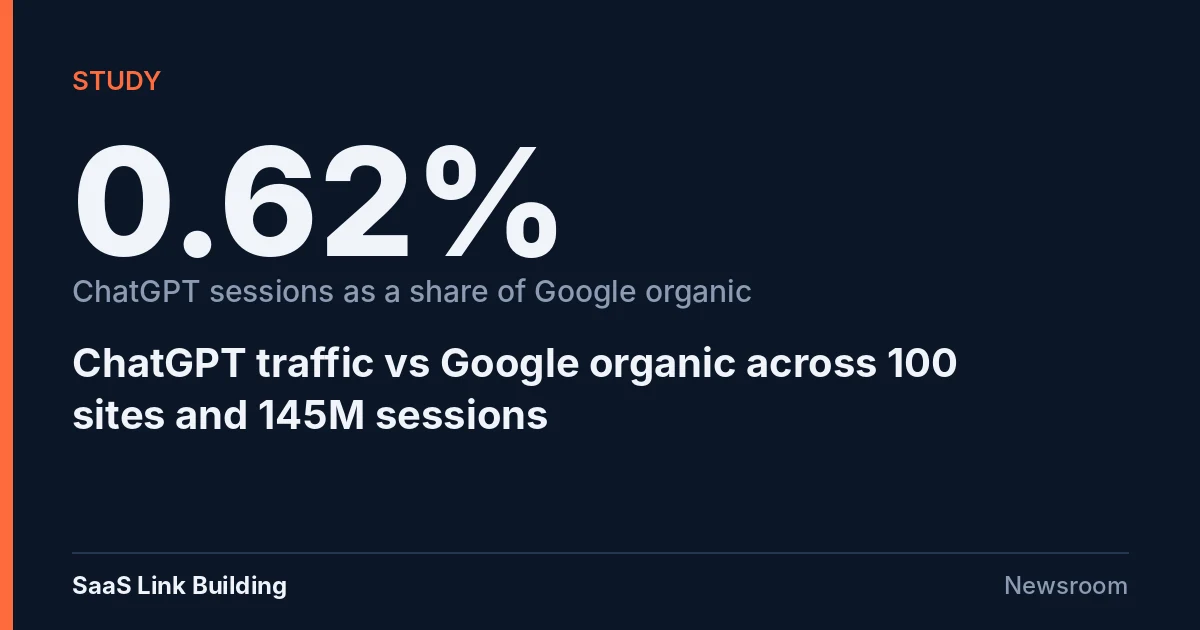
ChatGPT sends a small fraction of the visits Google organic search does, according to a new analysis of Google Analytics 4 data published on 21 October 2026 by SEO consultant Marie Haynes. Looking at 12 months of GA4 data across 100 websites of varying sizes, covering more than 145 million sessions, she found that sessions from ChatGPT amounted to 0.62% of the volume driven by Google organic search. Adding all other large language model referrers raised the figure to 0.73%.
The study, published under the title "GEO is a distraction", also found that ChatGPT visitors converted at a much higher rate than Google organic visitors, but in such small numbers that Google still delivered almost all conversions in the sample.
Key findings
- Traffic share: ChatGPT sessions equalled 0.62% of Google organic sessions. All LLMs combined equalled 0.73%.
- Conversion rate: Of the 100 sites, 55 tracked conversions in GA4. Among them, Google organic visitors converted at 3.02% and ChatGPT visitors at 13.8%, which the author describes as more than 4.5 times higher.
- Conversion volume: Google drove 96.5% of total conversions across the channels analysed, and Google organic drove 27 times more conversions than all LLMs combined.
- Trend: Collective ChatGPT sessions across the 100 properties stopped growing exponentially in August 2025, around the GPT-5 release, and have declined since, according to the analysis.
- Measurement gap: 45 of the 100 sites were not tracking any key events.
| Metric | Google organic | ChatGPT | All LLMs |
|---|---|---|---|
| Sessions, relative to Google organic | 100% | 0.62% | 0.73% |
| Google organic sessions per referral session (our calculation) | n/a | About 161 | About 137 |
| Conversion rate (55 sites tracking conversions) | 3.02% | 13.8% | Not reported |
| Conversions | 27 times all LLMs combined | Not reported separately | About 1/27 of Google organic |
How the data was gathered
The author describes the sample as 100 randomly sampled sites of varying sizes and calls it a small dataset. The article does not state the exact 12-month window, the industries covered, or how sites were selected. She says she used AI tooling (Gemini 4 Argon in Antigravity) to calculate the collective ChatGPT visit totals and to produce the graphics; the article does not describe separate verification steps. Conversion definitions are whatever each of the 55 sites had configured as key events in GA4, so they will vary from site to site.
Two caveats are worth keeping in view when using these numbers:
- Referral attribution. GA4 can only credit ChatGPT when the referrer or tagging survives. We reported on 17 October that ChatGPT links lost UTM tags after the GPT-6 launch, moving visits into direct traffic in one sample; Search Engine Land later reported the change was a bug. Any analysis covering that period may understate ChatGPT's share.
- Clicks are not influence. The study measures sessions and conversions. It does not measure citations or mentions inside AI answers that lead to a later branded search or direct visit.
Context
The findings add to recent research on how AI assistants use the web and send traffic to it. On 19 October we covered an arXiv study of the pages ChatGPT cites, and on 14 October a 66.6 million answer study that found ChatGPT searched the web in only 14.4% of responses. Inside Google, AI features are now measured separately: Google launched Search Generative AI performance reports in Search Console in June and says they reached all sites on 31 August 2026.
The author's own conclusion is that the bigger AI search shift is happening inside Google, through AI Overviews, AI Mode and AI-driven ranking systems, rather than through referrals from standalone chatbots. That is her opinion rather than a finding of the dataset, and the study does not measure Google organic trends over the period.
What this means for SEO teams
- Size AI referral traffic on your own data. Build a GA4 exploration that separates chatgpt.com and other assistant referrers, and compare it with Google organic over the same 12 months.
- Track key events. With 45 of 100 sites in the sample tracking none, conversion data is the first gap to close before judging any channel.
- Read conversion rates with volume. A 13.8% rate on a channel that is under 1% of organic sessions can still be a small number of conversions.
- Watch direct traffic. Unexplained rises in direct sessions to deep pages can hide assistant referrals that lost their attribution.
- Keep Google fundamentals funded. In this sample Google organic produced 96.5% of conversions, a reason to be cautious about moving budget away from Google search on the strength of AI visibility metrics alone.
Conclusion
Across 100 sites and 145 million sessions, ChatGPT referrals were a rounding error next to Google organic search, even though those visitors converted at more than four times the rate. The sample is small and the methodology lightly documented, but the scale of the gap, about 161 Google organic sessions for every ChatGPT session, is wide enough that attribution fixes would need to be very large to change the picture for most sites.
For most sites the practical step is the one the data exposes: measure conversions properly, then compare channels on outcomes rather than on how often a brand appears in AI answers.
Questions and answers
How much traffic did ChatGPT send compared with Google?
In Marie Haynes's GA4 analysis of 100 websites over 12 months, ChatGPT sessions equalled 0.62% of Google organic sessions. Including all other LLMs raised that to 0.73%.
Did ChatGPT visitors convert better?
Yes. Among the 55 sites tracking conversions, ChatGPT visitors converted at 13.8% and Google organic visitors at 3.02%.
Which channel drove more conversions?
Google. The study found Google drove 96.5% of total conversions across the channels analysed and that Google organic drove 27 times more conversions than all LLMs combined.
How large was the dataset?
100 websites of varying sizes, 12 months of GA4 data and more than 145 million sessions. The author describes it as a small dataset.
More releases
-
Explainers
Google: Emoji User-Agents, Decorative Rules and Custom AI Directives Don't Work in Robots.txt
In a video published on 21 October, Google's Gary Illyes and Cherry Prommawin explained what robots.txt can and cannot hold. Google's parser keeps only four fields, ignores invalid lines silently, and accepts user-agent tokens made of letters, hyphens and underscores, so emoji and invented AI rules have no effect.
-
Industry news
Google's Mueller: Serve a 503, Not a 404 or 500, if Patching PHP's Critical RCE Flaws Takes Your Site Offline
PHP released 8.5.12, 8.4.27, 8.3.36 and 8.2.35 on 21 October to fix two critical remote code execution flaws. Google's John Mueller told site owners who take PHP sites offline to patch them to return HTTP 503 rather than time out, 404 or 500, and Google's documentation explains why.
-
Updates
Google Lists Its AI Overviews and AI Mode Opt-Out in Core Blocking Guide, 51 Days After Global Rollout
Google updated its "Control what you share with Google Search" guide on 21 October to name the Search Console generative AI control, which can exclude a site from AI Overviews, AI Mode and AI features in Discover. The control reached all sites on 31 August; Google says it is not a ranking signal.
Tell us the site and the goals.
Rankings in Google and visibility in AI answers, from one monthly plan. One call is enough to say which one fits. Email works just as well.