0 of 799 Top-Site Pages Use Nosnippet, the Robots Rule That Also Limits AI Overviews
A SaaS Link Building crawl of 525 homepages and 274 inner pages from the world's top 1,000 domains found no page using nosnippet or a max-snippet limit, the page-level rules Google says also keep content out of AI Overviews and AI Mode. Only 17% of homepages asked for large image previews.
 Vibhu Dhariwal
Cofounder & CTO, Digital Gratified
- Published
- Section
- Studies
- Reading time
- 7 minutes
Ras Al Khaimah, United Arab Emirates, .
Not one of 799 pages we fetched from the web's most popular domains uses nosnippet or a numeric max-snippet limit, the two page-level rules Google says can keep content out of its AI answers. SaaS Link Building crawled the homepages of the top 1,000 domains in the Tranco research ranking on 27 October 2026, plus one article-style inner page per site, and parsed every robots meta tag and X-Robots-Tag header we received. We got 525 usable homepages and 274 usable inner pages.
The timing matters. On 21 October Google updated its Control what you share with Google Search page to list the robots meta tag, data-nosnippet and X-Robots-Tag alongside the site-wide Search generative AI control in Search Console, as we reported at the time. Our crawl shows how the biggest sites actually use the page-level half of that toolkit: mostly to ask Google for more, not less.
Key findings
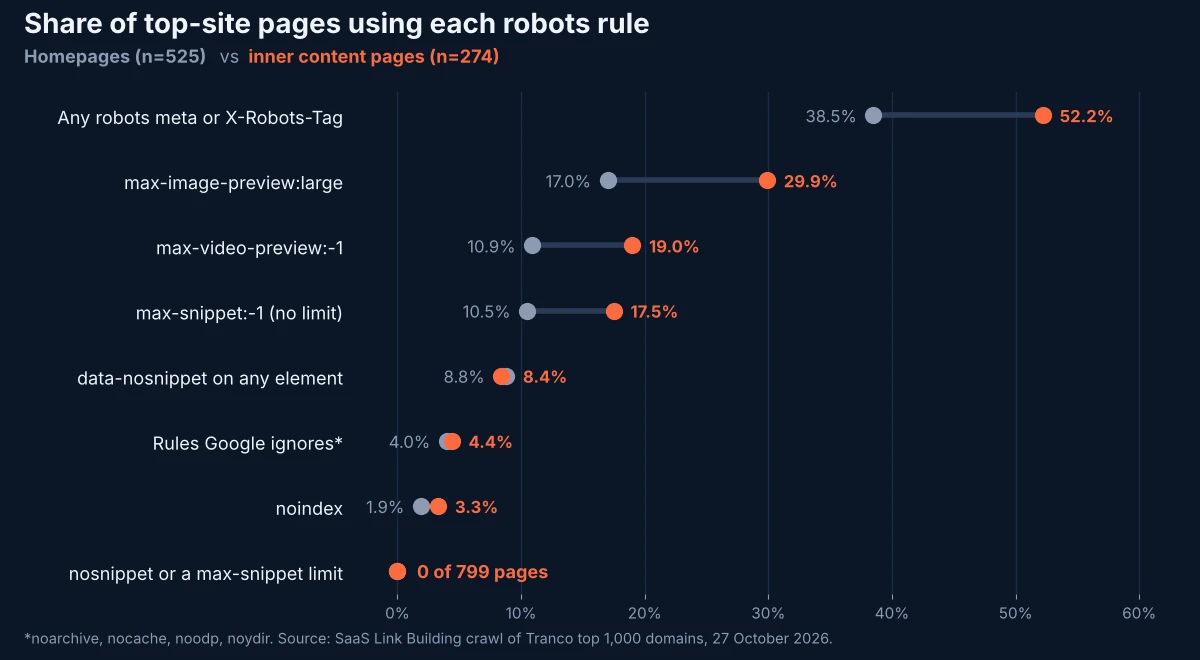
- No snippet restrictions at all. 0 of 525 homepages and 0 of 274 inner pages carried
nosnippetor amax-snippetvalue other than -1. Google's robots meta tag documentation saysnosnippetapplies to AI Overviews and AI Mode and also prevents the content being used as a direct input for them. - Permissive rules dominate. Where sites did set preview rules, they were the permissive ones: 53 homepages and 47 inner pages carried
max-snippet:-1,max-image-preview:largeandmax-video-preview:-1together. - Large image previews are still a minority choice. 89 homepages (17.0%) and 82 inner pages (29.9%) allowed large image previews, which Google's Discover documentation names as one way to become eligible for large images in the feed.
- Text-level hiding is rare. 46 homepages (8.8%) and 23 inner pages (8.4%) marked at least one element with
data-nosnippet. - Old rules linger. 21 homepages (4.0%) still send rules Google ignores, such as
noarchive,nocache,noodpornoydir.
Bigger sites set fewer rules
Splitting the homepages by rank shows the most popular domains are the least likely to send any robots rule at all. Many of the top 100 are platforms and app front doors rather than publishers, which may partly explain the gap.
| Tranco rank band | Homepages analysed | Any robots rule | max-image-preview:large | max-snippet:-1 |
|---|---|---|---|---|
| 1 to 100 | 56 | 16 (28.6%) | 3 (5.4%) | 0 (0.0%) |
| 101 to 500 | 198 | 69 (34.8%) | 33 (16.7%) | 24 (12.1%) |
| 501 to 1,000 | 271 | 117 (43.2%) | 53 (19.6%) | 31 (11.4%) |
| All | 525 | 202 (38.5%) | 89 (17.0%) | 55 (10.5%) |
Publishers restrict Bing, not Google
The clearest signs of AI caution in our data point at Microsoft rather than Google. The Guardian and both BBC domains return an X-Robots-Tag: bingbot: noarchive header on their homepages and on the inner pages we fetched. Ten homepages, including LinkedIn, NPR, Le Monde, the Daily Mail and La Repubblica, send a general noarchive, and inner pages on Wired and the Los Angeles Times do the same.
Google's documentation says it no longer uses noarchive, because the cached link feature no longer exists. Bing still reads it. Microsoft's September 2023 webmaster post says noarchive keeps content out of Bing's chat answers and out of training for its generative AI foundation models, while the page still appears in regular Bing results. The same rule therefore does nothing on Google and something specific on Bing.
Google offers no page-level equivalent that removes content from AI Overviews while leaving a full snippet in classic results. nosnippet removes the text snippet everywhere, including web results and Discover, which may explain why none of the sites we checked use it. The site-wide alternative is the Search Console control, which cannot be seen from outside a site, so our crawl cannot say how many of these domains have switched it on.
Context
Google's AI features documentation tells site owners to use nosnippet, data-nosnippet, max-snippet or noindex to limit what is shown from their pages, and points to Google-Extended for training and grounding in Google's other systems. Its snippet documentation covers the same rules for classic results. data-nosnippet is the narrowest of these tools: it hides a marked passage while the rest of the page stays eligible for snippets.
The max-image-preview rule is the other half of the story. Google's Discover guidance says large images are enabled by the max-image-preview:large setting or by using AMP. Our earlier coverage of how Discover filters stale stories showed how competitive that feed is; on inner pages, seven in ten of the top sites we checked do not send the large-preview rule.
The leftover noodp and noydir rules are not among the rules Google's robots meta documentation lists. They do no harm, but like the unsupported fields we found in a quarter of top sites' robots.txt files, they show how rarely these tags are audited.
What this means for SEO teams
- Decide on AI exposure at the right level. If the goal is to stay out of AI Overviews and AI Mode for a whole site, the Search Console control is the tool. If it is to keep specific passages, such as prices, member-only text or licensed material, out of quotes, use
data-nosnippeton those elements rather thannosnippeton the page. - Check what your CMS sends. 100 of the 799 pages carried the same three permissive preview rules. Confirm they are on every indexable template, not just the homepage, and that no template quietly adds
noindex; 9 of 274 inner pages did. - Add max-image-preview:large to article templates if Discover traffic matters, since Google ties large Discover images to that setting or AMP.
- Treat noarchive as a Bing setting. It has no effect on Google Search but, according to Microsoft, removes pages from Bing's chat answers. Keep it only if that is intended.
- Clean out dead rules such as
noodp,noydirand, for Google,nocache, so audits show only rules that do something.
Methodology
On 27 October 2026 we took the first 1,000 domains in the current Tranco list (list ID GQ3QK) and requested each homepage over HTTPS, trying the bare domain and then the www host, with a desktop Chrome user agent, following redirects. Many top-ranked domains are content delivery networks, API hosts or ad servers with no public homepage; 549 returned HTTP 200, and 525 of those returned an HTML document of more than 2,000 bytes. Those 525 form the homepage sample. For each, we took the first same-site HTTPS link whose last path segment contained at least four hyphen-separated words, excluding paths containing login, sign-in, account, privacy, terms, cookie, cart, careers, help, support or contact, as a proxy for an article or content page. 296 sites had such a link and 274 of those pages returned usable HTML.
We parsed meta tags named robots, googlebot or googlebot-news and any X-Robots-Tag header, split the comma-separated rules and counted each page once per rule. User-agent-prefixed header rules such as bingbot: noarchive were counted separately from general rules. data-nosnippet was counted when any element on the page carried the attribute. We read only what the server sent, without running JavaScript, so rules injected by scripts are not included. Results reflect what our crawler received from a single location and may differ for Googlebot or other regions. The Search Console generative AI control is not visible from outside a site and was not measured.
Conclusion
Google now lists page-level robots rules and its site-wide AI control side by side, but the biggest sites on the web are not using the page-level route to limit AI Overviews: across 799 pages we found no nosnippet and no snippet length cap. Where they set rules at all, they ask Google to show more, with full-length snippets and large images.
The few restrictions in our data were aimed at Bing through noarchive, a rule Google has retired. For SEO teams, the practical step is an audit of every template's robots output, so that each rule present is one that still does something on the engine it is meant for.
Questions and answers
Does nosnippet keep a page out of Google's AI Overviews?
Google's robots meta tag documentation says nosnippet applies to all forms of search results, including AI Overviews and AI Mode, and also prevents the content being used as a direct input for them. It also removes the text snippet from regular web results.
How many top sites use nosnippet?
None in our sample. We checked 525 homepages and 274 inner pages from the Tranco top 1,000 domains on 27 October 2026 and found no nosnippet rule and no numeric max-snippet limit.
What does max-image-preview:large do?
It allows Google to show a larger image preview, up to the width of the viewport. Google's Discover documentation says large images in Discover are enabled by this setting or by using AMP. In our crawl 17.0% of homepages and 29.9% of inner pages set it.
Does Google still use noarchive?
No. Google's documentation says noarchive is no longer used because the cached link feature no longer exists. Microsoft said in September 2023 that Bing uses noarchive to keep content out of its chat answers and generative AI training.
More releases
-
Industry news
ChatGPT Info-Seeking Hit a 20.7% High, Rising in 33 of the 35 Heaviest-Use Countries
OpenAI's Signals v3.0 data, released on 26 October, shows information requests reached 20.7% of consumer ChatGPT messages in August 2026, up from 16.7% in July 2024. Our analysis of the files finds the rise concentrated in heavy-use countries and among users aged 25 to 64.
-
Industry news
Trackers Spike Again on 27 October, but Our 14-Keyword SERP Check Finds No Extra Churn
Rank trackers showed a second, larger Google volatility spike on 27 October 2026, but Google has logged no ranking update since 8 October. Our comparison of stored snapshots for 14 US keywords found 65% of top URLs survived across 24 October, against 58.5% in the previous window, with the biggest swings tied to location errors or one-off snapshots.
-
Explainers
Page Indexing Report Stuck Since 16 October? Mueller Says Watch Performance Data First
A Search Console user says the Page Indexing report has not updated since 16 October, and Google's John Mueller replied that indexing changes show up in Performance reports first. Our check of our own property found 54 of 55 recent posts indexed via URL Inspection and most new posts earning impressions within a day.
Tell us the site and the goals.
Rankings in Google and visibility in AI answers, from one monthly plan. One call is enough to say which one fits. Email works just as well.