Page Indexing Report Stuck Since 16 October? Mueller Says Watch Performance Data First
A Search Console user says the Page Indexing report has not updated since 16 October, and Google's John Mueller replied that indexing changes show up in Performance reports first. Our check of our own property found 54 of 55 recent posts indexed via URL Inspection and most new posts earning impressions within a day.
 Vibhu Dhariwal
Cofounder & CTO, Digital Gratified
- Published
- Section
- Explainers
- Reading time
- 8 minutes
Ras Al Khaimah, United Arab Emirates, .
A Search Console user reported this week that the Page Indexing report for their properties had not updated since 16 October, leaving a flat graph. Google's John Mueller replied in the Reddit r/TechSEO thread that indexing rarely changes quickly, that real changes show up in the Performance reports first, and that Google does not comment on the freshness of every report. The exchange was covered by Search Engine Roundtable and Search Engine Journal on 27 October. To test Mueller's advice, we checked how our own newsroom's pages look in the Search Console tools that are still current: URL Inspection, Search Analytics and Sitemaps.
What changed
- The report: the Page Indexing report, which counts indexed and not indexed URLs for a whole property, reportedly stopped at 16 October for at least one user. Google has not announced a delay.
- Google's records: Google's Data anomalies in Search Console page lists "No recent issues" for the Page Indexing report, and the Search Status Dashboard showed no crawling or indexing incidents for 20 to 27 October when we checked.
- Google's answer: Mueller told the poster, whose site he described as relatively new with stable numbers, to "save your energy" rather than watch the report, and said Google prioritises faster updates where it thinks they are actually useful.
- Our check: URL Inspection reported 54 of 55 newsroom posts published between 15 and 26 October as indexed, including every post published after 16 October except one that was about 17 hours old.
Why the Page Indexing report lags
The Page Indexing report is a site-wide summary, not a live feed. Google's own Page indexing report help page says it is not meant for checking the status of individual pages and points users to the URL Inspection tool for that. It also says sites with fewer than 500 pages probably do not need the report at all, and suggests site: searches instead for a quick check.
That framing matters for reading Mueller's reply. Indexing is a slow-moving state for most sites, so a report that refreshes every few weeks still tells the same story. A sudden drop in indexed pages, the one event the report is most useful for catching, would usually also show up as falling impressions, and Search Console's Performance data refreshes within days.
This is not the first stall this year. Search Engine Roundtable reported in late June that the Page Indexing report was about two weeks behind, with data stuck at 11 June, and logged further gaps of around two weeks through July. On 1 July Mueller wrote on Bluesky, "Sorry for the delay," adding that Google was working on it without an ETA. None of those delays appears on Google's anomalies page today, which keeps a rolling record of issues from the last 3 to 16 months. Earlier this month we covered a separate 64-hour Performance report delay and date picker fault that also went unlisted.
In the Reddit thread Mueller also pointed the poster to an old Google Search Central video, "Which types of Webmaster Tools errors should I report to Google?", which, according to Search Engine Journal's account, explains that Google's team monitors its reports for errors.
Where to check indexing while the report is stale
There are four other places to see whether new pages are being picked up. We pulled each for saaslinkbuilding.com on 27 October.
| Source | What it shows | What we saw on 27 October |
|---|---|---|
| Page Indexing report | Site-wide indexed and not indexed counts, with reasons | Not available through the API, so not checked; one user reports 16 October as the last date |
| URL Inspection (tool and API) | Index status, Google-selected canonical and last crawl for one URL | 54 of 55 recent posts indexed; last crawl times as recent as 10:13 UTC on 27 October |
| Performance report (Search Analytics API) | Impressions, clicks and position by page and date | Web data available through 25 October |
| Sitemaps report (API) | URLs submitted and when Google last read the file | 68 URLs submitted; sitemap last downloaded at 17:12 UTC on 26 October; the "indexed" field returned 0 |
| Search Status Dashboard | Confirmed crawling, indexing, ranking and serving incidents | No incidents for 20 to 27 October |
Two details from that pull are worth knowing. First, the Search Console API exposes Search Analytics, Sitemaps, Sites and URL Inspection, but nothing for the Page Indexing report, so teams that monitor indexing through the API are not affected by this stall. Second, the Sitemaps API still returns an "indexed" count, but Google's Sitemaps resource documentation marks that field as deprecated. Our sitemap showed 0 indexed against 68 submitted, while URL Inspection showed nearly every recent post indexed. Anyone reading that field as an indexing signal will get a false alarm.
Our check: new pages showed up in Performance data within days
Mueller's point is testable: if indexing changes surface in Performance reports first, newly indexed pages should start earning impressions quickly, whatever the Page Indexing graph shows. We took the 41 newsroom posts published from 17 to 25 October, all after the date the stalled report stopped at, and found the first day each one recorded a web search impression.
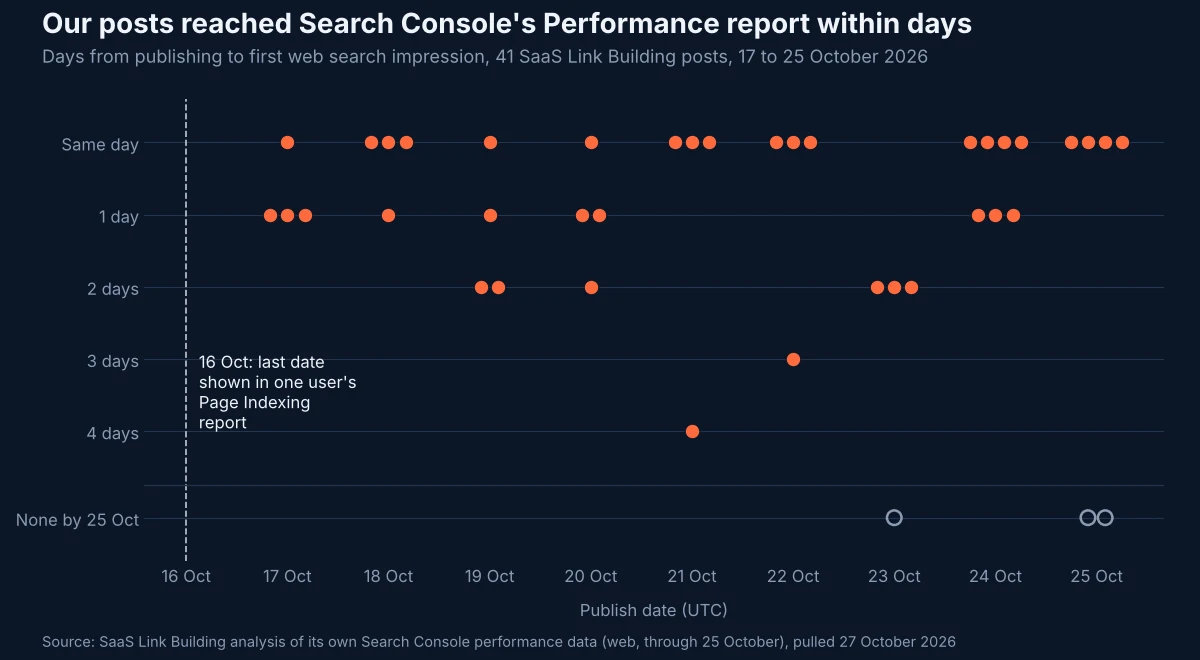
Thirty of the 41 posts (73%) recorded an impression on the day they were published or the next day, and 38 had impressions by 25 October. The three with none were published on 23 and 25 October, so they had little time to appear before the data cut-off. URL Inspection, meanwhile, showed that Google had crawled every indexed post in the sample on or after 17 October. Crawling and indexing carried on as normal; only the summary graph, for the user who reported it, stood still.
This is one small news site, and its numbers do not show what any other property's report says. It does show that the tools Mueller pointed to were current while the Page Indexing report was reportedly not. For background on how long Google takes to process new and changed pages, see our write-up of the crawling and indexing timelines Gary Illyes shared in Barcelona.
What to do
- Check key URLs, not the graph. Use URL Inspection for new or important pages. The URL Inspection API allows 2,000 inspections a day and 600 a minute per site, enough to check every new page on most sites daily.
- Watch impressions by page. Filter the Performance report, or query Search Analytics with the page and date dimensions, for URLs published since the report's last date. A new page with impressions is indexed; in our pull the data ran two days behind.
- Ignore the Sitemaps "indexed" count. Google documents it as deprecated. Use the submitted count and last-read date only.
- Rule out a real incident. Check the Search Status Dashboard and the anomalies page before treating a flat graph as a problem, and annotate the stall in any reporting so the jump when it refreshes is not read as a change.
- Small sites can skip it. Google's help page says sites under 500 pages probably do not need the report; a
site:search on key URLs is the simpler test. - Keep your own history. If your team relies on the Page Indexing trend, take a dated screenshot or export each week; the report keeps no record of when it was stale.
Methodology
On 27 October 2026 we inspected the 55 posts SaaS Link Building published between 15 and 26 October through the Search Console URL Inspection API, recording coverage state, verdict and last crawl time. We then pulled web search Performance data for saaslinkbuilding.com by page and date for 13 to 27 October through the Search Analytics API (the latest available date was 25 October) and, for the 41 posts published from 17 to 25 October, counted the calendar days from publication (UTC) to the first date with at least one impression. Search Console dates follow Pacific time, so a "same day" figure can be off by one day for posts published late in the UTC day. We also read the property's sitemap record through the Sitemaps API and checked Google's Search Status Dashboard and Data anomalies page. We did not have access to the poster's property and could not read our own Page Indexing report through the API.
Conclusion
The Page Indexing report has stalled for weeks at a time before, and Google's answer this time is to look elsewhere: indexing moves slowly, and the faster Performance data will show any real change first. Our own check is consistent with that. Pages published after the report's reported cut-off were crawled, indexed and earning impressions within days, and the tools that showed it, URL Inspection and Search Analytics, were current throughout.
The gap is in communication rather than data. Google lists no Page Indexing issues on its anomalies page and has not said when the report will refresh, so SEO teams are left to work out for themselves whether a flat line is a delay or a problem. Until that changes, per-URL inspection and page-level impressions are the more reliable signals.
Questions and answers
Is the Search Console Page Indexing report delayed?
A user in Reddit's r/TechSEO community reported that their Page Indexing report had not updated since 16 October, and the post was covered by SEO news sites on 27 October 2026. Google has not announced a delay, and its Data anomalies page lists no recent Page Indexing issues.
What did John Mueller say about the Page Indexing report delay?
Mueller said indexing does not change quickly, that real changes appear first in the Performance reports, and that Google does not comment on data freshness for every report but prioritises faster updates where they are useful.
How can I check if a new page is indexed while the report is stale?
Use the URL Inspection tool or API for the page, or look for impressions for that URL in the Performance report. The URL Inspection API allows 2,000 inspections a day and 600 a minute per site, according to Google's Search Console API usage limits.
Why does the Sitemaps API show 0 indexed URLs?
Google's Sitemaps API documentation marks the contents indexed field as deprecated. In our check it returned 0 for a sitemap of 68 URLs while URL Inspection showed nearly all recent posts indexed, so it should not be used as an indexing signal.
More releases
-
Industry news
Trackers Spike Again on 27 October, but Our 14-Keyword SERP Check Finds No Extra Churn
Rank trackers showed a second, larger Google volatility spike on 27 October 2026, but Google has logged no ranking update since 8 October. Our comparison of stored snapshots for 14 US keywords found 65% of top URLs survived across 24 October, against 58.5% in the previous window, with the biggest swings tied to location errors or one-off snapshots.
-
Studies
Is There a Google Sandbox? A Leaked hostAge Field and 38 SERPs Point to a Narrow Yes
Google's leaked documentation describes a hostAge field used to sandbox fresh spam at serving time, despite years of denials. But in our check of 38 live searches, domains under two years old held 13% of top-10 results for new AI topics, including two first places, and none for established topics.
-
Studies
ChatGPT Named Brands in 77 of 82 Searches for Unbranded Prompts, Our 20-Prompt Test Finds
When ChatGPT searched the web to answer 20 unbranded "best tool" questions, 77 of its 82 background queries already named brands, and 74% of the products in its answers had appeared in those queries. Our 27 October test supports Graphite's finding that what a model already knows shapes what it searches for.
Tell us the site and the goals.
Rankings in Google and visibility in AI answers, from one monthly plan. One call is enough to say which one fits. Email works just as well.