Trackers Spike Again on 27 October, but Our 14-Keyword SERP Check Finds No Extra Churn
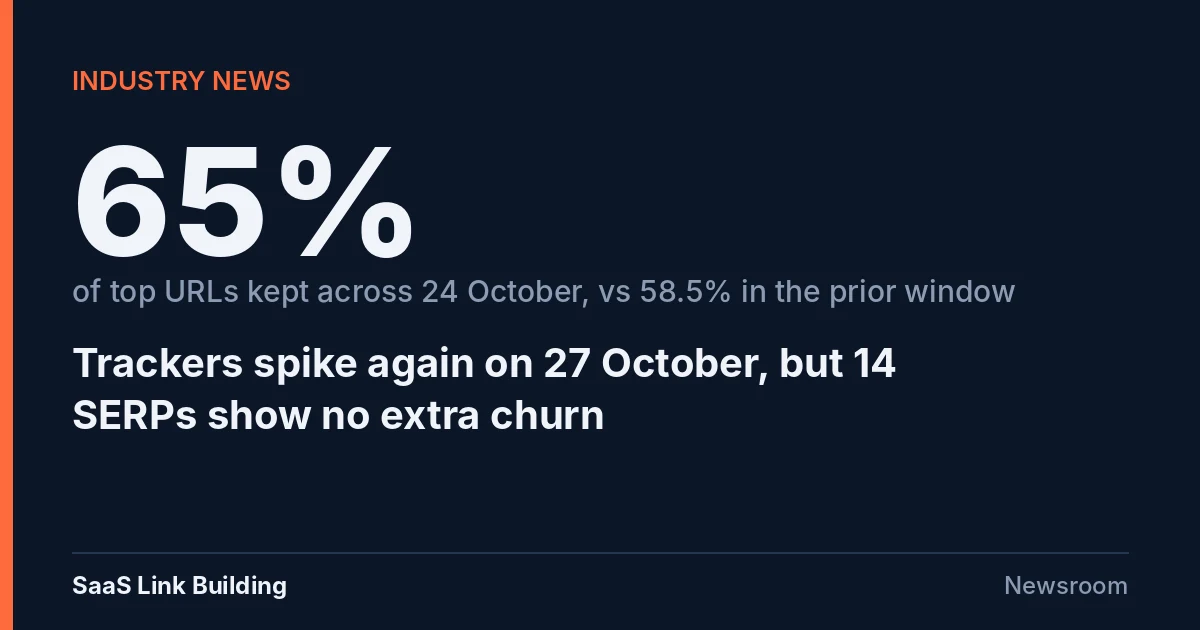
Rank trackers showed a second, larger Google volatility spike on 27 October 2026, but Google has logged no ranking update since 8 October. Our comparison of stored snapshots for 14 US keywords found 65% of top URLs survived across 24 October, against 58.5% in the previous window, with the biggest swings tied to location errors or one-off snapshots.
 Vibhu Dhariwal
Cofounder & CTO, Digital Gratified
- Published
- Section
- Industry news
- Reading time
- 8 minutes
Ras Al Khaimah, United Arab Emirates, .
Rank-tracking tools registered a second, larger burst of Google volatility on Tuesday, 27 October 2026, three days after the unconfirmed movement of Saturday, 24 October. Google has still not logged a ranking update: its Search Status Dashboard lists nothing after the September 2026 spam update, which finished on 8 October. To test whether the results themselves churned more than usual, we compared stored Google snapshots for 14 US keywords before and after 24 October. On the pooled count, they churned slightly less.
This follows our 25 October report on the 24 October spike and the core update gap, which relied on Google's own dashboard and did not compute any SERP data of our own. The new elements here are the 27 October spike and a like-for-like check of what changed in the results pages.
What changed since 24 October
- A bigger spike on 27 October. Search Engine Roundtable's Barry Schwartz reported on the morning of 27 October (US Eastern time) that volatility and chatter had risen above the Saturday level, starting roughly 12 hours before his post. His roundup embedded charts from 15 tracking tools, without numeric readings.
- Forum reports are mixed. Comments quoted in that roundup describe keyword gains with no matching traffic gain, weak Google News and Discover traffic, and a sharp fall in conversions on Monday. One commenter said the rollout appeared to have started.
- Still nothing from Google. On 27 October the dashboard's public incidents feed still showed the September 2026 spam update as its latest entry. That is 19 days without a logged ranking incident, and 159 days since the May 2026 core update began on 21 May.
- A Discover glitch, confirmed as a bug. Separately, Search Engine Roundtable reported that Google's Rajan Patel said on 27 October that a Discover experiment which disabled taps on the sources button of AI summary cards was a bug, and that the experiment had been turned off. That is a Discover interface issue, not a ranking change, but it falls in the same week as the Discover traffic complaints.
Our check: did results churn more after 24 October?
Volatility scores summarise how much tracked positions move, and they can be skewed by a handful of keywords. So we looked at the result sets directly. For 14 high-volume US keywords across finance, health, shopping and software, we pulled three stored Google snapshots from a commercial SEO data provider: the latest available (taken between 24 and 27 October), the last one taken before 24 October, and the one before that as a control. For each pair we counted how many of the earlier snapshot's top organic URLs were still present in the later one.
- Pooled across all 14 keywords, 65.0% of the URLs (78 of 120) in the last pre-24 October snapshots were still there afterwards. In the control window the figure was 58.5% (69 of 118). By this measure, results changed slightly less across 24 October, not more.
- Keyword by keyword, 7 of the 14 kept more of their URLs in the window spanning 24 October, 4 kept fewer and 3 were unchanged.
- Nine keywords never flipped completely in either window. For those nine, retention was identical: 58 of 79 URLs (73.4%) carried over in both windows.
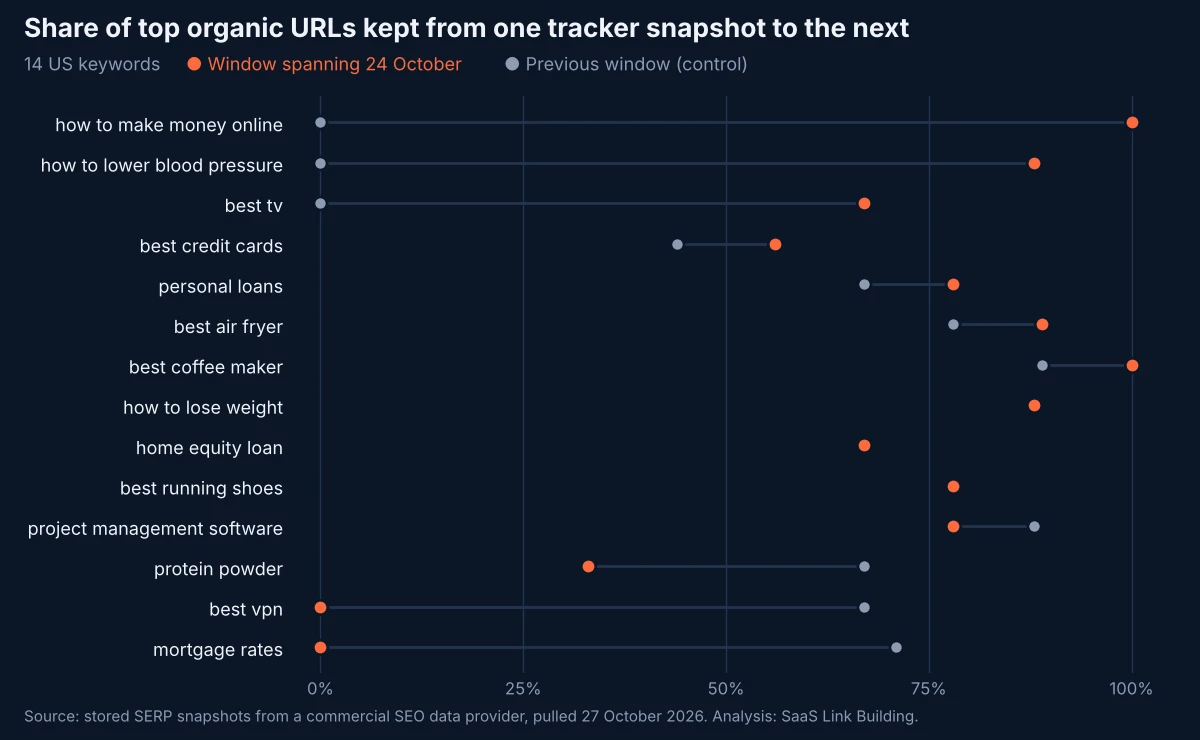
One caveat cuts the other way. The control windows were longer (a median of 9.4 days between snapshots, against 7.0 days for the window spanning 24 October), and longer gaps normally allow more change. A shorter window with similar churn is not proof of calm. Even so, the sample shows no broad reshuffle.
Where the big swings came from
Five of the 14 keywords lost every URL between one snapshot and the next. In each case, the odd snapshot looks more like a data or localisation problem than a ranking change, because the result sets either drifted to the wrong place or reverted at the next check.
| Keyword | Snapshot with full turnover | What it contained | Next snapshot |
|---|---|---|---|
| mortgage rates | 25 October | State pages (Mississippi, New York, Connecticut) and a New York state agency page, replacing national rate tables | None yet |
| best vpn | 27 October | UK-focused pages, including a "best VPN UK" guide and a UK newspaper, in a US result | None yet |
| how to lower blood pressure | 10 October | Mostly videos and natural-remedy articles | 20 October set shared no URLs with it |
| best tv | 7 October | Forum threads and a Spanish-locale Facebook page | 16 October set shared no URLs with it |
| how to make money online | 14 October | An app store listing, a forum hub page and a different set of guides | 22 October set shared no URLs with it |
Three of the five flips sit in the control window and look like one-off bad snapshots: the following check returned to a consistent set. The two in the later window (mortgage rates and best vpn) have no follow-up snapshot yet, so we cannot tell whether they will revert. Both show results that do not fit a national US search, which points to location handling rather than a ranking update.
That fits a month in which tracker data has been unusually fragile. We have covered Google serving altered results to rank trackers and a second fault in which Google ignored query words on a share of tracked SERPs. A volatility index that averages across thousands of keywords can jump when a minority of them return the wrong page, even if most searchers see the same results as last week.
What Google says about unannounced changes
Google's core updates guide says it continually updates its algorithms, including smaller core updates that are not announced because they "aren't widely noticeable." An unannounced adjustment in late October is therefore possible. But no Google page, Search Central post or named Googler has said one happened, and the dashboard help page describes the dashboard as the place where Google posts ranking updates relevant to site owners. Our 20 October report covers the earlier episodes this month.
What this means for SEO teams
- Audit the outliers before the average. If your tracker shows a keyword losing its whole top 10 overnight, open the stored result and check its location and language. A US query returning UK or single-state pages is a tracking problem, not a penalty.
- Measure set retention yourself. For your 20 most valuable queries, count how many of last week's top 10 URLs are still present this week. It takes minutes in a spreadsheet and is harder to distort than a single volatility score.
- Wait for Search Console. Performance data runs two to three days behind, so 27 October will not be complete until the end of the week. Compare it with the same weekday a week and two weeks earlier, and split web, Discover and News before drawing conclusions.
- Keep the label honest. In reports, describe 24 to 27 October as unconfirmed volatility. If Google later posts an incident, re-label it with the dates it gives.
Methodology
On 27 October 2026 we requested stored Google US SERP snapshots for 14 keywords from a commercial SEO data provider's API. For each keyword we took the latest snapshot (dated 24 to 27 October), the most recent snapshot dated before 00:00 UTC on 24 October (dated 16 to 22 October), and the snapshot immediately before that (dated 7 to 14 October). Each request returned the organic results within the first 20 tracked positions, which included SERP features; this gave 7 to 16 organic URLs per snapshot. We matched URLs exactly, ignoring the scheme and leading "www." For each pair, retention is the share of the earlier snapshot's URLs present in the later one; pooled figures sum matches and URLs across keywords. We queried 25 keywords and excluded the 11 whose latest snapshot predated 24 October, leaving 14. The sample is small and not random, so the results describe these 14 keywords rather than Google as a whole. We also downloaded the Search Status Dashboard incidents feed on 27 October to confirm that no new ranking incident had been posted.
Conclusion
Trackers jumped again on 27 October, but Google has logged nothing since 8 October, and our snapshot comparison for 14 keywords found no extra churn across 24 October. The largest swings in the sample came from result sets that drifted to the wrong location or reverted at the next check.
That does not rule out a quiet adjustment. It does mean the safest reading for now is unconfirmed volatility amplified by tracking noise. Check outlier keywords by hand, wait for Search Console, and watch the dashboard.
Questions and answers
Did Google confirm a ranking update on 27 October 2026?
No. On 27 October 2026 Google's Search Status Dashboard incidents feed still listed the September 2026 spam update, which ended on 8 October, as its latest ranking entry, and no Google page or named Googler had confirmed an October update.
Did Google search results change more than usual after 24 October?
Not in our sample. Across 14 US keywords, 65.0% of top organic URLs (78 of 120) in the last snapshot before 24 October were still present afterwards, against 58.5% (69 of 118) in the previous window.
Why did some keywords lose their whole top 10 in tracker data?
In our sample, the snapshots with full turnover contained results that did not fit a national US search, such as state-level mortgage pages or UK VPN guides, or they were one-off sets that the next snapshot did not repeat. That points to tracking or location issues rather than ranking changes.
Does Google make core updates without announcing them?
Yes. Google's core updates guide says it also makes smaller core updates that are not announced because they are not widely noticeable.
More releases
-
Explainers
Page Indexing Report Stuck Since 16 October? Mueller Says Watch Performance Data First
A Search Console user says the Page Indexing report has not updated since 16 October, and Google's John Mueller replied that indexing changes show up in Performance reports first. Our check of our own property found 54 of 55 recent posts indexed via URL Inspection and most new posts earning impressions within a day.
-
Studies
Is There a Google Sandbox? A Leaked hostAge Field and 38 SERPs Point to a Narrow Yes
Google's leaked documentation describes a hostAge field used to sandbox fresh spam at serving time, despite years of denials. But in our check of 38 live searches, domains under two years old held 13% of top-10 results for new AI topics, including two first places, and none for established topics.
-
Studies
ChatGPT Named Brands in 77 of 82 Searches for Unbranded Prompts, Our 20-Prompt Test Finds
When ChatGPT searched the web to answer 20 unbranded "best tool" questions, 77 of its 82 background queries already named brands, and 74% of the products in its answers had appeared in those queries. Our 27 October test supports Graphite's finding that what a model already knows shapes what it searches for.
Tell us the site and the goals.
Rankings in Google and visibility in AI answers, from one monthly plan. One call is enough to say which one fits. Email works just as well.