Does Word Count Help You Rank? Our 40-SERP Test Finds Length Tracks Intent, Not Position
Google says content length alone does not matter for ranking. Our test of 237 pages ranking for 40 Google searches agrees: word count and position were barely related (rho -0.125), the direction flipped from keyword to keyword, and query type, not position, set how long top pages were.
 Vibhu Dhariwal
Cofounder & CTO, Digital Gratified
- Published
- Section
- Studies
- Reading time
- 13 minutes
Ras Al Khaimah, United Arab Emirates, .
Few SEO beliefs have proved as durable as the idea that longer pages rank better. Content briefs still arrive with word-count targets, content-scoring tools still flag "too short" drafts, and "aim for 2,000 words" remains common advice. Google, for its part, has said in writing that it has no preferred word count. To test who is right, the SaaS Link Building newsroom pulled 40 live Google results pages on 28 October 2026, fetched every page we could read, counted the words in each one's main content and compared length with position.
The short version: across 237 measurable pages, length and ranking position were barely related, and the direction of the relationship flipped from one keyword to the next. What did predict length was the type of query. The rest of this piece sets out the theory, the evidence on both sides and our verdict.
Key findings
- A weak, inconsistent link. Pooling all 237 pages, the Spearman correlation between word count and position was -0.125 (p = 0.055), too weak to clear the usual 0.05 significance bar.
- The direction flips by keyword. Of 28 keywords with at least five measurable pages, 15 leaned towards longer pages ranking higher, 12 leaned the other way and one was flat. Only 7 showed a strong pro-length pattern (rho of -0.5 or lower); 2 showed a strong pattern in favour of shorter pages.
- The longest page rarely wins. The highest-ranked page we could measure was also the longest on its results page for just 7 of 28 keywords. For 12 of the 28, it sat in the shorter half.
- Intent sets the length. The median quick-fact page ran to 682 words; the median page ranking for an SEO topic ran to 1,691. For the 28 keywords with at least five measured pages, the longest ranking page was typically about 7 times the length of the shortest.
- A fifth of page one is not an article at all. 81 of the 391 unique ranking URLs (20.7%) were YouTube videos, Facebook posts, or Reddit and Quora threads, formats for which a word count says little.
The theory: more words, higher rankings
The belief has a plausible origin. Correlation studies published over the past decade have reported that the average first-page result is long. One widely cited industry study, first published in January 2016 and based on 11.8 million Google results, put the average word count of a top 10 result at 1,447 words. Numbers like that are easy to turn into targets, and content tools that score drafts against the length of current top-ranking pages give writers a figure to aim at.
The intuition behind it is also reasonable: a longer page can cover more subtopics, answer more follow-up questions and match more of the different ways people phrase a search. Many practitioners therefore treat length as a proxy for thoroughness, and thoroughness as something Google rewards.
The question this investigation asks is narrower: does length itself help a page rank, or is it simply a side effect of pages that suit their query?
What Google says on the record
Google has addressed the question directly in two of its own documents. Its SEO Starter Guide states that "the length of the content alone doesn't matter for ranking purposes", adds that there is no magic word-count target, minimum or maximum, and jokes that a page probably wants at least one word.
The guide to creating helpful, reliable, people-first content goes further. In its list of warning signs for "search engine-first" content, it asks whether a writer is aiming for a particular word count because they have heard Google prefers one, and answers in a parenthesis that it does not. We covered the latest changes to that page in our report on the four rater tests Google added to its helpful content guide.
Google's Search Quality Rater Guidelines, which tell human raters how to judge results (raters do not set rankings), make the same point from the quality side. They say high and low quality main content comes in all lengths. One of the guidelines' own examples of low-quality content is a page titled "How many centimeters are in a meter?" that has excessive filler and buries a very small amount of helpful information.
Evidence for the theory
The case for length is not empty, and it deserves a fair hearing.
1. Top results were longer overall
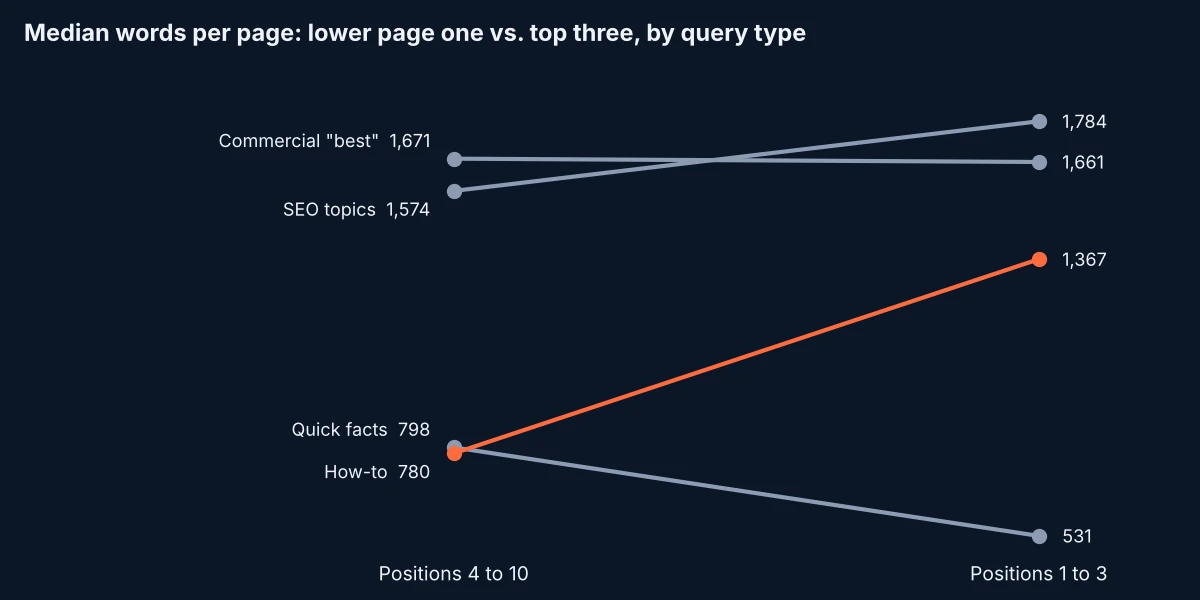
In our pooled data, pages in positions 1 to 3 had a median of 1,601 words against 1,127 for positions 4 to 10. Taken alone, that looks like support for the theory. As the next sections show, the gap shrinks or reverses once results are split by query type, because the keyword mix and the number of pages we could measure at each position both shape the pooled figure.
2. How-to and commercial results leaned long
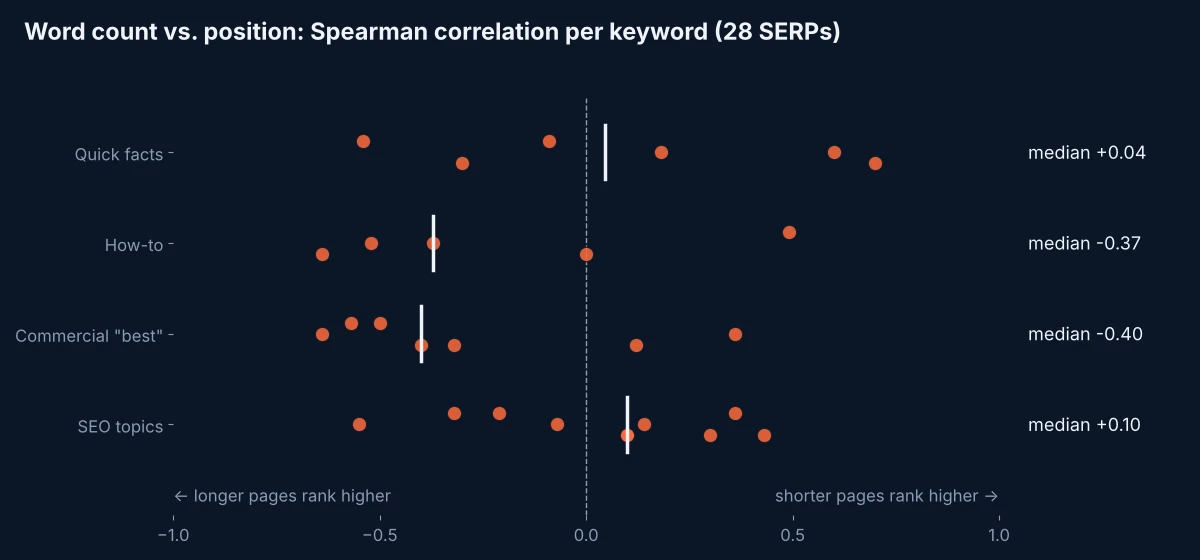
Two of our four query groups did show a pro-length pattern. For how-to searches, the median correlation between length and position was -0.37, and top-three pages had a median of 1,367 words against 780 lower on page one. For commercial "best" queries the median correlation was -0.40. On "how to improve credit score", "how to negotiate salary" and "best vpn for streaming", the top measurable result was also the longest page on the results page.
3. Longer pages can match more searches
Google itself describes an indirect route. The same Starter Guide passage that dismisses length notes that writers who vary their wording naturally have "more chances to show up in Search simply because you are using more keywords". A page that covers a topic in more depth tends to use more of the words people search with, which can earn it more queries without length being a ranking signal in its own right.
4. The leaked documentation measures short content
The internal Google API documentation that leaked in 2024, which we examined in our investigation into whether Google uses clicks to rank pages, includes fields that relate to how much text a page carries. In the PerDocData module, an "OriginalContentScore" field is described as present only for pages with little content, and a pair of "bodyWordsToTokensRatio" fields record the ratio of body words to tokens for the start and the whole of a document. This is speculation on our part, but the description suggests Google treats pages with little content as a distinct case worth scoring separately. Nothing in the documentation says how either field is used in ranking, and Google warned at the time against assumptions based on "out-of-context, outdated, or incomplete information", according to Rappler.
Evidence against the theory
1. Our data shows no consistent relationship
The pooled correlation of -0.125 means word count explains only a sliver of the variation in position, and the result did not reach statistical significance. Per keyword, the picture is close to a coin toss: 15 keywords leaned towards longer pages, 12 towards shorter ones. The median per-keyword correlation was -0.08.
2. For quick answers, the top results were shorter
For quick-fact searches the pattern reversed. Pages in the top three had a median of 531 words, against 798 lower on page one. The top-ranked page for "what time zone is arizona", a state library reference page, ran to 101 words. "What time zone is arizona" and "celsius to fahrenheit formula" both had correlations of +0.6 or higher, meaning shorter pages ranked higher. This fits the rater guidelines' warning about padded answers to simple questions.
3. SEO and commercial top results were not meaningfully longer
For commercial queries, top-three pages had a median of 1,661 words against 1,671 lower down, essentially no difference despite the negative median correlation. For SEO topics, the gap was 1,784 against 1,574, and the median correlation was +0.10, slightly favouring shorter pages. On "what is technical seo" the top result was a 201-word tool homepage, while a 7,607-word guide sat at position 5. On "best project management software" the top result was a 333-word review page; the longest page, at 6,128 words, ranked ninth.
4. The widely cited study did not find a ranking link either
The 2016 study behind the 1,447-word figure is often quoted as proof that length helps. Its own text says word count was evenly distributed across the top 10 and that it found no direct relationship between word count and rankings. The average became the headline; the finding about position did not. The same study did report that pages it graded as more comprehensive correlated with higher rankings, which fits the idea that coverage, rather than raw length, is what matters.
5. Format beats length on a fifth of page one
81 of the 391 unique URLs we collected (20.7%) were videos, social posts or forum threads. How-to searches had the most (25 of 96), followed by quick facts (23 of 99), commercial queries (18 of 99) and SEO topics (15 of 97). A page that ranks because it is a video demonstration or a forum discussion is not competing on word count at all.
What length actually tracked: query type
The clearest pattern in the data was not about position but about intent. The table shows how far median length moved between query groups, compared with how little it moved between the top three and the rest of page one.
| Query group | Measurable pages | Median words (all positions) | Median words, positions 1 to 3 | Median words, positions 4 to 10 | Median per-keyword correlation |
|---|---|---|---|---|---|
| Quick facts (10 keywords) | 51 | 682 | 531 | 798 | +0.04 |
| How-to (10 keywords) | 49 | 842 | 1,367 | 780 | -0.37 |
| Commercial "best" (10 keywords) | 60 | 1,666 | 1,661 | 1,671 | -0.40 |
| SEO topics (10 keywords) | 77 | 1,691 | 1,784 | 1,574 | +0.10 |
| All 40 keywords | 237 | 1,269 | 1,601 | 1,127 | -0.08 |
Source: SaaS Link Building analysis of 40 Google US results pages collected 28 October 2026. Correlations are Spearman's rho between word count and position for the 28 keywords with at least five measurable pages; negative values mean longer pages ranked higher.
Quick-fact pages and SEO explainers differ in median length by a factor of about 2.5, a much larger gap than anything we saw between positions. For the 28 keywords with at least five measured pages, the longest page was typically about 7 times the length of the shortest, yet both ranked on page one. That spread is hard to square with a ranking system that rewards length directly, and easy to square with one that rewards pages for answering the query in whatever form suits it.
Verdict: debunked as a direct ranking factor
On the specific claim that more words help a page rank, the evidence points one way. Google has said on the record, in two documents, that length alone does not matter and that it has no preferred word count. Our own data found no consistent relationship between length and position: the pooled correlation was weak and not significant, the direction flipped from keyword to keyword, and the top-ranked page was the longest for only 7 of the 28 keywords we could analyse in full. The industry study most often cited for the opposite view reported no direct relationship itself.
Two qualifications keep this from being the whole story. First, length can help indirectly: a page that covers more of a topic can match more searches, as Google's own guide acknowledges, and how-to and commercial results in our sample did lean long. Second, the leaked documentation suggests Google pays specific attention to pages with little content, so very thin pages may be judged differently. Neither point supports writing to a word count. Both support writing until the query is answered and then stopping.
A correlation study cannot prove that a factor plays no part, and ours is small. But a ranking factor strong enough to be worth targeting should leave a consistent mark across 40 results pages, and word count did not.
What this means for SEO teams
- Drop fixed word-count targets from briefs. Replace them with the questions the page must answer and the format the results page already rewards (a calculator, a short definition, a step-by-step guide, a comparison table).
- Check the results page for intent, not averages. Our quick-fact group shows that matching the average length of ranking pages can mean adding hundreds of words that the top result does without.
- Treat thin pages as a real risk. Pages with almost no original text may fall into a separate category in Google's systems. Consolidate or expand pages that exist only to target a keyword variation.
- Cut filler before adding words. Google's rater guidelines name "excessive filler" on a simple-answer page as a sign of low quality. If the answer is one line, put it first.
- Use depth for coverage, not count. Where a topic needs length, the benefit comes from covering subtopics and related questions people actually search for, which is also how pages earn more queries.
Our earlier test of whether Google rewards fresh dates reached a similar conclusion for a different signal: the answer depended on the query, not on a universal rule.
Methodology
On 28 October 2026 we collected Google US desktop organic results (English, United States location) for 40 keywords through a SERP data API, keeping the first 10 organic results for each and excluding ads and other SERP features. Keywords were split into four groups of 10: quick-fact questions (for example "how many teaspoons in a tablespoon"), how-to queries ("how to fix a leaky faucet"), commercial "best" queries ("best robot vacuum for pet hair") and SEO topics ("what is crawl budget"). Where a URL appeared twice in a keyword's top 10, we kept its first appearance and renumbered positions, leaving 391 unique ranking URLs.
We fetched each URL once with a standard browser user agent and extracted the main content (excluding navigation, footers and comments, and including tables) with the open-source trafilatura library, then counted words. Videos, social posts and PDFs (58 URLs) were not counted. 66 URLs refused or failed an automated request (53 of them returned HTTP 403), and a further 30 returned fewer than 100 words of extractable text, which can mean the text is loaded by script rather than that the page is short; both groups were excluded, and every Reddit and Quora thread fell into one of them. That left 237 measured pages covering all 40 keywords. Correlations are Spearman's rank correlation between word count and position, computed for the pooled set and for each of the 28 keywords with at least five measured pages. Because sites that block automated requests were excluded, large retail, forum and some publisher pages are under-represented. Results reflect one day, one location and one device type.
Conclusion
Word count is a poor guide to rankings. In our 40-SERP test it moved with the type of query far more than with position, and the pages at the top ranged from a 101-word reference page to guides of several thousand words. Google's documentation and the industry's own best-known study both point the same way. Length can help when a topic needs it, by covering more of what searchers ask, but the target is the answer, not the count.
What do you think?
Have you cut or expanded a page's length without changing anything else, and tracked what happened to its rankings in Search Console? Tell us what changed, and we will include reader data in a follow-up.
Questions and answers
Is word count a Google ranking factor?
Google says no. Its SEO Starter Guide states that the length of the content alone doesn't matter for ranking purposes, and its helpful content guide says Google has no preferred word count. In our test of 237 pages across 40 searches, length and position were only weakly related, and the direction changed from keyword to keyword.
Do longer pages rank higher in Google?
Not consistently. Across 28 keywords with at least five measured pages, 15 leaned towards longer pages ranking higher and 12 leaned towards shorter ones. The top measured page was the longest on its results page for only 7 of the 28.
How long should a page be to rank?
Long enough to answer the query. In our data the median quick-fact page had 682 words and the median page ranking for an SEO topic had 1,691. For quick-fact searches, top-three pages were shorter (median 531 words) than pages lower on page one (798).
Does Google penalise thin content?
Google's 2024 leaked API documentation describes an OriginalContentScore field that only pages with little content have, which suggests short pages are scored as a separate case. The documentation does not say how the field is used in ranking, and Google cautioned against assumptions based on out-of-context, outdated or incomplete information.
More releases
-
Industry news
Semrush Confirms Poisoned Google SERPs; 12 of Our 24 Repeat Fetches Failed to Agree
Semrush said on 27 October that Google is serving some automated searches results that differ from what users see, joining AccuRanker and Nozzle. Our test of eight keywords, fetched three times within five minutes, found 12 of 24 fetches shared fewer than half their top-10 domains with the other two.
-
Industry news
ChatGPT Info-Seeking Hit a 20.7% High, Rising in 33 of the 35 Heaviest-Use Countries
OpenAI's Signals v3.0 data, released on 26 October, shows information requests reached 20.7% of consumer ChatGPT messages in August 2026, up from 16.7% in July 2024. Our analysis of the files finds the rise concentrated in heavy-use countries and among users aged 25 to 64.
-
Studies
0 of 799 Top-Site Pages Use Nosnippet, the Robots Rule That Also Limits AI Overviews
A SaaS Link Building crawl of 525 homepages and 274 inner pages from the world's top 1,000 domains found no page using nosnippet or a max-snippet limit, the page-level rules Google says also keep content out of AI Overviews and AI Mode. Only 17% of homepages asked for large image previews.
Tell us the site and the goals.
Rankings in Google and visibility in AI answers, from one monthly plan. One call is enough to say which one fits. Email works just as well.