Semrush Confirms Poisoned Google SERPs; 12 of Our 24 Repeat Fetches Failed to Agree
Semrush said on 27 October that Google is serving some automated searches results that differ from what users see, joining AccuRanker and Nozzle. Our test of eight keywords, fetched three times within five minutes, found 12 of 24 fetches shared fewer than half their top-10 domains with the other two.
 Vibhu Dhariwal
Cofounder & CTO, Digital Gratified
- Published
- Section
- Industry news
- Reading time
- 8 minutes
Ras Al Khaimah, United Arab Emirates, .
Semrush has become the latest SEO data company to say publicly that Google is returning altered results to some automated searches. In an update on its blog dated 27 October 2026, the company said some results pages look normal but differ from what a typical user would see, called it an industry-wide problem rather than one specific to Semrush, and said it now filters and re-collects suspect data. It follows research from AccuRanker, first published on 19 October and updated through 26 October, and two reports from Nozzle that we covered on 13 October and on 25 October. Google has not commented.
To see what this looks like from the outside, we fetched the same eight Google searches three times within five minutes on 28 October, twice through one SERP data API and once through another. Half of the 24 fetches shared fewer than half of their top-10 domains with the other two fetches of the same keyword.
What changed
- Semrush is now on record. Its update describes two forms of the problem: a page where the whole first page is clearly wrong for the query, and a page that looks right at first but carries loosely matched results lower down. Its example was a Brazilian search for a baby stroller model that returned a dental supply page, because both share the Portuguese word "carrinho".
- No size estimate from Semrush. The update gives no share of keywords affected. Semrush says it drops clearly invalid results, has changed some data sources and re-collects doubtful results, and asks customers to compare unexpected swings with their Search Console data.
- AccuRanker has put numbers on Google's recent steps. It reports that detection tightened on 15 October (mostly automated Android sessions), on 20 October (hardest on desktop) and again on 23 October across both devices. On 24 October, 40% of its first desktop fetches came back poisoned before its checks, and 3.23% of stored desktop keyword-days still failed its after-the-fact test. By 25 October that fell to 0.6% on desktop and 1.0% on mobile.
- The first fetch is the weak point. AccuRanker says Google still poisons 4% to 6.5% of its first fetches, against 1.6% to 3.3% before 23 October, and that a second fetch with another session came back normal about three times in four. More than nine in ten poisoned runs for a keyword lasted one day.
Timeline: what the trackers saw and what Google logged
We set the vendors' published dates against Google's Search Status Dashboard. The dashboard lists no ranking update since the September 2026 spam update finished on 8 October.
| Date (2026) | Event | Source |
|---|---|---|
| 24 September | Google's September 2026 spam update starts (16:15 UTC). AccuRanker's data first shows unusual results late the same day. | Google dashboard; AccuRanker |
| 25 September | 30.2% of desktop and 25.7% of mobile page-1 results fail AccuRanker's check, its worst day. | AccuRanker |
| 8 October | Spam update rollout complete. | Google dashboard |
| 15 and 20 October | Google tightens detection, first on automated Android sessions, then hardest on desktop. | AccuRanker |
| 22 October | Nozzle publishes research on a second fault: pages that answer only part of the query. | Nozzle; our 25 October report |
| 23 to 24 October | Larger step on both devices. 40% of AccuRanker's first desktop fetches poisoned on 24 October, the same day trackers reported a volatility spike. | AccuRanker; our volatility report |
| 27 October | Semrush publishes its update. Trackers spike again with no Google update logged. | Semrush; our 27 October check |
Speculation, not confirmed: some of the swings tools reported on 24 October, the poisoning peak, may reflect collection problems rather than ranking changes. Our 14-keyword check on 27 October found no extra churn in live results.
Our test: three fetches, eight keywords, five minutes
We requested Google's United States desktop results for eight common searches three times: fetches 1 and 2 about a minute apart from one SERP data API, and fetch 3 from a second API. For each fetch we asked how many of its top-10 organic domains appeared in either of the other two. AccuRanker treats a page as poisoned when its top 10 keeps fewer than half of the sites from neighbouring days, so we used the same 50% line, applied across fetches minutes apart rather than days.
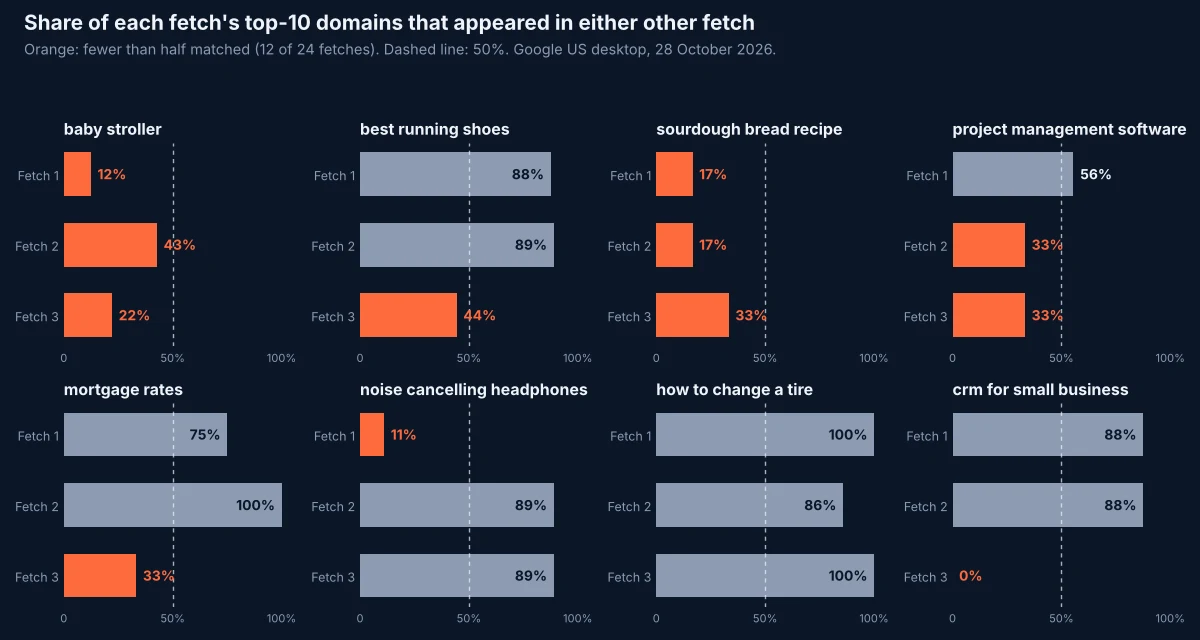
Pairwise, the picture by keyword was mixed:
| Keyword | Shared, fetch 1 and 2 | Shared, fetch 1 and 3 | Shared, fetch 2 and 3 | In all three | What stood out |
|---|---|---|---|---|---|
| how to change a tire | 6 | 7 | 6 | 6 | Stable across all three |
| best running shoes | 7 | 3 | 4 | 3 | Same-API fetches near identical |
| crm for small business | 7 | 0 | 0 | 0 | Same-API fetches agreed; the second API shared none of their domains |
| mortgage rates | 3 | 2 | 3 | 2 | Fetches 1 and 2 led with state rate pages for a national query |
| noise cancelling headphones | 1 | 1 | 8 | 1 | Fetch 1 the odd one out |
| project management software | 3 | 3 | 1 | 1 | Fetch 2 leaned to "free" tool pages |
| baby stroller | 1 | 0 | 2 | 0 | All three disagreed |
| sourdough bread recipe | 0 | 1 | 1 | 0 | Three different sets of recipe sites |
- Only one keyword was stable everywhere. For "how to change a tire", every fetch kept at least 86% of its domains in the others.
- Agreement did not prove accuracy. For "crm for small business", the two fetches from one API shared seven domains, so a check that compares a fetch with its own history would have passed them. The second API returned a different set entirely. AccuRanker says its history check cannot help where a keyword lacks enough history, and our case suggests a repeated fetch from the same source can repeat the same answer.
- No off-topic swaps. Every result we saw was about the query's subject. The disagreement was over which sites ranked, not which topic, which is the harder form to catch by eye.
We cannot say which fetch matched what a person in the United States saw: APIs can query Google from different places, and Google varies results for ordinary users too. The test shows something narrower: on 28 October one automated snapshot of page 1 was not a reliable record of where a site ranked.
Why Google might be doing it
Google has not explained it. Its spam policies class scraping results for rank-checking without express permission as machine-generated traffic that violates the policies and the Terms of Service. Semrush cites community reporting that the aim is to limit large-scale data collection for AI systems; that remains unconfirmed.
What this means for SEO teams
- Treat one-day drops as unverified. AccuRanker's data says most poisoned runs last a day. Wait for a second day, or a second fetch, before reporting a ranking loss.
- Use Search Console as the reference. Semrush now gives the same advice. If impressions and average position hold while a tracker shows a crash, the tracker is the likelier fault.
- Ask vendors what they check. Does the tool refetch suspect pages with a fresh session? Does it compare against history, and what happens on keywords with no history? Has it reprocessed data from 24 September onward?
- Repeat single-pull research. SERP overlap studies and AI Overview counts built from one fetch per keyword since late September may carry noise.
- Annotate the period. Mark 24 September onward in dashboards, and 24 October as a bad day for desktop data.
Methodology
On 28 October 2026, between 05:20 and 05:25 UTC, we requested Google organic results for eight keywords (United States, English, desktop, top 10 organic positions). Fetches 1 and 2 came from the same commercial SERP data API, roughly one minute apart; fetch 3 came from a second commercial SERP API using a country-level United States location. We kept organic results only, so some fetches had six to nine organic positions after SERP features. Each URL was reduced to its registrable domain (www dropped; subdomains such as cooking.nytimes.com counted as nytimes.com and us.amazon.com as amazon.com), and duplicate domains within a fetch were counted once. For each fetch we computed the share of its unique domains that appeared in either other fetch of the same keyword and flagged values under 50%. Topic relevance was judged by hand from titles and snippets. The sample is small and not random, covers one short window and two sources, and has no real-user baseline. Vendor figures come from the companies' published pages.
Conclusion
With Semrush joining AccuRanker and Nozzle, three rank tracking companies now say Google is feeding some automated searches results that real users would not see, and none of them claims to have solved it. AccuRanker's figures show the problem rising and falling with each step Google takes, with 24 October the worst recent day for desktop collection.
Our small test found that the problem is easy to see and hard to resolve: half the fetches disagreed with the others within five minutes, and two that agreed with each other did not agree with a third source. Until Google says what it is doing, rank data from any single fetch is best read as a sample, with Search Console as the record.
Questions and answers
What are poisoned SERPs?
They are Google results pages served to some automated searches that look normal but list a different set of organic results from the ones users see. Semrush describes two forms: a page that is clearly wrong for the query, and one that looks right but carries loosely matched results lower down.
Has Google confirmed it is serving altered results?
No. Semrush, AccuRanker and Nozzle all say Google has not commented. Google's spam policies say scraping results for rank-checking without express permission violates its policies and Terms of Service.
How common are poisoned results now?
AccuRanker reports that 0.6% of desktop and 1.0% of mobile page-1 results still failed its check on 25 October, down from 3.23% on desktop on 24 October and far below 30.2% on 25 September. It says 4% to 6.5% of its first fetches are poisoned before its own checks and refetches.
How can I tell if a ranking drop is real?
Compare it with Search Console impressions and average position, which Semrush also recommends, and wait for a second day of data. AccuRanker says more than nine in ten poisoned runs for a keyword last a single day.
What did the SaaS Link Building test find?
We fetched eight Google searches three times within five minutes on 28 October 2026, using two SERP data APIs. In 12 of the 24 fetches, fewer than half of the top-10 domains appeared in either other fetch of the same keyword. Only "how to change a tire" was stable across all three.
More releases
-
Industry news
ChatGPT Info-Seeking Hit a 20.7% High, Rising in 33 of the 35 Heaviest-Use Countries
OpenAI's Signals v3.0 data, released on 26 October, shows information requests reached 20.7% of consumer ChatGPT messages in August 2026, up from 16.7% in July 2024. Our analysis of the files finds the rise concentrated in heavy-use countries and among users aged 25 to 64.
-
Studies
0 of 799 Top-Site Pages Use Nosnippet, the Robots Rule That Also Limits AI Overviews
A SaaS Link Building crawl of 525 homepages and 274 inner pages from the world's top 1,000 domains found no page using nosnippet or a max-snippet limit, the page-level rules Google says also keep content out of AI Overviews and AI Mode. Only 17% of homepages asked for large image previews.
-
Industry news
Trackers Spike Again on 27 October, but Our 14-Keyword SERP Check Finds No Extra Churn
Rank trackers showed a second, larger Google volatility spike on 27 October 2026, but Google has logged no ranking update since 8 October. Our comparison of stored snapshots for 14 US keywords found 65% of top URLs survived across 24 October, against 58.5% in the previous window, with the biggest swings tied to location errors or one-off snapshots.
Tell us the site and the goals.
Rankings in Google and visibility in AI answers, from one monthly plan. One call is enough to say which one fits. Email works just as well.