Google Opens Connected Apps Platform as Search Lists 5 Apps Against Gemini's 85
Google opened a preview of its Connected Apps Platform on 28 October, letting developers bring MCP-based apps into AI Mode in Search and the Gemini app. Google's help pages list 85 Connected Apps in Gemini but only 5 in Search, all US English, and the new developer policy bans tool descriptions written to win selection.
 Vibhu Dhariwal
Cofounder & CTO, Digital Gratified
- Published
- Section
- Industry news
- Reading time
- 7 minutes
Ras Al Khaimah, United Arab Emirates, .
Google on 28 October opened a preview of its Connected Apps Platform, a single route for outside developers to plug their services into AI Mode in Google Search and into the Gemini app. The announcement, written by Chips Mistry, Group Product Manager for Search, and Mai Lowe, Group Product Manager for the Gemini app, says developers connect through a cloud-hosted MCP (Model Context Protocol) server or through Android MCP using the AppFunctions APIs, then register, test and submit their app in a new Google Connected Console.
Our check of Google's own help pages shows how far apart the two surfaces are at launch. The Gemini availability table lists 85 Connected Apps. The Search help page lists 5, and says the feature works only in AI Mode, in the US, in English. Google's developer policy, meanwhile, already bans the app equivalent of keyword stuffing.
What changed
- Self-service onboarding. The developer overview says that during the preview, onboarding is self-service through Google Connected Console, which covers tool registration, usage analysis, review and publishing. Developers apply for access first.
- One build, two surfaces. Before review, a developer picks Search, the Gemini app or both. Google's post pitches this as a way to "build once and reach high-intent users".
- Reporting. Live apps get traffic, latency and error-rate tracking, plus control of verified logos and authenticated accounts.
- Phased access. Google says it will add more developers, markets and Google products over the coming months, but it gave no date for general availability.
- Partners moving to Search. Adobe, Experian, Localiza and Peloton are live in Gemini and will reach Search within weeks, Google said. Calm is a new integration for both.
Gemini has 85 apps; Search has 5
We parsed every row of Google's Gemini availability table and sorted the 85 entries by who makes them. Fourteen are Google's own services (Google Workspace, Google Photos, YouTube Music, Google Ads, Google Business Profile and others). Eighteen are calendar, notes and gallery apps from Android device makers such as Samsung, Xiaomi, OPPO and TECNO. The remaining 53 are third-party services, which squares with Google's statement that it has launched more than 50 Connected Apps.
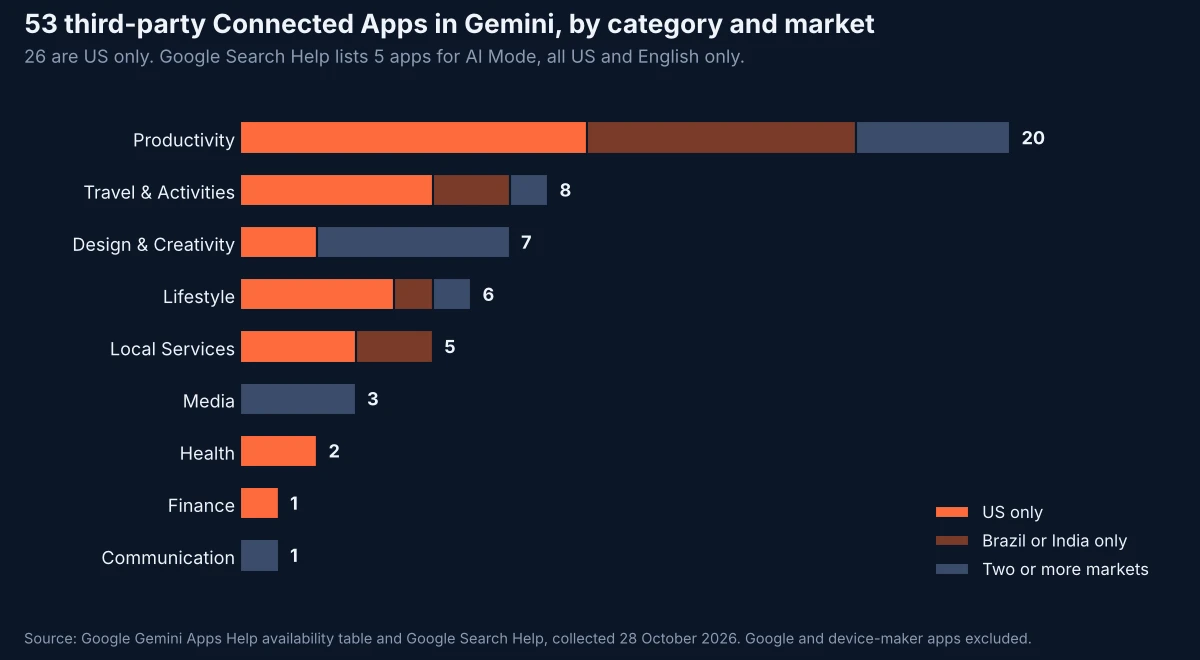
Availability is narrow. Of the 53 third-party apps, 26 are US only, 6 are Brazil only, 6 are India only and 1 (OpenTable) covers the UK and US. Only 14 run in two or more markets. Forty-two are English only, and 47 require users to be 18 or over.
| Measure | Gemini app | AI Mode in Search |
|---|---|---|
| Connected Apps listed on Google's help page | 85 (53 third-party) | 5 |
| Apps named | Adobe, Canva, Zillow, Ticketmaster, Zoho CRM and others | Instacart, Canva, YouTube Music, Yahoo Fantasy Football, Sleeper Fantasy Football |
| Markets | Varies by app; 26 third-party apps US only | US only |
| Languages | Varies; 42 third-party apps English only | English only |
| How an app is invoked | @ mention or naming the app | Naming the app, or picking from a list after a general request |
Source: Google Gemini Apps Help and Google Search Help (linked above), both read 28 October 2026.
How Search decides which app to use
For SEO teams the most useful detail sits in Google's Search help page rather than the launch post. A user who makes a general request in AI Mode, such as building a grocery cart for a recipe, is shown a list of available apps to choose from. Google adds that Search "may default to the last app you used" for a task, and that users can switch by naming a different app in their prompt. Apps must also be linked to the user's Google Account before they can act.
The MCP server guide confirms the same pattern from the developer side: an app can be triggered with an @ mention or by naming it in the query, and it then stays in context for related prompts in that session. The guide tells developers that models rely on their server instructions to decide when to hand a task to their server, so it recommends clear instructions, strongly typed schemas and detailed parameter descriptions to improve tool-calling accuracy.
Put together, the selection signals Google has documented are user intent, brand recall and recent use, not anything resembling classic ranking. Google has not published how AI Mode orders the list of apps for a general request, or how it chooses between two apps that do the same job.
The policy bans tool description stuffing
Google's Connected Apps policy, last updated on 28 September according to the page, closes off the most obvious optimisation tactic before most developers can get in. It prohibits influencing the model with "overly broad or deceptive capability descriptions" to win selection over another Connected App. The policy also says apps must not:
- reference other tools or create new rules for when other tools should be used;
- return system instructions through app responses (all instructions must be available when the app is ingested);
- create multiple Connected Apps with highly similar functionality;
- serve any third-party advertising or promotional material through the integration;
- wrap or repackage third-party APIs the developer does not own, which rules out thin pass-through apps;
- consistently return errors, crash, time out or fail authentication.
Penalties run from rejection at submission to suspension, removal from the platform and termination of the developer account.
How we got here
The platform formalises a rollout Google has run since the summer, mostly with hand-picked partners:
- 16 July: Google brought Connected Apps to AI Mode in the US, starting with Instacart, Canva and YouTube Music.
- 12 August: At Made by Google, the Gemini app announced a new slate including Fever, GetYourGuide, Localiza, OpenTable, Ticketmaster, Angi, Thumbtack and Zocdoc.
- 23 September: A further wave added Airtable, Linear, monday.com, Adobe, Squarespace, Webflow, Experian, Peloton and SeatGeek, among others.
- 28 October: The Connected Apps Platform preview opens the process to developers who apply.
It also follows Google's US launch of Universal Cart in Search and Gemini and its test of ads in AI Mode for Personal Intelligence users, both of which push more of the task inside Google's own interface. Sundar Pichai's recent remarks that agents will use both pages and protocols, which we covered alongside a crawl of agent files on top sites, now have a concrete protocol route on Google's side.
What this means for SEO teams
- Treat it as a product channel, not a ranking channel. Being picked depends on users naming or choosing your app, so brand demand matters more than page-level optimisation. Search marketers at SaaS, travel, local services and ecommerce companies should brief product teams rather than wait for Search Central guidance.
- Check eligibility before building. Search integrations run only in US English today. If your users are elsewhere, Gemini is the only route for now, and even there most third-party apps are limited to one market.
- Write tool descriptions for accuracy, not reach. The policy treats broad, catch-all descriptions as deceptive. Describe each tool narrowly and make sure it does exactly what it says.
- Plan measurement now. Connected Console reports traffic, latency and errors. Google has not said whether Connected App actions will appear in Search Console, so agree how you will attribute sign-ups and orders that start in AI Mode before launch.
- Keep the web pages. Many tasks still end on the partner's own site or app: the Search help page says users may be sent to Instacart to check out, to Canva to download a design and to YouTube Music to listen.
Methodology
On 28 October 2026 we downloaded Google's Gemini Apps Help availability table and parsed all 85 rows, recording each app's category tag, location, language, age and supported-app fields. We classed 14 rows as Google services and 18 as apps from Android device makers (Samsung, Xiaomi, OPPO, OnePlus, vivo, HONOR, TECNO and Lenovo, plus the Mind Space app), leaving 53 third-party apps. "US only", "Brazil only" and "India only" follow the table's own location wording; any app listing two or more countries, or every country where both Gemini and the app are supported, counted as two or more markets. Search figures come from the Google Search Help page on Connected Apps, read the same day. Policy and guide wording comes from the Connected Apps Platform pages on developers.google.com.
Conclusion
The Connected Apps Platform turns a partner programme into something any approved developer can join, and Google published its anti-manipulation rules before opening the doors rather than after. For now the gap between Gemini's 85 listed apps and Search's 5 shows where the volume is, but Google has told four Gemini partners they will reach Search within weeks.
The open questions for search marketers are the ones Google left unanswered: how AI Mode orders competing apps for a general request, and whether any of this activity will be visible in Search Console.
Questions and answers
What is Google's Connected Apps Platform?
It is a preview programme, announced on 28 October 2026, that lets developers bring their services into AI Mode in Google Search and the Gemini app through a cloud-hosted MCP server or Android MCP using the AppFunctions APIs, managed in Google Connected Console.
How many Connected Apps are available in Search?
Google's Search help page lists five: Instacart, Canva, YouTube Music, Yahoo Fantasy Football and Sleeper Fantasy Football. The feature is available in AI Mode in the US, in English. Google says Adobe, Experian, Localiza and Peloton will come to Search in the coming weeks.
How does AI Mode choose which Connected App to use?
Users can name an app in their request or pick one from a list after a general request. Google's help page says Search may default to the last app used for a task. Google has not published how it orders competing apps.
Can developers optimise tool descriptions to get picked more often?
Google's Connected Apps policy prohibits overly broad or deceptive capability descriptions meant to influence the model into selecting one app over another, and bans apps that reference other tools or return system instructions in responses.
Can Connected Apps show ads?
No. The policy says Connected App partners must not serve third-party advertising or promotional material through their integrations, though they may include their own brand elements.
More releases
-
Industry news
Google Search Revenue Rose 0.1% From Q2 as AI Mode Ads Expand to 10 New Countries
Alphabet's Q3 2026 results show Google Search & other revenue up 12% year on year to $63.35 billion but just 0.1% above Q2, as Google named lower AI Mode monetization as a drag and expanded AI Mode ads to 10 new countries. Google Network grew 1.4% after eight straight quarterly declines.
-
Updates
Google's Favicon Rules Now Cover Redirects; 76% of 541 Top Homepages Change Host First
Google has rewritten its favicon crawling guideline to say Googlebot must be able to follow any redirects from the home page to the page declaring the favicon. Our crawl of the 1,000 most popular domains found 412 of 541 working homepages (76.2%) redirect to a different hostname first.
-
Explainers
Google's 16 October Privacy Policy Lets Gmail and Photos Data Shape Ads: What Changed
Google's privacy policy, revised on 16 October 2026, now lets data from Gmail, Google Photos and Drive inform personalized ads when users connect those apps to Search. Google's own comparison shows five rewritten passages, and our archive check finds it came 15 days after the last version, the fastest revision in Google's archive.
Tell us the site and the goals.
Rankings in Google and visibility in AI answers, from one monthly plan. One call is enough to say which one fits. Email works just as well.