Google's Favicon Rules Now Cover Redirects; 76% of 541 Top Homepages Change Host First
Google has rewritten its favicon crawling guideline to say Googlebot must be able to follow any redirects from the home page to the page declaring the favicon. Our crawl of the 1,000 most popular domains found 412 of 541 working homepages (76.2%) redirect to a different hostname first.
 Vibhu Dhariwal
Cofounder & CTO, Digital Gratified
- Published
- Section
- Updates
- Reading time
- 8 minutes
Ras Al Khaimah, United Arab Emirates, .
Google has rewritten the crawling requirement in its favicon documentation for Search, which now carries a last-updated date of 27 October 2026. The guideline now says Googlebot must be able to crawl the home page and follow any redirects from it to the page where the favicon is declared, while Googlebot-Image must be able to fetch the favicon file itself. To see how many sites that redirect clause touches, we crawled the homepages of the 1,000 most popular domains: of the 541 that returned an HTML homepage, 412 (76.2%) ended on a different hostname from the one we requested.
What changed
We compared the live page with the Internet Archive copy captured on 22 October, which showed a last-updated date of 28 August 2026. A line-by-line diff of the article body found exactly one changed bullet, in the Guidelines section. Everything else, including the size and format rules, is word for word the same.
| Version | Crawling guideline (paraphrased) |
|---|---|
| Before (last updated 28 August) | Googlebot-Image must be able to crawl the favicon file and Googlebot must be able to crawl the home page; neither can be blocked. |
| After (last updated 27 October) | Googlebot must crawl the home page and follow any redirects from there to the page that specifies the favicon; Googlebot-Image must crawl the favicon file; none of these URLs may be blocked by robots.txt "or by other means". |
Two things are new in substance. The redirect path is now named as part of what Googlebot must be able to crawl, and the blocking rule now covers every URL in that path rather than only the home page and the icon file. The phrase "or by other means" also widens the rule beyond robots.txt, which in practice would take in things like login walls, firewall rules and bot challenges.
The edit does not appear in Google's Search documentation updates log, whose most recent entry is the 26 October change to the user-generated spam guide that we covered earlier this week. Search Engine Roundtable, which reported the edit, quoted Google's John Mueller as saying on LinkedIn that Google rewrote the line after seeing that AI systems did not understand how to investigate favicon problems. Mueller said the team tested the new wording as a prompt, found it worked much better, and thinks it may help people too. Google has not said that its favicon processing itself has changed.
Key findings from our crawl
- Redirects are the norm, not the edge case. 420 of 541 homepages (77.6%) redirected at least once, and 412 (76.2%) finished on another hostname. Most of those (274, or 50.6% of all sites) simply added or removed "www".
- One in five homepages leaves the domain. 120 sites (22.2%) redirected to a different registrable domain, and 117 (21.6%) needed two or more hops. The longest chain we recorded ran to seven hops.
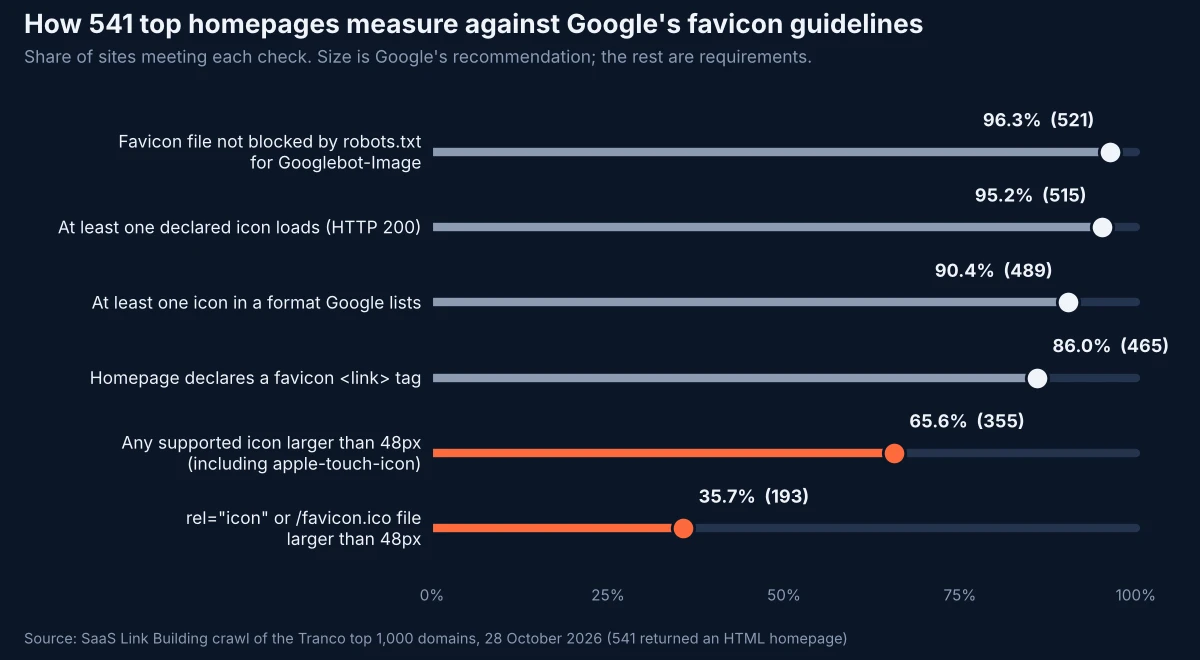
- Size is the weakest point. Only 193 sites (35.7%) serve a
rel="icon"file (or a default /favicon.ico) larger than 48px, the size Google recommends exceeding. Counting apple-touch-icon files, which Google also accepts, the figure rises to 355 (65.6%). - Some sites block their own icon. For 20 sites (3.7%), the robots.txt file we were served disallowed the favicon URL for Googlebot-Image.
- A minority rely on formats Google does not list. 70 sites (12.9%) declare an SVG icon, and for 14 the only working icon we could fetch was an SVG. Google's supported list is BMP, GIF, ICO, PNG, JPEG, PPM and TIFF.
Where the redirects go
| Homepage redirect outcome | Sites | Share of 541 |
|---|---|---|
| No redirect | 121 | 22.4% |
| Redirect within the same hostname (for example, to a language path) | 8 | 1.5% |
| Adds or removes www | 274 | 50.6% |
| Moves to another subdomain of the same domain | 18 | 3.3% |
| Moves to a different domain | 120 | 22.2% |
The cross-domain group includes some very large brands. Requesting sharepoint.com took six hops through office.com addresses before landing on a Microsoft 365 page on microsoft.com, and mozilla.com passed through mozilla.org before settling on firefox.com. Chains like these are usually deliberate, but every hop is now explicitly a URL Googlebot has to be allowed to fetch before it reaches the favicon tag. It also matters which hostname ends up holding the tag: Google supports one favicon per hostname, so the icon declared on the final host is the one that counts for that host.
Favicon sizes
| Largest rel="icon" or /favicon.ico file | Sites | Share of 469 measured |
|---|---|---|
| Smaller than 32px | 27 | 5.8% |
| 32px to 47px | 139 | 29.6% |
| Exactly 48px | 110 | 23.5% |
| Larger than 48px | 193 | 41.2% |
Google's minimum is 8x8px, so none of these fail the requirement. The recommendation is for an icon larger than 48x48px, and 276 of the 469 measurable sites (58.8%) offer nothing bigger than that under rel="icon". More than half of those (145) do publish a larger apple-touch-icon, which Google lists as a supported rel value. Only seven sites served icons that were not square.
Context
The edit follows the two help-page updates of 23 October on URL word separators and robots.txt percent-encoding, which Google logged as syncing its docs with its "The Non-Canonical Cabinet" video series. The favicon edit, by Mueller's account, came from watching how AI tools read the page. Google's documentation has been changing at a steady pace this year: our count of 2026 changelog entries found 52 by mid-October, and this one is not yet among the logged changes.
Robots.txt is still the most common way sites trip over these rules. In our 2,000-domain robots.txt crawl, a quarter of files carried fields Google ignores. The favicon cases we found were more specific: an asset host that disallows everything except named folders, a site that allows only its root URL, and a government site whose theme folder allows PNG, GIF and JPEG files but not the .ico file its favicon tag points to. Google's common crawlers page says preferences addressed to Googlebot-Image apply to every Search feature that shows favicons.
What SEO teams should do
- Trace the full path. Request your bare domain over http and https, with and without www, and record every hop. Each URL in that chain must return a redirect or a 200 to Googlebot, not a login page, a bot challenge or a blocked response.
- Test every hop against robots.txt. Check each redirect URL against the robots.txt of its own host for Googlebot, and the favicon URL against its host's file for Googlebot-Image. A CDN or asset domain has its own robots.txt, and 35.5% of the sites we crawled host their primary favicon on a different hostname from the homepage.
- Keep the redirect chain short. Google's HTTP status code documentation says its crawlers follow up to 10 redirect hops by default, and that some product crawlers have different limits. The longest chain in our sample was seven hops, so length alone rarely breaks the path, but one hop from the bare domain to the canonical homepage leaves the least to go wrong.
- Declare the icon on the final page. 76 sites (14.0%) in our crawl had no favicon link tag on the homepage they ended on. Google's implementation steps call for a
<link rel="icon">tag on the home page. - Ship a raster icon above 48px. Keep an SVG if you like it for browsers, but add a square PNG or ICO larger than 48px, in a format on Google's list, at a stable URL.
Methodology
We took the top 1,000 domains from the Tranco research list (ID GQ3LK) and requested https://<domain>/ (falling back to http) on 28 October 2026 between 17:19 and 17:24 UTC, with a desktop Chrome user agent, following all redirects. 541 domains returned an HTML page with status 200; 274 did not answer at the root (mostly infrastructure and CDN domains) and 185 returned a non-HTML or non-200 response, 99 of them a 403. We classified each redirect chain by comparing the first and final hostnames and registrable domains. On the final page we parsed every link element whose rel was icon, shortcut icon, apple-touch-icon or apple-touch-icon-precomposed, used /favicon.ico when none was declared, fetched up to 10 icons per site, identified the format from the file signature, and measured pixel dimensions (the largest frame for ICO files). We fetched robots.txt for each host as a browser and evaluated URLs for the Googlebot and Googlebot-Image tokens with an open-source parser that follows Google's matching rules. Limits: we did not crawl as Googlebot, and some sites serve different pages or robots.txt files to different agents, so the robots.txt and redirect results describe what a browser receives and may differ from what Googlebot sees. Format and size checks measure eligibility against Google's written guidelines, not whether Google shows a given favicon.
Conclusion
Google's favicon edit reads like a clarification, and Google has not said its systems changed. It still points at a common setup: three in four of the top homepages we tested redirect to another hostname before the favicon tag is reached, and one in five leaves the original domain entirely. Most sites pass the crawling checks. Size is where they fall short, with fewer than four in ten serving a standard favicon above Google's recommended 48px.
Questions and answers
What did Google change in its favicon documentation?
One guideline bullet. It now says Googlebot must be able to crawl the home page and follow any redirects from it to the page where the favicon is specified, that Googlebot-Image must be able to crawl the favicon file, and that none of these URLs may be blocked by robots.txt or other means. The page shows a last-updated date of 27 October 2026.
Why did Google make the change?
According to Search Engine Roundtable, Google's John Mueller said on LinkedIn that Google saw AI systems did not understand how to investigate favicon issues, tested the new wording as a prompt, and found it worked much better.
What favicon size does Google recommend?
Google requires a square favicon of at least 8x8px and recommends one larger than 48x48px. In our crawl, 193 of 541 top homepages (35.7%) served a rel="icon" or /favicon.ico file larger than 48px.
Which favicon formats does Google Search support?
Google's favicon documentation lists BMP, GIF, ICO, PNG, JPEG, PPM and TIFF. SVG and WebP are not on the list; for 14 of the 541 sites we crawled, the only working icon we could fetch was an SVG.
Which crawler fetches favicons for Google Search?
Googlebot-Image fetches the favicon file, and Google's common crawlers documentation says robots.txt preferences addressed to Googlebot-Image apply to Search features that show favicons. Googlebot crawls the home page and any redirects from it.
More releases
-
Explainers
Google's 16 October Privacy Policy Lets Gmail and Photos Data Shape Ads: What Changed
Google's privacy policy, revised on 16 October 2026, now lets data from Gmail, Google Photos and Drive inform personalized ads when users connect those apps to Search. Google's own comparison shows five rewritten passages, and our archive check finds it came 15 days after the last version, the fastest revision in Google's archive.
-
Studies
Does Word Count Help You Rank? Our 40-SERP Test Finds Length Tracks Intent, Not Position
Google says content length alone does not matter for ranking. Our test of 237 pages ranking for 40 Google searches agrees: word count and position were barely related (rho -0.125), the direction flipped from keyword to keyword, and query type, not position, set how long top pages were.
-
Industry news
Semrush Confirms Poisoned Google SERPs; 12 of Our 24 Repeat Fetches Failed to Agree
Semrush said on 27 October that Google is serving some automated searches results that differ from what users see, joining AccuRanker and Nozzle. Our test of eight keywords, fetched three times within five minutes, found 12 of 24 fetches shared fewer than half their top-10 domains with the other two.
Tell us the site and the goals.
Rankings in Google and visibility in AI answers, from one monthly plan. One call is enough to say which one fits. Email works just as well.