Does Google Still Rank on Links? Court Files and 184 Top Results Say More Than It Admits
Google says links matter less than people think, yet its ranking guide, a US v. Google court opinion and leaked documentation still describe PageRank as core. In our pull of 184 top Google results, the top three pages had a median 74 linking domains, against 11 to 13 below them.
 Vibhu Dhariwal
Cofounder & CTO, Digital Gratified
- Published
- Section
- Studies
- Reading time
- 15 minutes
Ras Al Khaimah, United Arab Emirates, .
Google has spent years telling site owners that links matter less than they think. Its own SEO Starter Guide now files PageRank under things not to focus on, and Google's Gary Illyes has said links are no longer a top three ranking factor. Yet a federal court record from United States v. Google, the Content Warehouse documentation that leaked in 2024, and Google's own ranking systems guide all describe link analysis as part of core ranking. To test which picture holds, we pulled Google's US top organic results for 21 keywords on 30 October 2026 and matched all 184 ranking pages against a commercial backlink index.
Our short answer: Google downplays links more than its systems appear to. Pages with more referring domains tended to rank higher in 16 of the 21 searches, and the top three results had a median of 74 referring domains against 11 to 13 for positions four to nine. But the signal is weaker and narrower than link building folklore suggests: 27 ranking pages had no referring domains recorded at all, and a domain-level authority score did not track rankings in most searches in our sample.
Key findings
- In the September 2025 remedies opinion in US v. Google, Judge Amit Mehta described PageRank as a key quality signal that measures a page's quality and authoritativeness from the links pointing to it, and cited a trial exhibit describing it as an input to the Quality score.
- Google's ranking systems guide lists link analysis systems and PageRank among its ranking systems and says PageRank is still part of its core ranking systems.
- The leaked AnchorsAnchor record has 39 attributes, including a PageRank weight for each link and a field that grades the quality of the linking page.
- In our pull, the rank correlation between a page's referring domains and its position was positive for 16 of 21 keywords, with a median of 0.35. The top three results had more referring domains than the bottom three in 16 keywords, fewer in 3 and the same in 2.
- Only 7 of the 21 number one results had the most referring domains on their page of results, and 3 of the 21 had none recorded.
- A third-party domain authority score did not track position: its correlation was positive in only 7 of 21 keywords and its median was negative (-0.15).
The theory: Google has quietly retired links
The claim comes in two strengths. The mild version says links still count but no longer dominate, because Google now leans on content quality, user signals and machine learning. The strong version, common in SEO forums and conference debates, says link building is close to dead: publish good content, build a brand and rankings will follow without links.
Much of the fuel for the strong version comes from Google itself. In 2016 Andrey Lipattsev, then a Google search quality senior strategist, named links as one of the top three ranking signals, as Search Engine Land has recorded. Since then the message has softened. Speaking at Pubcon Pro in 2023, Illyes said he did not agree that links were in the top three and had not been for some time, according to Search Engine Land. At SERP Conf in Sofia in April 2024, in a session whose topic list on the conference page includes "Google needs very few links to rank pages", Illyes said links had been made less important over the years, according to Search Engine Roundtable, which relied on an attendee's account posted on X. He later posted on X that he should not have said it, without spelling out which part he meant.
John Mueller has made a similar point about counting links. Answering a Reddit user who asked why a backlink tool showed no links while Search Console showed a few, he wrote that "over-focusing on links will often result in you wasting your time", as reported by Search Engine Journal on 1 April 2024. And Google's SEO Starter Guide now lists PageRank in a section titled "Things we believe you shouldn't focus on", adding that Google Search uses much more than links and that PageRank is one of many signals.
So the dispute is not whether links exist in Google's systems. It is whether Google's public framing matches how much those systems still rely on them. That is the question this investigation tests. It is the latest in our series on contested ranking claims, after whether Google uses clicks to rank pages and whether it favors big brands.
Evidence for: what Google's own documents say
Start with what Google publishes. The ranking systems guide does not describe PageRank as a legacy curiosity. Under a heading on link analysis systems and PageRank, Google says it has various systems that look at how pages link to each other to work out what pages are about and which are most helpful for a query. It says PageRank has evolved a lot since launch and is still part of its core ranking systems.
The Starter Guide wording is softer, but read closely it does not contradict this. It says PageRank uses links, is one of the fundamental algorithms at Google, and is one of many ranking signals. Its advice is about where to spend effort, not a statement that links stopped working.
Google's spam policies point the same way. They define link spam as creating links to or from a site primarily to manipulate search rankings. A company with no use for links in ranking would have little reason to keep a detailed policy against manipulating them.
Evidence for: what the court record shows
The clearest statement comes from the court record. In the remedies opinion of 2 September 2025 (page 143 of the opinion), Judge Mehta explained why he would not force Google to share its quality scores with rivals. Those scores, he wrote, are built largely from sources other than user data, and a key quality signal is PageRank, which captures a page's quality and authoritativeness from the frequency and importance of the links to it. He cited testimony from Google's expert Dr. James Allan and a trial exhibit stating that PageRank "is a single signal relating to distance from a known good source". The same exhibit says PageRank is an input to the Quality score.
The same passage covers a second link signal. Turning to a popularity signal the plaintiffs wanted shared, the judge noted that two exhibits suggest it draws on Chrome visit data and on a count of anchors, which he described as a measure of the links between pages used to promote well-linked documents. He said the court could say no more without testimony and declined to order sharing, so this description rests on the exhibits alone.
Two details matter for SEO teams. First, our reading of the exhibit's wording, which Google has not confirmed, is that it describes a trust-seeded version of PageRank, where links from pages close to trusted sources count for more, not a raw count of links. Second, the exhibit places PageRank inside the Quality score, which suggests links feed a page-quality judgement rather than acting only as a standalone vote.
Evidence for: what the leaked documentation shows
The leaked Content Warehouse documentation, which Google confirmed was genuine in a statement to The Verge while warning against reading it out of context, describes how links are stored. We read the three most relevant records on HexDocs.
| Record | Field | What the documentation says |
|---|---|---|
| AnchorsAnchor | pagerankWeight | A weight stored in link maps for the system the documentation calls the pageranker |
| AnchorsAnchor | sourceType | Records the quality of the linking page, roughly tracking its index tier; high quality anchors come from base documents, low quality ones roughly from the lowest tier |
| AnchorsAnchor | sourceType (continued) | Can also be used as an importance indicator for an anchor, with high quality sources ranked as more important |
| AnchorsAnchorSource | pagerank, pagerankNs, spamrank, homePageInfo | PageRank variants on a 16-bit scale for the linking page, a spam rank, and whether the source is a trusted home page |
| PerDocData | pagerank2, toolbarPagerank | Document-level PageRank fields, including a copy of a 0 to 10 toolbar-style value |
The sourceType field is the most telling. It shows that Google does not treat every link alike: links are labelled by the quality tier of the page they come from, and that label doubles as a measure of how important the link is. In our reading, that fits the exhibit's description of PageRank as distance from trusted sources, and it helps explain why raw link counts can mislead.
Evidence for: our own data
Documents show that link signals exist. They do not show how much they move results today. So we checked the live results. On 30 October 2026 we pulled Google's US top organic results for 21 keywords: 11 commercial software and app searches and 10 informational questions spanning finance, health, food, technology and careers. That gave 184 ranking pages, 8 or 9 per search. For each page we looked up how many distinct domains link to that exact URL in a commercial backlink index, and for each domain we took the same index's 0 to 1,000 authority score. We then measured, keyword by keyword, how closely each measure tracked ranking position.
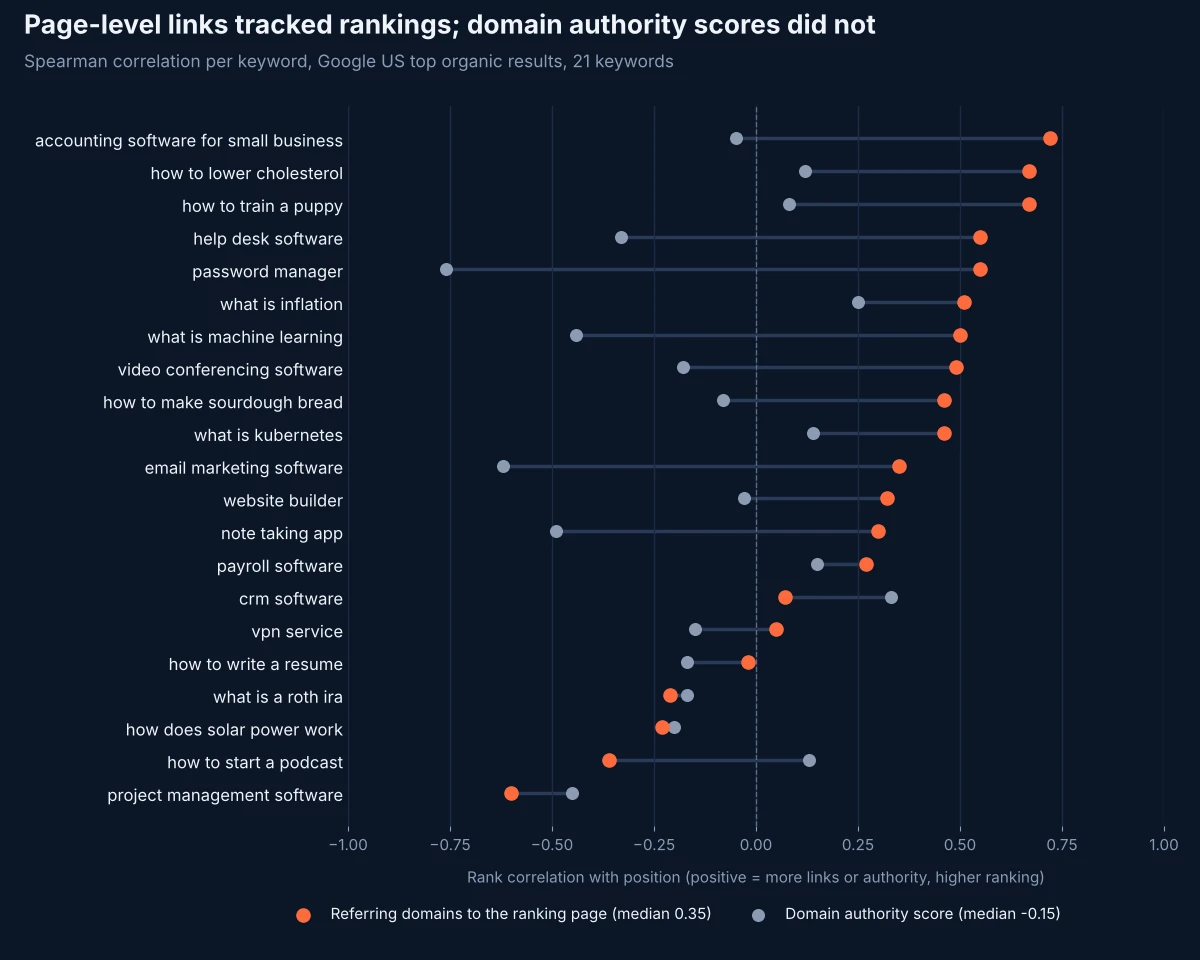
Page-level links tracked rankings in most searches. For 13 of the 21 keywords the correlation was 0.3 or higher, which is a meaningful relationship for samples this small. The strongest were accounting software for small business (0.72), how to lower cholesterol and how to train a puppy (both 0.67). Informational searches showed a slightly stronger link (median 0.46) than commercial ones (median 0.32).
| Positions | Pages | Median referring domains to the page | Pages with none recorded | Median domain authority score (0 to 1,000) |
|---|---|---|---|---|
| 1 to 3 | 63 | 74 | 6 | 523 |
| 4 to 6 | 63 | 11 | 11 | 523 |
| 7 to 9 | 58 | 13 | 10 | 563.5 |
The step between the top three and the rest is the clearest pattern in the data. The median page in positions one to three had several times as many referring domains as the median page below it. Domain authority, by contrast, was flat across the top two bands and slightly higher in positions seven to nine.
Evidence against: why links do not decide everything
The same data also shows the limits of the link theory, and these limits are where Google's public line has a point.
Plenty of pages rank with almost no links. Of the 184 ranking pages, 27 (about 15%) had no referring domains recorded and 78 had 10 or fewer. Even in the top three, 19 of 63 pages had 10 or fewer. Three number one results had none recorded: Spotify's guide for how to start a podcast, an Australian energy company's explainer for how solar power works, and a financial company's guide to what a Roth IRA is. Our speculation is that relevance, and for at least the first two site-level signals, carried them; the backlink index may also simply miss some of their links.
The most-linked page usually does not win. In only 7 of 21 searches was the page with the most referring domains also the number one result. In note taking app searches, Evernote's home page had 27,692 referring domains in the index and ranked sixth. For VPN service, a provider home page with 12,861 ranked fourth. Very large link counts on home pages did not buy the top spot for a specific query.
Forums and video can rank with almost no page links. We found 29 Reddit, YouTube and Quora results. Their median page had 2 referring domains, yet 6 of them ranked in the top three. That matches our earlier finding that YouTube and Reddit often outrank established brands, and it is one reason, though not the main one, that the domain authority score correlated negatively: with those 29 results removed, its median correlation was still about -0.10.
Some searches showed the reverse pattern. For five keywords the page-level correlation was negative, most clearly project management software (-0.60) and how to start a podcast (-0.36). In the first, a vendor home page with 1,766 referring domains ranked eighth; in the second, Spotify's guide ranked first with none recorded while the most-linked guide, with 243, ranked fourth.
Correlation is not weight. Pages that rank well attract links because people find and cite them, so part of the relationship we measured may run from ranking to links rather than the other way. Our sample of 21 searches is also small, and the backlink index is a third-party crawl, not Google's link graph. Mueller's point that there is no objective way to count links applies to our data too.
Verdict: likely
Likely: Google's public messaging understates how much its systems still use links. Google's own ranking systems guide calls PageRank part of its core ranking systems, an exhibit cited in the remedies opinion describes PageRank as an input to the Quality score, the leaked documentation stores a PageRank weight for each link and labels links by the quality of the linking page, and in our pull the top three results had far more linking domains than the pages below them. On that evidence, the strong theory that links no longer matter is not supported.
Also supported: Google's narrower claim that links matter less than many people think. A large share of ranking pages have few or no links, the most-linked page wins only a minority of searches, and an off-the-shelf domain authority score correlated positively with position in only a third of searches. Our interpretation is that the evidence describes a quality-weighted signal, where a few links from trusted pages count for more than raw totals.
A fair reading of both sides: when Illyes says Google needs very few links to rank pages, that is consistent with a system that values links by source quality and distance from trusted seeds. It is not the same as saying links stopped counting. Our speculation, which Google has not confirmed, is that "less important" means fewer links are needed once a page is relevant and sits on a trusted site, not that link signals were switched off.
What this means for SEO teams
- Measure links to the page, not the domain. In our sample, links to the exact ranking URL tracked position in most searches while the domain-level score did not. When you compare yourself with a competitor, look up the referring domains of the specific page that ranks.
- Chase quality tier, not volume. The leaked sourceType field and the exhibit cited by the court both suggest that the trust of the linking page matters. Our view, which Google has not confirmed, is that one citation from a reputable publication is likely to do more than dozens of links from low-quality directories.
- Fix relevance before buying links. Heavily linked home pages ranked below better-matched guides in several searches, such as Evernote's for note taking app. If your page does not answer the query as well as the current top three, links are unlikely to close the gap. Our word count test found the same pattern: format and intent outweighed surface metrics.
- Stay inside the spam policy. Google's link spam rules cover buying links, excessive exchanges and automated link building. A signal weighted by source quality is exactly the kind that cheap link schemes fail to move.
Methodology
On 30 October 2026, between about 14:50 and 15:15 IST, we requested Google results for 21 keywords through a SERP API, with the country set to the United States and the language to English, and recorded the organic results in order. We excluded ads, AI Overviews, video carousels and other features, keeping only numbered organic listings. Each search returned 8 or 9 organic results, 184 pages in total, all unique. For each page we queried a commercial backlink index for the number of distinct referring domains linking to that exact URL, counting followed and nofollowed links; pages missing from the index were counted as zero. For each host name we took the same index's domain authority score on a 0 to 1,000 scale. We calculated Spearman rank correlations per keyword between position and each measure and report the sign so that positive values mean more links or a higher score went with a better position. Commercial keywords were the 11 software and app searches; informational keywords were the 10 question searches. Court passages come from Document 1436 in case 1:20-cv-03010. Leaked documentation was read from version 0.4.0 of the google_api_content_warehouse package on HexDocs. Correlations show association in a small sample, not causation or ranking weight.
Conclusion
Google's public line on links and its own technical record are not as far apart as the "links are dead" camp suggests, but they are not aligned either. The ranking systems guide, the remedies opinion and the leaked documentation all describe a link signal that is still part of core ranking and still feeds page quality. Our pull of 184 results found that signal in the live results: the top three pages had far more linking domains than the rest in most searches.
What the evidence does not support is the old shortcut of counting links. Many pages rank with few links, huge link totals do not guarantee the top spot, and a domain-wide authority score did not track position in most searches. Our reading is that links matter in the way Google's documents describe them: weighted by how trusted the source is, and applied to pages that already answer the query.
What do you think?
Have you seen a page move into the top three after earning a handful of links from highly trusted sites, with no content change, and how long did it take? Share your data with us; we would like to compare it with ours.
Questions and answers
Are backlinks still a Google ranking factor?
Yes. Google's ranking systems guide says PageRank, which uses links, is still part of its core ranking systems, and an exhibit cited in the September 2025 US v. Google remedies opinion describes PageRank as an input to Google's Quality score.
Did Google say links are no longer a top three ranking factor?
Google's Gary Illyes said at Pubcon Pro in 2023 that links had not been in the top three for some time, according to Search Engine Land. At SERP Conf in April 2024 he discussed Google needing very few links to rank pages.
Does the number of backlinks predict Google rankings?
Only loosely. In our pull of 184 Google US results for 21 keywords, page-level referring domains correlated positively with position in 16 searches, but the most-linked page ranked first in only 7 of 21, and 27 ranking pages had no referring domains recorded.
Does a high domain authority score help a page rank?
Not in our sample. A third-party domain authority score correlated positively with position in only 7 of 21 searches, and its median correlation was negative (-0.15).
What does the Google leak say about links?
The leaked Content Warehouse documentation stores a PageRank weight for each link and a sourceType field that labels links by the quality tier of the linking page, which the documentation says can also indicate how important an anchor is.
More releases
-
Studies
Only 26% of 295 Google News Sites Ask Readers to Add Them as a Preferred Source
A SaaS Link Building crawl of 295 sites surfaced in Google News finds 77 (26.1%) prompting readers to add them as a Preferred Source in Google Search. Most use a plain deeplink on article pages rather than Google's recommended button, and none links to a Search profile badge.
-
Explainers
ChatGPT's Aura Check Can Block Sites Before Any Request Reaches Your Server
ChatGPT's browsing tools can refuse to open a site through an undocumented OpenAI safety check called Aura, a 29 October report says, leaving no trace in server logs. Our count of OpenAI's four published IP files, including 235 ChatGPT-User prefixes refreshed on 27 October, shows what site owners can and cannot control.
-
Industry news
Discord Opens 63,000 Servers to Web Search; Its Sitemap Lists Only 32,437 Today
Discord will give all of its more than 63,000 Discoverable Servers a public web page on 16 November and push some public-channel messages into web search from mid-December. Our sitemap check finds 32,437 server pages listed today, a 318-URL message pilot already in Google, and every pilot outbound link nofollowed.
Tell us the site and the goals.
Rankings in Google and visibility in AI answers, from one monthly plan. One call is enough to say which one fits. Email works just as well.