Only 26% of 295 Google News Sites Ask Readers to Add Them as a Preferred Source
A SaaS Link Building crawl of 295 sites surfaced in Google News finds 77 (26.1%) prompting readers to add them as a Preferred Source in Google Search. Most use a plain deeplink on article pages rather than Google's recommended button, and none links to a Search profile badge.
 Vibhu Dhariwal
Cofounder & CTO, Digital Gratified
- Published
- Section
- Studies
- Reading time
- 7 minutes
Ras Al Khaimah, United Arab Emirates, .
Only 77 of 295 sites that Google News surfaced for seven broad news queries carry a prompt asking readers to add them as a Preferred Source in Google Search, a SaaS Link Building crawl run on 30 October 2026 finds. That is 26.1%, two weeks after Google said on 15 October that the number of people using Preferred Sources has grown by more than 7x since the start of the year. Google also offers a Search profile badge for websites; none of the 295 sites links to one.
Preferred Sources lets a signed-in user star the outlets they want to see more often. Google's guide for web publishers says a chosen site is more likely to appear in Top Stories with a "preferred" badge, and can carry the same badge in AI Mode and AI Overviews. In its 30 April global rollout post, Google said readers are twice as likely to click through to a site after marking it as a Preferred Source, and that people had already selected more than 200,000 unique sites.
Key findings
- 26.1% adoption. 77 of the 295 sites we could fetch show a Preferred Source prompt on their homepage, on a current article, or on both.
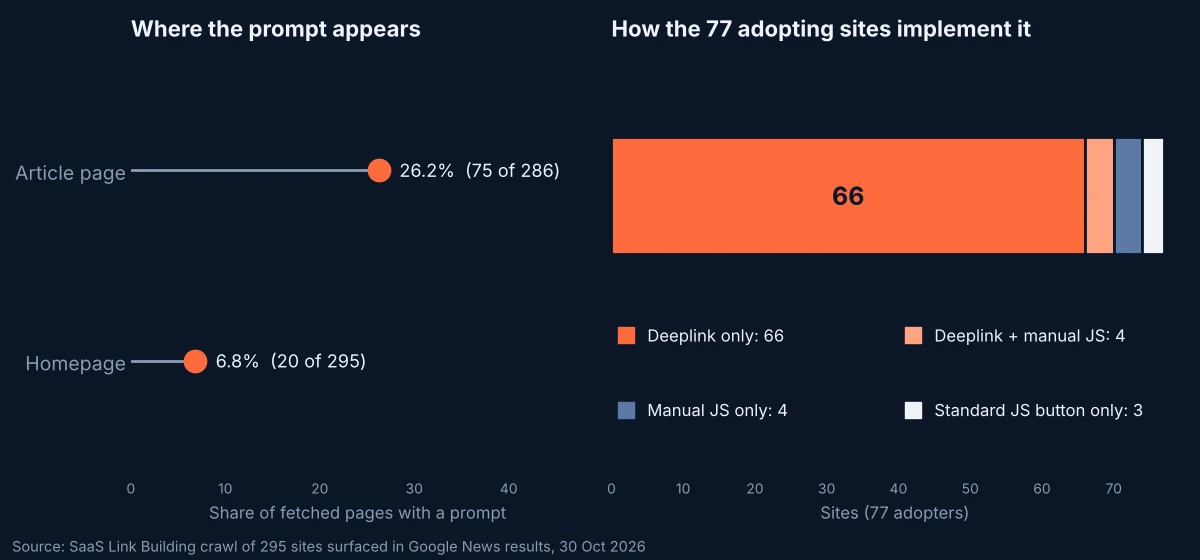
- Article pages, not homepages. 75 of 286 article pages (26.2%) carry the prompt, against 20 of 295 homepages (6.8%). 57 adopters show it only on articles.
- Deeplinks beat Google's recommended button. 70 adopters use the plain deeplink. Only 3 use the standard JavaScript button Google recommends, and 8 use Google's advanced (manual) JavaScript implementation; some sites combine methods.
- Loose deeplink formats. 28 of the 70 deeplinking sites pass a full URL with the protocol rather than the bare domain shown in Google's example. One passes a social-style handle rather than a domain, and one points to a different domain from the one serving the page.
- No Search profile badges. 0 of 295 sites link to a
profile.google.com/@address, although Google documented that badge in September.
Which frequently surfaced sites ask for the star
Adoption is not limited to small outlets. Among the 20 fetchable sites that appeared most often in our Google News results, 7 carry a prompt. The two Yahoo properties that dominated the sample did not show one on the pages we fetched, although Yahoo's main domain and its shopping subdomain did.
| Site | Results in sample | Preferred Source prompt |
|---|---|---|
| sports.yahoo.com | 76 | No |
| finance.yahoo.com | 28 | No |
| nbcnews.com | 19 | Yes (deeplink) |
| theguardian.com | 12 | Yes (deeplink) |
| aljazeera.com | 9 | No |
| pbs.org | 9 | No |
| livemint.com | 8 | Yes (deeplink) |
| npr.org | 7 | No |
| cnn.com | 7 | No |
| bbc.com | 6 | Yes (deeplink) |
| cbsnews.com | 5 | Yes (deeplink) |
| nature.com | 5 | No |
| m.economictimes.com | 5 | No |
| kcra.com | 4 | Yes (deeplink) |
| foxbusiness.com | 4 | No |
| calmatters.org | 3 | No |
| technologyreview.com | 3 | No |
| news.un.org | 3 | No |
| fool.com | 3 | Yes (deeplink) |
| abcnews.com | 3 | No |
Local TV news sites stand out among adopters: 29 of the 77 are station sites, from WTOC and WIS to KCRA and WMUR, and 28 of those 29 carry the deeplink on article pages. Their links fall into two consistent groups, 22 passing a full https address and 6 a bare domain, with one more pointing to a different brand domain. Our reading, which is speculation, is that station groups added the link once at platform level and rolled it out to every site on that platform, the cheapest way to add the prompt.
Context: what Google asks publishers to do
Google's guide lists three ways to send readers to the source preferences tool. The recommended option is two lines of HTML: a script tag that loads publisher.js and a div with the google-add-preferred-source-btn attribute, which renders a localised, Google-styled button and returns the reader to the page afterwards. An advanced option lets sites trigger the same flow from their own design elements. The fallback is a deeplink of the form google.com/preferences/source?q= followed by the site's domain, which works in a text link, an image, a newsletter or a social post.
Google says none of this is required to appear as a preferred source. It does set two conditions. Only domain-level and subdomain-level sites are eligible, so a subdirectory such as /blog cannot be chosen on its own. And a site must be included in Search generative AI features in Search Console, which means publishers that use the Search generative AI control to opt out of AI Overviews and AI Mode give up eligibility in the process.
The stakes for publishers have grown. Google's 15 October post said news carousels inside AI features are rolling out to more locations and languages and will highlight sources users have chosen. Meanwhile search referrals to news sites keep shrinking: Chartbeat data showed search fell to 12% of North American publisher pageviews in Q3. A reader's star is one of the few levers publishers control directly.
What this means for SEO teams
- Put the prompt on article templates first. The sites that adopted it overwhelmingly chose article pages, where a reader has just shown interest. A single template change covers every story.
- Follow Google's deeplink example. Google's example passes the bare domain,
example.com. If your link uses a full URL, a handle or another brand's domain, test it while signed in to a Google account and confirm the tool opens on your site. If you run several brands, check that each site's link names its own domain. - Consider the JavaScript button. Google recommends it because it localises automatically and returns readers to the page. Only 3 sites in our sample use it, so most publishers are choosing simplicity over that flow.
- Check eligibility before promoting. Enter your domain in the source preferences tool. If it does not appear, a prompt will not help, and an AI features opt-out may be the reason.
- Set expectations. Google describes the benefit in terms of the users who made the choice: their Top Stories and AI features are more likely to show your site. It does not describe it as a change for everyone else.
- Claim a Search profile if you publish on social and video platforms. No site in our sample links to one yet, and Google's guidance says following a profile makes linked content more likely to appear in Discover.
Methodology
On 30 October 2026 we pulled Google News results through a SERP API for seven queries: economy, election, technology, health and sports (US, English), climate (UK, English) and stock market (India, English). That returned 700 result links from 348 unique hosts. For each host we fetched the homepage and the first article URL Google News returned for it, using a desktop Chrome user agent, and searched the raw server HTML for four markers: the google-add-preferred-source-btn attribute (standard button), Google's publisher.js script with a manual-control attribute or preferred-sources label (advanced implementation), links to google.com/preferences/source (deeplink), and links to profile.google.com/@ (Search profile badge). A second pass on the 77 adopters classified implementation and extracted the deeplink q value.
295 hosts returned HTTP 200 for at least one page; 53 blocked us (mostly HTTP 403) or failed, including several large paywalled publishers, so they are excluded from every percentage. Limits: we read server HTML without running JavaScript, so a prompt injected only by client-side code would be missed and adoption may be understated; we sampled one article per site; and the sample is whatever Google News surfaced for these queries on one day, which includes sports team sites, universities and government pages as well as news outlets. Publisher.js also powers other Google publisher tools, so the script alone was not counted as adoption without a preferred-sources marker.
Conclusion
Google has given publishers a button, an SDK and a deeplink, and says readers are twice as likely to click through to a site after starring it. Yet three in four sites that Google News surfaced in our sample do not ask readers to star them, and those that do mostly use the simplest link rather than the button Google recommends.
For a newsroom, the work is small: one template change, a correctly formatted link, and a check that the site is still eligible. With Preferred Sources now feeding carousels in AI features as well as Top Stories, the gap between the 26% that ask and the rest is likely to matter more than it did in April.
Questions and answers
What is a Preferred Source in Google Search?
It is a site a signed-in user has chosen to see more often. Google's publisher guide says a chosen site is more likely to appear in Top Stories with a "preferred" badge and can carry the badge in AI Mode and AI Overviews for that user.
How can publishers prompt readers to add their site?
Google's guide lists three methods: a standard JavaScript button (its recommended option), an advanced JavaScript implementation with custom design, and a deeplink to google.com/preferences/source with the site's domain in the q parameter.
How many sites in the crawl use Google's recommended button?
Three of the 77 adopting sites use the standard button. Seventy use the deeplink, and eight use the advanced JavaScript implementation; some sites combine methods.
Can a site that opts out of AI Overviews still be a preferred source?
No. Google's guide says a site must be included in Search generative AI features in Search Console to be eligible for display as a preferred source.
Does Google say Preferred Sources increases clicks?
Google said on 30 April 2026 that readers are twice as likely to click through to a site after marking it as a Preferred Source. It has not published site-level data.
More releases
-
Explainers
ChatGPT's Aura Check Can Block Sites Before Any Request Reaches Your Server
ChatGPT's browsing tools can refuse to open a site through an undocumented OpenAI safety check called Aura, a 29 October report says, leaving no trace in server logs. Our count of OpenAI's four published IP files, including 235 ChatGPT-User prefixes refreshed on 27 October, shows what site owners can and cannot control.
-
Industry news
Discord Opens 63,000 Servers to Web Search; Its Sitemap Lists Only 32,437 Today
Discord will give all of its more than 63,000 Discoverable Servers a public web page on 16 November and push some public-channel messages into web search from mid-December. Our sitemap check finds 32,437 server pages listed today, a 318-URL message pilot already in Google, and every pilot outbound link nofollowed.
-
Studies
Google Says Let Dead Pages 404, but 15% of 546 Top Sites Don't Return One
Google's Gary Illyes and Cherry Sireetorn Prommawin said on 28 October that 404 errors carry no penalty and do not drain crawl budget. Our crawl of 573 top sites found 15.2% of usable responses to an invented URL were not a 404 or 410, led by 200 pages and homepage redirects that Google treats as soft 404s.
Tell us the site and the goals.
Rankings in Google and visibility in AI answers, from one monthly plan. One call is enough to say which one fits. Email works just as well.