Search Console's Links Report Is a Sample: 12 SaaS Sites Hold 150,823 Spam-Scored Linkers
Google's John Mueller says site owners should ignore random spammy backlinks rather than check whether Search Console lists them. Google documents the Links report as a sample with 1,000-row tables, and all 12 SaaS sites we checked hold more than 1,000 spam-scored linking domains, with a median of about 12 new ones a day.
 Vibhu Dhariwal
Cofounder & CTO, Digital Gratified
- Published
- Section
- Explainers
- Reading time
- 8 minutes
Ras Al Khaimah, United Arab Emirates, .
Google's John Mueller has told a site owner not to judge spammy backlinks by whether Search Console lists them. Replying in a Reddit r/TechSEO thread, reported by Search Engine Roundtable on 29 October 2026, to a site owner who sees new spam links every day in a third-party tool but not in Search Console, Mueller said he would not anchor on Search Console and added that "if these are random spammy links on the web, I'd just ignore them". Google's own Links report documentation says why the two lists differ: the report "isn't a comprehensive list" and shows a sample.
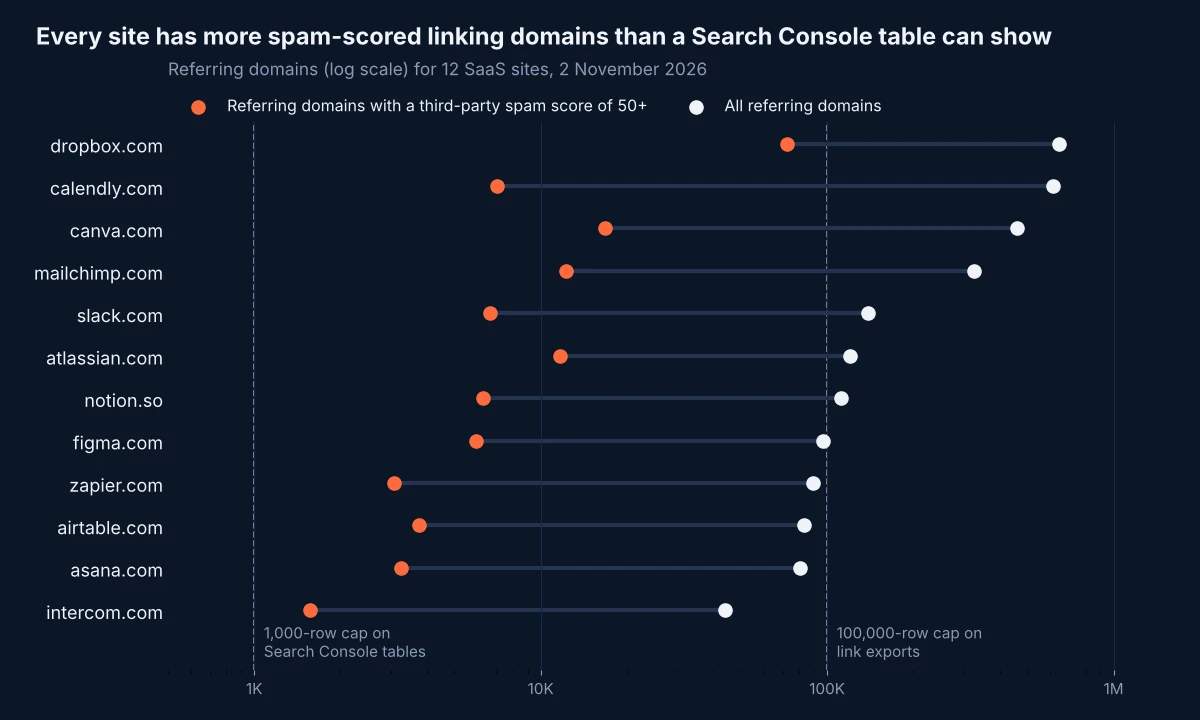
To show the scale of that gap, we pulled backlink index data for 12 well-known SaaS domains on 2 November 2026. Together they have 2,809,897 referring domains, and 150,823 of them (5.4%) carry a third-party spam score of 50 or more out of 100. Every one of the 12 sites has more than 1,000 such domains, which is more rows than any single Search Console links table can display.
What Google's documentation says about the Links report
The statement is short, but it rests on documented limits that explain most "missing link" questions:
- It is a sample. The Links report help page says the report shows a sample of internal and external links to help you understand the overall profile, and that some URLs are left out, for example non-indexed pages or deduplicated URLs.
- Tables stop at 1,000 rows. The same page says tables are limited to 1,000 rows and may be truncated on larger or more linked-to sites. Single-table downloads also stop at 1,000 rows.
- Exports stop at 100,000 rows. The "Latest links" and "More sample links" exports each return up to 100,000 rows, the second drawn from the full set of links Google knows about.
- Grouping hides detail. Linking sites are grouped by root domain, with protocol, subdomains and subdirectories stripped, and the report does not say whether a link is nofollow. It can also include links that have since been removed.
- Disavowed links still appear. Google's disavow help page says disavowed links continue to be shown in the Links report, so the report is not a list of links Google counts.
The Links report page also says that for known spam sites, Google typically ignores the links. That matches Google's history on the subject: when Penguin became part of the core algorithm in 2016, Gary Illyes wrote that it now devalues spam by adjusting ranking based on spam signals rather than affecting a whole site, and the December 2022 link spam update used SpamBrain to neutralise unnatural links and the credit they pass.
Our check: spam-scored linkers at 12 SaaS sites
The chart compares each site's total referring domains with the subset that a third-party backlink index scores at 50 or above. The dashed lines mark Search Console's 1,000-row table cap and its 100,000-row export cap.
The table below looks at the flow rather than the stock: how many spam-scored domains each site's index record picked up in the 31 days from 2 October to 2 November.
| Site | Share of linking domains scored 50+ | New 50+ domains, 2 Oct to 2 Nov | Per day |
|---|---|---|---|
| dropbox.com | 11.2% | 1,038 | 33.5 |
| canva.com | 3.7% | 953 | 30.7 |
| figma.com | 6.2% | 578 | 18.6 |
| slack.com | 4.8% | 465 | 15.0 |
| calendly.com | 1.1% | 416 | 13.4 |
| atlassian.com | 9.8% | 389 | 12.5 |
| notion.so | 5.6% | 346 | 11.2 |
| mailchimp.com | 3.7% | 295 | 9.5 |
| zapier.com | 3.5% | 226 | 7.3 |
| airtable.com | 4.5% | 222 | 7.2 |
| asana.com | 4.0% | 222 | 7.2 |
| intercom.com | 3.6% | 73 | 2.4 |
Source: SaaS Link Building analysis of backlink index data for 12 SaaS domains, collected 2 November 2026. "Per day" divides the 31-day count by 31.
Three things stand out:
- Daily spam links are normal. The median site in our set gained about 12 new spam-scored linking domains a day, and all 12 gained at least 73 in the month. The Reddit poster's experience of new spam links every day is what large, healthy sites see too.
- The counts are a floor. Slack picked up 8,122 new referring domains in the same window, of which 465 carried a score of 50 or more. Newly found domains may not have been scored yet, so the true number of low-quality arrivals is likely higher.
- Concentration is extreme. One referring domain in Slack's profile accounts for 2,474,791 backlinks on its own, and one in Dropbox's for 439,258. A single site-wide template can dwarf the rest of a link profile in any tool that counts links rather than domains.
Why a third-party spam score is not Google's view
The score we used is a heuristic from one commercial index, not a Google signal. It flags patterns associated with spam, and it also catches sites that are not spam. Among the domains scored 50 or above for slack.com, for example, was democracyclub.org.uk, a UK civic information site. Google does not publish a spam score, does not say which links it ignores, and, as the documentation above shows, does not promise to show every link it has seen.
That is the practical point of Mueller's answer. A link appearing in a third-party tool but not in Search Console tells you about the two databases, not about how Google treats the link. Google's own guidance is consistent with this: the disavow page says that in most cases Google can work out which links to trust without help, so most sites never need the tool. We made a similar argument in our investigation into how much Google still ranks on links: links still matter, but Google has spent a decade building systems to discount the ones that look manipulative.
What to do: a worked example
Say a SaaS site gets an alert that 40 new low-quality domains linked to it this week, and none of them show up in Search Console. A sensible review takes four steps:
- Check whether you built them. Google's spam policies define link spam as links created mainly to manipulate rankings, including paid links and link exchanges. If nobody on your team or at an agency paid for or arranged these links, they are the random web noise Mueller described.
- Check the Manual actions report. Google's disavow guidance says to disavow only when you have a considerable number of spammy, artificial or low-quality links and they have caused, or likely will cause, a manual action. No manual action and no paid links means no disavow file.
- Use Search Console for the shape of your profile, not the count. The top linked pages, top linking sites and top linking text tables are useful for spotting unexpected anchors or a sudden spike to one page. Treat them as a sample, as Google does. If you need a longer list, use the "More sample links" export rather than the 1,000-row tables.
- If you do disavow, follow the format. The disavow file must be a UTF-8 or 7-bit ASCII .txt file of at most 100,000 lines and 2MB, uses the
domain:prefix for whole domains, and replaces any earlier list when uploaded. The tool does not support Domain properties.
This is the same pattern as other recent Search Console questions. When the Page indexing report stopped updating last month, Mueller advised site owners to watch performance data first rather than react to the report itself. For links, the performance data is the same place to look: a real link problem shows up as lost rankings or a manual action, not as rows in a third-party export.
Methodology
On 2 November 2026 we queried a commercial backlink index for 12 widely used SaaS domains (slack.com, notion.so, zapier.com, canva.com, atlassian.com, figma.com, airtable.com, mailchimp.com, calendly.com, asana.com, dropbox.com and intercom.com), chosen as familiar SaaS brands of different sizes, not as a random sample. For each domain we recorded the number of live referring main domains (subdomains included), the number of referring domains whose average backlink spam score in that index was 50 or more on its 0 to 100 scale, and the number of those first seen on or after 2 October 2026. The threshold of 50 is our choice, not a standard. Referring domains without a score were excluded from the spam counts, so the spam figures are a lower bound. Index coverage differs from Google's, and none of these counts describe what Google has crawled, indexed or ignored. Search Console limits come from Google's Links report and disavow help pages, read on the same day.
Conclusion
Search Console's Links report was never meant to be a complete backlink list. Google documents it as a sample with 1,000-row tables and 100,000-row exports, and all 12 SaaS sites we checked carry more spam-scored linking domains than one of those tables can hold. Most also add new ones every day.
For most teams, Mueller's advice is the right default: if you did not build the links and have no manual action, ignore them. Spend the audit time on the links you earned or paid for, because those are the only ones Google's guidance says you might need to answer for.
Questions and answers
Does Search Console show every backlink Google knows about?
No. Google's Links report help page says the report is not a comprehensive list and shows a sample of internal and external links. Its tables are limited to 1,000 rows, and its link exports to 100,000 rows.
What did John Mueller say about spammy links missing from Search Console?
In a Reddit r/TechSEO thread reported by Search Engine Roundtable on 29 October 2026, Mueller said he would not anchor on whether Search Console shows such links, and that random spammy links on the web can simply be ignored.
Should I disavow spammy backlinks I did not build?
Google's disavow help page says most sites will not need the tool. It recommends disavowing only when you have a considerable number of spammy, artificial or low-quality links and they have caused, or likely will cause, a manual action.
Do disavowed links disappear from the Links report?
No. Google's disavow help page says disavowed links continue to be shown in the Links report.
How many spam-scored linking domains do large SaaS sites have?
In our 2 November 2026 check of 12 SaaS domains, between 1,568 (intercom.com) and 72,474 (dropbox.com) referring domains carried a third-party spam score of 50 or more, 150,823 in total, or 5.4% of all their referring domains.
More releases
-
Industry news
Gemini Dropped Its utm_source Tag After 3 Weeks; None of 28 AI Mode Citations Carry One
Google's Gemini stopped adding utm_source=gemini to cited links around 29 September, about three weeks after it appeared, according to server logs shared by consultant Natzir Turrado. Google has not documented either change. Our pull of 10 AI Mode answers found no UTM tags on 28 citation links, and 24 routed through a Google redirect.
-
Studies
49% of Top Sites Using Schema Still Ship Markup for Rich Results Google Retired
A SaaS Link Building crawl of 1,567 top-site homepages found 839 using structured data, and 414 of them still carry markup for Google features that no longer exist. Sitelinks search box markup, retired in November 2024, remains on 23.2% of homepages, and FAQ markup on 66.
-
Studies
Long Google Queries Drew 37% Forum and Video Links vs 15% for Head Terms
Google says AI Mode questions are triple the length of classic searches. We typed 10 topics into Google at five lengths: AI Overviews showed on 48 of 50 searches, but forum, video and social links rose from 15% of organic results for head terms to 37% for 20-plus-word questions.
Tell us the site and the goals.
Rankings in Google and visibility in AI answers, from one monthly plan. One call is enough to say which one fits. Email works just as well.