Gemini Dropped Its utm_source Tag After 3 Weeks; None of 28 AI Mode Citations Carry One
Google's Gemini stopped adding utm_source=gemini to cited links around 29 September, about three weeks after it appeared, according to server logs shared by consultant Natzir Turrado. Google has not documented either change. Our pull of 10 AI Mode answers found no UTM tags on 28 citation links, and 24 routed through a Google redirect.
 Vibhu Dhariwal
Cofounder & CTO, Digital Gratified
- Published
- Section
- Industry news
- Reading time
- 7 minutes
Ras Al Khaimah, United Arab Emirates, .
Google's Gemini app has stopped adding a utm_source=gemini parameter to the links it cites, roughly three weeks after the tag first appeared. Independent consultant Natzir Turrado, who tracks AI referral traffic in server logs, wrote that the tag grew through September and then "disappeared overnight" on 29 September. He raised the change on X on 27 October, and Search Engine Roundtable reported it on 30 October, with Barry Schwartz saying he no longer sees the tag on any Gemini link.
Google never announced the tag and has not commented on its removal. We searched Google's Gemini Apps release notes on 2 November and found no mention of UTM tagging in either direction. To see whether Google's other AI surface tags its links, we also pulled 10 Google AI Mode answers through a SERP API: none of the 28 citation links in them carried a UTM parameter.
What changed
- The tag: a single parameter,
utm_source=gemini, appended to some links Gemini cited. No medium or campaign values were reported alongside it. - How widespread it got: by the week of 21 September, about two in three visits arriving with a Gemini referrer also carried the tag, according to Turrado's logs.
- The stop: Turrado dates the disappearance to 29 September; Search Engine Roundtable put it "around September 28th". Neither source has seen it return.
- What did not change: visits with a
gemini.google.comreferrer stayed flat through the whole period, Turrado reported, so the removal affects tagging, not the volume of clicks. - Google's position: no documentation and no statement. The only Google comment on record came earlier, when Search Engine Journal reported on 1 October that John Mueller replied "I see it too" in a Reddit thread about the tags and said it would be good to keep referrers as well as UTMs.
Timeline
| Date (2026) | Event | Source |
|---|---|---|
| Early September | Gemini starts appending utm_source=gemini to some cited links | Turrado's server logs; Search Engine Roundtable |
| Week of 21 September | About 2 in 3 Gemini-referred visits carry the tag | Turrado's logs |
| 29 September | Tag disappears overnight (28 September in Search Engine Roundtable's account) | Turrado; Search Engine Roundtable |
| 1 October | Search Engine Journal reports the tags from a Reddit thread; Mueller says he sees them too | Search Engine Journal |
| 27 October | Turrado flags the removal on X | Turrado |
| 30 October | Search Engine Roundtable reports Gemini no longer tags cited links | Search Engine Roundtable |
| 2 November | Gemini Apps release notes still make no mention of UTM tagging | Our check of the release notes page |
Sources as listed. Turrado's figures come from his own published log analysis; Google has not confirmed any of these dates.
Our check: do Google's AI Mode citations carry tags?
Gemini was the only Google AI product known to tag its outbound links, so its removal leaves Google's AI surfaces without any UTM-based attribution. To test that for AI Mode, we pulled 10 AI Mode answers on 2 November across commercial, informational, health, finance and SEO topics, and inspected every link in each answer's reference list.
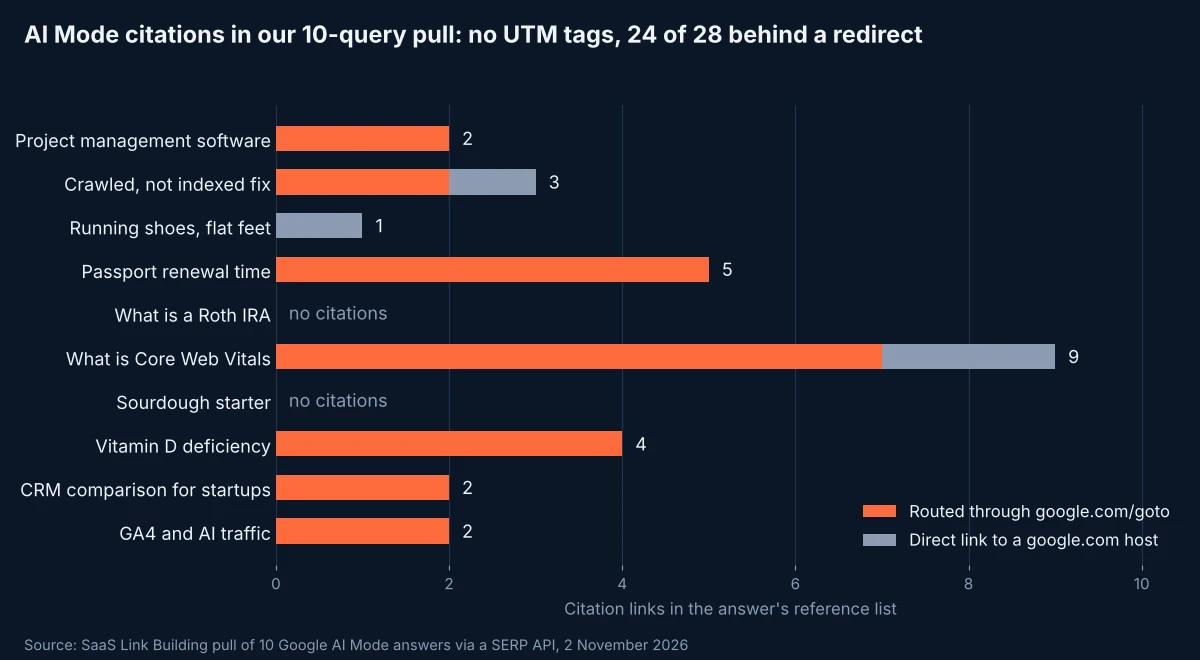
Three things stood out. First, no destination URL in the 28 citations carried a utm_ parameter or a #:~:text= fragment. Second, every citation pointing outside google.com hosts, including Google-owned YouTube and web.dev pages, was wrapped in a google.com/goto redirect; the four direct links all pointed at Search Central documentation, a Google help thread, a Search Console help page or a Google Shopping page. Third, three of the 10 answers cited no outside site at all: the Roth IRA and sourdough answers listed no references, and the running-shoe answer cited only a Google Shopping page, in line with what we found in our earlier test of product cards in AI Mode linking back to Google.
The redirect matters for measurement. A click that passes through google.com/goto should reach the publisher with a Google referrer, which is how Google wants these visits counted: its AI features documentation says AI Overviews and AI Mode traffic is reported inside the Performance report's "Web" search type. We covered the same redirect in organic results when we found most top-100 organic URLs sitting behind /goto links.
Context: how each surface reaches your analytics
The Gemini change lands in a measurement setup that already treats Google's AI products differently. Google Analytics' traffic-source documentation describes an AI Assistant default channel for visits from sources such as ChatGPT, Gemini, Deepseek, Copilot or Grok, and says it excludes AI Overviews and AI Mode. The channel is assigned when the referrer matches a list of AI assistants, not when a UTM tag is present.
Search Console offers no click data for AI features either. The generative AI performance reports Google launched in June, and rolled out to all sites on 31 August, show impressions, pages, countries, devices and dates, but no clicks.
Turrado's log analysis adds the app picture. He reports that Gemini's iOS app opens links in an in-app WebView that strips the referrer, so those visits show up as Direct and can only be spotted by a GeminiiOS user agent in server logs, and that Android app traffic lands in Direct almost without exception. While the tag was live, it also appeared on visits with no referrer, which is why its removal matters: for every Gemini visit with a referrer, he counted 0.16 to 0.65 tagged visits without one, excluding iOS. Those visits now have no marker at all.
ChatGPT went the other way. It has tagged citation links with utm_source=chatgpt.com since 2025, and when a bug stripped those tags in October, the effect on reported traffic was large, as we covered in our report on ChatGPT links losing UTM tags after GPT-6.
What this means for SEO teams
- Do not rely on
utm_source=gemini. Any filter, segment or dashboard that counts Gemini traffic by that tag has been undercounting since late September. Count Gemini by thegemini.google.comreferrer instead. - Annotate the change. Add a note in GA4 and your reporting for 29 September so that a drop in tagged Gemini sessions is not read as a drop in Gemini visibility.
- Check Direct for app traffic. If you have server logs, look for the
GeminiiOSuser agent to size the iOS share that GA4 files as Direct. - Treat AI Mode as organic. Our pull found no tags and a Google redirect on outside citations, so AI Mode clicks will keep blending into google / organic. Use Search Console's generative AI report for impressions and landing-page trends for clicks.
- Keep custom channel rules referrer-based. Google's own AI Assistant channel matches on referrer, and so should any custom group you build, since tags can appear and disappear without notice.
Methodology
On 2 November 2026 we requested 10 Google AI Mode answers through a SERP API, one per query, using US English defaults. Queries covered project management software, a Search Console indexing status, running shoes, US passport renewal, Roth IRAs, Core Web Vitals, sourdough starters, vitamin D deficiency, a CRM comparison and Google Analytics AI traffic. For each answer we took the reference list (28 links in total) and recorded the resolved destination URL, whether it contained a utm_ parameter or a #:~:text= fragment, and whether the rendered answer linked it through google.com/goto or directly. Inline links in the answer text were excluded because the API rendered them inconsistently. This is a small snapshot of one market on one day, not a measure of referrer behaviour in browsers, which we did not test. The Gemini timeline relies on Turrado's published log analysis and press reports, not on our own Gemini data.
Conclusion
Gemini's UTM tag lasted about three weeks and left without notice, the same way it arrived. Google has not said whether the removal is permanent, and its release notes do not mention it. For now, Gemini web visits remain identifiable by referrer, while app visits and Google's AI Mode clicks carry no marker that separates them from Direct or organic traffic.
Our AI Mode pull points the same way: no tags on any of 28 citations, and a Google redirect on every outside link. Teams that report on AI traffic should build on referrers and logs, and treat any vendor-added UTM as a bonus that can vanish overnight.
Questions and answers
What UTM parameter did Gemini add to cited links?
Gemini appended utm_source=gemini to some cited links from early September 2026. No medium or campaign values were reported with it.
When did Gemini stop adding the tag?
Natzir Turrado's server logs show the tag disappearing on 29 September 2026. Search Engine Roundtable put the date at around 28 September.
Has Google confirmed the change?
No. Google never documented the tag or its removal, and the Gemini Apps release notes we checked on 2 November make no mention of UTM tagging.
How does Google Analytics classify Gemini visits now?
Google Analytics' documentation says its AI Assistant channel is assigned when the referrer matches a list of AI assistants, including Gemini. Visits that keep the gemini.google.com referrer can still be grouped there; the same documentation excludes AI Overviews and AI Mode from that channel.
Do AI Mode citation links carry UTM tags?
Not in our sample. None of the 28 citation links in 10 AI Mode answers we pulled on 2 November carried a UTM parameter, and 24 were routed through a google.com/goto redirect.
More releases
-
Studies
49% of Top Sites Using Schema Still Ship Markup for Rich Results Google Retired
A SaaS Link Building crawl of 1,567 top-site homepages found 839 using structured data, and 414 of them still carry markup for Google features that no longer exist. Sitelinks search box markup, retired in November 2024, remains on 23.2% of homepages, and FAQ markup on 66.
-
Studies
Long Google Queries Drew 37% Forum and Video Links vs 15% for Head Terms
Google says AI Mode questions are triple the length of classic searches. We typed 10 topics into Google at five lengths: AI Overviews showed on 48 of 50 searches, but forum, video and social links rose from 15% of organic results for head terms to 37% for 20-plus-word questions.
-
Explainers
Google Lets Restaurants Switch Off Delivery Apps; 82% of 240 Listings Show Order Online
Restaurants can now hide individual third-party ordering providers on their Google Business Profile, with separate switches for pickup and delivery, instead of asking each app to remove them. Our pull of 240 Google Maps restaurant listings in six cities found an Order online button on 196 of them.
Tell us the site and the goals.
Rankings in Google and visibility in AI answers, from one monthly plan. One call is enough to say which one fits. Email works just as well.