Google's num=100 May Be Back, but 74.5% of Top-100 Organic URLs Still Hide Behind /goto
Google may be restoring the num=100 results parameter, an SEO consultant reported on 30 October, though it could not be reproduced. Our pull of 20 Google result pages found 1,323 of 1,776 organic URLs (74.5%) returned as google.com/goto links, at every position from first to hundredth.
 Vibhu Dhariwal
Cofounder & CTO, Digital Gratified
- Published
- Section
- Industry news
- Reading time
- 7 minutes
Ras Al Khaimah, United Arab Emirates, .
Google may be letting the num=100 parameter work again, 13 months after it stopped returning 100 results on one page. SEO consultant Brodie Clark said on 30 October that the parameter appeared to work again in at least some cases, with 99 organic results on one page, according to Search Engine Roundtable, whose editor could not reproduce it. Google has not commented. Our own pull of 20 Google result pages on 31 October shows why a restored num=100 would not solve the bigger problem for rank tracking: 74.5% of the organic URLs came back as opaque google.com/goto links rather than the address of the ranking page.
Key findings
- Across 20 US desktop keywords pulled 100 results deep, 1,323 of 1,776 organic results (74.5%) carried a
google.com/goto?url=token instead of the destination URL. - All 1,323 of those rows were recorded under the domain
google.comin the raw data, so any report that groups rankings by domain would credit Google with them. - The rate barely moved with position: 74.0% in the top 10, 73.5% in positions 11 to 20, 74.9% in 21 to 50 and 74.6% in 51 to 100. In 14 of the 20 searches, the number one organic result was a
/gotolink. - Every one of 100 randomly sampled
/gotolinks resolved with a single 302 redirect to the real page when requested onwww.google.com, so the destination is recoverable, at the cost of one extra request per result. - We could not confirm the
num=100report: a direct request with the parameter hit Google's JavaScript-required page, and neither of the two SERP data feeds we used passed the parameter to Google. One of them needed 10 result pages to reach 100 results for "project management software".
What was reported
Google stopped honouring num=100 in mid-September 2025. Search Engine Roundtable first noticed it working only about half the time on 12 September 2025, then updated its report to say it had fully stopped, which broke most Google rank trackers. Since then, a tracker that wants the top 100 results has had to request ten pages of ten.
On 30 October 2026, Clark posted on X and LinkedIn that a click from a knowledge panel led to a results URL containing num=100, with 99 organic results on the page. Search Engine Roundtable's Barry Schwartz tried several browsers and could not repeat it. Clark also said /goto links were now getting past workarounds that had previously helped some tools read destination URLs. There is no Google statement on either point, and nothing in Google's Search Central documentation updates mentions results-per-page settings.
Why /goto matters more than num=100
The /goto change is older and better documented. It was first spotted publicly on 23 June 2026, reported by Search Engine Roundtable on 8 July and, on 26 August, a Google spokesperson confirmed the rollout to the same site with a one-line statement: "We have a long history of deploying technical measures against evolving forms of abuse". Google did not say which abuse, but its spam policies already name "scraping results for rank-checking purposes" without express permission as machine-generated traffic that violates the policies and the Google Terms of Service.
A /goto link replaces the destination with an encoded token that cannot be decoded locally. The only way to learn where it points is to request it. In August, the founder of one rank tracking vendor estimated that resolving every link for a five-page ranking takes 500 to 1,000 requests, PPC Land reported. That is the context in which a returning num=100 would help: fewer page requests, but the same number of redirects to follow.
We have tracked how Google's anti-scraping measures distort third-party data before, from altered "poisoned" results served to rank trackers to results pages where Google ignored words in the query. Two months after Google confirmed /goto, our pull is a check on how much of a raw results page it still covers. Google has also been vocal about automated traffic in the other direction, as our report on fake Googlebots and reverse DNS checks showed.
Our check: three in four organic URLs hidden
The /goto share was steady across intent types. Informational, commercial, local and finance queries all landed between 67% and 89%, and no keyword fell below two thirds.
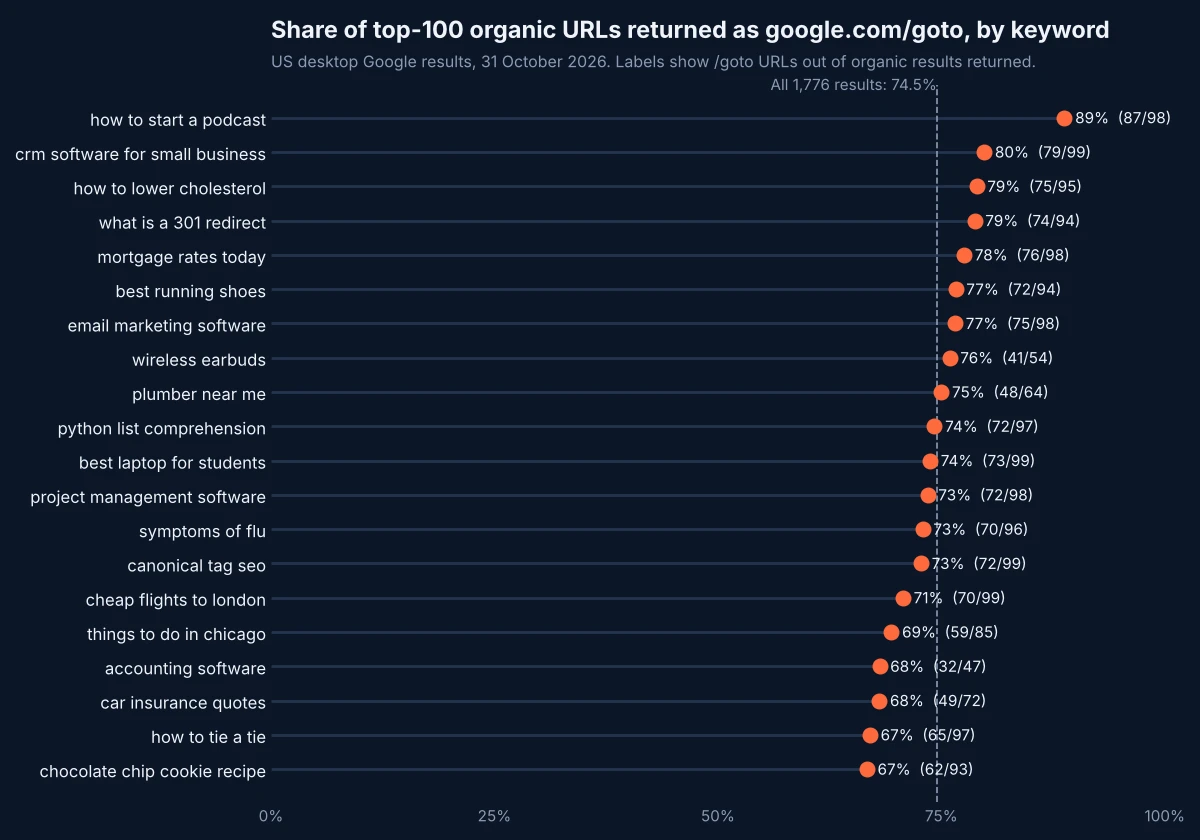
google.com/goto links, per keyword, top 100 US desktop results collected 31 October 2026. Source: SaaS Link Building analysis of SERP API data.Position made no difference, which suggests the rewriting is applied across the page rather than reserved for top results:
| Organic position | Results | Returned as /goto | Share |
|---|---|---|---|
| 1 to 10 | 200 | 148 | 74.0% |
| 11 to 20 | 200 | 147 | 73.5% |
| 21 to 50 | 597 | 447 | 74.9% |
| 51 to 100 | 779 | 581 | 74.6% |
| All | 1,776 | 1,323 | 74.5% |
Source: SaaS Link Building analysis of 20 Google result pages, US desktop, collected 31 October 2026.
We also compared the two groups field by field. Sitelinks appeared on 63% of results in both groups, prices on 5% and video results on 13% and 16%. No result attribute we could see predicted whether a link would be rewritten, and the same site could appear as a plain URL at one position and as a /goto token at another. A second SERP data feed, which resolves some links itself, still returned 47 of 56 page one organic links (84%) across seven of the same queries as unresolved /goto paths.
The destination is not lost. Each /goto row still carried Google's displayed breadcrumb, and when we requested 100 of the links, all 100 answered with a 302 redirect. In 85 cases the redirect host matched the breadcrumb exactly. The other 15 were YouTube, Reddit, Quora, Medium and Facebook results, whose breadcrumb shows a platform name rather than a hostname. Requests to the bare google.com host added one more hop: a 301 to www.google.com before the 302.
What this means for SEO teams
- Check your tracker's URL column, not just positions. If ranking URLs show as
google.comor/goto, page-level reports (which URL ranks, cannibalisation, landing page changes) are unreliable even when positions look right. - Use the displayed breadcrumb as a fallback for domain-level tracking. In our data it matched the real host for every non-platform result we resolved. It does not give the full page URL.
- Ask vendors whether they resolve redirects. Resolving costs one request per link (two from the bare host), so a provider may resolve only the top 10 or a sample. Ask which.
- Treat a working num=100 as unconfirmed. Until it is reproducible, budget for ten page requests per 100 results.
- Use Search Console for your own pages. The Performance report reports clicks, impressions and average position by query and by page from Google's own data, with no scraping involved, though only for sites you verify.
Methodology
On 31 October 2026 we requested Google's top 100 organic results for 20 keywords (US location, English, desktop) through a SERP API. The keywords mixed informational, commercial, local, health, finance and technical queries. We counted every item typed as an organic result and classed it as /goto when its URL contained /goto?. Positions are the organic rank within each page set. We then drew a random sample of 100 /goto links, requested each once on www.google.com, and recorded the status code and redirect target, comparing the target host with the host in the result's breadcrumb. Separately, we pulled page one for seven of the keywords through a second SERP API and applied the same test. One direct request to Google with num=100 returned Google's JavaScript-required page, so we could not test the parameter ourselves. This is a single-day, US-only, desktop sample of 20 keywords; shares may differ by country, device and day.
Conclusion
A returning num=100 would cut the number of pages a rank tracker has to request, but our pull shows Google still hides about three in four organic destination URLs behind /goto tokens, at every position from first to hundredth. Until Google says otherwise, teams should assume third-party ranking URLs are reconstructed, check how their tools do it, and rely on Search Console for their own pages.
Questions and answers
Has Google brought back the num=100 parameter?
It is unconfirmed. An SEO consultant reported on 30 October 2026 seeing 99 organic results on a page with num=100 in the URL, but Search Engine Roundtable could not reproduce it and Google has not commented. Google stopped honouring the parameter in September 2025.
What is a google.com/goto link in search results?
It is a passthrough link that replaces a result's destination URL with an encoded token. Clicking it, or requesting it, triggers a 302 redirect to the real page. Google confirmed the rollout to Search Engine Roundtable on 26 August 2026.
How many Google organic results use /goto links?
In our 31 October 2026 pull of the top 100 US desktop results for 20 keywords, 1,323 of 1,776 organic results (74.5%) came back as google.com/goto links. The share was between 73.5% and 74.9% in every position band.
Can the real URL behind a /goto link be recovered?
Yes. In our test, all 100 sampled /goto links returned a 302 redirect to the destination page when requested on www.google.com. The displayed breadcrumb matched the redirect host in 85 cases; the other 15 were platform results whose breadcrumb shows a name rather than a hostname.
Does Google allow scraping its results for rank tracking?
Google's spam policies list scraping results for rank-checking purposes without express permission as machine-generated traffic that violates its spam policies and the Google Terms of Service.
More releases
-
Industry news
Reddit to Test Logged-In Only Access After Losing 2.8M US Logged-Out Daily Users
Reddit lost 2.8 million US logged-out daily users in the third quarter as search referrals fell, and says referrals dropped by more than 1 million a week in October. It will test a logged-in-only site outside the US this quarter. Our 20-search check finds Reddit still ranks on most results pages.
-
Studies
Google AI Mode Linked All 180 Product Cards in Our 50-Query Test to Its Own Pages
Google's AI Mode linked every product card to its own pages in our test of 50 US searches on 30 October 2026. All 180 linked cards opened google.com product pages rather than retailers, Google pages made up 40% of source links, and 70% of all links stayed on Google.
-
Updates
Google Will Honor a Shared AI Training Opt-Out in 2027; 128 of 531 Top Sites Block AI Bots
Google plans to treat a new cross-company robots.txt token, __usage_ai-training, as a Google-Extended opt-out from 2027, and Bing will honour it from 1 February 2027. Our crawl of 531 top-site robots.txt files found 128 already block AI tokens, most listing five or more companies.
Tell us the site and the goals.
Rankings in Google and visibility in AI answers, from one monthly plan. One call is enough to say which one fits. Email works just as well.