Did Google Keep Its Promise to Small Sites? Their Share of 29 SERPs Tripled Since 2024
Google promised in August 2024 to show more small and independent sites. Across the same 29 searches, results from low-authority domains rose from 3.4% of top-10 listings in July 2024 to 10.8% now. A leaked small-site score and court notes on site-level quality complicate the picture. Our verdict: likely, but modest.
 Vibhu Dhariwal
Cofounder & CTO, Digital Gratified
- Published
- Section
- Studies
- Reading time
- 13 minutes
Ras Al Khaimah, United Arab Emirates, .
When Google launched its August 2024 core update, it made a specific promise. In a Search Central blog post signed by John Mueller on 15 August 2024, the company said it aimed to connect people with a range of high quality sites, "including small or independent sites that are creating useful, original content" when relevant to a search, and called this an area it would keep addressing in future updates. Eight core updates later, with the November 2026 core update now rolling out, we tested whether the promise shows up in the search results.
We pulled stored Google US results for the same 29 searches at two points: 12 to 31 July 2024, a few weeks before that announcement, and October to November 2026. Results from domains with a low link-based strength score (under 40 on a 0 to 100 scale) rose from 8 of 235 top-10 organic listings to 22 of 204, from 3.4% to 10.8%. Results from the strongest domains (90 and above) fell from 52.3% to 39.7%. Our verdict on whether Google has made room for small sites is likely, with an important caveat about how much room, and why.
The theory
The claim comes in two parts, and they pull in opposite directions.
The first is a grievance voiced by independent publishers: that Google's quality changes pushed small, specialist sites out of the results while large publishers, forums and platforms gained. Google's own ranking update history shows the sequence they point to: a September 2023 helpful content update, followed by core updates in October and November 2023 and a 45-day March 2024 core update, the longest on the dashboard. Google's August 2024 post said only that the update took into account feedback from some creators and others over the preceding months, without saying what that feedback was.
The second part is the promise. If Google meant what it said in August 2024, small and independent sites with original content should have regained some visibility over the following two years. A stronger version of the theory holds that Google has a dedicated mechanism for this: an explicit boost for small personal sites.
We set out to answer three questions. Did small sites gain ground in a fixed set of searches between mid-2024 and now? Is there evidence Google built something specific to make that happen? And do Google's site-level signals still favour established domains?
Evidence for: Google said it, and the leak names a mechanism
Google's public commitment
The August 2024 post is the clearest statement Google has made on the subject. It said the update took into account feedback from creators, that Google aimed to connect people with a range of high quality sites, including small or independent ones, when relevant to the search, and that the update aimed to better capture improvements sites had made. Google repeated a version of the message when it launched the November 2026 update: in a Search Central LinkedIn post reported by Search Engine Journal and Search Engine Roundtable, it described a regular update meant to surface relevant, satisfying content from all types of sites.
A leaked field called smallPersonalSite
The Google Content Warehouse API documentation that leaked in 2024 includes a module named QualityNsrNsrData. In the version 0.4.0 copy on hexdocs, a field called smallPersonalSite is described as the "Score of small personal site promotion", followed by an internal shortlink that refers to promoting personal blogs. The same module lists site-level quality fields, including siteQualityStddev, an estimate of how widely page-level quality ratings vary across a site.
That is the strongest documentary hint that Google at least built a way to identify and promote small personal sites. It is not proof that the field is used in live ranking, or how much weight it carries. A Google spokesperson told The Verge in May 2024 that people should avoid inaccurate assumptions based on "out-of-context, outdated, or incomplete information", while confirming the documents were genuine. Speculation: a field with its own internal go/ link suggests a real project at some point, but whether it shipped, and in which systems, is unknown.
Our data: small sites gained in 12 of 29 searches
Our two-period comparison is the main new evidence. We used 29 everyday US searches including software, personal finance, health, home and garden, cooking, careers, pets and outdoor recreation. For each, we pulled the stored top-10 organic results from July 2024 and the latest stored results from 13 October to 12 November 2026, along with a third-party domain strength score that rates each site's backlink profile from 0 to 100.
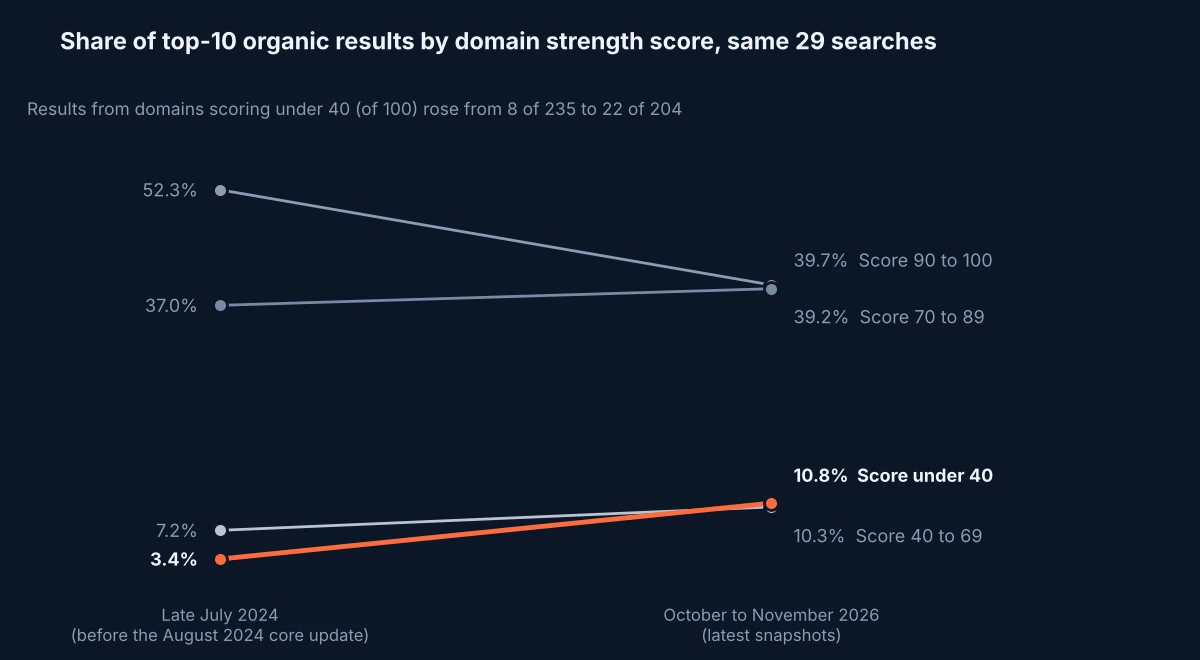
The low-score share roughly tripled. In 2024, 8 of the 29 searches had at least one result from a domain scoring under 40; in 2026, 15 did. Twelve searches had more such results than before, one had fewer and 16 were unchanged. Small sites also ranked higher when they appeared: 7 of the 22 low-score listings in 2026 sat in the top three organic results, against 1 of 8 in 2024.
The median domain score of a top-10 result fell from 90 to 85, and the median score dropped in 18 of the 29 individual searches. The biggest shifts came on hobby and how-to searches. On "best hiking trails in colorado", the median fell from 90 to 62 and three of the seven organic results came from domains scoring under 40, including the top organic listing. On "how to train a puppy to stop biting", the median fell from 91 to 68, with two dog trainers' own sites on page one.
| Measure (29 searches) | July 2024 | Oct to Nov 2026 |
|---|---|---|
| Top-10 organic listings counted | 235 | 204 |
| Listings from domains scoring under 40 | 8 (3.4%) | 22 (10.8%) |
| Listings from domains scoring under 70 | 25 (10.6%) | 43 (21.1%) |
| Listings from domains scoring 90 or more | 123 (52.3%) | 81 (39.7%) |
| Median domain score of a listing | 90 | 85 |
| Searches with at least one domain under 40 | 8 | 15 |
| Under-40 listings in the top three organic results | 1 | 7 |
Evidence against: a small gain, from a low base, with no clear cause
Large domains still dominate
Even after the shift, four in five listings came from domains scoring 70 or more, and 14 of the 29 searches had no low-score result at all. Personal finance and security searches barely moved: "what is a good credit score", "roth ira vs traditional ira" and "what is zero trust security" had no low-score result in either period. Within the 2026 results, higher-scoring domains still tended to rank above lower-scoring ones on the same page (a mean Spearman correlation of 0.23, positive in 23 of 29 searches). That is a weak relationship, and a different 40-search sample we analysed in October found almost none, but it does not suggest that strength has stopped mattering.
Platforms remain prominent
Among the strong domains that remain, one platform stands out. In the 2026 results, Reddit appeared in 20 of the 29 searches, with a median organic position of 2, and 15 of those 20 threads had a page-level link score of zero, with most showing no more than a handful of referring domains. We cannot tell from our 2024 data whether Reddit ranked as often then. Speculation: threads with almost no links of their own ranking near the top suggests the platform's strength carries them, which is the opposite of a small-site preference. We covered how often Reddit ranks on Google but gets few AI Overview citations earlier this month.
Site-level signals still exist
Google says plainly that it uses site-level signals as well as page-level ones. Its guide to ranking systems says the systems work at page level but that "site-wide signals and classifiers are also used". The 2022 helpful content announcement described a site-wide signal, and that system became part of core ranking in March 2024.
Court records point the same way. Notes of a February 2025 call with Google engineer HJ Kim, filed as exhibit PXR0356 in the US search antitrust case, describe Google's Q* quality score as "largely static and largely related to the site rather than the query", and record that PageRank is an input to it. The notes summarise the call rather than quote Kim verbatim, do not name their author and are not sworn testimony. A companion set of notes from a January 2025 call with Pandu Nayak, exhibit PXR0357, describes Q* as Google's measure of the quality of a document. Read together, they suggest a quality score with a strong site component. Speculation: a largely static, site-related score would tend to favour sites with long records over new or small ones, which would limit how far any small-site promotion can go.
Not every small site is an independent publisher
"Small site" in the debate usually means an independent creator. Our measure is a backlink score, which is a different thing. Based on the sites' own pages, about 9 of the 22 low-score listings in 2026 were personal or hobby blogs. At least 11 were businesses' own pages: a seed company, a home services firm, a pest control company, two dog trainers, two medical practices, a bookkeeping practice, a parts supplier, a wealth manager and a resume tool. One came from a group of public water providers and one from a commercial product management resource. A rise in low-score domains is not the same as a rise in independent publishing.
We cannot attribute the change to any one update
Eight core updates ran between our two snapshots: August, November and December 2024, March, June and December 2025, and March and May 2026, plus several spam updates. SERP features also took more of the top ten positions: our sample averaged 8.1 organic listings per search in 2024 and 7.0 in 2026. Fewer listings for large sites to occupy could produce part of the shift on its own. At least 4, and possibly 7, of the 29 snapshots from 2026 were taken after the November 2026 core update began on 10 November, so a few may already reflect it.
What Google has said, and what it has not
We found no Google statement saying it ranks sites by size, and Google has not confirmed any "small site boost". Its August 2024 language was about relevance: showing small or independent sites when they create useful, original content relevant to the search. That is consistent with what we found on hobby and how-to searches, where personal experience is the point, and with the lack of change on finance and security definitions, where institutions dominate. It is also consistent with Google's core updates guidance, which says the changes are broad and do not target specific sites or pages.
What Google has not explained is the leaked smallPersonalSite field, or how the site-level Q* signal described in the antitrust notes treats sites with short histories. Those are the two places where the promise and the machinery could conflict.
Verdict: likely
Likely. In our fixed sample, Google's results now include more pages from small, low-authority domains than they did before the August 2024 promise, roughly three times as many, and those pages rank higher. That is consistent with Google doing what it said. The leaked documentation shows Google at least designed a score to promote small personal sites, though not that it uses one.
The scale is modest. Small domains still hold about one listing in ten, many searches show none, part of the gain went to small businesses rather than independent creators, and strong domains and platforms such as Reddit still take most of page one. Site-wide signals, which Google confirms exist, may favour sites with long track records. Whether a deliberate small-site boost explains the change, rather than fewer organic slots, more SERP features and normal churn over eight core updates, remains unproven.
What SEO teams should do
- Benchmark your own searches. Pick 20 to 30 queries that matter to you and record the domain mix of page one before and after the November 2026 core update completes. Our 29-search mix is not your market.
- Do not treat authority as a moat. Domains scoring under 40 reached the top three in 6 of our 29 searches (7 listings). On experience-led queries, a strong domain alone did not hold the position.
- Lead with first-hand experience on how-to and hobby content. Many of the small sites that ranked were practitioners or small businesses writing about their own work, from dog trainers to hiking bloggers.
- Expect less movement on definitional and financial queries. Institutions held their ground there in both periods.
- Watch site-wide quality, not only pages. Google says site-wide signals exist, and its 2022 helpful content guidance said unhelpful content could affect how a whole site performs, a theme we explored in our review of what court files say about links.
Methodology
On 12 November 2026 we selected 29 US English searches with informational or commercial intent across a range of topics, chosen before pulling data and excluding branded queries. For each, we pulled from an SEO tool's index the stored Google US desktop SERP nearest to 1 August 2024 (all 29 were dated 12 to 31 July 2024) and the most recent stored SERP (dated 13 October to 12 November 2026). A 30th search was dropped because its latest snapshot dated from February 2024. We kept only organic listings within the first ten SERP positions, which include positions taken by features such as AI Overviews and video packs, giving 235 listings in 2024 and 204 in 2026.
For each listing we recorded the tool's domain strength score (0 to 100, based on backlinks) as reported with each snapshot. We could not confirm whether the 2024 scores are historical values or current values, which would make the 2024 figures understate small sites that have since grown, and so overstate the rise. We grouped listings into bands (under 40, 40 to 69, 70 to 89, 90 and above) and counted per search and overall. For the 2026 snapshots we also recorded the tool's page-level link score and referring domains, and calculated Spearman rank correlations between organic order and domain score for each search. The classification of low-score sites as blogs or businesses is our own, based on their URLs and homepages. This is a small, fixed sample of stored snapshots, not a census of Google results, and stored snapshots can differ from what an individual user sees.
Conclusion
Two years after Google promised to make room for small and independent sites, our fixed set of searches shows that it has, a little. Low-authority domains tripled their share of page one, mostly on hobby and how-to searches where first-hand experience counts, while strong domains and big platforms still hold most positions. Google's documentation confirms site-wide signals, the antitrust notes describe a largely site-related quality score, and the leak shows a small-site promotion score that may or may not be live. We will rerun the same 29 searches once the November 2026 core update completes.
What do you think?
If you run a small or independent site, did your visibility change after the August 2024 core update or any update since, and what did you change before it moved? Tell us, with Search Console data if you can share it, through the press contact below.
Questions and answers
What did Google promise small sites in 2024?
In its 15 August 2024 Search Central post on the August 2024 core update, Google said it aimed to connect people with a range of high quality sites, including small or independent sites creating useful, original content, when relevant to users' searches, and that it would keep addressing this in future updates.
Do small sites rank more often on Google now than in 2024?
In our fixed sample of 29 US searches, results from domains with a link-based strength score under 40 rose from 8 of 235 top-10 organic listings in July 2024 (3.4%) to 22 of 204 in October to November 2026 (10.8%). Domains scoring 90 or more fell from 52.3% to 39.7%.
Does Google have a small personal site boost?
The leaked 2024 Content Warehouse API documentation lists a field called smallPersonalSite, described as a score of small personal site promotion. Google has not confirmed that it is used in ranking, and a Google spokesperson cautioned against assumptions based on out-of-context, outdated or incomplete information in the documents.
Does Google use site-wide signals?
Yes. Google's ranking systems guide says its systems work at page level but that site-wide signals and classifiers are also used. It adds that good or poor site-wide signals do not mean all of a site's content will rank well or poorly.
More releases
-
Updates
Google Adds Things to Do to EEA Aggregator Units; 45 of 50 Attraction Links Left Google
Google extended its EEA aggregator and supplier units to things-to-do searches on 9 November. In our ten-city check, EEA results showed attraction cards linking to official sites on five pages, while US results showed Google's own Top sights module on all ten, with every entry linking back to Google.
-
Explainers
Google Warns CDN Moves Can Swamp Origins; 154 of 346 Top Homepages Skipped the Cache
Google says moving a site to a CDN can raise its crawl rate before edge caches warm up, sending crawler requests straight back to the origin server. Our check of top sites found 154 of 346 that expose cache headers did not serve their homepage from cache on either of two back-to-back requests.
-
Updates
Google's November 2026 Core Update Ends a 173-Day Wait, the Longest Since 2023
Google started the November 2026 core update on 10 November, its first core update since 21 May. Our review of the Search Status Dashboard finds the 173-day gap is the third longest since 2021, the announcement now specifies all languages, and a full rollout would end two days before US Thanksgiving.
Tell us the site and the goals.
Rankings in Google and visibility in AI answers, from one monthly plan. One call is enough to say which one fits. Email works just as well.